東京
Tokyo
1928年の東京について、交通、宿泊、商店、祭礼、歴史、市街各地区、皇居、寺社、公園、博物館、郊外を網羅する大規模な都市案内。原本110–234頁を画像・OCR照合し、英文校正と日本語校閲を行った版です。
- 原著
- pp. 110–234
Railway Stations. Transportation. Tourist Bureaus. Hotels.
鉄道駅。交通手段。観光局。ホテル。
Restaurants. Shops.
レストラン。店。
Railway Stations. All trains entering Tokyo stop at (or pass through) the great Central Station (Chuo Suteishon; pronounced chew-oh'-soo-tai-shun; described hereinafter), in Marunouchi, Kojimachi-ku (Pl. F, 6). As Yokohama is the seaport for Tokyo, tourists usually approach the capital from this angle. Some board the steam trains that leave from the Yokohama Union Station; others the more frequent electric trains running out (about every 8 min.) from the Sakuragicho Station (referred to under Yokohama). Travelers aboard these trains bound for the Tsukiji section of Tokyo (p. 232; Pl. F, 7) can save time and taxi fares by descending at the (big, commodious) Shimbashi Station (Tokyo, Pl. E, 7). Those bound for the Imperial Hotel can save a little distance by descending at the Yurakucho Station (Pl. E, 6—not advisable with luggage).
鉄道駅。東京へ入る列車はすべて、麹町区丸ノ内(図F-6)の大きな中央停車場(中央ステーション。後述)に停車、または通過する。横浜が東京の外港なので、旅行者は通常この方向から首都へ入る。横浜聯合駅発の蒸気列車を利用する者もいれば、桜木町駅から約8分ごとに出る、より頻繁な電車を利用する者もいる。築地方面(232ページ、図F-7)へ向かうなら、大きく広い新橋駅(図E-7)で降りると時間とタクシー代を節約できる。帝国ホテルへ行く場合は有楽町駅(図E-6)で降りると少し近いが、荷物がある場合は勧められない。
In addition to the hundreds of trains which daily arrive and depart from the Central Station, there is an interurban, transversal electric car line (part surface, part elevated) operated by, and in conjunction with, the Imperial Gov't lines, which crosses and half circles the metropolis, and provides good, frequent, cheap and speedy communications every few minutes with many suburban places.
中央停車場には毎日何百本もの列車が発着するほか、帝国政府鉄道が本線と連携して運営する都市間横断電車がある。一部は地上、一部は高架で、市内を横切り半周し、多くの郊外と数分間隔で安価・迅速・便利に結ぶ。
The Baggage Room is conducted on American practice. By giving checks to the hotel runner, baggage will be promptly and satisfactorily delivered. Trunks can be stored and insured at the Imperial Hotel Storerooms. Baggage Insurance is issued by the Japan Tourist Bureau.
手荷物取扱所は米国式で運営される。荷札をホテルの使いに渡せば、手荷物は速やかに確実に届けられる。トランクは帝国ホテルの倉庫で保管し、保険を掛けることができる。手荷物保険はジャパン・ツーリスト・ビューローが扱う。
Transportation. Taxicabs (taxis, or noriai jidosha ) are almost as numerous as in New York. American cars are used, and fares (which are cheaper than in the U.S.) are recorded by meters as in the U.S.
交通。タクシー(乗合自動車を含む)はニューヨークとほぼ同じほど多い。米国製の車が使われ、運賃は米国より安く、同じくメーターで計算される。
Hotel Cars (Imperial Hotel and others) meet express trains. The former sends its luxurious cars as far as the Yokohama Docks to meet incoming ships and bring travelers promptly and safely to the hospitable hotel doors. By telephoning ahead one can always be met by a hotel car. Low rates. Excellent service.
ホテルの送迎車(帝国ホテルほか)は急行列車を出迎える。帝国ホテルは豪華な車を横浜埠頭まで送り、入港船を迎えて旅行者を迅速かつ安全にホテルへ運ぶ。事前に電話すれば常に送迎車を手配できる。低料金でサービスはよい。
Note that when driving a car the Rule of the Road in Japan is to the left. The fleet of Motor-Busses (many with women conductors) which center at, or pass the Central Station, are not always the most convenient for strangers, who may not speak the language or know the different points of the city. An exception is
日本の自動車は左側通行である。中央停車場を起点または経由する多数の乗合バス(女性車掌のいる車も多い)は、日本語を話せず市内の地理にも不案内な旅行者には必ずしも便利でない。例外は
The Mitsukoshi Motor-Bus (see Tokyo Shops), a red bus with 3 horizontal stripes on the side, which starts (at frequent intervals) from a point near the Station entrance and carries customers (free) between the station and the store. Willing, careful, courteous drivers. After inspecting the great store (which stocks many things and is of unfailing interest to travelers—who should ask for Mr. Antoku Takehara, the English-speaking guide [courteous, willing, tireless] whom the generous-minded management has appointed for the sole purpose of conducting strangers over the store; fees unnecessary; no obligation to buy) the traveler will, on emerging from the front entrance, find himself facing the busy prolongation of the Ginza, with Nihonbashi, the Ginza, the Christian Literature Society (formerly Methodist Publishing House; or Kyo-bun-kwan; English and American books, magazines, etc.), Mikimoto's fascinating Pearl Store, Shimbashi Station, Tsukiji, etc., on the right; and Uyeno Park, Asakusa and other places on the (far) left.
三越乗合バス(「東京の商店」参照)である。側面に横三本の縞を付けた赤いバスで、駅入口近くから頻発し、駅と店の間を無料で客を運ぶ。運転手は親切、慎重、礼儀正しい。品揃え豊かで旅行者の興味が尽きない大店舗を見学する際は、店内案内のため経営者が置いた、英語を話す親切で熱心な竹原安徳氏を頼むとよい。案内料も購入義務もない。正面玄関を出ると銀座の賑やかな延長部に面し、右手には日本橋、銀座、教文館(旧メソジスト出版社。英米の書籍・雑誌など)、御木本真珠店、新橋駅、築地など、遠い左手には上野公園、浅草などがある。
Jinrikis ply for hire but are fast being ousted by the quicker and more satisfactory motor-cars. Rates are unstable, and it is always advisable to ask the man what he is going to charge for a desired service. Where there are several in a party a taxi will be found to be cheaper.
人力車も客を運ぶが、より速く快適な自動車に急速に押されている。料金は一定しないので、利用前にいくら取るか尋ねるのがよい。数人連れならタクシーの方が安い。
Electric Street Cars (densha) traverse the city in all directions and are cheap, convenient, and rapid aids to getting about. Many foreigners use them. The stranger rarely has any serious trouble in finding a place, as the people are kind and helpful, and the car conductors make it a point to aid strangers.
電気路面電車(densha)は市内をあらゆる方向に走り、安く、便利で、迅速な移動手段である。多くの外国人も利用している。初めての旅行者でも目的地を見つけるのに大きく困ることは少ない。人々は親切で助けてくれ、車掌も旅行者を助けることを心がけているからである。
The Elevated Railway Line ( koka tetsudo) offers the best, quickest, and cheapest means of reaching many of the suburban towns. Time cards at the Japan Tourist Bureau.
高架鉄道(koka tetsudo)は、多くの郊外の町へ行く最良かつ最速、そして最も安い手段である。時刻表はジャパン・ツーリスト・ビューローで入手できる。
このページの翻訳・編集注
原本画像とOCRデータを照合して英文を校正し、固有名詞・数値・単位を確認したうえで日本語訳を校閲しました。歴史的な表現は原著の記録性を尊重して残しています。
Hotels. TOKYO'
ホテル。東京
Subways (chika tetsudo) are being constructed in several places in the capital, and in some quarters are in operation. The popular line between Uyeno Park Station and Asakusa was opened to traffic Jan. 1, 1928. Though cruder than American subways, they are well managed and reliable.
地下鉄(chika tetsudo)は首都の数か所で建設中で、一部の地区ではすでに運行している。上野公園駅と浅草を結ぶ人気路線は、1928年1月1日に開通した。アメリカの地下鉄に比べると粗削りだが、運営はよく、信頼できる。
Information Bureaus. The Head Office of the admirable, widely known (offices in many parts of the world), ably-managed Japan Tourist Bureau is in the Central Station (ground floor, near main entrance) and is of peculiar value to the traveler. Here visiting strangers always find a warm welcome* Many have their letters addressed in the Bureau's care, seek its advice in planning trips through the Empire, in securing hotel accommodations, arranging for motor-cars, etc. The desirable booklets issued (free) by the Bureau, and the equally excellent maps (sold at the exact cost of printing) are of unfailing use and interest to travelers.
案内所。世界各地に事務所を持ち、よく運営されている著名なジャパン・ツーリスト・ビューローの本部は、中央停車場の1階、正面入口近くにあり、旅行者にとって特に価値が高い。ここでは訪問客がいつも温かく迎えられる。多くの旅行者は、手紙の宛先をビューロー気付にし、帝国内の旅行計画、ホテルの手配、自動車の手配などについて助言を求める。ビューローが無料で発行する有用な小冊子や、印刷実費で販売される同じく優れた地図は、旅行者にとって常に役立ち、興味深い。
Strangers should never hesitate to use this unqualifiedly excellent service. (cheerfully provided; no tips), which is maintained by the Imperial Japanese Government Railways, several great Steamship Lines, and other organizations desirous of assisting the tourist in Japan and the Far East. The Bureau has a Branch Office in the Imperial Hotel Arcade and in most of the chief cities of the Empire. As it is not a money making institution, travelers can always buy their railway, steamship, and other tickets here at no advance in prices. The Bureau is also valuable for its willingness to secure for travelers cards of admission to various places, translate Japanese letters, send telegrams in Japanese, and to make itself useful in other ways.
旅行者は、この文句なく優れたサービスをためらわず利用すべきである。親切に提供され、チップも不要である。この機関は、帝国日本鉄道、いくつかの大手汽船会社、日本および極東の旅行者支援を望む諸団体によって維持されている。帝国ホテルのアーケード内、および帝国内の主要都市のほとんどにも支所がある。営利機関ではないため、鉄道、汽船、その他の切符を割増なしで購入できる。また、各所への入場券の手配、日本語の手紙の翻訳、日本語電報の発信など、さまざまな面で旅行者の役に立とうとする点でも貴重である。
Hotels. Comfortable modern hotels adapted to foreign requirements, under the direction of English-speaking Japanese familiar with American and European hotels and their methods, and equipped with reading-rooms with foreign newspapers and magazines, steam heat, electric lights, hot and cold running water, garages with autos, etc., are now features of Tokyo and more are under construction to cater to the thousands of travelers who annually visit the metropolis. Excellent food served in foreign style, good and willing service and many unexpected comforts characterize them, while the rates (on application) are lower than those of American hotels.
ホテル。外国人の要望に合わせた快適で近代的なホテルは、アメリカやヨーロッパのホテルとその運営法を知る英語話者の日本人のもとで運営され、外国新聞・雑誌を備えた閲覧室、蒸気暖房、電灯、温冷水道、自動車用ガレージなどを備えている。こうしたホテルはすでに東京の特色となっており、毎年この大都市を訪れる何千人もの旅行者を迎えるため、さらに建設が進んでいる。外国式の優れた料理、親切で行き届いたサービス、多くの思いがけない快適さが特徴で、料金は問い合わせによるが、アメリカのホテルより低い。
* Imperial Hotel ( Teikoku: Telegraphic address: ' Impeho, Tokyo') a super-excellent establishment (one of the best known and liked hotels in the Far East) in the heart of the most attractive section (Marunouchi, Kojimachi-ku, PI. F, 6) of the Japanese Capital, overlooking the extensive and charming Hibiya Park (good air, delightful walks; an ideal playground for children) near the Imperial Palace grounds, the foreign embassies, legations, business houses; the best theatres, banks, the railway stations (10 min. to the Central Station; 5 min. to Shimbashi and Yuraku-cho stations), steamship offices, the best shops, etc. The chosen rendezvous of the social, diplomatic, and touristic life of the capital. A famous meeting-place for the ever-moving tides of travel that swirl around the world.
*帝国ホテル(Teikoku、電報宛名「Impeho, Tokyo」)。日本の首都で最も魅力ある地区、丸の内・麹町区(図F・6)の中心にある、極東で最もよく知られ愛されるホテルの一つで、すぐれた施設である。広く魅力的な日比谷公園を見渡し、空気がよく散策に快く、子どもたちの遊び場としても理想的である。皇居、外国大使館・公使館、商館、主要劇場、銀行、鉄道駅(中央停車場まで10分、新橋・有楽町駅まで5分)、汽船会社の事務所、主要商店などにも近い。首都の社交・外交・観光生活の選ばれた集合場所であり、世界をめぐる旅の流れが絶えず集まる有名な会合点である。
The Imperial is known far and wide for the excellence of its unique appointments, its good food, perfect service, and for its many comforts and refinements. Its outstanding features are: 300 handsomely furnished bedrooms (accommodations for 500 persons) with private baths; a main diningroom with a seating capacity of 400; fine grill-rooms; 15 private diningrooms; a magnificent banquet-hall that will seat 1000 persons; a unique auditorium; a private theatre; a spacious lobby with open fireplaces; a library and reading-room with English, American and European books, magazines and newspapers; an attractive roof-garden with dining-room (dances; fine views; a delight in summer); an exceptionally fine orchestra (music at meals and at other times); an American bar, beauty-shop, barbershop, a branch post-office, etc.
帝国ホテルは、独特の設備、よい料理、完全なサービス、多くの快適さと洗練によって広く知られている。主な特色は、専用浴室付きの美しく整えられた客室300室(500人収容)、400席の主食堂、優れたグリル室、15の個室食堂、1,000人を収容できる壮麗な宴会場、独特の講堂、私設劇場、暖炉のある広いロビー、英米欧の書籍・雑誌・新聞を備えた図書室兼閲覧室、食堂を備えた魅力的な屋上庭園(ダンス、好展望、夏の楽しみ)、非常に優れたオーケストラ(食事時その他に演奏)、アメリカン・バー、美容室、理髪店、郵便局分室などである。
Being thoroughly modern the Imperial is equipped with telephones (in every room), has safety deposit boxes in the office, provides a stenographic service, is electrically lighted and heated, has many quiet nooks and lounging places, and an inner garden, after the Japanese manner, with lotus pools, etc.
帝国ホテルは徹底して近代的な設備を備え、全室に電話があり、事務所には貸金庫を置き、速記サービスを提供している。電灯と暖房を備え、静かに腰を下ろせる隅や談話の場所も多い。さらに日本風の中庭があり、蓮池などが設けられている。
In the extensive wine cellars are choice liquors valued at a quarter of a million dollars. The private laundry, and the hotel valets do excellent work at moderate prices. Sumptuous dances are frequently held in the hotel, along with gorgeous banquets, private theatricals, etc.
広大なワインセラーには、25万ドル相当の選りすぐりの酒類が収められている。ホテル専属の洗濯所とヴァレット係は、手頃な料金でよい仕事をする。ホテルでは豪華な舞踏会のほか、華やかな宴会、私的な芝居などもしばしば催される。
The Hotel Management (Mr. T. Inumaru, Manager; Mr. Taunekichi
ホテル支配人は犬丸徹三氏、田種吉氏。
このページの翻訳・編集注
原本画像とOCRデータを照合して英文を校正し、固有名詞・数値・単位を確認したうえで日本語訳を校閲しました。歴史的な表現は原著の記録性を尊重して残しています。
Imperial Hotel
インペリアルホテル
Otsuka, assistant manager) has had a wide experience in the management of hotels and knows how to cater to the wants of foreigners. 'Service' is the hotel motto, and it is lived up to. The Tokyo Kaikan, best among the famous restaurants of the capital, and referred to hereinafter, is under the Imperial Hotel management.
大塚氏(副支配人)はホテル経営の経験が豊かで、外国人の要望にどう応えるべきかを心得ている。「サービス」がこのホテルのモットーであり、その言葉どおりに実行されている。後述する、首都の有名レストランの中でも最良の東京会館は、帝国ホテルの経営下にある。
The Imperial Hotel Rates (European Plan only) are: for a typical single room with private bath 12 yen per day; double room with twin beds and bath, 16 yen. A few single and double rooms, with and without baths, at slightly lower prices. A few very large single and double rooms with baths are slightly higher in price. A few suites (large double bedroom, bath, and sitting-room) range from 22 to 30 yen per day.
帝国ホテルの料金(ヨーロピアン・プランのみ)は、おおむね次の通りである。浴室付きの標準的なシングルルームは1日12円、ツインベッドと浴室付きのダブルルームは16円。浴室付き、または浴室なしのシングル・ダブルには、これよりやや安い部屋も少数ある。浴室付きの大きなシングル・ダブルは少し高く、スイート(大きなダブル寝室、浴室、居間)は1日22円から30円である。
Meals are served in both the Main Dining-Room and the Grill-Room. In the Main Dining-Room breakfast is served à la carte, and tiffin and dinner table d'hôte at 3 yen and 3.50 respectively. In the Grill-Room there is an à la carte service from 9.30 a.m. to 11 p.m. (only cold dishes after 10 p.m.). Music by a capable orchestra in the hotel lobby daily from 4 to 6 p.m. (during afternoon tea), and from 6.30 to 9 p.m. (during dinner). Dancing, etc.
食事は主食堂とグリル室の双方で供される。主食堂では朝食はアラカルト、ティフィンと夕食の定食はそれぞれ3円、3円50銭である。グリル室では午前9時30分から午後11時までアラカルトを出す(午後10時以後は冷菜のみ)。ホテルのロビーでは、有能なオーケストラが毎日午後4時から6時(午後の茶の時間)と午後6時30分から9時(夕食時)に演奏する。ダンスなどもある。
The Imperial Hotel Kitchen is a sort of electrical laboratory (electric ranges, ice-making plant, scientific apparatus for distilling the drinking water, etc.) where skilled chefs evolve dishes as dainty and as appetizing as one will find anywhere. It is said that the architect planned the kitchen and built the hotel around it. From it 3000 persons can be fed immediately and satisfactorily. The food is a blend of American and European, with a spice of Japanese that appeals instantly and permanently to the American palate. A feature is the big fish tank where fish are kept alive until needed for the table.
帝国ホテルの厨房は、電気レンジ、製氷装置、飲料水蒸留用の科学装置などを備えた一種の電気実験室であり、熟練した料理人が、どこに出しても見劣りしない繊細で食欲をそそる料理を生み出している。建築家はまず厨房を設計し、その周囲にホテルを建てたと言われる。ここから3,000人にただちに満足のいく食事を供することができる。料理はアメリカ式とヨーロッパ式に日本的な風味を加えたもので、アメリカ人の味覚にすぐ、そして長く訴える。大きな魚槽が特色で、食卓に出す直前まで魚を生かしておく。
The Hotel Motor-Bus meets express trains arriving at the Central Station, and ships that arrive at Yokohama, to carry passengers to the hotel. The hotel has a fleet of good motor-cars for the convenience of guests for sight-seeing, country and other trips. Moderate charges.
ホテルの送迎バスは、中央停車場に到着する急行列車や横浜に入港する船に合わせて乗客をホテルへ運ぶ。観光、郊外行き、その他の小旅行のために、ホテルは良質な自動車を多数用意している。料金は手頃である。
The Japan Tourist Bureau has a branch office in the hotel, on the lower floor of which space has been given to some of the best known among the Tokyo curio and other dealers, to display their wares to guests.
ジャパン・ツーリスト・ビューローはホテル内に支所を持つ。また下階には、東京の骨董商やその他の有名店の一部に場所が与えられ、宿泊客に商品を展示している。
The Pan Pacific, The Rotary, and other Clubs, with the Japan-America and other societies, hold their meetings and banquets at the Imperial Hotel, which during its brief existence has sheltered many distinguished guests, among them the Prince of Wales and other world-known characters.
パン・パシフィック、ロータリーその他のクラブ、日本アメリカ協会その他の団体は、帝国ホテルで会合や宴会を開く。このホテルは短い歴史の中で、プリンス・オブ・ウェールズをはじめ、世界的に知られる多くの著名客を迎えてきた。
Other Tokyo hotels are: The * Tokyo Station Hotel (Tel. add. ' Staho Tokyo'), in the Tokyo Central Station, Marunouchi, within 3 min. walk of the financial section, the Castle, the big steamship offices, etc. Under the able management of the Seiyoken Hotel Co. (which has a hotel in Uyeno Park and several excellent restaurants in other parts of the capital). Big, airy, well-furnished rooms. Good service. Excellent food. English spoken. Rooms only, from 5 yen and up. With meals from 11 yen. Write for descriptive booklet, etc. Member of the Japan Hotel Association.
その他の東京のホテルには、東京駅ホテルがある(電報宛名「Staho Tokyo」)。東京中央停車場内、丸の内にあり、金融街、皇居、大汽船会社の事務所などから徒歩3分以内である。上野公園にホテルを持ち、首都各所に優れたレストランを経営する精養軒ホテル会社の有能な経営による。広く風通しがよく、よく整えられた客室。サービスはよく、料理も優れている。英語が通じる。室料のみ5円から、食事付き11円から。案内小冊子などは照会のこと。日本ホテル協会会員。
* Marunouchi Hotel, in Yuraku-cho, Kojimachi-ku, near the Central Station. Under the same management as the excellent Mampei Hotel, at Atami, and Karuizawa. A big, new, modern, well-equipped, American-style hotel with good rooms, service, and food. Moderate rates. Well spoken of. Member of the Japan Hotel Association.
丸ノ内ホテル。麹町区有楽町、中央停車場近く。熱海および軽井沢の優良な万平ホテルと同じ経営である。大きく新しい、近代的で設備の整ったアメリカ式ホテルで、客室、サービス、料理ともよい。料金は中等。評判もよい。日本ホテル協会会員。
Restaurants abound in Tokyo but they are rarely as satisfactory as the hotel dining-rooms. Perhaps the most popular (with Japanese and foreigners alike) of the best-known Tokyo Restaurants is the Kaikan, next door to the Imperial Theatre (connected thereto by a short subway) and not far from the Imperial Hotel, under whose able management it is. The stranger should not fail to dine here at least once, in the Japanese fashion, on xukiyaki (see below), of which delectable native dish it makes a specialty, and for which it is celebrated. The Imperial Hotel management will make the necessary arrangements. In addition to enjoying a satisfying repast amid delightful surroundings, one is apt to have the unexpected opportunity of witnessing a picturesque native wedding (it being a popular custom in Japan to be married in these high-class restaurants, where there is always a beauty parlor for the bride's adornment, a shrine, an officiating priest, etc.) and a wedding feast. Such a ceremony among aristocratic Japanese usually is marked by costuming of a gorgeousness unknown in the West.
東京にはレストランが多いが、ホテルの食堂ほど満足できるものはまれである。よく知られた東京のレストランのうち、日本人にも外国人にもおそらく最も人気があるのは東京会館で、帝国劇場の隣にあり(短い地下道で接続)、帝国ホテルからも遠くない。同ホテルの有能な経営下にある。初めての旅行者は、少なくとも一度はここで日本式に、同店が名物とし名高いすき焼き(下記参照)を食べてみるべきである。帝国ホテルの管理部が必要な手配をしてくれる。快い環境で満足のいく食事を楽しむだけでなく、思いがけず絵になる日本式の結婚式や披露宴を見る機会もある。日本では、この種の高級レストランで結婚式を挙げることが流行しており、花嫁の支度をする美容室、神前、司式者などが備えられている。上流日本人のこうした儀式は、西洋では見られないほど華やかな衣装で行われるのが普通である。
このページの翻訳・編集注
原本画像とOCRデータを照合して英文を校正し、固有名詞・数値・単位を確認したうえで日本語訳を校閲しました。歴史的な表現は原著の記録性を尊重して残しています。
Restaurants.
レストラン。
Sukiyaki (pronounced skee-yah'-key) customarily is prepared by the host, who, with his guests, squat round a small electric brazier brought to a private room floored with soft matting and bright with flowers. Slices of red meat (beef), onions, leeks, bamboo-shoots, mushrooms, bean-curd and various seasoning vegetables, along with skoyu sauce are placed in the hot dish where a good soup stock is already sizzling. When all is cooked (a question of a few minutes) it is served with a raw egg. in a dainty lacquered bowl, and eaten with chopsticks (o-hashi — spoons are available). Hot boiled rice (with which it often is mixed) is served in another bowl, and in yet another, pickled cucumbers, bits of pickled cabbage and other native dainties. Warmed sake from tiny cups punctuate the mouthfuls. To eat sukiyaki once is always to want it. It is filling and satisfying. Many Sukiyaki restaurants are found throughout Japan. Every city has one or more.
すき焼き(発音はスキー・ヤー・キー)は、ふつう主人が用意する。花で明るく飾られ、柔らかな畳を敷いた個室に小さな電気火鉢が運び込まれ、主人と客はその周りに座る。薄切りの赤身肉(牛肉)、玉葱、葱、筍、茸、豆腐、さまざまな薬味野菜を、醤油のたれとともに、すでに良い出汁が煮立っている鍋に入れる。すべてに火が通ると(ほんの数分である)、生卵を添え、愛らしい漆塗りの器に入れて、箸で食べる(匙も用意される)。熱い飯は別の椀に盛られ、しばしば具と混ぜて食べる。さらに別の器には胡瓜の漬物、白菜漬けの切れ端、その他の日本の小菜が出る。小さな杯の燗酒が、食事の合間を区切る。すき焼きは一度食べるとまた食べたくなる。腹が満ち、満足感がある。日本各地にすき焼き店は多く、どの都市にも一軒以上ある。
From the front windows of the Tokyo Kaikan (which resembles a luxurious club; contains many banquet-halls and private dining-rooms where both Japanese and foreign food are served, and where 4000 persons can dine at one time) one commands a charming view over the old moat to the distant palace grounds.
東京会館の正面の窓からは、古い濠越しに遠く皇居の敷地を望む魅力的な眺めが得られる。会館は豪華なクラブに似ており、多くの宴会場と個室食堂を備え、日本料理と外国料理の双方を供し、一度に4,000人が食事できる。
The midday luncheons served in the native style in the picturesque cafe of the Mitsukoshi Department Store are dainty, appetizing, and cheap (as they are supplied at a trifle above their cost, as a service to patrons of the store). Here one will be surprised at the excellence of the coffee, the cocoa, the ice cream and the apple-pie American style! The charming Japanese maids w'ho serve one refuse tips (which the store management forbids). Ask for Mr. Antoku Takehara, a polite and helpful gentleman whose stand is near the side entrance to the store, and whose pleasure is to conduct foreign visitors over it. Free and willing service.
三越百貨店の絵になるカフェで日本式に供される昼食は、繊細で食欲をそそり、しかも安い。店の顧客向けサービスとして、ほとんど原価に近い価格で出されているためである。ここでは、コーヒー、ココア、アイスクリーム、そしてアメリカ風アップルパイの出来のよさに驚くだろう。給仕する愛らしい日本人女店員たちは、店の方針で禁じられているためチップを受け取らない。店の側入口近くに持ち場のある、礼儀正しく親切な竹原安徳氏に頼むとよい。外国人客を店内に案内することを喜びとしている人物で、無料で快く案内してくれる。
The Inns of Tokyo cater chiefly to the wants of Japanese. Although some have assumed the name 'hotel,' they are not patronized much by foreigners.
東京の旅館は、主として日本人の需要に応じている。「ホテル」の名を掲げるものもあるが、外国人が利用することは多くない。
The foreigner who might be tempted to lodge at a native inn so as thus to get a taste of Japanese life, may like to remember that the average Inn contains no furniture suited to foreign needs; no raised beds, chairs, chiffonniers, washing appliances in the rooms; no satisfactory heating apparatus, and no central dining-room. The ' help ' rarely speaks English, and the stranger would find himself paying for an uncomfortable experience. Furthermore, he should be reminded that devastating fires frequently sweep those sections of the metropolis where native inns are most likely to be situated, and the dry, frame houses burn so quickly and completely that heavy trunks such as customarily accompany American travelers would have little chance of being saved.
日本の生活を味わうために日本式旅館に泊まってみたい外国人は、平均的な旅館には外国人向きの家具、すなわち高いベッド、椅子、衣装だんす、室内の洗面設備がなく、満足な暖房装置も中央食堂もないことを覚えておくとよい。使用人が英語を話すことはまれで、旅行者は不快な経験に対して代金を払うことになるだろう。さらに、日本式旅館の多い地区は大火にしばしば襲われ、乾いた木造家屋は非常に早く完全に燃えるため、アメリカ人旅行者がふつう携えるような重いトランクは救い出される見込みがほとんどないことも思い出すべきである。
Shops (comp. p. cxii). Tokyo is headquarters for certain specialties that can be bought perhaps to better advantage there than elsewhere, conspicuous among them culture pearls, carved ivories, silver work, wireless cloisonne, cheap grades of lacquer, porcelains, etc. While the best and most celebrated silk weaving mills are in Kyoto, some of their finest products are made specially for the Tokyo market, and are to be found in attractive profusion at certain of the stores.
商店(112ページ参照)。東京は、他の場所より有利に買えることのある特産品の中心である。代表的なものには、養殖真珠、象牙彫刻、銀工品、無線七宝、安価な漆器、磁器などがある。最良で最も名高い絹織物工場は京都にあるが、その優品の一部は東京市場向けに特別に作られ、いくつかの店で豊富に見られる。
A few years ago one had to search the small shops for desirable things, but the rapid development of the department store idea has resulted in the assembling under one roof of a host of things which formerly one had to spend much time and energy to find. Mikimoto's famous Pearl Store, on the Ginza, is now devoted exclusively to beautiful pearl and other jewelry, while in the great Mitsukoshi Department Store one finds a bewildering assortment of many of the charming things for which Japan is noted — gorgeous silks and brocades made up or in the piece; lacquer-wares, porcelains, silver, and a list of art objects too long to itemize. As English is spoken in both of these stores, and as prices are fixed and are not deviated from (thus saving the tourist the disagreeable task of haggling in order to get the right price), it is materially to the advantage of the stranger (particularly if he hasn't a fair idea of values) to make his purchases of them. To both of these internationally celebrated stores comes the finest flower of the Japanese aristocracy (as well as the picturesque proletariat), and perhaps in no places in Tokyo can Japanese life and manners be studied to better advantage.
数年前までは、欲しい品を見つけるために小さな店を探し回らなければならなかった。しかし百貨店という考え方が急速に発達したため、かつては多くの時間と労力を費やして探した品々が、一つの屋根の下に集められるようになった。銀座の御木本の有名な真珠店は、現在では美しい真珠と宝飾品を専門に扱う。一方、大きな三越百貨店では、日本が誇る魅力的な品々、仕立て済みまたは反物の華麗な絹や錦、漆器、磁器、銀器、列挙しきれない美術品など、目移りするほど多彩な品揃えを見ることができる。両店では英語が通じ、価格は定価で値引き交渉をしないため、正価を得るために値切るという旅行者にとって不愉快な手間を省ける。とくに相場に明るくない外国人旅行者には、ここで買うことが実際に有利である。国際的に知られたこの二店には、日本の上流階級の精華も、絵になる庶民層も訪れる。東京で日本の生活や作法を観察するには、これ以上よい場所はおそらくない。
While the following list does not exhaust the number of Tokyo shops, it
以下のリストは東京店舗の数を網羅していませんが、
このページの翻訳・編集注
原本画像とOCRデータを照合して英文を校正し、固有名詞・数値・単位を確認したうえで日本語訳を校閲しました。歴史的な表現は原著の記録性を尊重して残しています。
Shops -
ショップ -
will no doubt fill the tourists requirements. It has been compiled with care and with the aim of securing for the stranger fair treatment and right prices. The establishments listed rank high and are unreservedly recommended.
以下の一覧は東京の商店を網羅するものではないが、旅行者の需要を満たすには十分であろう。旅行者が公正な扱いと適正な価格を得られるよう、注意して編成したものである。掲載した店はいずれも評価が高く、ためらいなく推薦できる。
The Mikimoto Pearl & Jewelry Store, K. Mikimoto, 3 Ginza Shichome (Pl. E-F, 7). Culture Pearls at prices lower than those of the United States or Europe. Real pearls, fine diamond and other jewelry in quaint and original designs, made by skilled native craftsmen. Native pearls obtained by the unique and ingenious method described at pages cxix to cxxi are here sorted, mounted or strung, and here the inquiring traveler may inspect the different formative processes of natural pearls in the making. Pearl lovers can select gems from an unusual quantity to match others or to have them set according to individual taste and ideas. Because of their undeniable beauty, their moderate cost and their value and portability, Mikimoto pearls are among the most desirable souvenirs one can carry away from Japan. The Mikimoto name is an unquestioned guarantee of excellence and fair dealing.
御木本真珠宝石店(K. Mikimoto、銀座七丁目3番地、図E-F・7)。米国や欧州よりも安価な養殖真珠を扱う。本真珠、上質なダイヤモンド、その他の宝飾品は、熟練した日本の職人による趣ある独創的な意匠で作られている。119〜121ページで説明されている独自で巧妙な方法により得られた日本産真珠は、ここで選別され、台座に留められ、または糸に通される。興味を持つ旅行者は、天然真珠が形成されるさまざまな過程をここで見ることもできる。真珠を好む人は、ほかの宝石と合わせたり、自分の好みや考えに合わせて仕立てたりするために、豊富な品の中から選ぶことができる。疑いようのない美しさ、手頃な価格、価値、携帯しやすさから、御木本の真珠は日本から持ち帰る土産として最も望ましいものの一つである。御木本の名は、品質と公正な取引を保証するものとして疑いがない。
The Mitsukoshi Department Store, 6 to 8 Suruga-cho (a prolongation westward of the Ginza; see the PI. F, 0), with many departments. English spoken. Greatest modern store of its kind in the Far East. Branch stores in Osaka, Kobe and other cities. American, European, and Japanese articles in wide variety, at fixed prices.
三越百貨店。駿河町6〜8番地(銀座の西方延長、図F・6参照)にあり、多くの売場を持つ。英語が通じる。この種の近代店舗としては極東最大で、大阪、神戸その他の都市に支店がある。アメリカ、ヨーロッパ、日本の品を幅広く扱い、価格は定価制である。
Silks, Brocades, Embroideries, Kimonos, haori-coats, obis, shawls, tapestries, fans, dolls, silk underthings, etc. The best-dressed women of the capital buy their wearing apparel here. See the Special Note under Kobe. Other Mitsukoshi specialties are
絹、錦織物、刺繍、着物、羽織、帯、ショール、タペストリー、扇、人形、絹の肌着など。首都で最も身なりのよい女性たちは、ここで衣服を買う。神戸の特別注記も参照。その他の三越の特色は次の通りである。
Silver work, lacquer, porcelains, and many Japanese art objects.
銀細工、漆、磁器、そして多くの日本の美術品々。
American drugstore specialties (shaving soaps, creams, listerine, tooth pastes, and a full line of similar things).
アメリカの薬局で扱うような専門品。ひげ剃り石鹸、クリーム、リステリン、歯磨き粉、その他同種の品を一通り揃える。
Cigars, Cigarettes (imported and native), pipes, tobaccos, etc.
葉巻、紙巻きたばこ(輸入品および国産品)、パイプ、刻みたばこなど。
Hats, shoes (American, English), traveling-outfits and requirements.
帽子、靴(アメリカ製、イギリス製)、旅行用の服装や要件。
Deijcai essen Department (American & English biscuits, crackers, jams, candies, tinned milk and other things).
デイカイ・エッセン部門(アメリカンおよびイングリッシュのビスケット、クラッカー、ジャム、キャンディー、缶入りミルクなど)。
The Shirt & Dressmaking Department makes to order quickly and satisfactorily anything in the line of silk and other fabrics.
シャツ・洋裁部では、絹その他の生地を用いる品なら、迅速かつ満足のいく仕上がりで注文制作する。
Beauty Parlor, Ladies' Barber Shop, and beauty aids in wide variety. Fine imported (American, French) perfumes.
美容室、婦人理髪室、および多種多様な美容用品。上質な輸入香水(アメリカ、フランス)も扱う。
Restaurant where American coffee, apple-pie, doughnuts, cookies, ice cream and many American specialties are served at moderate prices. Many native dishes. No tips allowed.
アメリカンコーヒー、アップルパイ、ドーナツ、クッキー、アイスクリーム、その他多くのアメリカ風料理を手頃な価格で出すレストラン。日本料理も多い。チップは一切不要である。
Photo Studio. Bird Store. Fruit Store. Flower Shop. Mechanical Toys.
写真スタジオ。バードストア。フルーツストア。花屋。機械式おもちゃ。
The Mitsukoshi Department Stoke is unique in several ways. The highly progressive English-speaking Managing Director and General Manager (Mr. K. Kitada) lias, by visiting and studying the great department stores of America and England, skilfully adapted their best practices to a Japanese environment, with a result that pleases the foreigner and amazes the Japanese. At all times throngs of picturesque natives who display all the range of color and costume, wander through the store, and make of it a sight the westerner will not wish to omit. At nearly every season some special attraction is staged to please the populace, whence the remark that the store 'is a reduced map of Japan!'
三越百貨店はいくつかの点で独特である。英語を話す進歩的な常務取締役兼総支配人、北田敬氏は、アメリカとイギリスの大百貨店を訪問・研究し、その最良の方式を日本の環境へ巧みに適応させた。その結果は外国人を喜ばせ、日本人を驚かせている。店内には、色彩と衣装のあらゆる幅を見せる絵のような日本人の群れがいつも行き交い、西洋人旅行者が見逃したくない光景となっている。ほとんどどの季節にも、人々を楽しませる特別な催しが行われ、そのためこの店は「日本の縮図」とも言われる。
At the time of the Annual Doll Festival (usually in Feb.) an elaborate and spectacular display of dolls, many of them wonderfully dressed in conventional, brilliant court, and other costumes (some of them worth as much as ¥3,000) are displayed, to the delight of thousands of children (and not a few grown-ups) who come from all over to see it. At other times there are displays of valuable Japanese paintings, collections of valuable art objects, etc. There is a private theater with a seating capacity of 700 where patrons may see (free) moving pictures, plays, dances; hear lectures, and good music. To the ladies' barber shop come prospective Japanese brides, clad in wondrous garments, to be coiffed and dolled preparatory to the wedding.
年中行事の雛祭り(通常2月)の時期には、精巧で壮観な人形展示が行われる。多くは伝統的で華麗な宮廷衣装その他の装束をまとい、中には3,000円もの価値を持つものもある。各地から訪れる何千人もの子どもたち、そして少なくない大人たちを喜ばせる。別の時期には、貴重な日本画や美術品コレクションなどの展示もある。700席の私設劇場があり、来店客は無料で映画、芝居、舞踊を見、講演やよい音楽を聴くことができる。婦人理髪室には、結婚式の支度のため、見事な衣装をまとった日本の花嫁候補たちが髪を結い、身支度を整えに来る。
There is a special hospital for the 3300 employees, and no one ill, or even with a cold, is permitted to serve customers. There is special machinery for testing the vitality of the air in the store, and for changing it frequently. In the scientific laboratory on the roof, cloths and other things sold in the. store are tested for tensile strength, for the fading quality of their colors, for
3,300人の従業員のために特別な病院が設けられており、病人はもちろん、風邪をひいた者でさえ客に接することを許されない。店内の空気の活力を検査し、頻繁に入れ替えるための特別な機械もある。屋上の科学実験室では、店で販売される布地その他の品について、引張強度、色あせの性質などを検査している。
このページの翻訳・編集注
原本画像とOCRデータを照合して英文を校正し、固有名詞・数値・単位を確認したうえで日本語訳を校閲しました。歴史的な表現は原著の記録性を尊重して残しています。
Shops.
店。
any poisonous ingredients in these (paints on porcelains, lacquers, etc.) and for general excellence. Cheap goods are rejected.
また、磁器や漆器の顔料などに有毒成分が含まれていないか、全般的な品質が優れているかも調べられる。粗悪品は排除される。
Note: The Mitsukoshi Department Store serves as a good orientation point for the stranger. The free Bus Service from the Central Station is mentioned at p. 110. Returning to the store, one proceeds to the Delicatessen Department, thence to the (near-by) side door from which the bus starts back to the station.
注。三越百貨店は、初めての旅行者にとってよい方角の目印となる。中央停車場からの無料バスサービスについては110ページで述べた。店へ戻るには、デリカテッセン売場へ進み、そこから近くの側面入口へ出ると、駅へ戻るバスが発車する。
The Silk Store of S. Nishimura & Co., 10 Yamashitacho, Kyobashi-ku (PI. E. 6), is a branch of the famous house at Kyoto. Full line of silk goods including kimonos, haoris, obis, shawls, etc.
S. Nishimura & Co. の絹物店は、京橋区山下町10番地(図E・6)にあり、京都の有名店の支店である。着物、羽織、帯、ショールなど、絹製品を一通り扱う。
Booksellers. American, English, French, German, etc., books, magazines, etc. Christian Literature Society of Japan (the Kyo-bun-kwan), successors to the Methodist Publishing House. Main salesroom and office, 1 Ginza, 4-chome. Branches in various sections of the capital. Agents for Terry's Guidebooks, Chamberlain's Things Japanese, The Japan Year Book, and many books of special interest to travelers. Postcards. Stationery. Publishing Agents for the Asiatic Society of Japan. — Maruzen, Tori ichome (a prolongation of the Ginza, near the Nihonbashi). Also with a big line of foreign books, etc. — Takahashi, in the Imperial Hotel.
書店。アメリカ、イギリス、フランス、ドイツなどの書籍・雑誌など。日本キリスト教文学協会(教文館)はメソジスト出版社の後継で、主売場と事務所は銀座四丁目1番地にある。首都各地区に支店を持つ。Terry's Guidebooks、チェンバレンの『Things Japanese』、『The Japan Year Book』、旅行者に特に有用な多くの書籍を扱う。絵葉書、文房具もある。日本アジア協会の出版代理店でもある。丸善は通一丁目(銀座の延長、日本橋近く)にあり、外国書などを豊富に扱う。帝国ホテル内には高橋がある。
Typewriters and supplies. Christian Literature Society as above.
タイプライターおよび用品。上記の日本キリスト教文学協会で扱う。
Photographs of Japanese Life, postcards, etc. The best assortment of these is displayed by H. Suito 34 Hitotsugi-Machi, Akasaka. On sale in the branch office of the Japan Tourist Bureau, in the Imperial Hotel. Correspondents who desire photographs to illustrate articles on Japanese subjects will do well to get in touch with Mr. Suito. Speaks English. Charges moderate. The Imperial Hotel clerk will telephone for him.
日本の生活を写した写真、絵葉書など。この種の品で最も充実した品揃えは、赤坂一ツ木町34番地のH. Suito氏が扱っている。帝国ホテル内のジャパン・ツーリスト・ビューロー支所でも販売されている。日本関係の記事に写真を添えたい通信員は、Suito氏に連絡を取るとよい。英語を話し、料金も手頃である。帝国ホテルの係が電話で取り次いでくれる。
Curios, Antiques and various art objects are displayed in the numerous shops in the arcade of the Imperial Hotel.
珍品、骨董、各種美術品は、帝国ホテルのアーケードに並ぶ多くの店で見ることができる。
Post & Telegraph Offices. Telephones. Steamship Offices. Banks.
郵便・電信局。電話。蒸気船事務所。銀行。
Embassies & Legations. Clubs. Churches, physicians & Dentists.
大使館および公使館。クラブ。教会、医師、歯科医。
Post & Telegraphic Offices are located in various parts of the city. The Branch Post Office in the Imperial Hotel customarily is the most useful to travelers. The Main Office of the Japan Wireless Telegraph Co. (see the special reference under Telegraph) is in the Jiji Building, in Marunouchi, overlooking the Imperial Palace Grounds, not far from, the Imperial Hotel. The traveler is recommended to mark all radiograms for America, Europe, and other foreign countries Via IWA (since the company mentioned is a quasi-governmental organization and is favorably known to experienced travelers for its speed and accuracy).
郵便局・電信局は市内各所にある。帝国ホテル内の郵便局分室は、旅行者には通常最も便利である。日本無線電信株式会社の本局(電信の項参照)は、丸の内の時事ビルにあり、皇居前広場を見渡し、帝国ホテルからも遠くない。アメリカ、ヨーロッパ、その他の外国へ送る無線電報は IWA 経由と指定することを勧める。同社は半官半民の組織で、迅速さと正確さにより経験ある旅行者によく知られているからである。
Telephones (see the special reference under Telephones) are widely used in Tokyo. Booths in many places. The traveler can always get the hotel clerk or some one in the Japan Tourist Bureau to call the desired number or translate message into Japanese.
電話(電話の項を参照)は東京で広く用いられている。各所に電話ボックスがある。旅行者は、ホテルの係員またはジャパン・ツーリスト・ビューローの誰かに、希望の番号へ電話してもらったり、伝言を日本語に訳してもらったりできる。
Steamship Offices. The Nippon Yusen Kaisha head offices are in the superb Yusen Building, in Yeirakucho, Marunouchi. Telephones: Marunouchi 2511, 2521. English spoken in all departments. For the office addresses of the other companies consult the local directory.
汽船会社事務所。日本郵船会社の本社は、丸の内有楽町の立派な郵船ビルにある。電話は丸の内2511、2521。全部門で英語が通じる。他社の事務所所在地は地元の名簿を参照のこと。
Banks where Travelers' Cheques, Letters-of-Credit, Drafts, etc., can be cashed, money exchanged (see Exchange), etc. Among the hundreds of Tokyo banks, a very few of the best only are used by foreigners. Prominent among these are:
旅行小切手、信用状、為替手形などを現金化し、両替(Exchange参照)もできる銀行。東京には数百の銀行があるが、外国人が利用するのは、その中でもごく少数の有力行に限られる。主なものは次の通りである。
American Banks: National City Bank of New York (successors to the International Banking Corporation; branches in many cities of the Far East) Yaesucho Marunouchi, Kojimachi-ku (PI. F, 6). Widely and favorably known and liked. Headquarters for Americans. Recommended.
アメリカ系銀行。ナショナル・シティ・バンク・オブ・ニューヨーク(インターナショナル・バンキング・コーポレーションの後継で、極東の多くの都市に支店を持つ)は、麹町区丸の内八重洲町(図F・6)にある。広く好評を得ており、アメリカ人の拠点である。推奨。
Japanese Banks: Yokohama Specie Bank, Ltd., in Honryogaye-cho, Nihonbashi-ku (PI. G, 6). One of the best, strongest, widest known and liked among the native institutions. Branches in many of the chief cities of the world (including New York). Headquarters at Yokohama. English spoken. Recommended. — For the addresses of the Bank of Japan, the Mitsui, the Mitsubishi, and other banks, consult the Telephone Directory. The great Bank of Taiwan (Formosa) has a branch in Tokyo (PI. F, 6).
日本の銀行。横浜正金銀行(Yokohama Specie Bank, Ltd.)は日本橋区本両替町(図G・6)にある。日本の金融機関の中でも最も優れ、堅実で、広く知られ好評を得ているものの一つである。ニューヨークを含む世界の主要都市に支店があり、本店は横浜に置かれている。英語が通じる。推奨。日本銀行、三井、三菱その他の銀行の住所は電話帳で調べるとよい。台湾銀行も東京(図F・6)に支店を置いている。
Embassies and Legations. Ambassadors or Ministers are accredited to the Japanese Government from most of the foreign powers of note, and
大使館および公使館。主要な外国のほとんどから、日本政府に対して大使または公使が派遣されており、
このページの翻訳・編集注
原本画像とOCRデータを照合して英文を校正し、固有名詞・数値・単位を確認したうえで日本語訳を校閲しました。歴史的な表現は原著の記録性を尊重して残しています。
Doctors — Dentists
医師 — 歯科医
with few exceptions the embassies and legations cluster near the Imperial Palace, in Kojimachi-ku, or in the contiguous wards at the west and south. Constantly changing conditions and new construction render it so difficult to give permanent street addresses that the user of the guidebook is recommended to consult the local directory, or the hotel manager, for information on the subject.
少数の例外を除き、大使館と公使館は皇居付近の麹町区、またはその西・南に隣接する区に集まっている。状況は絶えず変わり、新築も続いているため、恒久的な住所を示すことは難しい。このため本書の利用者は、現地の住所録かホテル支配人に問い合わせることを勧める。
Consulates will be found in all the chief ports.
領事館は主要な港のすべてに置かれている。
Clubs. There arc a number of famous clubs in Tokyo, but as some of them are at present occupying temporary quarters, the traveler is advised to look up their addresses in the local directory. The Tokyo Rotary Club, the Pan-Pacific Club, the Japan-America Society, and others hold their meetings at the Imperial Hotel.
クラブ。東京には有名なクラブがいくつもあるが、現在仮住まいの施設を使っているものもあるため、旅行者は住所を地元の名簿で調べるのがよい。東京ロータリークラブ、パン・パシフィック・クラブ、日本アメリカ協会その他は帝国ホテルで会合を開く。
Churches of many nationalities and creeds exist in Tokyo. Many were destroyed by the fire that followed the 'quake of 1923, and are in process of rebuilding. The Hotel Manager will have a list of the different churches, their pastors, hours of service, etc. The traveler desirous of obtaining more detailed information about the different denominations is recommended to ask at the Christian Literature Society of Japan (formerly the Methodist Publishing House), 1 Ginza, 4-chome.
教会。東京には多くの国籍・教派の教会がある。多くは1923年の地震後の火災で焼失し、再建中である。ホテルの支配人は、各教会、牧師、礼拝時間などの一覧を持っている。各教派についてさらに詳しい情報を得たい旅行者は、日本キリスト教文学協会(旧メソジスト出版社)、銀座四丁目1番地で尋ねるとよい。
Physicians & Dentists. Travelers needing the services of a physician are recommended to seek the advice of a friend (regarding ability, fees, etc.) or the hotel manager, where practicable, before employing such. Many of the Japanese doctors are extraordinarily skilful, beside possessing an intimate knowledge of the whimsies of local maladies. The writer knows from personal experience that Dr. L. E. Butler (whose office is on the 7th floor of the Marunouchi Building), is a skilled American Dentist (graduate of a famous American Dental College) who does excellent work at moderate prices, and who is widely known to, and warmly recommended by, American residents. Usually very busy. Appointment necessary.
医師・歯科医。医師を必要とする旅行者は、依頼する前に、可能なら友人(技量や料金などについて)またはホテル支配人に相談するのがよい。日本人医師の多くは非常に熟練しており、土地の病気の癖にも詳しい。筆者は個人的経験から、丸の内ビル7階に診療所を持つ L. E. Butler 博士を、著名なアメリカの歯科大学を卒業した熟練のアメリカ人歯科医として知っている。適正な料金で優れた治療を行い、在留アメリカ人の間で広く知られ、強く推薦されている。通常たいへん多忙なので予約が必要である。
The Climate is referred to at p. lxvi. The temperature ranges from about 90° F. in Aug. (78° in May; 80° in June) to 28° (very thin ice) in late Jan. and early Feb. The season of greatest cold (climate variable) is supposed to set in Jan. 21 and end Feb. 7. During this short period the cold rains and snows are apt to be raw. The violent dust-storms which in March usually follow a dry spell are disagreeable. Winds are to Tokyo what fogs are to London. The former possess the advantage of being propitious for kite-flying, and of rendering unfrequcnt the yunagi, or 'evening calm,' which is such a sultry feature of points in W. Japan. The average number of rainy days is 140. Nov., Dec., and the first 3 weeks in Jan. are sometimes fine and crisp, with many clear days. The temperature throughout the year is not afflictive to foreigners accustomed to life in the Temperate Zone, but the long summer days are trying. Typhoons sometimes do considerable damage m Aug.-Sept.
気候については66ページで述べた。気温は8月の約90°F(5月は78°F、6月は80°F)から、1月下旬から2月初旬の28°F(ごく薄い氷が張る程度)まで変化する。最も寒い時期は、気候により変わるが、1月21日に始まり2月7日に終わるとされる。この短い期間には、冷たい雨や雪が身にしみることがある。3月に乾燥した時期の後で起こりがちな激しい砂ぼこりは不快である。風は東京にとって、霧がロンドンにとってそうであるのと同じである。ただし風には凧揚げに好都合で、西日本の一部で蒸し暑い特徴となる夕凪を少なくする利点がある。雨の日は平均140日。11月、12月、1月の最初の3週間は、時に晴れてきりっとした日が多い。年間を通じての気温は、温帯の生活に慣れた外国人には耐えがたいものではないが、夏の長い日はつらい。8月から9月には台風がかなりの被害をもたらすことがある。
このページの翻訳・編集注
原本画像とOCRデータを照合して英文を校正し、固有名詞・数値・単位を確認したうえで日本語訳を校閲しました。歴史的な表現は原著の記録性を尊重して残しています。
Theaters.
劇場。
The Drinking Water comes to the capital from various sources; wells, rivers (see p. 132), etc. While it is believed to be good, unimmune tourists easily affected by mineral traces in strange water will be on the safe side to drink it only after it has been boiled. A yet safer plan is to drink some well-known bottled spring water. The Clifford Wilkinson Tansan Water (referred to m detail at page 629) undoubtedly is the best among these, with the added advantages of being unusually pure and palatable. It can be had 'still' or 'charged.' The Tansan Ginger Ale will make an instant appeal to the American palate. As the Wilkinson Tansan products are widely copied and counterfeited, the traveler should see that the label on the bottle carries the name.
飲料水は、井戸、川(132ページ参照)など、さまざまな水源から首都へ供給される。良質と考えられているが、見知らぬ土地の水に含まれる鉱物分に影響を受けやすい旅行者は、煮沸してから飲む方が安全である。さらに安全なのは、よく知られた瓶詰の鉱泉水を飲むことである。629ページで詳述するクリフォード・ウィルキンソン炭酸水は、この種の中で疑いなく最良で、非常に純良で口当たりがよい利点もある。無炭酸でも炭酸入りでも入手できる。ウィルキンソンの神社ーエールはアメリカ人の味覚にすぐ訴えるだろう。ウィルキンソン炭酸水製品は広く模造・偽造されているため、旅行者は瓶のラベルにその名があることを確かめるべきである。
Theaters. Festivals and Flower Displays.
劇場。祭りや花の展示。
Theaters ( Gekijo ) abound in Tokyo. Some of them are excellent and are constructed in western style on a magnificent scale. The people love the drama, spectacular plays, thrilling movies, and good farces, and to them the theater is as much a diversion as it is in the U.S. As a rule functions are longer, and comprise one play or a number of short ones (like the Spanish tanda or turn). Sometimes they begin early in the afternoon and last until about 10 p.m. The entire family goes and takes luncheon or dinner along, to eat during the long intermissions. Usually there is a good restaurant (American style) in the best theaters, or one next door connected by a subway. If there is a turn the spectator does not care for, he repairs to the restaurant, dines leisurely, and returns to his seat. The admission fee (kidosen) includes all the play or plays, and there is no rebate if one leaves before the end. This ranges (in the best theaters) from one yen in the galleries (uzura; sajika), where one squats on the floor to 8 yen in the orchestra, where there are cnairs (obligatory m all new theaters) like those in American theaters. These seats are called doma. Rows are retsu. The front, or 4 bald-headed' row is agokake (chin hanging).
劇場(gekijo)は東京に多い。その中にはすぐれたものもあり、西洋式で壮大な規模に建てられている。人々は芝居、見世物的な演劇、胸の躍る映画、よくできた笑劇を好み、劇場は米国と同じほど大きな娯楽となっている。一般に上演時間は長く、一つの芝居、またはスペイン語のtanda(順番)のように複数の短い芝居から成る。午後早くに始まり、午後10時ごろまで続くこともある。家族全員で出かけ、長い幕間に食べる昼食または夕食を持参する。よい劇場にはたいていアメリカ式の立派な食堂があるか、隣接する食堂と地下通路で結ばれている。気に入らない演目があると、観客は食堂へ行き、ゆっくり食事をして席へ戻る。入場料(kidosen)は全演目を含み、途中で帰っても払い戻しはない。料金は、上等の劇場では、床に座る桟敷(uzura、sajika)の1円から、アメリカの劇場のような椅子席(新しい劇場では必須)の平土間8円までである。これらの席は土間(doma)と呼ばれる。列はretsu。最前列、すなわち「禿頭の列」は顎掛け(agokake)である。
The lateral aisles which project from the stage (butai) are called Hon (permanent) Hanamichi (flowery way), and Kari (temporary) Hanamichi. The actors (yakusha) and actresses (onna-yakusha) approach or leave the stage by them. The stage often rests on rollers, like a rly. turntable, and when a new scene is wanted it is turned round with the scenery and actors in position. The latter often speak their parts in strained, throaty, apoplectic voices; at other times they posture and make pantomimic gestures which are interpreted by the chorus accompanied by samisen. Certain of the historical dramas ( jidaimono ) can be enjoyed as much through the eye as through the ear, hence a knowledge of the language is not a great drawback. The best theaters print a synopsis of the play in English for distribution to patrons. No tips are allowed.
舞台(butai)から客席側へ突き出す通路は、本花道(常設の花道)と仮花道(一時的な花道)と呼ばれる。役者(yakusha)や女役者(onnar-yakusha)は、ここを通って舞台に出入りする。舞台はしばしば鉄道の転車台のようにローラーの上に載せられており、新しい場面が必要になると、背景や役者を載せたまま回転させる。役者はしばしば張りつめた喉声で、血の上ったような声を発する。また、姿勢を決め、身振りで演じ、その意味を三味線の伴奏付きの合唱が説明することもある。歴史劇(時代物)の中には、耳で聞くだけでなく目でも十分楽しめるものがあり、言葉が分からなくても大きな不利にはならない。よい劇場では、観客向けに英語の筋書きを印刷して配布している。チップは不要である。
このページの翻訳・編集注
原本画像とOCRデータを照合して英文を校正し、固有名詞・数値・単位を確認したうえで日本語訳を校閲しました。歴史的な表現は原著の記録性を尊重して残しています。
Festivals.
祭り。
One of the newest, finest and best liked among the metropolitan theaters is the magnificent (inside and out) Kabuki-zain Tsukiji (PI. F, 7), completed in 1925 at a cost of 2,700,000 yen. The temple-like exterior is artistic and attractive. The interior will remind travelers of a Spanish Theater (an example of which is the Tedtro Nadonal at Havana). From the pit, or orchestra, rise horse-shoe shaped tiers of balconies divided into small boxes without chairs (as many Japanese are more comfortable in a kneeling posture). The interior is splendidly lighted, and the scene, when full of handsomely apparelled, picturesque humanity, a brilliant one. The great pit measures 100 by 120 ft., and will seat 4,000 persons. The stage is 69 ft. long and looks about twice as large as any American stage. The decorations recall the finest artistic motifs of old Japan; the comforts those of the best American theater. The able management makes a special effort to please foreigners as well as Japanese. The actors and actresses are the best and highest paid in Japan. In the old plays men impersonate women. In the new (so-called mobo) plays men and women act together.
東京の劇場の中で最も新しく、最も立派で、人気の高いものの一つが、内外ともに壮麗な築地の歌舞伎座(図F・7)である。1925年に270万円を投じて完成した。寺院を思わせる外観は芸術的で魅力がある。内部は、旅行者にスペイン風の劇場(ハバナのTeatro Nacionalなど)を思わせるだろう。平土間、すなわちオーケストラ席からは、椅子のない小さな枡席に分けられた馬蹄形の桟敷席が立ち上がる(膝を折って座る方が楽な日本人も多い)。内部は華やかに照明され、立派な衣装をまとった絵のような人々で満たされると、実に輝かしい光景となる。大きな平土間は100フィート×120フィートで、4,000人を収容する。舞台は長さ69フィートで、アメリカのどの舞台よりも二倍ほど大きく見える。装飾は古い日本の最良の芸術的モチーフを思わせ、快適さは最良のアメリカ劇場に通じる。有能な経営陣は、日本人だけでなく外国人をも満足させようと特に努力している。俳優・女優は日本最高級で、最も高給である。古い芝居では男性が女性を演じる。新しい、いわゆるモボ劇では男女がともに演じる。
If, through the kind offices of some Japanese friend, the traveler can be taken behind the scenes, down beneath the stage and through the maze of dressing-rooms, and there be permitted to watch the actors and actresses make up and prepare for their parts, he will not forget the experience. Some of the costumes are of a gorgeousness undreamed-of in the West.
日本人の友人の親切な取り計らいで、旅行者が舞台裏へ案内され、舞台下を通り、楽屋の迷路を抜けて、俳優や女優が化粧をし役の準備をするところを見ることができれば、その経験は忘れがたいものとなるだろう。衣装の中には、西洋では夢にも思えないほど華麗なものがある。
Other well-known theaters are the Imperial, the Hogakuza, etc. See the newspapers or advertisements.
ほかによく知られる劇場には、帝国劇場、邦楽座などがある。新聞または広告を参照のこと。
The best book on the Japanese Stage is Kabuki, The Popular Stage of Japanf by Zoe Kincaid (Mrs. John Penlington, of Tokyo). Printed in 1925 by Macmillan & Co., London and New York. Recommended.
日本の舞台についての最良の書物は、ゾーイ・キンケイド(東京のジョン・ペンリントン夫人)による『Kabuki, The Popular Stage of Japan』である。1925年、ロンドンおよびニューヨークのマクミラン社刊。推薦できる。
Festivals and Flower Displays. The festivals ( matsuri, etc.) of greatest interest to travelers are usually associated with floral displays. The Japanese, from the highest to the lowest, have a genuine passion for flowershana ), and flower-markets (hamdchi) — held customarily after twilight, to the accompaniment of colored lanterns and pine torches — are conspicuous features of the capital. At certain seasons, thousands of gayly clad folks repair to spots where flowers abound to there take undisguised pleasure in their contemplation (hanami),
祭礼と花の名所。旅行者に最も興味深い祭礼(祭など)は、たいてい花の鑑賞と結びついている。日本人は上層から下層まで花に対して本物の情熱を持つ。夕暮れ後、色とりどりの提灯と松明を伴って開かれる花市は、首都の目立つ特色である。ある季節には、華やかな服装の人々が何千人も花の多い場所へ出かけ、そこで花見を率直に楽しむ。
The official list of national holidays is: Jan. 3 and 5 (New Year Holiday); Feb. 11 ( Kigensetsu, or anniversary of the accession of Jimmu Tenno the 1st Mikado) j April 3 (anniversary of Jimmu Tenno's death); April 21 (spring festival); July 30 (death of Meiji Emperor ); Sept. 23 (autumn festival); Oct. 17 (harvest festival); Oct 31 (Emperor's birthday — born Aug. 31; see p. cl); Nov. 23 (offering of the first rice to the Gods). There are numerous other bank, and minor holiday
公式の国民祝祭日は次の通りである。1月3日・5日(新年休暇)、2月11日(紀元節、すなわち初代天皇・神武天皇即位の記念日)、4月3日(神武天皇祭)、4月21日(春祭)、7月30日(明治天皇祭)、9月23日(秋祭)、10月17日(神嘗祭)、10月31日(天長節。天皇誕生日、8月31日生、150ページ参照)、11月23日(新嘗祭、神々への新米の供え)。このほかにも銀行休日や小さな休日が多数ある。
このページの翻訳・編集注
原本画像とOCRデータを照合して英文を校正し、固有名詞・数値・単位を確認したうえで日本語訳を校閲しました。歴史的な表現は原著の記録性を尊重して残しています。
Festivals..
祭り...
Houses are decorated at New Year with branches of young pine trees called kado-matsu ('pine of the doorway'), typifying longevity; and lithe bamboos (symbolic of uprightness); both planted at either side of the vestibule. A rope of rice-straw ( shimenawa ) similar to the one supposed to have been stretched across the entrance to the cave of the Sun Goddess, is suspended across the boughs or fastened to them as an indication of spring freshness. At the central point of the rope a lobster (ebi — 'which with its curved back and long tentacles is typical of life so prolonged that the back becomes bent and the beard grows to the waist '), some fern-fronds and puzuriha (laurel) leaves (suggestive of hardiness); a piece of charcoal to ward off evil influences; a dried persimmon (for its medicinal qualities); and a bit of dried bitter orange ( daidai ) symbolic of longevity, are placed — the whole being called ahimekazari. Two bamboo poles, usually painted with black rings and topped by brass balls and national flags, are crossed over the gateway. ' New Year calls are made, the visitor customarily carrying with him a "year jewel" (loshi-dama) in the form of a bundle of dried seaweed (hoshi-ncrri), a fan, a basket of oranges, a salted salmon, a towel, a box of sweetmeats or the like, always wrapped with scrupulous neatness and encircled by a cord with strands of red and gold or red and white, the ends joined in a "butterfly knot," under which is thrust a bit of haliotis (signifying durability of love) looking out from a quiver-shaped envelope. Black is the ill-omened hue among colors in Japan; red stands at the opposite end of the category, and red and gold constitute the richest combination, red and white being next in order of auspiciousness.'
正月には家々が若松の枝で飾られる。これは門松(kado-matsu、「門口の松」)と呼ばれ、長寿を象徴する。しなやかな竹はまっすぐさの象徴で、松とともに玄関の両側に立てられる。天照大神の岩戸の入口に張られたとされるものに似た稲藁の縄、すなわち注連縄(shimenawa)が、春の新鮮さを示すものとして枝に掛けられ、または結び付けられる。縄の中央には、曲がった背と長いひげから長寿を表す海老(ebi)、丈夫さを暗示する羊歯の葉や譲葉(yuzuriha)、邪気を払う炭片、薬効を持つ干し柿、長寿を象徴する橙(daidai)などが置かれ、全体を注連飾りと呼ぶ。黒い輪を描き、真鍮の球と国旗を頂いた二本の竹竿が、門の上で交差されることも多い。年始回りでは、訪問者はふつう年玉(toshi-dama)を携える。干し海苔(hoshi-nori)の束、扇、蜜柑籠、塩鮭、手拭、菓子箱などで、いずれも几帳面に包まれ、赤金または紅白の水引で結ばれ、その端は蝶結びにされる。結び目の下には、愛の永続を意味する鮑(haliotis)の小片が、矢筒形の包みからのぞくように差し込まれる。日本では黒は不吉な色とされる。赤はその対極にあり、赤と金が最も華やかな組み合わせ、紅白がこれに次ぐ吉祥の配色である。
The shops are closed and business is limited to the sale or purchase of 'treasure-snips' (takara-bune), toys typical of good fortune. Sweet sake and sweet bean paste ( yokan ) are hawked, through the streets, where many girls in bright costumes play battle-boardhago-ita) and shuttlecock. Kiteflying is popular among boys (huge kitesare flown at Hoshibana-mura, in the suburbs, on June 5th and 6th). The strings of the kites ( ehien ) arc often covered with powdered glass (a Hindu custom), and whosoever can sever that of his opponent wins his kite. Dances are often performed in the streets by fantastically apparaled actors with fans and drums, who go about from house to house. 'At the Palace and in the residences of noblemen, special dances are performed, and wherever a shrine stands in honor of Daikoku cakes of flour moistened with warm water are offered.' The Jan. observances are customarily referred to as hatsu ('new, fresh*). On New Year's Day many Tokyoites repair to Uyeno Park, Atago-yama, and other elevated sites to get the first sunrise view (hatsu hinode) of Fuji-san. The first merchandise delivered (hatsu ni ) by the merchants after the turn of the year is sent out in carts decorated with flags, evergreens, etc. The New Year festivities begin with the Shi hohai, or 'Worshiping of the Emperor.' The Genshihai, or * Worshiping of the Imperial Ancestors,' is performed on the •3d, which is also a big Buddhist holiday.
店は閉まり、商いは幸運を象徴する玩具である宝船(takara-bune)の売買などに限られる。甘酒や羊羹が街で売り歩かれ、明るい衣装の少女たちは羽子板と羽根で遊ぶ。少年たちには凧揚げが人気で、郊外のHoshibana-muraでは6月5日と6日に大凧が揚げられる。凧糸にはしばしば粉ガラスが塗られ(インド由来の習慣)、相手の糸を切った者がその凧を得る。街では扇や太鼓を持ち、奇抜な衣装をまとった役者たちが、家々を回って踊りを演じることも多い。「宮中や華族の邸宅では特別な舞が行われ、大黒を祀る社がある所では、湯で湿らせた小麦粉の餅が供えられる。」一月の行事はふつう「初(hatsu、新しい、初めて)」という語で呼ばれる。元日には多くの東京市民が上野公園、愛宕山などの高地へ行き、富士山越しの初日の出(hatsu hinode)を見る。年明け後、商人が最初に届ける荷(hatsu-ni)は、旗や常緑樹で飾った車で運ばれる。正月の祝祭は四方拝に始まる。元始祭は3日に行われ、この日も大きな仏教休日である。
During the succeeding days there are many temple festivals; a popular indoor game in which the entire household joins is played with cards and is called karula (perhaps derived from the Spanish carlo). The festival of the Fire Brigade ( Dezomeshiki ), which falls on Jan. 6 and is celebrated at Hibiya Park (PI. E, 6), is usually of interest to travelers. Although cards of invitation are sent out, strangers are admitted without formality. Ropes are stretched round the esplanade, marquees are placed in position, and 10,000 or more persons assemble to witness the manoeuvres. At an early hour the clanging of the fire-bells is heard, engines from the different stations throughout the city foregather, and about 10 a.m. parade round the park. Medals, gifts, and 40 or more barrels of sake are distributed among the firemen, who, clad in the picturesque costumes of bygone times, join in a melodious chant called Kiyari-uta, usually sung by men when uniting their strength to pull heavy objects. After the exercises, amid a great fanfare of trumpets, 20 or more of the companies bring out long bamboo ladders which are held upright and on which expert tumblers perform astonishing acrobatic feats. A rescue race follows, a handsome young man dressed as a woman being rescued from a burning building, slid down a rope, and hurried to a hospital. In a succeeding rescue, dummies representing slow-witted yokels are dragged from a burning fire-trap.
続く数日には多くの寺祭りがある。家族全員で楽しむ人気の室内遊びに、カルタ(karuta、おそらくスペイン語cartaに由来)がある。1月6日に日比谷公園(図E・6)で行われる消防出初式(Dezomeshiki)は、旅行者にもたいてい興味深い。招待状は出されるが、外国人旅行者も形式ばらず入場できる。広場の周囲には縄が張られ、天幕が立ち、1万人以上の人々が演技を見ようと集まる。早朝には火の見鐘が鳴り、市内各署の消防車が集まって、午前10時ごろ公園を一周して行進する。消防夫には勲章、贈り物、40樽以上の酒が配られる。彼らは昔風の絵になる衣装をまとい、重い物を引く時に力を合わせて歌う木遣り歌(Kiyari-uta)を朗々と歌う。演技の後、盛んなラッパの響きの中で二十組以上の隊が長い竹梯子を持ち出し、直立させた梯子の上で熟練者が驚くべき曲芸を披露する。続いて救助競争が行われ、女装した若者が燃える建物から救い出され、綱を滑り降りて病院へ運ばれる。次の救助では、鈍重な田舎者を表す人形が燃える火の罠から引き出される。
Wrestling-Matches (p. clxvii) begin about Jan. 10. On the- 14th the
相撲(167ページ)は1月10日ごろに始まる。14日には、
このページの翻訳・編集注
原本画像とOCRデータを照合して英文を校正し、固有名詞・数値・単位を確認したうえで日本語訳を校閲しました。歴史的な表現は原著の記録性を尊重して残しています。
Flower Displays.
花の展示。
decorations of pine, bamboo, etc., are burned and replaced with willow wands split into flower-like forms and fixed to the eaves. 'The cremation of the pine saplings and their companions is intended to drive away the mountain demons (who hate the crackle and sputter of fire), and to invite the cheerful principle while expelling the sad.' All apprentices and servants are given a holiday on Jan. 16, and the temple parks, cheap theaters, etc., are crowded. On the night of the 20th, thinly clad men in white garments may be seen running through the streets, ringing bells and aiming for a well, from which they take cold water and pour over themselves, at midnight, to expel all sinfulness. Throughout the month the stranger will note undue animation in many parts of the city, particularly in the vicinity of temples.
松や竹などの飾りは焼かれ、花の形に割った柳の枝に替えられて、軒先に取り付けられる。「松の若木とその仲間を焼くのは、火のはぜる音を嫌う山の鬼を追い払い、陰気なものを退けて陽気な気を招くためである。」1月16日にはすべての見習いと使用人に休みが与えられ、寺の公園や安芝居などは混雑する。20日の夜には、白衣をまとった薄着の男たちが鐘を鳴らしながら街を走り、井戸へ向かう姿が見られる。彼らは真夜中に冷水を汲んで身に浴び、すべての罪けがれを祓うのである。一月を通じて、旅行者は市内各所、とくに寺院の周辺で、いつも以上の活気に気づくだろう。
The Flower Season begins with the blossoming of the Plum Trees (ume. — Prunus mume), the harbingers of spring. The blossoms usually burst about Feb. 15, and visits to the various gardens mark the beginning of the year's open-air fetes. The better class people usually repair to the Garden of 100 Flowers ( hyaku-ka-en ) beyond Mukojima (PI. J, 6; — rly. from Ryogoku station, or boat from Azuma-bashi landing). Though privately owned, the garden is open to the public, who make return by paying (about 25 sen per person) for the tea served. The plum garden near Kamcido (PI, J, 8) is of lesser interest. The rly. runs excursions to Mito (Rte. 17), whither many repair to see the blossoms. The Plum Gardens of Sugita near Yokohama are popular, as are also several gardens between that city and Tokyo, on the rly. The blossoms exhale their sweetest fragrance after nightfall; the round, pubescent fruit, resembling small, hard peaches, is sour, and is usually eaten salted or dried, under the name Ume-boshi. The bark of the dark reddish-brown wood yields a light-brown color called shira-cha.
花の季節は、春の先触れである梅(ume、Prunus mume)の開花から始まる。花はふつう2月15日ごろ咲き、各地の庭園を訪れることが、その年の戸外行楽の始まりとなる。上層の人々はたいてい向島の先にある百花園(hyaku-ka-en、図J・6。両国駅から鉄道、または吾妻橋船着場から船)へ向かう。私有の庭だが一般に開かれており、客は出された茶代として一人約25銭を支払う。亀戸近くの梅園(図J・8)は、これに比べると関心はやや劣る。鉄道は水戸(Route 17)行きの遊覧列車を走らせ、多くの人が花を見に出かける。横浜近郊の杉田梅林も人気があり、横浜と東京の間の鉄道沿いにもいくつかの梅園がある。花は夜になると最も甘い香りを放つ。丸く産毛のある果実は小さく硬い桃に似て酸味が強く、ふつう塩漬けまたは乾燥させ、梅干しとして食べる。暗い赤褐色の木の樹皮からは、白茶と呼ばれる淡褐色が得られる。
The Peach (momo. — Amygdalus persica), one of the most popular and widely distributed stone-fruits in Japan, blossoms in March. When the flowers fall the embryonic fruit is protected from insects by individual paper bags — which also serve to keep it pale, and free from the ruddiness disliked by the Japanese. The bark produces the cha-iro, or tea-color. Many fine peach orchards flank the rly. line between Tokyo and Yokohama, and 8.W. of the latter port. The Girls' Doll Festival ( hma-asobi ) falls on March 3. On the 18th, the Buddhist paradise day ( higan ) is celebrated with great rejoicing at many of the city temples.
桃(momo、Amygdalus persica)は、日本で最も人気があり広く分布する核果の一つで、3月に花を咲かせる。花が散ると、幼い果実は一つずつ紙袋で包まれて虫から守られる。この袋はまた、日本人が好まない赤みを避け、果実を淡い色に保つ役割も果たす。樹皮からは茶色(cha-iro)が得られる。東京と横浜を結ぶ鉄道沿線、また横浜港の南西には、立派な桃畑が多い。雛遊び、すなわち女児の人形祭は3月3日に行われる。18日には仏教の彼岸が、市内の多くの寺で大いに祝われる。
The Cherry ( sakura. — Prunus pseudocerasus) is the 2d great favorite of the year. The blossoms attain their finest achievement in early April, at which time Tokyo is a beautiful bower, and Uyeno Park (PI. I, 4) Hoshiga-oka (Pi. E, 5) and other places flame with the lovely pinkish blossoms. The wild, original trees (chosen emblems of the old warriors) grow extensively in the mt. forests of Japan and are called Yama-sakura. From them a great number of varieties have been produced, some with blossoms a pale indigo; others yellow, etc. The double blossoms are lovely. The fruit is not pleasant to the taste. Nearly every city in Japan has parks or gardens filled with cherry trees. Those of Yoshino (Rte. 34) are celebrated. Mukojima, with its cherry blossoms, is mentioned at p.229; Koganai, in Rte. 25. The blooms last about one week; then the petals fall.
桜(sakura、Prunus pseudocerasus)は、年中行事の中で二番目に大きな人気を持つ花である。花は4月初旬に最盛期を迎え、その頃の東京は美しい花のあずまやとなる。上野公園(図I・4)、星ヶ岡(図E・5)その他の場所は、愛らしい桃色の花で燃えるように見える。野生の原種(古武士の紋章として選ばれたもの)は日本の山林に広く生え、山桜(Yama-sakura)と呼ばれる。そこから多くの品種が生まれ、淡い藍色の花をつけるもの、黄色い花をつけるものなどもある。八重咲きはとりわけ美しい。果実は味がよくない。日本のほとんどすべての都市には桜で満ちた公園や庭がある。吉野(Route 34)の桜は名高い。向島の桜は229ページで、小金井はRoute 25で触れられている。花は約一週間続き、その後花びらが散る。
The Imperial Cherry Blossom Garden Party ( Kand-kwai ), held each year (unless the Court is in mourning) at the detached Hamn-Rikyu Palace in Tsukiji (PI. E, 7), though ostensibly for the purpose of viewing the fine cherry blossoms within the park, is not unfrequontly postponed until so late in April that only a few late blooms remain. Travelers who desire an invitation must first call upon their minister or ambassador, then make a formal application for an invitation — which is obtained from the Board of Ceremonies (shikibushoku). The cards arc handsomely embossed with the Imperial chrysanthemum crest in gold, and are accompanied by entrance tickets and instructions to gentlemen to wear frock coats and silk hats (or official uniforms). Ladies are expected to avoid somber attire, particularly mourning, which because of its hue is offensively suggestive to the Japanese minu. If the day is propitious, the Emperor and Empress, and members of the royal family and nobility, the diplomatic corps, titled strangers, and others are present (usually 800 or more persons). In case of rain or unusually high wind (or other minor causes) the function is either declared off, or their Majesties remain away (but permit strangers to inspect the grounds, etc.). An elaborate luncheon is served. The above remarks
皇室観桜会(Kan-o-kwai)は、毎年(宮中が喪中でない限り)築地(図E・7)の浜離宮で行われる。表向きは園内の見事な桜を見るための催しだが、4月下旬まで延期され、遅咲きの花がわずかに残るだけになることも少なくない。招待を望む旅行者は、まず自国の公使または大使を訪ね、そのうえで正式に招待を申請しなければならない。招待状は式部職から得られる。カードには金色の皇室菊花紋が美しく型押しされ、入場券と、男性はフロックコートとシルクハット(または官服)を着用すべしとの指示が添えられる。女性は地味すぎる服装、とくに喪服を避けることが求められる。その色が日本人には不吉な印象を与えるためである。天候に恵まれれば、天皇・皇后、皇族・華族、外交団、爵位を持つ外国人その他(通常800人以上)が出席する。雨や強風、その他軽微な事情がある場合、行事は中止されるか、両陛下は出席されない(ただし外国人には庭園見学を許す)。手の込んだ昼食が供される。以上の注意は、後述の皇室観菊会にも当てはまる。
このページの翻訳・編集注
原本画像とOCRデータを照合して英文を校正し、固有名詞・数値・単位を確認したうえで日本語訳を校閲しました。歴史的な表現は原著の記録性を尊重して残しています。
Flower Displays.
花の展示。
apply also to the Imperial Chrysanthemum Party mentioned hereinafter. The water in the palace ponds is saline. The bronze statue in the park is of Umashimate no Mikoto, a fabulous character supposed to have dwelt in Japan at the time of the arrival of Jimmu Tenno (b.c. 660).
宮中の池の水は塩分を含む。園内の青銅像は、神武天皇(紀元前660年)の到来のころ日本にいたとされる伝説的人物、宇摩志麻遅命の像である。
The Pear (nashi, — Pyrus sinensis), which is extensively cultivated and widely distributed, blossoms late in April and is seen at its best in the many orchards which flank the rly. between Yokohama and Tokyo. At a height of 8-10 ft. the tree-tops are bent horizontally, and made to form trellised arbors like those of the grape. The rich, creamy-white blossoms often cover this lattice-work with a beautiful carpet. The large fruit ripens in Aug.- Oct. and is spherical and somewhat flattened at both ends; the bronze-yellow skin is flecked with light gray spots; and the coarse, lumpy flesh, of a yellow color, though juicy and tolerably sweet, lacks the mellowness and flavor of American pears.
梨(nashi、Pyrus sinensis)は広く栽培され、分布も広い。4月下旬に花を咲かせ、横浜と東京を結ぶ鉄道の両側に広がる多くの果樹園で最もよく見られる。高さ8〜10フィートほどで梢を水平に曲げ、葡萄棚のような棚仕立てにする。豊かなクリーム白色の花が、この格子状の棚を美しい絨毯のように覆うことがある。大きな果実は8月から10月に熟し、球形で両端がやや平たい。青銅がかった黄色の皮には淡い灰色の斑点が散り、黄色の果肉は粗く粒状で、汁気がありほどよく甘いが、アメリカの洋梨のようなまろやかさや香りには欠ける。
The Fire-Walking Ceremony (hiwatari) and the boiling-water ordeal (yubana-shiki), which take place at the Shinshu-kyo Shrine at Imagawa-koji, Kanda-ku, in early April (consult the daily newspapers for advertisements), are not frequented by the better classes, and travelers will find it difficult to get near enough (because of the dense and frowsy throngs) to see the clumsy conjuring tricks. The fire-walking (a ceremony imported from India via China) takes place in the courtyard of the shrine. A thin layer of charcoal embers are placed upon sand, fanned into flame, then carefully beaten down. After several handfuls of salt have been thrown upon the bed, various priests and their attendants shuffle their feet in wet salt and tramp across it. The thinness of the fire-bed and the wet feet explain the immunity. Any one can try it who is willing to run the risk of being scorched. The credulous believe the priests are in league with the Devil! The ordeal by hot water consists in wearisome incantations and the dipping of bamboo fronds into the hot liquid and letting air-cooled drops fall upon the naked person.
神田区今川町の神習教神社で4月初めに行われる火渡り(hiwatari)と湯花式(yubana-shiki)は、上流階級の人々にはあまり見られない。混雑がひどいため、旅行者が近づいて、素朴な手品めいた仕掛けをよく見ることも難しい。火渡りは、インドから中国を経て伝わった儀式で、神社の中庭で行われる。砂の上に薄く炭火を敷き、火をつけ、慎重に叩いてならす。そこへ何握りかの塩を投げ入れた後、神職や従者が湿らせた足を塩の上でもぞもぞ動かし、火床を踏んで渡る。火床が薄いことと足が濡れていることが、火傷しない理由である。焦げる危険を引き受けるなら、誰でも試みることができる。信じやすい人々は、神職が悪魔と結託しているのだと考える。熱湯の試練は、長い祈祷の後、熱い湯に竹の葉を浸し、空中で冷めたしずくを裸の身体に落とすというものである。
The Wistaria (fuji. — Wistaria chinensis), a genus of leguminous plant known in England as the kidney-bean tree; in Australia as the grape-flower vine; and in America (erroneously) under the generic name Wisteria, was named in honor of Caspar Wistar (an American anatomist who lived between 1761 and 1818), and blossoms best in Japan in early May. It is widely distributed and may be seen in many places (fine displays at the Kameido Garden). The Wistaria japonica differs but slightly from W. chinensis, and is popular for its handsome white and purplish papilionaceous flowers, which are usually trained horizontally over trellises so that the terminal racemes pend below, and the leaves (which develop later) spread above the trellis. The plant affords an ornamental shade; sometimes lives for more than a century; produces a bast from which certain textures are made; bears hundreds of beautiful flower clusters; and has wide-spreading branches and a stout, low trunk. When young, several small shoots are sometimes evenly twisted so that late in life the trunk has the appearance of a cable. It is one of the oldest and most popular among Japanese plants, and is supposed to have been brought to Japan from China. The Kuroda family, one-time rulers of Chikuzen Province, adopted the flower as its crest.
藤(fuji、Wistaria chinensis)は、英国ではkidney-bean tree、オーストラリアではgrape-flower vine、米国では誤って属名のWisteriaで呼ばれるマメ科植物である。1761年から1818年に生きた米国の解剖学者Caspar Wistarにちなみ命名され、日本では5月初旬に最もよく咲く。広く分布し、多くの場所で見ることができる(亀戸庭園の見事な藤が有名)。Wistaria japonicaはW. chinensisとわずかに異なるだけで、美しい白や紫がかった蝶形花で人気がある。花はふつう棚の上に水平に仕立てられ、房の先が下へ垂れ、後から伸びる葉が棚の上を覆う。この植物は観賞用の日陰を作り、ときに百年以上生き、織物に用いられる靭皮繊維を生じ、数百もの美しい花房をつける。枝は広く伸び、幹は太く低い。若木のころに数本の小枝を均等に撚り合わせると、成長後の幹は綱のように見える。日本の植物の中でも古くから最も親しまれたものの一つで、中国から渡来したとされる。かつて筑前国を治めた黒田家は、この花を家紋に採用した。
The Boys* Festival (tango) falls on May 5. At every house where a male child has been born during the preceding year, a huge hollow paper or silk carp, painted red and black, is raised banner-wise from the flagstaff above the house. The wind fills the symbols and. thousands are seen whipping and gyrating to and fro, typifying, to the native mind the resolution which the boy will show, as he swims against the current of adversity and vanquishes life's obstacles.
端午の節句は5月5日に行われる。前年に男児が生まれた家では、赤と黒に彩った巨大な中空の紙製または絹製の鯉を家の旗竿に掲げる。風がその象徴を満たし、何千もの鯉がはためき、身をよじる姿は、少年が逆境の流れに逆らって人生の障害を突破しようとする決意を、日本人の心に表すものとされる。
The Peony ( botan; of the genus Poeonia), one of the most beautiful and prolific of ornamental plants, was brought hither originally from China, where it is regarded as the King of Flowers ( Hwa Wang), and where it has been cultivated for ages as the 'Pride and Glory of China.1 It is greatly esteemed in both countries for the supposed healing powers of its root. The species most cultivated and admired, and which serves as one of the most popular modes of decoration in Japanese and Chinese industry, is Pceonia Moutan (Chinese: mowtan), or tree-peony, a tall, shrubby species, devoid of fragrance but with large, rose-colored, or nearly white flowers, several on a stalk. The most common variety is P. officinalis, an herb with a large, com-
牡丹(botan、Paeonia属)は、観賞植物の中でも最も美しく多花性に富むものの一つで、もとは中国から伝わった。中国では花王(Hwa Wang)とされ、古くから「中国の誇りと栄光」として栽培されてきた。両国では、その根に薬効があると信じられ高く評価されている。最も栽培され、鑑賞され、日本・中国の工芸意匠にも頻繁に用いられる種はPaeonia Moutan(中国語mowtan)、すなわち木牡丹である。背の高い低木状の種で、香りはないが、大きな薔薇色またはほぼ白色の花を一本の茎に数輪つける。最も普通の品種はP. officinalisで、大きな、
このページの翻訳・編集注
原本画像とOCRデータを照合して英文を校正し、固有名詞・数値・単位を確認したうえで日本語訳を校閲しました。歴史的な表現は原著の記録性を尊重して残しています。
TOKYO Flower Displays.
東京花の展示。
monly red flower, one on a stalk. The magnificent blossoms of P. Moutan unfold in May, and can usually be seen to best advantage in landscape gardens.
ふつう赤い花を一本の茎に一輪つける草本である。P. Moutanの壮麗な花は5月に開き、たいていは庭園で最も美しく見ることができる。
The Azalea ( tsutsuji), a word derived from Greek, meaning 'diy,' in allusion to the dry habitat of the plant, grows wild in many parts of Japan. In company with Deutzia and a host of other flowers, it adorns not merely the uncultivated sunny slopes all through temperate Japan, but is found in almost every garden. It blooms in April in the S.; in May in Tokyo and vicinity; and farther N, and in the mts., not till June, The collection at Hibiya Park is one of the finest in the capital.
躑躅(tsutsuji)は、植物の乾いた生育地にちなみ「乾いた」を意味するギリシア語に由来する語で、日本各地に野生する。卯の花(Deutzia)や多くの花々とともに、日本の温帯各地の手入れされていない日当たりのよい斜面だけでなく、ほとんどあらゆる庭を飾る。南部では4月に、東京とその近郊では5月に、さらに北や山地では6月になって咲く。日比谷公園のコレクションは、首都で最良のものの一つである。
The Iris ( hana-shobu, etc. — Iris laevigata) delights flower-lovers in June. There are many species, and many gardens ( Horikiri; Kamata, etc.).
花菖蒲(hanashobu、Iris laevigata)は6月に花好きの目を楽しませる。多くの品種があり、堀切、蒲田など多数の庭園で見られる。
The Opening of the Sumida River takes place in July. The Bon Matsuri, or ' Festival of the Dead,' survives in much of its original picturesqueness at Nagasaki (Rte. 40).
隅田川の川開きは7月に行われる。盆祭、すなわち「死者の祭」は、長崎(Route 40)で古い絵のような姿をかなりよく残している。
The Lotus-Flower (comp. p. ccxiii) is seen at its best in Aug. at Shinobazu Pond, at Uyeno Park, and in the Palace Moats.
蓮の花(213ページ参照)は、8月の不忍池、上野公園、皇居の堀で最も美しく見られる。
The Chrysanthemum ( kiku ), a plant of the genus chrysanthemum (Greek: 'golden' flower'), the favorite of the autumn flora of Japan and China (whither it was brought in the 9th cent.), has developed under cultivation a great diversity of handsome and remarkable varieties. In Japan it ranks as the national flower, and constitutes the Imperial emblem. Travelers fortunate enough to secure an invitation to the Imperial Chrysanthemum Garden Party ( Kan-giku-kwai ), or 'Chrysanthemum-viewing Assembly,' held in Nov. of each year in the Aoyama Palace Garden, will there view the finest collection in the Empire. Some of the numerous single plants in this display have others grafted upon them, and produce as many as 1290 beautiful flowers, of various colora. Others have all their energy skillfully directed to the production of a single gorgeous bloom. In Oct.-Nov. numerous Chrysanthemum Shows will be found advertised in the daily newspapers; that of Dangozaka is spoken of at p. 197. Among the finest displays in private gardens is that of Count Okuma.
菊(kiku)はChrysanthemum属の植物で、語源はギリシア語の「黄金の花」である。日本と中国(9世紀に伝わった)における秋の花の代表で、栽培により美しく注目すべき多様な品種が発達した。日本では国花とされ、皇室の紋章にもなっている。毎年11月に青山御所庭園で開かれる皇室観菊会(Kan-giku-kwai)に招かれる幸運な旅行者は、帝国内で最良のコレクションを見ることができる。この展示の中には、一株に他のものを接ぎ、さまざまな色の美しい花を1290輪も咲かせるものがある。また、全ての力を一輪の豪華な花に集中させるよう巧みに仕立てられたものもある。10月から11月にかけて、多くの菊花展が新聞に広告される。団子坂のものは197ページで述べられている。私庭での最良の展示の一つに、大隈伯爵邸のものがある。
The Maple, of which there are 22 or more varieties belonging to the genus Acer, of the natural order Sapindacece, constitutes one of the floral beauties of Japan, where none of the ornamental trees are more highly prized. The best known and most valued varieties are Acer palmatam ( kaede ), and Acer japonicum ( momiji ), whose leaves take on a magnificent red color before falling in autumn, and present a picture of exceptional charm. The tree in alt its varieties is of low stature, sometimes dwarfed, and they produce beautiful and spectacular effects when growing amidst the other green shrubs in a garden, or among trees on a hillside. Splendid displays can be observed in almost any part of the country, Kyoto and Nikko being specially famed. During the season the rlys. run excursions to the best-known localities, and advertise them in the newspapers. The extremely fine-grained, close, heavy, tough, and durable maple wood is highly prized as a cabinet-wood.
楓には、ムクロジ科Acer属に属する22種以上の品種があり、日本の花木の美の一つを成す。日本では観賞樹の中でもとりわけ高く評価される。最も知られ価値を置かれる品種はAcer palmatum(kaede)とAcer japonicum(momiji)で、秋に落葉する前、葉は見事な赤色に変わり、格別の魅力ある眺めを作る。いずれの品種も木は低く、ときには矮小に育ち、庭の緑の低木の間や丘陵の樹木の中に生えると、美しく劇的な効果を生む。見事な紅葉は国中ほとんどどこでも見られ、京都と日光は特に有名である。季節になると鉄道会社は名所への遊覧列車を走らせ、新聞に広告する。非常に木目が細かく、緻密で重く、強く耐久性のある楓材は、家具材として高く評価される。
The Camellia japonica ( tsubaki ), one of the most popular and widely cultivated of the Japanese shrubs, is highly prized as a decorative plant. Its name (given by Linnaeus in his Genera plantarum — in 1737) is in honor of George Joseph Kamel, a Moravian Jesuit and traveler of the 17th cent., who visited Manila and later described the plant in his Historia Stirpium Insula Luzonis. In 1739, the camellia was transplanted from Manila to the Jardin del Buen Retiro at Madrid, and on its introduction into England it received the name * Japanese rose.' The genus contains about a dozen species of shrubs or trees and belongs to the natural order Ternstroemiaceae. They all have thick, shining, evergreen leaves and white or rose-colored flowers. The genus is divided into two sections, one with pendulous flowers and persistent sepals, represented by Camellia theifera (the tea-plant of commerce); the other with erect flowers and deciduous sepals, of which Camellia japonica is an example. Of this species, with beautiful but odorless flowers and elegant laurel-like leaves, several hundred varieties have been produced, as well as numerous hybrids with the larger-flowered C. reticulata of China, and the fragrant-lea fed C. Sasanqua (or Sizankwa) of Japan — the latter widely cultivated for its valuable nuts and oil. Its wood is also used in the manufacture of combs, etc. Both the single and double camellias are found in gardens and temple groves. The blooming season begins according to the latitude, in Jan. or Feb., and lasts until April. Certain of the
椿(tsubaki、Camellia japonica)は、日本の低木の中でも最も人気があり広く栽培されるものの一つで、装飾植物として高く評価される。リンネが1737年の『Genera plantarum』で与えたその名は、17世紀のモラヴィア出身のイエズス会士で旅行家George Joseph Kamelにちなむ。彼はマニラを訪れ、のちに『Historia Stirpium Insula Luzonis』でこの植物を記述した。1739年、椿はマニラからマドリードのJardin del Buen Retiroへ移植され、英国に導入された時には「日本の薔薇」と呼ばれた。この属には約12種の低木または樹木が含まれ、ツバキ科に属する。いずれも厚く光沢のある常緑葉と、白または薔薇色の花を持つ。この属は二群に分かれ、一つは垂れ下がる花と残存する萼を持つもので、商業用茶樹Camellia theiferaが代表である。もう一つは直立する花と落ちる萼を持ち、Camellia japonicaがその例である。この種は、美しいが香りのない花と優雅な月桂樹に似た葉を持ち、数百の品種が作出されてきた。中国の大輪種C. reticulataや、日本の香り高い葉を持つC. Sasanqua(またはSizankwa、山茶花)との交配も多い。後者は価値ある実と油のために広く栽培される。材は櫛などの製造にも用いられる。一重・八重の椿は庭や寺の林で見られる。開花期は緯度により1月または2月に始まり、4月まで続く。
このページの翻訳・編集注
原本画像とOCRデータを照合して英文を校正し、固有名詞・数値・単位を確認したうえで日本語訳を校閲しました。歴史的な表現は原著の記録性を尊重して残しています。
Parks and Museums. TOKYO
公園と博物館。東京
species bloom in Nov. and Dec., and their flowers may often be seen gleaming through a covering of snow. The bark of the tree resembles that of the beech. The wild variety belonging to the forest is called Yama-tsubaki. Its simple red flowers open only in a bell, not a wheel form, remaining half-closed, like a tulip. In the neighborhood of Tokyo, C. japonica is usually seen as a good-sized bush; in S. Japan it grows into a tall tree, on whose branches the leafless mistletoe (hoya) called Viscum articulatum is sometimes found.
種類によっては11月、12月に咲き、花が雪の覆い越しに輝いて見えることも多い。樹皮はブナに似る。森林に生える野生種は山椿(Yama-tsubaki)と呼ばれる。単純な赤い花は車輪形ではなく鐘形に開き、チューリップのように半ば閉じたままである。東京近郊ではC. japonicaはふつう大きな低木として見られるが、南日本では高木となり、その枝には葉のないヤドリギ(hoya)であるViscum articulatumが時に見られる。
Disposition of Time.
時間の配分。
In view of the difficulty of planning successfully for the special tastes and interests of each individual, unquestionably the most effective way for the stranger to get what he considers the best return for a visit to Tokyo is for him to select from the following detailed descriptions those which make the strongest appeal to him, and visit the places in question. While a week at least should be devoted to the metropolis, one can get a superficial view of it in 1-2 days and crowd into the time a hurried inspection of the Shiba Mausolea, Imperial, Railway, and Arms Museums; the Palace environs, Ginza, and Uyeno and Asakusa Parks. The traveler is recommended to consult one of the principal daily newspapers in English for a list of the sights of the day.
各人の特別な好みや関心に合わせて計画を立てるのは難しい。したがって、東京訪問から最も大きな成果を得るには、以下の詳細な説明から最も強く心を引かれるものを選び、該当する場所を訪ねるのが、外国人旅行者にとって疑いなく最も効果的である。首都には少なくとも一週間を充てるべきだが、1〜2日でも表面的な印象は得られる。その場合は、芝の霊廟、帝室・鉄道・兵器の各博物館、皇居周辺、銀座、上野・浅草公園を駆け足で見ることになる。旅行者は、その日の見どころ一覧を知るために、主要な英字日刊紙の一つを参照するとよい。
The hotel manager can render valuable assistance in helping one to form sight-seeing plans, and in getting special permits to see private museums, etc. A bright day should be reserved for the mausolea; a rainy one can be utilized for the museums. The night life and the river offer but few attractions. The principal permanent attractions are listed below. Festivals and seasonal Flower Displays are mentioned above.
ホテルの支配人は、観光計画を立てたり、私設博物館などを見るための特別許可を得たりするうえで、大いに助けになる。霊廟の見学には晴れた日をあて、雨の日は博物館に使うとよい。夜の生活や川には、見どころは少ない。主な常設の見どころは以下に挙げる。祭礼や季節の花の展示については前述した。
Consult also the literature issued free by the Japan Tourist Bureau.
ジャパン・ツーリスト・ビューローが無料で発行する資料も参照のこと。
* Asakusa Park and Temple (p. 215), open daily, free.
浅草公園および浅草寺(215ページ)。毎日開放、無料。
* Imperial Museum (p. 201), daily, from 8 to 6 in summer, and 9 to 4 in winter, between Jan. 5 and Dec. 25; small admission fee.
帝室博物館(201ページ)。1月5日から12月25日まで毎日開館。夏は8時から18時、冬は9時から16時まで。入場料少額。
* Imperial University (p. 191), daily, 9 to 4, except Sunday; card from the hotel manager.
帝国大学(191ページ)。日曜を除き毎日9時から16時まで。ホテル支配人から紹介状を得る。
Landscape Garden of the Koishikawa Arsenal (p. 188), daily;
小石川砲兵工廠庭園(188ページ)。毎日。
card of admittance from the hotel manager.
入場券はホテル支配人から得る。
*Mausolea of the Tokugawa Shoguns at Shiba (p. 168) and Uyeno (p. 210) Parks, daily, from 8 to 4; small admission fee to each temple.
芝公園(168ページ)および上野公園(210ページ)の徳川将軍霊廟。毎日8時から16時まで。各寺院とも入場料少額。
* The Meiji Jinsha, * National Picture Gallery, and the Stadium.
明治神社、国立絵画館、競技場。
The first and the last can be seen at any time. The Picture Gallery is referred to in detail at p. 160.
最初と最後のものはいつでも見られる。絵画館については160ページで詳述する。
* Museum of Arms (p. 157), daily, 8 to 5 in summer, 9 to 3 in
兵器博物館(157ページ)。毎日、夏は8時から17時、
winter; small admission fee.
冬は9時から15時まで。入場料少額。
* Railway Museum (p. 140), daily except Monday, from 9 a.m.
鉄道博物館(140ページ)。月曜を除き毎日9時から
to 5 p.m. Free.
17時まで。無料。
Zoological Garden (p. 210), daily, till dusk. Small admission
動物園(210ページ)。毎日、日没まで。入場料少額。
このページの翻訳・編集注
原本画像とOCRデータを照合して英文を校正し、固有名詞・数値・単位を確認したうえで日本語訳を校閲しました。歴史的な表現は原著の記録性を尊重して残しています。
Descriptive.
概説。
Situation, History, and Character of the City.
都市の状況、歴史、そして性格。
Tokyo (pronounced toque-yoh) or Tokio, or Tokei (or East Capital, from the Sinico-Japanese word To, east, and Kyd, or Kid, or Kei, capital), until 1869 called Yedo,1 or Edo (from Ye, bay, and Do, door, or ' Bay Door ')» the finest, wealthiest and most prosperous and progressive city (shi) of New Japan; capital of the Empire and residence of the Imperial ruling family; the social, intellectual, and financial center *of the Island; is a huge, scattered but orderly city in a constant process of transformation, a few feet above the level of the sea at the N. end of the vast Tokyo Bay. It stands on the N. and S. banks of the Sumida River, in Tokyo-fu, Musashi Province, in the Kwanto district (p. cxliii), on the island of Hondo, in lat. 35° 41° N.; and long. 139° 54' E. of Greenwich — practically that of Washington and San Francisco, Athens and Madrid. It is 18 M. northeast of its natural port, Yokohama. -
東京(発音はトーキョー)、または Tokio、Tokei は、漢語系日本語の「東」と、都・京・京に由来する「東の都」の意で、1869年までは江戸または Yedo と呼ばれた(ye は湾、do は戸で、「湾の戸」の意とされる)。新日本で最も立派で、最も富み、最も繁栄し進歩的な都市であり、帝国の首都、皇室の居所である。日本の社会的・知的・金融的中心であり、東京湾の広大な北端、海面からわずか数フィートの高さに広がる、巨大で散在しながら秩序ある、絶えず変貌する都市である。本州、武蔵国東京府、関東地方(143ページ)の隅田川南北両岸に位置し、北緯35度41分、グリニッジ東経139度54分で、ほぼワシントンとサンフランシスコ、アテネとマドリードに相当する。天然の外港である横浜の北東18マイルにある。
As one of the three Imperial Fu of the Empire, Tokyo stands near the center of an administrative district of great size and importance; embracing 8 gun, more than two score towns, and nearly 200 villages distributed over an area of upward of 160 square miles. The census of 1927 gave the metropolis a population of 2,150,000 (against Osaka's 2,259,900), but with the carrying out (now in operation) of the Greater Tokyo Plan it will have upward of 5 million inhabs. and thus be (perhaps) the 3d largest city of the world. The Tokyo Central Station is the proposed center of a ten mile radius.
帝国の三つの府の一つとして、東京は大きく重要な行政区域の中心近くに位置している。その区域には8郡、二十余りの町、ほぼ200の村が含まれ、160平方マイルを超える地域に分布する。1927年の国勢調査では、東京市の人口は2,150,000人(大阪は2,259,900人)であった。しかし現在実施中の大東京計画が進めば、人口は500万人を超え、おそらく世界で三番目に大きな都市となるであろう。東京中央停車場が、半径10マイル圏の中心として想定されている。
In the present city there are about 485,000 houses (rapidly increasing) and 1462 streets distributed through 15 Wards, or Ku, as follows:
現在の市内には、急速に増えつつある約485,000戸の家屋と1,462の通りがあり、次の15区に分布している。
Wards
区
Meaning
意味
No. of houses
家屋数
No. of streets
通りの数
Population
人口
Akasaka
赤坂
Hillslope
坂地
16,432
16,432
47
47
67,225
67,225
Asakusa
浅草
Corchoropsia
ココロプシア
crenala
クレナラ
56,161
56,161
160
160
263,238
263,238
Azahu
麻布
Hemp
麻
17,658
17,658
50
50
67,700
67,700
Fukagawa
深川
Deep River
深い川
34,957
34,957
99.
99.
123,887
123,887
Hong 6
本郷
Native Country
故郷
30,762
30,762
66
66
131,375
131,375
Honjo
本所
Main Place
本拠地
40,927
40,927
82
82
162,159
162,159
Kanda
神田
God's Field
神の田
47,154
47,154
133
133
148,461
148,461
Koinhikaioa
小石川
Pebble River
小石の川
23,570
23,570
77
77
96,396
96,396
Kojimachi
麹町
Old Street
古い町
16,685
16,685
76
76
71,817
71,817
Kyobashi
京橋
Capital Bridge
都の橋
50,010
50,010
207
207
190,664
190,664
Nihonbashi
日本橋
Japan Bridge
日本橋
24,206
24,206
140
140
146,356
146,356
Shiba
芝
Herbage
芝草
34,601
34,601
132
132
166,540
166,540
Shitaya
下谷
Lower Valley
下の谷
50,389
50,389
73
73
169,202
169,202
Ushigome
牛込
Oxen Quarter
牛の区域
22,001
22,001
78
78
96,141
96,141
Yolsuya
四谷
Four Valleys
四つの谷
19,487
19,487
42
42
68,672
68,672
1 Some historians claim that Yedo was named for Ycdo Taro Shigpnaga who, as a political agent for the Shogun Yoritomo, settled in Musashi province in the 12th century.
1 一部の歴史家は、江戸の名は、12世紀に将軍頼朝の政治上の代理人として武蔵国に定住した江戸太郎重長に由来すると主張している。
このページの翻訳・編集注
原本画像とOCRデータを照合して英文を校正し、固有名詞・数値・単位を確認したうえで日本語訳を校閲しました。歴史的な表現は原著の記録性を尊重して残しています。
Descriptive.
描写的だ。
These wards, shown on the accompanying plan, make the getting about the city comparatively easy; if the stranger will fix them in the mind, it is not difficult to locate any desired place, since the local custom is to mention them frequently. Strangers with no knowledge of the language can often get near to a destination by uttering the single word Uyeno, Asakusa, Tsukiji, Shiba, or the like, when addressing jinriki-men or street-car conductors.
添付の図に示したこれらの区を覚えておくと、市内の移動は比較的容易になる。地元では区名をしばしば用いるので、旅行者がそれを頭に入れておけば、目的の場所を見つけるのは難しくない。言葉を知らない旅行者でも、人力車夫や路面電車の車掌に話しかける際、「上野」「浅草」「築地」「芝」など一語を発するだけで、目的地の近くまで行けることが多い。
With the exception of a few low hills at the N. and W., the city is comparatively level, spreading out over a wide plain like a huge ellipse, about 6 miles E. and W. and 8 miles N. and S. with an approximate area of 37.7 sqr. M. The Imperial Household owns about § of the land; § of the remainder belonging to the Tokyo Municipality, and the residue to individuals. The most aristocratic quarter is Kojimachi, where the Imperial Palace, the embassies, legations! and governmental departments are situated. Nihonbashi-ku is the busiest commercial section, with the highest land values (cheapest in Fukagawa and Koishikawa). The most elevated section is Akasaka (120 ft.), and the lowest Fukagawa (4 ft.) — which is flooded frequently. The Palace stands 111 ft. above the Bay; Uyeno Park, 67 ft.
北と西にいくつかの低い丘があるほかは、市域は比較的平坦で、広い平野の上に巨大な楕円形のように広がっている。東西約6マイル、南北約8マイル、面積はおよそ37.7平方マイルである。皇室は土地の約3分の1を所有し、残りの約3分の1は東京市に属し、残余は個人所有である。最も上流的な地区は麹町で、皇居、大使館、公使館、官庁が置かれている。日本橋区は最も忙しい商業地区で、地価も最も高い(深川と小石川が最も安い)。最も高い地区は赤坂(120フィート)、最も低い地区は深川(4フィート)で、深川はしばしば浸水する。皇居は湾面から111フィート、上野公園は67フィートの高さにある。
The Central Imperial Gov't (p. cliii) is represented in an administrative capacity by a governor, and a mayor; each of the guns possess an executive chief and an assembly, while the villages have petty local governing bodies. Of the 4000 foreigners residing in Tokyo about 75% are English and American, the rest Chinese, Koreans, Germans, Frenchmen, Russians, and other nationalities in the order described. The former are chiefly represented in the diplomatic and ecclesiastical bodies, and reside in or near the embassies and legations, or at Tsukiji: the Chinese and Koreans are mostly University students. The native-born are not averse to being called by the colloquial appellative Edokko (Yedoites), since its recessive meaning implies boldness and fortitude as their greatest virtues. Owing to the steady influx of advanced foreign ideas and improved sanitary methods which help to decrease the death rate, the capital expands and grows apace.
中央政府(153ページ)は、行政上、知事と市長によって代表される。各郡には執行責任者と議会があり、村には小規模な自治機関がある。東京に住む約4,000人の外国人のうち約75パーセントはイギリス人とアメリカ人で、残りは中国人、朝鮮人、ドイツ人、フランス人、ロシア人その他の国籍の順である。前者は主に外交・教会関係者で、大使館・公使館の内外、または築地に住む。中国人と朝鮮人は多くが大学生である。生まれながらの東京人は、口語的な呼称である江戸っ子(Yedoites)と呼ばれることを嫌わない。その含意は、大胆さと忍耐を最大の美徳とするものだからである。先進的な外国思想と、死亡率低下に役立つ衛生法の改善が絶えず流入することにより、首都は急速に拡大し成長している。
Under the stimulus of a singularly intelligent and capable gov't, it is rapidly acquiring international renown as a progressive educational center. It possesses a number of splendidly equipped libraries, universities, and colleges; a seismological institute, which is perhaps the most complete in the world; several uniquely attractive museums; scores of minor educational institutions; numerous fine landscape gardens and parks; and all the requisites of a brilliant Oriental metropolis.
非常に聡明で有能な政府の刺激のもと、東京は進歩的な教育中心地として急速に国際的名声を得つつある。よく整備された図書館、大学、専門学校を多数備え、おそらく世界で最も完全な地震学研究所、いくつかの独特で魅力ある博物館、多数の小教育機関、多くの美しい庭園と公園、そして輝かしい東洋の大都市に必要なあらゆる要素を備えている。
Tokyo is founded on water in the sense that the plain was reclaimed from a swamp long known geographically as Musashi-
東京が水の上に築かれているというのは、この平野が、地理上長く武蔵として知られた湿地から造成されたという意味である。
このページの翻訳・編集注
原本画像とOCRデータを照合して英文を校正し、固有名詞・数値・単位を確認したうえで日本語訳を校閲しました。歴史的な表現は原著の記録性を尊重して残しています。
History of
歴史
no Hara (the Musashi moor); and that water is within easy reach of the surface all over the city. The 355 wells of the metropolis testify to this, as do the 442 pumps, familiar figures standing at intervals along the thoroughfares or alongside the canals — from which water is pumped to sprinkle the streets. This function is made necessary by the peculiar nature of the soil (Pliocene of the Tertiary). Composed chiefly of sedimentary deposits, it is so compact and tenacious that neither heat nor air penetrate it. Instead of absorbing the sun's rays it reflects them, thereby rendering the atmosphere stifling on summer days, and cool as soon as the sun sets. As the earth is too dense for the water to soak into it readily, a consecutive rainfall of an hour or more converts the city into a sea of mud. In the absence of other paving material than macadam, whirling clouds of fine, grayish dust, which penetrates like the sand from the Chinese Loess, rise on windy days, and make traveling highly disagreeable. Were the city more compact, and could one get a bird's-eye view of it, it would bear some likeness to Venice or Bangkok, for a multiplicity of canals spanned by 477 bridges (153 of stone, 29 of iron, and 295 of wood) cross and re-cross it. Tidal water is considered the life of certain districts, especially Nihonbashi, Kyobashi, and Fukagawa — the centers of commercial as well as canal life. The daily life and character of many of the inhabitants of these wards, and of the others which flank the swift Sumida-gawa, are influenced by water. Likewise their destinies, for many are drowned each year, through accidents or by the floods which sometimes devastate the low-lying quarters of the city and claim an appalling list of victims.
武蔵野の原であり、水は市内のどこでも地表近くにある。首都の355本の井戸がそれを物語り、大通り沿いや運河沿いに一定間隔で立ち、街路に撒く水を汲み上げる442基のポンプもそれを示している。この散水が必要なのは、土壌の特異な性質(第三紀鮮新世)による。土壌は主に堆積物から成り、非常に緻密で粘り強いため、熱も空気も通しにくい。太陽光を吸収する代わりに反射し、そのため夏の日中は空気を蒸し暑くし、日没とともに涼しくする。地面が密で水が容易にしみ込まないため、1時間以上雨が続くと市は泥の海になる。砕石舗装以外の舗装材がないため、風の強い日には中国黄土の砂のように入り込む細かな灰色の塵が渦を巻いて立ち、移動をひどく不快にする。もし市街がもっとまとまっており、鳥瞰できるなら、477の橋(石橋153、鉄橋29、木橋295)が架かる多数の運河が縦横に走るため、ヴェネツィアやバンコクに似た姿を見せるだろう。潮の水は、とくに日本橋、京橋、深川といった商業と運河生活の中心地にとって生命線と考えられている。これらの区、また急流の隅田川に沿う他の区の住民の多くは、日常生活と性格を水に左右されている。運命も同じで、事故や、時に市の低地を荒廃させ恐ろしい数の犠牲者を出す洪水によって、毎年多くの人が溺れる。
Sixty-three main Canals (hori) and numerous branches reach inward from the river and enable fairly big junks to bring their cargoes right up to the doors of many of the Tokyo warehouses. Vast quantities of merchandise are carried in and out on these aqueous lanes, — on which most of the city's refuse is floated out to sea, and the fish and market supplies are brought in. The city records show that 2839 junks, 2135 sculling-boats, 278 steamboats, 66 European sail-boats, 27 warehouse-boats, and 54 ferry-boats, plying between 22 ferries, traffic on the surface of the Sumida and its converging canals. When typhoons blow in the right direction, or mt. torrents swell the upper waters of the river, many of these fluvial lanes overflow their banks and bring consternation and destruction in their train. The great flood of Aug., 1907, killed 459 persons, injured 237, partly destroyed 3259 houses, flooded 87,000, washed away 3108, and ruined many bridges. That of 1910 was almost as destructive. When the tide is out, some of the canals are offensively pestiferous, and are paved with blue-black slime which indicates that the refluent tide brings much of the refuse back into the city.
63本の主要な運河(堀)と多数の支線が川から市内へ入り込み、かなり大きな和船でも東京の多くの倉庫の戸口まで貨物を運べる。大量の商品がこれらの水路を出入りし、市内の廃棄物の大半は海へ流され、魚や市場の品々はここから運び込まれる。市の記録によれば、隅田川とそれに合流する運河の水面では、2,839隻の和船、2,135隻の艪漕ぎ船、278隻の蒸気船、66隻のヨーロッパ式帆船、27隻の倉庫船、54隻の渡し船が、22の渡し場の間を往来していた。台風が水位を押し上げる向きに吹いたり、山地からの急流が川の上流を増水させたりすると、こうした水路の多くは岸を越えてあふれ、恐慌と破壊をもたらした。1907年8月の大洪水では459人が死亡し、237人が負傷、3,259戸が半壊し、87,000戸が浸水、3,108戸が流失し、多くの橋が破壊された。1910年の洪水もほぼ同じほど破壊的であった。潮が引くと、一部の運河はひどい悪臭を放ち、青黒い泥に覆われる。これは、差し戻す潮が廃棄物の多くを市内へ運び戻していることを示している。
Old Yedo, prior to the 15th cent., was a characterless fishing-village. It came first into history in 1456 when Ota Sukenaga (known also as Ota Dokwan), a vassal of the Sadamasa branch of the Uesugi family (of daimyos ), built a castle on a hill overlooking the bay, and after considerable fighting with his envious neighbors became the acknowledged master of Musashi Province. The castle and fief passed to others, —
15世紀以前の旧江戸は、これといった特徴のない漁村であった。歴史に初めて現れるのは1456年で、上杉家(大名)の定正系の家臣・太田資長(太田道灌の名でも知られる)が湾を見下ろす丘に城を築き、妬む隣人たちとのかなりの戦いの末、武蔵国の公認の主となったときである。(やがてその城と所領は他の者の手に渡り、——
このページの翻訳・編集注
原本画像とOCRデータを照合して英文を校正し、固有名詞・数値・単位を確認したうえで日本語訳を校閲しました。歴史的な表現は原著の記録性を尊重して残しています。
Old Yedo.
旧江戸。
ultimately to Hojo Ujitsuna, who held it until his downfall in 1590. It went then to the first Tokugawa Shogun, Ieyasu who razed the structure and on its site erected another which endured as the seat of the shogunate for 260 yrs. After his crushing victory over his enemies at Sekigahara, the celebrated founder of the Tokugawa line (who is regarded as the father of the present city) set about with customary energy to make the reedy swamps about Edo a fit place of residence. With characteristic strategy the wily general not only effected this, but he safeguarded his position as master by ordering all the great feudal barons of the country to build their metropolitan mansions (yashiki) near his well-nigh impregnable castle; to live at the capital during a portion of each year; and upon departing for their distant fiefs to leave wives and children as hostages against a safe and loyal return. [Bronze statuettes of both Dokwan and Ieyasu maybe seen on the stairway landing of the mayor's office, — PI. F, 6.] At this period Yedo resembled a vast military encampment, with the shogun's headquarters in the castle on the hill, and the dwellings of the daimyos and their swashbuckling retainers spread out like a fan before it. Mile after mile of the fortress-like yashiki of these territorial barons stood where the governmental bureaus,* the embassies and legations, the house of Parliament, Hibiya Park, etc., stand now; grim but picturesque structures surrounded by open ditches, entered through massive gateways clamped with iron or bronze, oftentimes studded with bosses and spikes, and always guarded by haughty, two-sworded samurai, each with his little retinue; so that the great army added considerably to the population and prosperity of the new town. Despite the earthquakes which at intervals almost demolished it, and the conflagrations which from time to time cut tremendous swaths through it, Yedo flourished apace — so much so that at its period of greatest prosperity (before the collapse of the feudal system and the consequent downfall of the shogunate) it is said to have contained more than a million inhabitants. When the shogun's influence began to wane, and the obligation laid upon the daimyos to maintain feudal mansions in Yedo could be evaded, there was an exodus which for a time threatened the very existence of the erstwhile shogunal stronghold; had it not befallen that the 1 restored' Mikado made (in 1869, 28th day, 3d month, 2d year of Meiji) of Yedo his 'East Capital,' and established (at the instigation of Okuho Toshimichi) his residence and the seat of the Imperial Gov't here, the glory and glitter of the once famous 1 City of the Tycoons' might have departed forever. The rise of Yokohama was coincident with Yedo's threatened decadence, and Osaka's prestige was seriously impaired by the removal of the capital from Kyoto.
最終的には北条氏綱の手に渡り、1590年の滅亡までその支配下にあった。その後、初代徳川将軍家康のものとなり、家康は旧構造物を取り壊して、その跡に新たな城を築いた。これは260年間、幕府の所在地であり続けた。関ヶ原で敵を圧倒的に破った後、徳川家の名高い創始者、現在の都市の父と見なされる人物は、いつもの精力をもって江戸周辺の葦の茂る沼地を居住にふさわしい場所へ変え始めた。老練な将軍はその特有の戦略でこれを成し遂げただけでなく、全国の大名に、ほとんど難攻不落の城の近くに江戸屋敷を建て、毎年一定期間首都に住み、遠い領国へ戻る際には妻子を人質として残すよう命じることで、支配者としての地位を守った。道灌と家康の青銅小像は、市長室(図F・6)の階段踊り場で見ることができる。この時期の江戸は巨大な軍営に似ており、丘上の城に将軍の本営があり、その前面には大名と荒々しい家臣たちの屋敷が扇状に広がっていた。現在、官庁、大使館・公使館、国会議事堂、日比谷公園などが立つ場所には、これら領主たちの要塞のような屋敷が何マイルも続いていた。陰鬱だが絵のような建物で、開渠に囲まれ、鉄や青銅で固められ、しばしば鋲や棘を打った巨大な門から入る。門は常に、供回りを従えた誇り高い二本差しの侍に守られていた。こうして大きな軍勢は、新しい町の人口と繁栄を大いに増した。たびたびほとんど壊滅させる地震や、ときおり大きな帯状に焼き尽くす火災にもかかわらず、江戸は急速に繁栄し、封建制度の崩壊とそれに伴う幕府の没落以前、最盛期には100万を超える人口を持ったといわれる。将軍の勢力が衰え、大名が江戸屋敷を維持する義務を免れられるようになると、流出が起こり、かつての将軍の牙城そのものの存続が一時危ぶまれた。もし1869年(明治2年3月28日)、復興した天皇が大久保利通の建議によって江戸を「東の都」とし、ここに住居と帝国政府の所在地を置くことがなかったなら、かつて名高かった「大君たちの都」の栄光と輝きは永遠に去っていたかもしれない。横浜の興隆は江戸の衰退の危機と同時に起こり、京都から首都が移ったことで大阪の威信も大きく損なわれた。
History speaks in mournful terms of the disasters which overtook Yedo during the early years of its existence; fires did
歴史は江戸の初期に襲った災難を悲しげに語っている。火災がそうでした
このページの翻訳・編集注
原本画像とOCRデータを照合して英文を校正し、固有名詞・数値・単位を確認したうえで日本語訳を校閲しました。歴史的な表現は原著の記録性を尊重して残しています。
Old Yedo.
旧江戸。
terrible damage, particularly when they 'got away' and developed into what American fire-fighters term 'conflagrations/ Those of 1621-57-68 and 1845 left scarcely anything but smouldering ruins in their wake, not even sparing the Imperial Palace, which burned, to be again destroyed in 1863. So terrifying were some of these holocausts that the populace became panic-stricken when a fire started, and frantic men dashed through the narrow streets furiously beating great drums whose booming notes echoed far and wide and warned the people to be on the watch against an ember-bombardment and its consequences. So deeply rooted became this custom that it is still practiced, and oftentimes in the still hours of the night the visitor hears the deep, thrilling tones of drums spreading their triple warning notes; men march through streets miles from the fire, tapping drums and ringing bells, as solemn and lugubrious warnings to those afar to prepare for dire disaster. In 1760 more than one half of Yedo was reduced to ashes, and 11 yrs. later a fire which burned for 10 days and swept over 5 districts destroyed an untold number of nouses and killed 400 persons.
とりわけ火が「手に負えなくなって」、アメリカの消防士のいう「大火」に発展したときには、ひどい被害が出た。1621年・57年・68年と1845年の火災は、燃えるあとにくすぶる廃墟のほかほとんど何も残さず、皇居さえも容赦せず、皇居は焼け、1863年に再び焼失した。これらの惨事のいくつかはあまりに恐ろしく、火が出ると人々はうろたえ、取り乱した男たちが、遠近に響き渡る大太鼓を激しく打ち鳴らしながら狭い街路を駆け抜け、火の粉の襲来とその結果に用心せよと人々に警告した。この習わしはあまりに深く根づいて今なお行われ、しばしば夜更けの静けさの中で、旅行者は、三度ずつ警告の音を広げる太鼓の深く胸を打つ響きを聞く。男たちは火から何マイルも離れた街路を、太鼓を打ち鐘を鳴らして練り歩き、遠くの人々に大災害への備えを促す、厳かで物悲しい警告を発する。1760年には江戸の半ば以上が灰となり、その11年後には、10日間燃えて5つの地区を焼き払った火が、数知れぬ家を焼き、400人を死なせた。
'The Government (writes Captain Brinkley] seems to have been engaged in constant legislation and organization for checking these catastrophes. At first the city was divided into 47 sections, each having its own band of firemen, and on alarm being raised, all the bands were ordered to proceed to the scene. But it was soon recognized that the loss of life and the robberies caused by failure to control the crowds thronging the streets were more terrible even than the havoc wrought by the flames. Therefore the divisions of the city were reduced to ten, and a decree directed that only the firemen of the section actually burning should proceed to the place, all the rest remaining to protect their sections against sparks and thieves. Measures almost savagely drastic were adopted to prevent disorder. Again and again regulations appeared on the noticeboards at the cross-streets forbidding any save the nearest relatives to repair to the scene of a fire, and authorizing the guards to kill every person acting in defiance of that restriction. The incendiary was crucified, and any one causing a fire by negligence became liable to capital punishment, while the members of the five-family group to which he belonged shared his guilt to the extent of imprisonment.'
「政府は(とブリンクリー大尉は記す)、これらの惨事を防ぐために絶えず立法と組織化に努めていたようである。初め市は47の区に分けられ、おのおのが自前の火消し組をもち、警報が上がると、すべての組が現場へ向かうよう命じられた。だが、街路にひしめく群衆を抑えきれぬために生じる人命の損失と盗みのほうが、炎のもたらす惨害よりもなお恐ろしいことが、ほどなく分かった。そこで市の区分は10に減らされ、現に燃えている区の火消しだけが現場へ向かい、残りはみな、火の粉と盗人から自分の区を守るためにとどまるよう、布令が定めた。混乱を防ぐために、ほとんど残忍なまでに厳しい措置が取られた。最も近い親族のほかは火事場へ駆けつけることを禁じ、その定めに背いて行動する者はことごとく斬ってよいと番人に認める規則が、辻の高札に幾度も掲げられた。放火犯は磔にされ、過失で火を出した者は死罪に問われ、その者の属する五人組の者たちも、投獄という形でその罪を分かち合った」。
About the middle of the 17th cent, the wealthier citizens began using tiles for roofing purposes, as an added precaution against fire, and this was followed in 1721 by the invention (ascribed to Hachiroji Iga) of the fireproof storehouse ( dozd ) covered with mud 'and plaster, now conspicuous features in every town. Conflagrations continued, however, and in time they came to be regarded as one of the inevitable ills of daily life, and it was said, 'The Fire is Yedo's Flowero ( Kaji-wa Yedo no hana da), a proverb which lives in the vernacular. It is no uncommon thing for fires to destroy from 1000 to 2000 houses at a time in Tokyo; statistics show that the annual fires aggregate about 700, and that some 8000 houses valued at 6 million yen are burned. To the unstable paper-lamp ( andon ), the unhygienic fire-box ( kotatsu ), the shichirin (a portable furnace so called because it requires only of a pennyworth of charcoal )most of the fires, are due. Servants scorn the most
17世紀半ば頃、裕福な市民たちは火災対策として屋根用に瓦を使い始め、1721年には(八郎次・伊賀に帰せられる)防火庫(土蔵)が発明され、泥と漆喰で覆われ、現在ではどの町でも目立つ特徴となっている。しかし火災は続き、やがて日常の避けられない病の一つと見なされるようになり、『火は江戸の花(カジワ・江戸の花だ)』という俗語に残ることわざと言われた。東京では火災で一度に1000軒から2000軒の家屋が焼失することは珍しくない。統計によると、年間火災は約700件、約600万円相当の約8000軒の家屋が焼失している。不安定な紙灯(行灯)、不衛生な暖炉(こたつ)、七輪(炭1ペニー分で済むことからそう呼ばれた携帯炉)がほとんどの火災の原因となっている。召使いが最も軽蔑する
このページの翻訳・編集注
原本画像とOCRデータを照合して英文を校正し、固有名詞・数値・単位を確認したうえで日本語訳を校閲しました。歴史的な表現は原著の記録性を尊重して残しています。
The Present City.
現在の都市。
elementary precautions against fire, and the surprising thing is that there are not more each year. The greatest fires oftentimes break out in brothels and bath-houses.
火災への初歩的な備えも十分とはいえないが、それでも毎年もっと多くの火災が起こらないのは驚くべきことである。大火はしばしば娼家や浴場から発生する。
There was no lack of floods in the early days, for then the canals were as much in evidence as now, and the unruliness of the Sumida-gawa equally disastrous; but the toll of lives and property exacted by them was trifling compared with the havoc wrought by earthquakes — the scourge which the long-suffering Japanese dread the most. In 1703 an earthquake shook down a large portion of the colossal walls of the castle moats, and a fire followed in which 37,000 lives were lost; coincidently a tidal wave destroyed upward of 100,000 persons in the districts of Sagami, Kazusa, and Awa. Of the most destructive earthquakes through which the city has passed that of 1855 deserves special mention, for the recollection of it and its attendant horrors remains with the oldest inhabitants; and the people, notwithstanding their habitual stoicism, fear nothing more than a repetition of it. Eighty shocks were felt within a month, the most violent on the night of Nov. 10; in the twinkling of an eye Yedo was little better than a rubbish heap. Fire broke out simultaneously in 30 places throughout the capital, which was made as light as day by the glare. Those of the terrified people who had not thought instantly of saving themselves, mostly perished under beams and debris; many were burned to death. The survivors took refuge on the hills and in the environs. From time to time the shocks were repeated, until they finally ceased Nov. 28. The number of fallen houses in Yedo was estimated at 14,200, with 1600 warehouses; 104,000 persons are said to have perished. (Comp. Earthquakes, p. 195.)
初期の頃も洪水に事欠かなかった。当時も運河は今と変わらず多く、隅田川の荒れようも同じく壊滅的であった。だが、それらの奪った人命と財産の犠牲は、地震——長く苦しんできた日本人が最も恐れる災い——のもたらす惨害に比べれば、取るに足らぬものであった。1703年、地震が城の堀の巨大な石垣の大部分を揺るがし崩し、続いて火災が起こって3万7000人が命を落とした。同じ頃、津波が相模・上総・安房の地で10万人余りを死なせた。市が経てきた最も破壊的な地震のうち、1855年のものは特に記すに値する。その記憶と、それに伴う惨状は、最も年長の住民の心に今なお残り、人々は、その平生の沈着にもかかわらず、それの繰り返しほど恐れるものはない。一か月のうちに80回の震動が感じられ、最も激しかったのは11月10日の夜であった。またたく間に江戸はごみの山も同然となった。首都の30か所で一斉に火の手が上がり、市はその照り返しで昼のように明るくなった。とっさに我が身を救うことを思わなかった怯える人々の多くは、たいてい梁や瓦礫の下で死に、多くは焼け死んだ。生き延びた者は丘や近郊に避難した。震動は時おり繰り返され、ついに11月28日にやんだ。江戸で倒れた家は1万4200、土蔵は1600と見積もられ、10万4000人が死んだといわれる。(195ページ「地震」参照。)
The Present City. The first intelligent and sustained efforts to beautify and modernize the 'Eastern Capital' were made by the late Emperor aided by the Municipal Board, Both were ceaseless in their efforts to reclaim the tawdry suburbs; replace mediaeval structures with comfortable, modern ones; convert the unsightly, outlying moats into well-paved thoroughfares; and change the vast waste places of the metropolis into flower-decked parks or pleasure-grounds. A splendid example of the latter is Hibiya Park, long a neglected, unkempt, parade-ground, and now a center for the most magnificent display of azaleas in the city. Many of the abuses which obtained during the days of the shogunate were corrected, and the Emperor instituted many good ideas in civic reform. The old two-sworded men who once paraded the city streets — picturesque adjuncts to a shogun but terrible to the cringing citizen — have vanished into the limbo reserved for such obsolete things, albeit their romance and history are enshrined in many a song and poem. This praiseworthy interest on the part of the Mikado in his new capital soon began to crystallize in terms of expansion and
今の都市。「東の都」を美しく近代化しようとする、最初の賢明で粘り強い努力は、先帝が市政委員会の助けを得て行ったものである。両者は、けばけばしい郊外を立て直し、中世風の建物を快適な近代のものに替え、見苦しい外縁の堀をよく舗装した大通りに変え、都の広大な空き地を花咲く公園や遊園に変えようと、たゆまず努めた。後者の見事な一例が日比谷公園で、長らく打ち捨てられて荒れた練兵場であったが、今では市中で最も壮麗な躑躅の眺めの中心地である。幕府の世にはびこった多くの弊害が正され、天皇は市政の改革に多くの良き考えを取り入れた。かつて市の街路を練り歩いた二本差しの武士——将軍には絵になる付き物だが、ひれ伏す市民には恐ろしい存在——は、その物語と歴史が多くの歌や詩に祀られてはいるものの、そうした時代遅れのもののために用意された忘却の淵へと消え去った。新しい首都への天皇のこの称賛すべき関心は、ほどなく拡張と
prosperity. The city throve visibly under the imperial urge,
繁栄。都市は帝国の衝動に目に見えて繁栄し、
このページの翻訳・編集注
原本画像とOCRデータを照合して英文を校正し、固有名詞・数値・単位を確認したうえで日本語訳を校閲しました。歴史的な表現は原著の記録性を尊重して残しています。
The Present City.
現在の都市。
and the census of 1875 recorded 149,383 houses, 1177 streets, and 565,905, inhabitants. The environs of the castle were beautified; trees were planted; boulevards were laid out; parks planned; and the Nipponese were shown that they had the right setting for one of the finest cities in the Far East. Its greatest growth and development date from about 1880, when Japan was practically freed from serious internal disorder, and fairly launched on its unexampled career of progress. The united people began to show their eagerness to place their country and its historic capital on an equal footing with those of other great nations, and civic improvements became the theme uppermost in. the metropolitan mind. Public-spirited citizens began to found and endow universities and colleges; sturdy granite buildings appeared where formerly stood the thatched and wattled huts of the proletariat; electric tramways and other imported conveniences were added; and the sometime feudal stronghold renounced retirement and obscurity and fell into its present stride.
1875年の国勢調査は、家14万9383戸、街路1177本、住民56万5905人を記録した。城の周りは美しく整えられ、木が植えられ、並木道が敷かれ、公園が設けられ、日本人は、極東有数の見事な都市にふさわしい背景を備えていることを示された。その最大の成長と発展は1880年ごろに始まる。日本がほぼ深刻な内乱を脱し、前例のない進歩の道に本格的に乗り出した頃である。団結した人々は、自国とその歴史ある首都を他の偉大な国々のそれと対等の地位に置こうとする熱意を示し始め、市政の改善が都の人々の念頭を占める主題となった。公共心ある市民が大学や専門学校を設けて基金を寄せ始め、かつて庶民の茅葺き・小舞壁の小屋が立っていた所に頑丈な花崗岩の建物が現れ、電車その他の舶来の便利が加わり、かつての封建の牙城は隠遁と無名を捨てて、今の歩みに入った。
The Tokyo of to-day must be a far more comfortable place for a Japanese to live in than was the Yedo of the Tycoons. Formerly if an official made a blunder he was likely to be poisoned or stabbed; in default of either he ws practically sure to receive from some thoughtful soul a poniard accompanied by an invitation quickly to disembowel himself! Again, if a timid layman but looked askance at a picaroon of a samurai his head was sliced off in a trice and his remains kicked into the canal to be floated out to sea. To-day the humblest citizen has a voice that is oftentimes louder than was that of the shogun in the 17th cent., and the commoner is protected in his rights to a degree anciently undreamed of.
今日の東京は、将軍の江戸に比べれば、日本人にとってはるかに住みやすい場所であるに違いない。昔は役人が失策を犯せば毒殺や刺殺の危険があり、それを免れても、親切ぶった誰かから短刀を差し出され、早々に腹を切れと促されることがほぼ確実だった。また、気の弱い庶民が無頼の侍を横目で見ただけで、たちまち首を斬られ、遺体は運河へ蹴り込まれて海へ流された。今日では、最も卑しい市民でさえ、17世紀の将軍の声よりもしばしば大きな声を持ち、庶民の権利は昔なら想像もできなかったほど守られている。
.The sometime exclusive capital of the Tohugawa is in an agitated state of steady reformation; it is undergoing a sort of sustained moulting season during which the old, weatherbeaten, historic plumage is being shed and a newer, more iridescent, composite garb is taken on. In old Yedo the castle was the center round which the capital developed its institutions, and such also is the case in modern Tokyo. The sumptuous gov't offices, theaters, banks, clubs, commercial structures, and fine boulevards which the increasing wealth of the people enables them to construct, and which extend in a constantly widening circle away from the fine old castellated relic of feudal days, are significant of the newer order, and symptomatic of the conditions which the Tokyo of the next few decades will present to the stranger. No longer can the critic lament that Tokyo is monotonous and lacks individuality. Many of the modern edifices are not only solid and semi-classical in character, of cut stone, and three or four stories in height, but they stand in large compounds, away from the shingle roofs of the flimsy native structures, not only imparting a park-like
かつて徳川家だけの都であったこの町は、着実な改革の動きの中で揺れ続けている。古く風雨にさらされた歴史的な羽衣を脱ぎ、より新しく、より虹色に輝く混成の衣をまとう、長い換羽期のただ中にあるようだ。旧江戸では城が首都の制度を発展させる中心であり、現代の東京でも同じである。人々の富の増大によって建設されるようになった豪華な官庁、劇場、銀行、クラブ、商業建築、立派な大通りは、封建時代の見事な城郭遺構から外へ外へと広がる輪を成し、新しい秩序を示すとともに、今後数十年の東京が外国人旅行者に見せる状態を予告している。もはや批評家は、東京が単調で個性を欠くと嘆くことはできない。現代建築の多くは、切石造りで堅牢、半古典的な性格を持ち、三階または四階建てであるだけでなく、粗末な日本家屋の板葺き屋根から離れた広い敷地の中に建っている。そのため、その一帯に公園のような趣を与えるだけでなく、
このページの翻訳・編集注
原本画像とOCRデータを照合して英文を校正し、固有名詞・数値・単位を確認したうえで日本語訳を校閲しました。歴史的な表現は原著の記録性を尊重して残しています。
The Present City.
現在の都市。
aspect to the locality, but proving a check against the spread of fire. Whenever a conflagration does cut a swath through any portion of the old quarter, the alert and progressive authorities profit by a municipal regulation covering such cases; and narrow lanes, which formerly ran like hair lines up and down and across the city, are converted into wide thoroughfares, dotted here and there with bronze statues or monuments of national heroes. These fires prove blessings in their way, for Tokyo is so vast that normal improvements — always necessarily slow — are scarcely noticeable, and many years would ordinarily be required to convert Ieyasu's old capital into a preventable Occidental metropolis. It thus befalls that between visits, certain quarters of the city grow almost out of recognition — even to Japanese who go abroad and later return. Present-day Tokyo is showing its commercial genius by absorbing a good deal of the trade which once belonged to Yokohama, and during the last few years not a few Yokohama merchants have been forced either to open branches here or transfer bodily their allegiance.
火災の延焼を食い止める役割も果たしている。旧市街の一部を大火がなぎ払うたびに、機敏で進歩的な当局は、そのような場合を想定した市の規則を活用する。かつて髪の毛のように細く市内を縦横に走っていた小路は、広い大通りに変えられ、ところどころに国家的英雄の青銅像や記念碑が置かれる。こうした火災は、それなりに恵みでもある。東京はあまりに広大で、通常の改良はどうしても遅く、ほとんど目に見えないからである。家康の旧都を防火可能な西洋風大都市へ変えるには、ふつうなら何年もかかっただろう。そのため、訪問と訪問の間に、市内のある区域は、海外へ出て後に戻ってきた日本人にとってさえ、ほとんど見分けがつかないほど変わっていることがある。今日の東京は、かつて横浜に属していた商取引の多くを吸収することで商業的才能を示しており、ここ数年、横浜商人の少なからぬ者が東京に支店を開くか、事業そのものを移すことを余儀なくされている。
The relative smallness of the majority of the ephemeral, frame, neutral-tinted, one- or two-storied, pantile-roofed Japanese Houses — which customarily shelter 4-6 persons and are constructed with the reserve idea that they may at any time be burned, or shaken down by an earthquake — accounts for the lack of Tokyo's compactness. Though outwardly modest, even tawdry, some of them are as deceptive as those of Seville, with their delightful patios, fountains, and flowers; for behind their monotonous exteriors often lie charming little landscape gardens dotted with tiny pools, microscopic islands, bridges, and the like, where fluffy-tailed goldfish with pop-eyes and distended little stomachs swim beneath flowering iris, lotus, maples, or cherry blooms, and dispute the restricted spaces with captive turtles, lovely cranes, porcelain pagodas, or sundry bronze ornaments and dwarf trees. So spread out is the old daimyo stronghold, and so few the marked elevations, that there is no one point from which the city as a whole can be seen. Sectional views are possible from Vyeno Park, and Atago-yama, and a sweeping perspective is obtainable from the edge of Kudan Hill (PI. F, 4), whence one looks out toward the NJ E. over Kanda-ku, Nihonbashi, and the wards beyond, but all serve to impress one with the vastness of Tokyo, broken in many places by trees, singly, in groves, and in avenues.
一時的で木造、淡い中間色、一階または二階建て、桟瓦葺きの日本家屋の多くは比較的小さい。ふつう4〜6人を収容し、いつ焼けても、いつ地震で倒れてもよいという前提をどこかに残して建てられている。このことが、東京にまとまりがない理由の一つである。外見は控えめで、ときに安っぽくさえ見えるが、セビリアの家々のように、人を欺く魅力を隠しているものもある。単調な外観の背後には、しばしば小さな池、ごく小さな島、橋などを配した愛らしい庭があり、膨らんだ目と小さな腹を持つふさふさ尾の金魚が、花菖蒲、蓮、楓、桜の下を泳ぎ、限られた空間を飼われた亀、美しい鶴、磁器の塔、さまざまな青銅の飾りや盆栽と分け合っている。古い大名の城下はあまりに広がり、目立った高台が少ないため、市全体を一望できる地点はない。上野公園や愛宕山からは部分的な眺めが得られ、九段坂の端(図F・4)からは神田区、日本橋、その先の区々を北東へ見渡す広い眺望が開ける。しかし、どれも東京の広大さを印象づけるにすぎず、その広がりは随所で、一本立ちの木、木立、並木によって区切られている。
The vista from the E. edge of Uyeno Terrace is one of the most satisfying, for beyond the intervening sea of dull gray roofs there rise the fine old upward-sweeping, heavily tiled roofs of the Asakusa temples, with their gilded crests glinting in the sun, and hard by, the ever-picturesque pagodas and semi-Arabic roofs of the metropolitan Coney Island. Beyond is the glistening Sumida-gawa, and cutting the horizon like
上野台地の東端からの眺望は、最も心満たされるものの一つである。間に広がる鈍い灰色の屋根の海の向こうに、浅草寺の古く上向きに広がる厚い瓦屋根がそびえ、その金箔の頂が日にきらめき、すぐそばに、いつも絵のように美しい塔と半アラビア風の屋根が連なる。その向こうには、きらめく隅田川が広がって地平を切る。
このページの翻訳・編集注
原本画像とOCRデータを照合して英文を校正し、固有名詞・数値・単位を確認したうえで日本語訳を校閲しました。歴史的な表現は原著の記録性を尊重して残しています。
The Present City.
現在の都市。
lapis-lazuli spires, fading away into the pearly haze, are scores of peaks of Japan's northern mt. range. The traveler is frequently impressed by the singular attractiveness of these grand old temple roofs seen from afar. Some of them are astonishingly complicated, with a maze of gables, involuted angles, demons and mythological monsters, and throughout Japan they take the place of the cathedral spires of Europe and America, and of the polychromatic tiled domes and minarets of India and the near East. Coupled with the beguiling views of the winsome Fuji, which one gets from many points in Tokyo, the temples would rescue any city from the commonplace. They certainly refute the remark of a hypercritical traveler that 'Tokyo is a city of magnificent distances without the magnificence. ' No thoughtful traveler could entertain this belief after having seen the splendid old castle inclosure with its superb moats and colossal, aristocratically sedate and impressive walls; the barbarically grandiose mausolea of Shiba Park, with their splendid circumvallation; Uyeno itself enshrined in its glorious groves of majestic cryptomerias and bewilderingly beautiful avenues of flowering cherry trees, or even the broad Shinobazu-no-ike which stretches W. from the foot of Uyeno heights and which, in August, is so choked with a myriad gorgeous lotus blooms that scarcely an inch of its erstwhile mirror-like surface is exposed to view. No well-advised traveler to Tokyo will fail to make a pilgrimage to this enchanting spot when the lotuses are in bloom, nor yet in early April when the cherry blooms so idealize the park that the beauty-loving Japanese seem seized with a species of flower-madness and drop everything to hasten there and drink in the impressive sight.
真珠色の霞の中へ消えていく瑠璃色の尖峰のように、日本北部の山脈の多くの峰が見える。遠くから望む壮大な古寺の屋根の独特な魅力に、旅行者はしばしば強い印象を受ける。中には驚くほど複雑なものがあり、切妻、入り組んだ角、鬼や神話上の怪物が迷路のように組み合わさっている。日本各地でそれらは、欧米の大聖堂の尖塔や、インド・近東の多彩なタイル張りのドームやミナレットに代わる役割を果たしている。東京の多くの地点から得られる魅力的な富士の眺めと相まって、寺院はどんな都市も平凡さから救い出すだろう。東京は「壮麗さを欠く壮大な距離の都市だ」と評した過度に批判的な旅行者の言葉は、確かにこれによって退けられる。見事な堀と、巨大で貴族的な落ち着きのある印象的な城壁を備えた古城の囲い、芝公園の野趣に富む壮大な霊廟、その見事な周囲の変化、上野そのものを包む壮麗な杉木立と、眩しいほど美しい桜並木、さらに上野台地の麓から西へ伸び、8月には無数の豪華な蓮の花で、かつて鏡のようだった水面がほとんど一寸も見えなくなる広い不忍池を見た後で、思慮ある旅行者がそのような考えを抱き続けることはできない。東京をよく知る旅行者なら、蓮の咲く時期、また4月初めに桜が公園を理想化し、美を愛する日本人が花狂いのようになって全てを投げ出し、この印象深い光景を吸い込むために急ぐ時期に、この魅惑的な場所を訪れずに済ませることはない。
No quarter in Tokyo can be said to be given up solely to business, unless it be the restricted area immediately adjacent to Yaesu-cho, as the Japanese custom is to live and do business — even manufacturing — under the same roof. So many of the houses are demure, box-like affairs, too tiny to hold the family when the bread-winning machinery is in motion, that thousands of the inhabitants make the streets their home during certain hours of the day. The saunterer along the city's byways may see scores of native products in the process of making in the little houses whose front casements are shunted out of sight in the morning to leave the interior with most of its domestic practices open to the gaze of every passer-by. In this, as in other ways, huge areas of Tokyo are provincial rather than metropolitan, but adherences to age-old customs and social regulations add to the general picturesqueness. In those remote quarters of the city where a foreigner is still strange to the people, one gets many queer glimpses of the life of Ola Japan, transplanted but not changed.
八重洲町に隣接する限られた区域を除けば、東京のどの地区も純粋に商業だけに捧げられているとは言えない。日本では、同じ屋根の下で生活し、商売をし、場合によっては製造までも行う習慣があるからである。多くの家は控えめな箱のような造りで、生計を立てる機械が動き出すと家族を収めきれないほど小さい。そのため、住民の何千人もが一日のある時間、通りを自分たちの家のように使う。市内の小路をぶらつく者は、朝になると正面の建具が脇へ寄せられ、家内の営みの大半が通行人の目にさらされる小さな家々で、多くの国産品が作られているのを見ることができる。この点でも他の点でも、東京の広大な区域は大都市的というより地方的である。しかし、古くからの習慣や社会規則への固執が、全体の絵になる趣を増している。外国人がまだ珍しがられる市内の遠い区域では、移植はされたが変わっていない古い日本の生活の、奇妙な一端を多く垣間見ることができる。
The Japanese possess the German's genius and liking for statistics and minuteness, and a scrupulously exact record is
日本人はドイツ人のように統計と細部を好む才能を持っており、東京とその住民の動きについて、きわめて厳密な記録が取られている。
このページの翻訳・編集注
原本画像とOCRデータを照合して英文を校正し、固有名詞・数値・単位を確認したうえで日本語訳を校閲しました。歴史的な表現は原著の記録性を尊重して残しています。
The Present City.
現在の都市。
kept of Tokyo and the doings of its people. The daily floating population of the metropolis is 29,000, and those who come in are counted as well as those who leave. The yearly average of marriages is 13,000, with 2000 divorces and 400 suicides (150 of which are women). Upward of 200,000 persons live on 7-8 sen a day, and envy those who can spend 10 sen (5 cents, American money). Of the 752,000 women, 191,000 work outside their homes — 59,000 as maid-servants; 26,000 as dressmakers; 24,200 as shop assistants; 20,000 as hotel- and bar-maids; and 14,500 as teachers. The majority (aged 15 to 60yrs.) are unmarried. Of the 50,000 children born each year 7000 are Shoal. i (bom of concubines). The 5200 children who are lost each year are as regularly found by the 4000 policemen (average salary, ¥75 a month) and restored to their careless parents. The same policemen maintain order in 886 bath-houses; the 5 licensed quarters with their 6734 women of the half-world; the 1618 geisha houses containing 3938 geisha (many of whom lead the police a desperate chase); the 545 high-class, and the 7736 low-class restaurants; 350 amusement-halls, numerous theaters, and 450 inns and hotels. To keep the police well exercised, they are made to help put out the 700-odd fires which occur annually; muzzle the 12, 110 dogs (7634 of them 'honest' watch-dogs) owned in the city; kill the 1,500,000 honorable rats (of which there are about 3 in each house) slaughtered annually (411 a day); keep one eye on the 6000 loafers (who call themselves ronin, but who in many cases are just plain thieves) that roam and dawdle about the streets; keep another eye on the 1176 pawnbrokers; and the 759 waste-paper collectors, the while directing autos and other vehicles to keep on the left side of the road! The questions put to these overworked public servants, who earn a small wage, but who are always courteous, and usually unbribable, have not been listed. There are 1310 Buddhist temples (50 yrs. ago there were 3300) divided among 9 sects, in the metropolis, and 213 Shinto shrines. Of the 123 places where Christianity is preached, 7 are Roman Catholic and 8 Russian (Greek) Orthodox. The 120 toy manufacturers ship toys ( omocha ) each year to the value of 1$ million yen. — That the Japanese are fast becoming a meat-eating people is shown by the fact that each year 35,000 beeves, 12,000 horses, and 60,000 hogs are killed in the Tokyo abattoirs, and that they consume besides, numerous monkeys, wild-boars, deer, — and cats [which are known to be served in some of the cheap macaroni restaurants].
首都の一日の流動人口は29,000人で、入ってくる人も出ていく人も数えられる。年間平均の結婚数は13,000件、離婚は2,000件、自殺は400件(そのうち150件は女性)である。20万人以上が1日7〜8銭で暮らし、10銭(米貨5セント)を使える人々をうらやむ。752,000人の女性のうち、191,000人が家の外で働いている。内訳は女中59,000人、仕立職26,000人、店員24,200人、ホテルやバーの女給20,000人、教師14,500人である。大多数(15歳から60歳)は未婚である。毎年生まれる50,000人の子どものうち7,000人は妾腹の子である。毎年5,200人の迷子は、4,000人の警官(平均月給75円)によってきちんと発見され、不注意な親のもとへ戻される。同じ警官たちは、886軒の浴場、6,734人の女性を抱える5つの公認遊廓、3,938人の芸者を擁する1,618軒の芸者家、545軒の高級料理店と7,736軒の下級料理店、350の遊戯場、多数の劇場、450軒の宿屋やホテルで秩序を保っている。警官を十分に働かせるため、彼らは毎年700件余りの火事の消火を手伝い、市内で飼われる12,110匹の犬(そのうち7,634匹は「正直な」番犬)に口輪をつけ、毎年150万匹、すなわち一日411匹の鼠を退治し、街をうろつき自ら浪人と称する6,000人の無頼漢(多くは単なる泥棒)に目を光らせ、1,176軒の質屋と759人の古紙回収人にも注意を払いながら、自動車その他の車両に左側通行を守らせる。薄給で過労ながら常に礼儀正しく、ふつう買収されないこれら公僕に投げかけられる質問は、記録されていない。首都には仏教寺院が1,310(50年前は3,300)あり、9宗派に分かれている。神社は213ある。キリスト教が説かれる場所は123か所で、そのうち7か所がローマ・カトリック、8か所がロシア(ギリシア)正教である。120の玩具製造業者は、毎年150万円相当の玩具(omocha)を出荷する。日本人が急速に肉食民族になりつつあることは、東京の屠場で毎年35,000頭の牛、12,000頭の馬、60,000頭の豚が処理されること、さらに多数の猿、猪、鹿、そして一部の安いマカロニ料理店で出されることが知られる猫まで消費されていることから分かる。
The wide-open, metamorphosed capital of the old shoguns now contains five palaces and several imperial villas; a score or more foreign embassies and legations; a Stock and a Produce Exchange; a Clearing-House; 150 Banks (and many Postal Savings Banks); three widely celebrated Universities (nearly all with private museums and libraries); and several letrcr
旧将軍の都は、開かれ変貌した首都となり、今では五つの宮殿といくつかの離宮、二十を超える外国大使館・公使館、株式取引所と商品取引所、手形交換所、150の銀行(および多くの郵便貯金銀行)、広く知られた三つの大学(そのほとんどは私設博物館と図書館を備える)、さらにいくつかの小規模な大学を持っている。
このページの翻訳・編集注
原本画像とOCRデータを照合して英文を校正し、固有名詞・数値・単位を確認したうえで日本語訳を校閲しました。歴史的な表現は原著の記録性を尊重して残しています。
The Present City.
現在の都市。
ones; an Academy of Fine Arts; one of Music; and a host of colleges and minor schools — conspicuous among them Marine, Naval, Military, Technical, Sericultural, and Polytechnics! Schools, as well as schools for Engineering, Surgery, Agriculture, Rly. Science, Natural Science, Commerce, and what-not. The excellent Foreign Language School accounts for hundreds of the polyglot men and women one meets throughout Japan, while the admirable Rly. School, maintained and conducted by the Imperial Gov't Rly. Bureau, turns out each year scores of young men not only well versed in the science of rly. management, but able to speak English with amazing fluency and academic purity. The Jujutsu School of Prof. Jigoro Kano is a unique product of Old Japan and a special feature of Tokyo. In this unpretentious place many young men and women are daily trained to proficiency in the subtle ethics of a singular Oriental science in which foreigners have long been interested, but whose higher laws of physical dynamics have yet to be expatriated.
美術学校、音楽学校、そして多数の大学や小学校がある。中でも海事、海軍、陸軍、工業、養蚕、工芸、工学、外科、農業、鉄道学、自然科学、商業などの学校が目立つ。すぐれた外国語学校は、日本各地で出会う多言語を話す男女を多数育てており、帝国政府鉄道局が維持運営する立派な鉄道学校は、鉄道経営の科学に通じるだけでなく、驚くほど流暢で学問的に正確な英語を話す若者を毎年多数送り出している。嘉納治五郎教授の柔術学校は、古い日本が生んだ独特の産物であり、東京の特別な特色である。この飾り気のない場所で、多くの若い男女が、外国人が長く関心を抱いてきた東洋独特の術の微妙な倫理に日々熟達していく。しかし、その身体力学上の高次の法則は、まだ国外へ十分に移植されていない。
As the greatest focus of the new order of things in Japan, Tokyo naturally heads the list with post-offices, of which tnere is a central office with 23 lesser ones and 205 branches through which 225 million pieces of mail matter pass annually; there are 1740 post-boxes scattered throughout the city. The stamps, as well as the national paper currency, are printed at the Mint mentioned at p. 140. Ten attractive bazaars add to the glitter of the metropolis, and scores of Commercial Guilds conduct the vast commerce of the capital through proper channels. About 350 patents are issued each year in the Patent Office, but so many of these are to foreigners that one concludes the Japanese lack inventiveness. The municipally owned tramways (150 or more M. of track) carry about 200,000 passengers daily, safely, quickly, and for an inclusive small fare. At present there are 12 parks, but the system is being extended. Besides the well-stocked Zoological Garden there are 2 attractive Botanical Gardens and an unlisted number of fine Landscape Gardens. The annual flower displays at certain of the parks and public gardens are scarcely equaled anywhere. Most of the 15 Hospitals (the Salvation Army Hospital was opened in 1912) are modern and complete; as are also the 4 prisons. The Yoshiwaras are located at the cardinal points of the capital, and being thus relegated, the main thoroughfares of the city are freer from a certain element than are those of almost any city of equal size on the globe. The extensive sewer system now under way will cost about 33 million yen. The water (safer to drink it boiled) supply comes from the Tamagawa ('crystal river') 24 M. away, and it was first brought into the city in 1900. There are 9 cemeteries in Tokyo, besides several crematories (at Kameido, Meguro, etc.) or kasoba. The Metropolitan Race-Course is at Meguro (PI. A, 6),
日本の新秩序の最大の焦点として、東京は郵便局の数でも当然筆頭に立つ。中央郵便局のほか23の小局と205の支局があり、年間2億2,500万通の郵便物が通過する。市内には1,740の郵便箱が散在する。切手と国の紙幣は、140ページで述べる印刷局で印刷される。十の魅力的なバザールが首都の輝きを増し、多数の商業組合が首都の巨大な商取引を適切な経路へ導いている。特許局では毎年約350件の特許が発行されるが、その多くが外国人向けであるため、日本人は発明力に乏しいのではないかと結論したくなる。市営電車は150マイル以上の軌道を持ち、毎日約20万人の乗客を、安全、迅速、低廉な均一料金で運ぶ。現在、公園は12あるが、制度は拡張中である。充実した動物園のほか、魅力的な植物園が二つあり、数えきれないほどの見事な庭園がある。いくつかの公園や公共庭園の年中の花の展示は、ほとんど比類がない。15の病院の大半(救世軍病院は1912年開院)は近代的で設備が整っており、四つの監獄も同様である。吉原は首都の要所に配置され、このように隔離されているため、市の主要道路は、地球上の同規模のほとんどどの都市よりも、ある種の人々から自由である。現在進められている広大な下水道制度には約3,300万円を要する。水道水は、飲むなら沸かした方が安全で、24マイル離れた玉川(「水晶の川」)から来ており、1900年に初めて市内へ導かれた。東京には9つの墓地があり、亀戸、目黒などには火葬場、すなわち火葬場(kasoba)もいくつかある。市営競馬場は目黒(図A・6)にある。
このページの翻訳・編集注
原本画像とOCRデータを照合して英文を校正し、固有名詞・数値・単位を確認したうえで日本語訳を校閲しました。歴史的な表現は原著の記録性を尊重して残しています。
The Present City.
現在の都市。
Although Tokyo abounds in places of minor interest, and the strangeness of its street life appeals powerfully to the Occidental, it possesses but few rapturous charms and genuine fascinations. It lacks the lustrous, jewel-like brilliancy of certain of the gorgeous cities of British India; the gay, suggestive whirl of San Francisco, Paris, or Berlin; the stately streets and delirious resorts of New York; or the more sedate but equally attractive haunts of London. Practically speaking, there is no night life that appeals to the foreigner; no nocturnal thrills strong enough to keep him out of his bed till 5 a.m. There are no gay squares or plazas; no majestic streets like Fifth Avenue or the Boulevard des Italiens; no 'Great White Way*; no luxurious 'Lobster Palaces'; and no fashionable drives like the Bois, Rotten Row, the Maidan, or even the Bubbling-Well Road. Exhibitions of plutocratic pomp; of diamond-decked difficulties; of fascinating feminine charms, are wanting. Nor is there a Bohemian quarter. The theaters possess but few allurements for the average traveler fresh from 'home/ and the fact that the local 'Coney Island ' is within a temple compound somehow chills his vivaciousness. Nor is he often blind to the curious fact that not far from some big temple are those strange products of Japanese civilization, the Yoshiwaras, — poison-spots where dwell the glittering enchantresses known as the licensed hetairai. Neither codes of pride nor prejudice seem to suggest that brothels should be as far removed as possible from temples.
東京には小さな見どころが多く、街頭生活の奇異さは西洋人に強く訴えるが、陶酔的な魅力や本物の魔力は多くない。英領インドの壮麗な都市のいくつかに見られる、宝石のような輝きはない。サンフランシスコ、パリ、ベルリンの陽気で示唆に富む渦、ニューヨークの堂々たる街路と熱狂的な行楽地、あるいはより落ち着いているが同じほど魅力的なロンドンのたまり場もない。実際のところ、外国人を引きつける夜の生活はない。朝5時まで寝床に入らずにいさせるほど強い夜の刺激はない。陽気な広場もプラザもなく、五番街やブールヴァール・デ・イタリアンのような壮大な通りもない。「グレート・ホワイト・ウェイ」も、豪華な「ロブスター・パレス」も、ブローニュの森、ロッテン・ロウ、マイダン、さらにはバブリング・ウェル・ロードのような流行の馬車道もない。富豪の華やかな誇示、ダイヤで飾った社交界の婦人たち、魅惑的な女性美の披露にも乏しい。ボヘミアン地区もない。「本国」から来たばかりの平均的な旅行者にとって、劇場の魅力は少なく、土地の「コニー・アイランド」が寺の境内にあるという事実は、どこか活気を冷ましてしまう。大きな寺の近くに、日本文明の奇妙な産物である吉原、すなわち公許の遊女として知られるきらびやかな誘惑者たちの住む毒の斑点があるという奇妙な事実にも、彼はしばしば気づかずにはいられない。誇りや偏見の規範は、遊廓が寺からできるだけ遠く離れているべきだとは、どうやら示唆しないらしい。
After dark Tokyo is a big dusky village to all but the initiated, and to some a somewhat dull one. Unless one figures in the diplomatic swing, and officiates at the almost ceaseless round of entertainments enjoyed by that favored class, there is little for the average man to do outside the comfortable hotel; for the few thousand foreigners who dwell in Tokyo are practically lost in the huge metropolis. On the other hand, the Japanese, who do not go in much for a fast life, and who are easily pleased, find the decorous allurements of Tokyo so potent that they are drawn to them, as by magnets, from all parts of the Empire. To hobnob perpetually with a tiny pot of insipid, sugarless tea and a tobacco-pipe with a bowl no bigger than a bullet, the while listening to the beating of a tom-tom and the doleful ditties of pantomimic geisha, fill them with rapture; and once installed in the capital they regard with positive pity all who are so unfortunate as to dwell outside it. Late diners, midnight smokers, with the Great Napoleon's ability to sleep anywhere, in any position, and at anytime, the Japanese, when enjoying themselves, play stronger on the soft pedal than on the loud, with a non-percussive pianissimo effect in which the restless, feverish foreigner finds it impossible to join.
夜の東京は、事情を知る者を除けば大きな薄暗い村であり、人によってはやや退屈な村でもある。外交界の社交圏に入り、その恵まれた階級が享受するほとんど絶え間ない接待の輪に加わるのでなければ、普通の旅行者が快適なホテルの外でできることは少ない。東京に住む数千人の外国人は、この巨大な大都市の中ではほとんど姿を失ってしまうからである。一方、日本人は刺激の強い生活をあまり好まず、満足しやすいので、東京の折り目正しい娯楽に強く引き寄せられ、磁石に吸い寄せられるように帝国各地から集まってくる。小さな急須の薄く砂糖のない茶と、弾丸ほどの火皿しかない煙管を相手にいつまでも過ごし、太鼓の音と身振り芝居めいた芸者の哀調ある小唄に耳を傾けることが、彼らを歓喜で満たす。そしていったん首都に住みつくと、その外に暮らす不運な人々を心底気の毒に思う。遅い食事、深夜の喫煙、どこでも、どんな姿勢でも、いつでも眠れるナポレオン的能力を備えた日本人は、楽しむ時にも大音量より弱音を利かせ、落ち着きなく熱っぽい外国人には加われない、打楽器的でないピアニッシモの効果を生み出す。
Despite the incessant drive which modern ambitions are gradually instilling into commercial Tokyo, the traveler notes
現代的な野心が商業都市東京に絶え間ない推進力を徐々に植えつけているにもかかわらず、旅行者の目には
このページの翻訳・編集注
原本画像とOCRデータを照合して英文を校正し、固有名詞・数値・単位を確認したうえで日本語訳を校閲しました。歴史的な表現は原著の記録性を尊重して残しています。
The Present City.
現在の都市。
a lack of discord incompatible with so big a city. One may tramp the streets for weeks on end and never witness a brawl, see a child spanked (children are never struck in punishment), hear a profane word, or note a cross look. The fact that most of the huddle of houses in the city have but a very thin party wall; that sounds are conveyed distinctly through them, and that the majority of the people live almost in each others' mouths, speak volumes for the forbearance mutually shown. That such a vast multitude can dwell so closely packed yet on such amiable and courteous terms is a sustained surprise to Westerners. Whether the free adoption of the modern strenuous life will make for the permanent maintenance of this almost idyllic state remains to be seen. With many, the struggle to keep heads above the rising tide of high prices is pathetic, and that individualism is now prevailing where collectivism formerly ruled is too apparent to be disregarded. Notwithstanding tliis, the capital i& practically free from footpads; life is safer than in many Occidental cities, and foreigners can usually walk the streets unharmed at any time of night.
これほど大きな都市にはそぐわぬ、いさかいのなさである。何週間も街を歩き続けても、喧嘩を目にすることも、子供が打たれるのを見ることも(子供は罰として打たれることがない)、罵りの言葉を聞くことも、不機嫌な顔を認めることもないであろう。市の家のひしめく多くが、ごく薄い隔ての壁しかもたず、音がそれを通してはっきり伝わり、人々の大半がほとんど互いの口もとで暮らしていることは、互いに示される忍耐の大きさを雄弁に物語る。これほど多くの群衆が、これほど密に詰め合いながら、なおこれほど和やかで礼儀正しい間柄で暮らせることは、西洋人には絶えざる驚きである。近代の激しい生き方を進んで取り入れることが、このほとんど牧歌的な状態を永く保たせるかどうかは、これから分かることである。多くの者にとって、高騰する物価の上げ潮の上に頭を出し続けようとする苦闘は痛ましく、かつて集団主義の支配した所に今や個人主義が広まっていることは、見過ごすにはあまりに明らかである。それにもかかわらず、首都にはほとんど追い剥ぎがおらず、暮らしは多くの西洋の都市より安全で、外国人はたいてい夜のどの時刻でも危害を受けずに街路を歩ける。
Among the many picturesque spots in the capital are certain reaches along the network of canals, to which the quaint doll-like houses back up and squeeze tightly one against the other. Some are built on wooden piles and have overhanging rear balconies in the form of modified oriels supported by brackets or corbels; when they are filled with flowers and with cages of song-birds they strongly recall vistas in Italy and southern Spain. The activity of the barges, junks, and sampans which ply almost ceaselessly along these tidal ways, and the graceful shadows cast by the old-fashioned humpbacked bridges add additional charm.
首都に数多い絵になる場所の中には、運河網に沿ったいくつかの区間がある。そこでは、風変わりな人形の家のような家々が背を向け合い、互いに身を寄せるようにぎっしり並んでいる。木杭の上に建つものもあり、持送りや肘木で支えられた張出し窓風の裏手のバルコニーが突き出している。そこが花や鳴き鳥の籠で満たされると、イタリアや南スペインの眺めを強く思わせる。潮の通う水路をほとんど絶え間なく行き来する艀、ジャンク、伝馬船の活気、そして昔風の太鼓橋が落とす優美な影が、さらに魅力を添えている。
The undiscriminating hand of progress is fast eliminating many of these picturesque reminders of the tranquil life of Old Japan, but happily it will be many years before all the old customs are discarded in favor of newer (and less attractive)
進歩という見境のない手は、古い日本の穏やかな生活を思い起こさせるこうした絵のような名残を急速に消し去りつつあるが、幸いにも、すべての古い習慣が新しいもの、しかも魅力に乏しいものに取って代わられるまでには、まだ長い年月があるだろう。
ones.
一つ。
Canal life in Tokyo, or in any of the other native cities, is always colorful and picturesque to the foreigner, for in a sense maritime Japan has fostered many of the old tradition;; and ways. Some of the craft look as old as time and suggest the 10th rather than the 20th centuries. Some of the smells, too, strike the foreigner as having survived th§ feudal period and been handed down from a remote antiquity.
東京、あるいは他の日本都市の運河生活は、外国人の目にはいつも色彩豊かで絵のように映る。海に生きる日本は、ある意味で古い伝統と暮らしぶりを数多く育んできたからである。舟の中には時代を超えて古びて見え、20世紀というより10世紀を思わせるものがある。匂いの中にさえ、外国人には封建時代を生き延び、遠い古代から受け継がれてきたように感じられるものがある。
Someone has remarked that 'every city setup hv the hand of man possesses a distinctive smell.' An ungrudging and enthusiastic liberality characterizes those on some of the minor canals in the purlieus of Tokyo, but the fine sea breeze, the 'saving grace of the city,' minimizes them.
ある人が「人の手が通るすべての都市には独特の匂いがある」と言っている。東京細かい運河のいくつかに住む人々は、質素で熱狂的な寛大さを特徴づけているが、街の「救いの恩恵」である清涼な海風が彼らを抑えている。
Tokyo has practically none of t he offensive attributes of certain Oriental cities of its age and size*
東京には、その時代や規模の特定の東洋都市に見られるような不快な特徴はほとんどない*
このページの翻訳・編集注
原本画像とOCRデータを照合して英文を校正し、固有名詞・数値・単位を確認したうえで日本語訳を校閲しました。歴史的な表現は原著の記録性を尊重して残しています。
The Streets,
街の皆さん、
The Streets ( machi, cho, chome, tori, or dori), of which there are 1418 covering some 600 M., are nearly all animated, and as full of color and joyousness as an Indian bazaar. They are named for individuals, trades, animals, flowers, birds, fishes, views, and various natural objects; many of the names are duplicated and triplicated, and very few retain the same name along their entire length. Most of them are rich in historical interest — theaters of stirring events before and after the Restoration. Repeated municipal edicts have changed many of the picturesque old names, notably those that smacked too strongly of the adventurous shoguns and the swashbuckling picaroons who helped them to make history; while the devastating hand of progress has spared all too few of the bizarre landmarks that were living messages from the days of Old Japan. There is a Matsu (pine) street in almost every one of the various subdivisions of the city, while many are named for the bamboo, peony, chrysanthemum, cherry, stork, monkey, bear, plum, rice, many kinds of fish, and what-not. Some streets take their names from near-by bridges. Few if any recall military exploit; one, Anjin-cho (Pilot St.), is named for Will Adams (p. 38), the first Englishman who ever came to Japan. The first Tokugawa Shogun, Ieyasu, gave new names to several of the principal streets, calling them after some of those in Shizuoka, and this nomenclature remained, with scarcely any variations, until after the civil war. But when Yedo was changed to Tokei (then Tokio and later Tokyo), every name borrowed from Shizuoka or which in any way recalled the former power and glory of the House of Tokugawa, was erased and replaced by others. About one sixth of the street names were altered by this decree, and the old names, along with Yedo (which is not now used), were soon forgotten. Many of the long streets have local names that apply to the sections through which they pass. The newer streets are wide and spacious, and usually straight. One rarely sees a permanently filthy street in Tokyo; even the narrowest lanes are almost always clean and well swept. Sidewalks are being added to the new streets, — an innovation dating from the present era. Blind alleys are called ' bag streets.' The wide avenues along the castle moats and on the hill at the W. of the Palace are said to have been made originally for the spectacular display of feudal trains. The shogunal glories have departed, but the streets remain to grace the splendid capital of New Japan. Those on the plain are designated as Shitamachi ('the lowest part of a city '), and those on the hill-slopes Yama-no-te ('a region adjoining hills '). Those within the outer moat are known as Marunouchi. Five big national roads run through Tokyo, the most prominent being the Tokaido, — the one-time highroad to Kyoto.
東京の通り(machi、cho、chome、tori、dori)は1,418あり、総延長は約600マイルに及ぶ。ほとんどが活気に満ち、インドのバザールのような色彩と陽気さを帯びている。名は人物、職業、動物、花、鳥、魚、景色、その他の自然物に由来し、同じ名が二重三重に現れることも多く、一本の通りが全長にわたって同じ名を保つ例は少ない。多くは歴史的興味に富み、維新前後の激動の舞台でもあった。市の布告によって、絵のように美しい古い名は幾度も改められた。とりわけ、歴史を動かした冒険的な将軍や荒々しい侠客を強く思わせる名は変えられた。また進歩の名のもとに、旧日本の時代からの生きた便りともいうべき奇異な目印も、あまり多くは残されていない。市内のほとんどの地区に松の名を持つ通りがあり、竹、牡丹、菊、桜、鶴、猿、熊、梅、米、さまざまな魚などにちなむものも多い。近くの橋から名を取る通りもある。軍功を記念する名はほとんどなく、安針町だけは、日本に来た最初のイギリス人ウィル・アダムズ(38ページ)にちなむ。初代徳川将軍家康は、主要な通りのいくつかに静岡の通りの名を与え、この命名は内乱後までほとんど変わらなかった。しかし江戸が東京へ改められると、静岡から借りた名や徳川家の旧勢力・栄華を思わせる名は消され、別の名に置き換えられた。この布告で通り名のおよそ6分の1が変わり、江戸という名とともに旧名もやがて忘れられていった。長い通りの多くは、通過する区間ごとに別の通称を持つ。新しい通りは広く、たいていまっすぐである。東京で恒常的に不潔な通りを見ることはまれで、最も狭い路地でさえ、ほとんどいつも清潔に掃き清められている。新しい通りには歩道も設けられつつあり、これは現代に始まった新機軸である。袋小路は「袋町」と呼ばれる。城の堀沿いや宮城西側の丘上にある広い大通りは、もとは大名行列を壮観に見せるために造られたともいう。幕府の栄光は去ったが、通りは新日本の壮麗な首都を飾り続けている。低地の街は下町、丘陵側は山の手と呼ばれる。外堀の内側は丸の内である。東京には五つの大きな国道が通り、その筆頭が、かつて京都へ通じた東海道である。
このページの翻訳・編集注
原本画像とOCRデータを照合して英文を校正し、固有名詞・数値・単位を確認したうえで日本語訳を校閲しました。歴史的な表現は原著の記録性を尊重して残しています。
Marunouchi.
丸の内。
The Centra] or Marunouchi (' inside the circle 9) Quarter.
セントラまたは丸の内(円の内側9)四分の一。
The region bounded by the Imperial Palace on the W.; the Sumida River on the E.; Shimbashi Station at the S.; and Manseibashi on the N., is the busiest, the most densely populated, the wealthiest and the most progressive of the metropolis. At its W. limit a wide boulevard ( Kasumigaseki, and its prolongation Sakuramondori) leads N.E. to the historic Sakuradamon Gate of the Palace, and is flanked on its N.W. side by the Russian Embassy and the Foreign Office, both of which, with the region to the W., are referred to at p. 159. Diagonally opposite the latter, on the S.E., in Uchisawaicho and in a wide compound in which are a number of big guns (relics of the Japan-Russia War), are the Upper and Lower Houses of Parliament (see p. clii). The chief secretaries of both houses have their offices in the compound; the official residence of the Speaker of the Upper House is at the S. W. corner of Hibiya Park; that of the Speaker of the Lower House is opposite that of the former. Directly facing the Foreign Office is the solid, Westernized brick and stone structure which houses the Department of the Navy; the middle one of the ill-proportioned bronze statues in the front yard is of the celebrated Marquis Saigo Tsugumichi (1843-1902), Minister, Marshal, Admiral, and faithful supporter of the late Emperor, as well as brother to the ill-fated Saigo Takamori (whose monument stands near the entrance to Uyeno Park). The statue at the S.W. is of Count Kawamura of the Satsuma (Kagoshima) Clan, who was ennobled after the Restoration; the one at the N.E. is of Viscount Nire, of the same clan. The companion structures which stretch along the street toward the N.E. are the several Departments of Justice (the District, Appeal, and Supreme Courts). The green-bronze shaft with a sculptured stele in the yard near the entrance to the first edifice, commemorates the late Count Yamada. The statue at the left is of the late Count Oki — both well-known Ministers of Justice who contributed toward the codification of the Japanese Laws. The interior of the building, with its hundreds of small offices, is gloomy; the N.E. corner of the 2d structure is the official residence of the Minister of Justice. Flanking the line of houses on the E, is the fine
西を皇居、東を隅田川、南を新橋駅、北を万世橋に囲まれた地域は、首都で最も忙しく、最も人口密度が高く、最も富み、最も進歩的な一帯である。その西端では、霞ヶ関とその延長である桜田門通りの広い大通りが、北東へ歴史的な桜田門へ通じる。その北西側にはロシア大使館と外務省が並び、これらと西側の地域については159ページで述べる。外務省の斜め向かい、南東の内幸町には、日露戦争の遺物である大砲をいくつも置いた広い構内があり、貴族院と衆議院がある(152ページ参照)。両院の書記官長の事務所は構内にあり、貴族院議長公邸は日比谷公園の南西隅、衆議院議長公邸はその向かいにある。外務省の正面には、海軍省を収める堅固な西洋風煉瓦・石造建築が立つ。前庭にある均整を欠く三体の青銅像の中央は、西郷従道侯(1843〜1902)で、政治家、元帥、海軍大将、故天皇の忠実な支持者であり、上野公園入口近くに記念碑のある悲運の西郷隆盛の弟でもある。南西の像は薩摩(鹿児島)藩出身で維新後に叙爵された川村伯、北東の像は同藩の仁礼子爵である。北東へ通りに沿って続く一連の建物は、司法関係の諸庁、すなわち地方裁判所、控訴院、大審院である。最初の建物の入口近くの庭にある、彫刻碑を備えた青銅緑の柱は故山田伯を記念する。左の像は故大木伯で、両者とも日本法典の編纂に貢献した著名な司法大臣であった。何百もの小部屋を持つ建物内部は陰鬱で、第二棟の北東角は司法大臣公邸である。東側の家並みに沿って、立派な
Hibiya Park (PI. E, 6), one of the most popular of the city playgrounds (opened in 1893, covers about 44 acres). It occupies the site of a one-time parade- and drill-ground embraced within the Imperial Palace inclosure, and is celebrated locally for its splendid display of white, pink, red, and violet azaleas, which bloom late in April and are in their prime early in May. The finest groups arc in the S.W. corner, near the pretty fountain and lakelet (music by the military band Sunday afternoon).
日比谷公園(図E・6)は市内で最も人気のある遊び場の一つで、1893年に開園し、約44エーカーを占める。かつて皇居の囲い内にあった閲兵場・練兵場の跡地にあり、4月下旬に咲き5月初めに盛りとなる白、桃、赤、紫の躑躅の見事な眺めで地元に知られる。最もよい群落は南西隅、美しい噴水と小池の近くにある(日曜午後には軍楽隊の演奏がある)。
このページの翻訳・編集注
原本画像とOCRデータを照合して英文を校正し、固有名詞・数値・単位を確認したうえで日本語訳を校閲しました。歴史的な表現は原著の記録性を尊重して残しています。
Imperial Hold. '
インペリアルホールド。'
One of the most interesting of the metropolitan structures faces Yuraku-cho and Hibiya Park in this Marunouchi Section, the unique and sumptuous Imperial Hotel (see p. Ill), a peculiarly pleasing ensemble of lava-stone, brick, hammered copper, glass, green tiles and whatnot, variously classified as the 'Jewel of the Orient'; a 'Superbly beautiful and noble prophecy'; a 'Symphony in brick and stone'; a 'Blending of the ideals of two civilisations/ etc. It is the work of native artisans acting under the supervision of an American architect, Mr. Frank Lloyd, Wright. It is 3 stories high, covers an area of 300 by 500 ft.; was completed in 1922 at a cost of more than 8$ million yen, and is a maze of terraces, loggias, porte-cocheres, turrets, inner gardens, glassed-in corridors and roof-gardens whence one gets delightful views over the city and the Palace grounds. It is exceptional in that every fitment of its interior (furniture, hangings, windows, bath-fixtures, radiators, lamp-globes, etc.) were specially designed and made for it. Oriental rugs to the value of $300,000 cover its tiled and wood floors, and rich coverlets of opulent yellow silk its comfortable beds and pillows.
この丸の内区画の由楽町と日比谷公園に面した最も興味深い建造物の一つは、独特で豪華な帝国ホテル(第3ページ参照)である。これは溶岩、レンガ、打ち立て銅、ガラス、緑色のタイルなどが巧みに組み合わさった独特の美しい組み合わせで、「東洋の宝石」とも称されている。「卓越して美しく高貴な予言」と評され、「レンガと石の交響曲」、「二つの文明の理想の融合」など。これはアメリカ人建築家フランク・ロイド・ライト氏の監督のもと、現地の職人たちによる作品である。3階建てで、300フィート×500フィートの面積をカバーしている。1922年に800万円以上の費用で完成し、テラス、ロッジア、ポルト・コシェール、塔、内庭、ガラス張りの廊下、屋根のガランが入り混じった迷路のようで、そこからは街や宮殿の敷地を一望できる素晴らしい眺めが楽しめる。家具、吊り具、窓、浴室備品、ラジエーター、ランプグローブなど、内部のあらゆる設備が特別に設計・製作されている点で特異である。30万ドル相当のオリエンタルラグがタイルと木製の床を覆い、豪華な黄色い絹のカバーレットが快適なベッドや枕を飾っている。
The style of architecture is referred to as Old Japanese. Observant travelers will note in certain of its most salient features a striking resemblance to the strangely beautiful ruined Maya palaces of Palenque and Chichen-Itza, buried deep in the silent, humid forests of the Mexican states of Campeche, Chiapas, and Yucatan. The first fugitive impression one receives is that it is a religious rather than a secular structure, a Byzantine fane rather than a modern hotel. It needs only the addition of an Aztec Huitzilopochtli or a colossal bronze Buddha with the patina of centuries on its impassive face to confirm this impression. In few of the city's structures have utility and a strangely appealing art been so happily blended, and few if any of them will remain so long impressed upon the alien mind.
この建築様式は古代日本風と呼ばれる。観察力のある旅行者は、その最も目立つ特徴のいくつかに、メキシコのカンペチェ、チアパス、ユカタンの静かで湿った森の奥深くに埋もれた、パレンケやチチェン・イッツァの奇妙に美しいマヤ宮殿の廃墟との驚くべき類似を認めるだろう。最初に受ける一瞬の印象は、これは世俗の建物というより宗教建築であり、近代ホテルというよりビザンティン風の聖堂だというものである。この印象を確かめるには、アステカのウィツィロポチトリ像か、無表情な顔に幾世紀もの緑青を帯びた巨大な青銅仏を加えるだけで足りる。市内の建築物の中で、実用性と奇妙に心をひく芸術がこれほど幸福に結びついた例は少なく、外国人の心にこれほど長く印象を残すものもほとんどない。
The Main Entrance is approached over a semi-circular drive which skirts a drowsy lily pool whose calm waters reflect the dwarf pines, the azaleas and other semi-tropic flowers that flame* along its banks. Attractive additions are the lava-stone lanterns made after the Japanese fashion.
正面入口へは半円形の車道を通って進み、眠そうなユリの池を囲む。その穏やかな水面には、矮性マツやツツジ、その他の半熱帯の花々が川岸で燃え盛る様子が映っている。魅力的な追加要素としては、日本風に作られた溶岩のランタンがある。
The salient architectural features of the exterior have been reproduced in the interior, where there are columns, ledges, winding tiled stairs and temple-like effects that again recall Byzantium and Uxmal. The lighting effects are peculiarly soft and suggestive. Many of the ostensibly solid pillars. arches and architraves conceal rows, and chains, groups and rosettes, of prismatic lights that beam out richly but softly, and recessively endow the nooks and lounges with a sort of Oriental enchantment. The dimmed and muted lights of the long, cloister-like halls impart a strong suggestion of monastcrial tranquillity and charm. Some of the patio gardens have fountains and flowers, and Moorish celosias are features of certain of the mezzanine galleries. The superb banquet-hall is the finest in the East, and is the predilection of Japanese officialdom of the imperial city. It ia cruciform, with a high central dome marked by ribbed vaulting, by wall decorations in which polychromatic peacocks and other attractive designs predominate.
外観の際立った建築的特徴は内部にも再現され、柱、張り出し、曲がりながら上るタイル張りの階段、寺院を思わせる効果が、ここでもビザンティンやウシュマルを連想させる。照明効果は独特に柔らかく、暗示的である。一見堅固に見える柱、アーチ、まぐさの多くは、列、鎖、群、花飾り状に配されたプリズム状の灯りを隠しており、それらが豊かだが柔らかく輝き、奥まった隅やラウンジに東洋的な魔法のような趣を与えている。長い回廊風の廊下の、暗く抑えた灯りは、修道院の静けさと魅力を強く思わせる。中庭には噴水と花を持つものがあり、一部の中二階ギャラリーにはムーア風の格子窓が見られる。見事な宴会場は東洋随一で、帝都の日本官界が好んで用いる場所である。十字形で、中央に高いドームを持ち、リブ・ヴォールトと、多彩な孔雀その他の魅力ある意匠を主とする壁面装飾が特徴である。
The noteworthy Auditorium Theatre will seat 750 persons: more than a million yen were lavished on its decorations. Ornamental columnar lanterns
注目すべきオーディトリアム劇場は750人を収容でき、その装飾には100万円以上が惜しみなく注がれた。装飾的な柱状の灯籠が
and daimyo lantern motifs in sculptured lava, add charm to its distinctively Nipponese character. Here native dramas, tragedies and dances that thrill the Japanese are frequently portrayed, along with comedies, moving pictures and western theatricals aimed to please the foreign guests.
彫刻された溶岩に施された大名灯籠風の意匠が、そのはっきり日本的な性格に魅力を加えている。ここでは、日本人をわくわくさせる日本の芝居、悲劇、舞踊がしばしば上演され、外国客を楽しませるための喜劇、映画、西洋劇もあわせて行われる。
When the great jishin of Sept. 1, 1923, threw Tokyo into a panic, the Imperial Hotel would have burned, as did many similar near-by structures, but for the efficient action of the distinguished manager, who leaped to the electric switch, and by cutting off the current, prevented fire from entering the building. _ The heat from without melted the window glass and threatened to disintegrate the entire structure, but it held as the staff worked heroically to ameliorate conditions inside. For days the hotel was a haven of refuge in a sea of fire. A host of homeless, hungry people were fed from its vast stores of provisions, along with members of the foreign embassies, who moved in and set up their offices. For his heroic and altruistic conduct the manager, Mr. T. Inumaru, was thanked and decorated by England, France, Italy and other European governments. He is a writer of note, and one of his books, The Management of Hotels, has
1923年9月1日の大地震が東京を恐慌に陥れた時、帝国ホテルは近隣の同種の建物と同じく焼け落ちていたはずである。だが、優れた支配人が電気スイッチへ飛びつき、電流を遮断して火が建物へ入るのを防いだため、それを免れた。外部の熱で窓ガラスは溶け、建物全体が崩壊しかねない状況になったが、職員たちは内部の状態を改善しようと勇敢に働き、建物は持ちこたえた。数日の間、ホテルは火の海の中の避難所であった。住まいを失い飢えた多くの人々が、ホテルの膨大な食料庫から食事を与えられ、外国公館の人々も移り込んで事務所を設けた。この英雄的で利他的な行動により、支配人の犬丸徹三氏は英国、フランス、イタリアその他の欧州政府から感謝され、勲章を受けた。彼は著名な著述家でもあり、著書の一つ『ホテル経営』は
become the textbook of hotel managers throughout the Orient.
東洋中のホテルマネージャーの教科書となる。
このページの翻訳・編集注
原本画像とOCRデータを照合して英文を校正し、固有名詞・数値・単位を確認したうえで日本語訳を校閲しました。歴史的な表現は原著の記録性を尊重して残しています。
From where the wide, clean, and attractive Yaesucho (PI. F, 6) debouches on Yurakucho — which it intersects at right angles — one gets an extensive and satisfying view along the broad pebbly esplanade that sweeps straight up from the outer moat (where the Babasakimon formerly stood) to the Seimon gate of the Palace inclosure; here it branches to right and left and seems to encircle the frowning walls with its white, protecting arms. The vista is inspiring, and few Occidental cities can offer anything quite so pleasing as the white turrets with gracefully gabled and tiled roofs crowned by upturned dolphins, rising spectrally from the gray ramparts and serving as guard-houses or outposts of the palace beyond; nor the view of the copper-bronze, temple-like roofs which rise from amid the green trees beyond the moat and walls. The mediaeval flavor of the scene is as perfect as the contrast between the fortress and the modern structures which it overlooks — and keeps at a respectful distance — from its verdant scarps. Level greensward flecked with graceful pine trees flank the wide driveway at the right and left. From the nobly proportioned outer wall that here rises high above the broad (almost 200 ft.) moat, pend a number of the wonderfully gnarled and artistic pine trees ( Pinus parviflora) which impart such a decided and characteristic charm *to the landscape. The bronze monument to Kusunoki Masashige, in the park at the left, is described at p. 154. Yaesucho, with its big office buildings in the Cincinnati or Seattle style, has the most pronounced foreign aspect of any of the metropolitan streets and is significant of what the entire neighborhood will perhaps be a few years hence. Few things are more symptomatic of the modernizing and leveling influences that are constantly at work in the old Tycoon capital than these big upstanding symbols of commerce and wealth. In old Yedo the yashikis of the daimyos that once stood here and envisaged the sacred Palace inclosure, remained only on sufferance, and at the cost of complete self-abasement and cringing devotion. The present structures (regarded as vulgar anachronisms by the adherents of the old regime) are here by moral right and commercial advancement — a dual dominion which aids materially to soften the difference between the buildings and the grim old record of Tokyo's fighting past. The dissimilarity of these office-rookeries to the turreted outposts of the Imperial retreat is singularly apparent, but there is no trace of harshness. The impression one gains is that the old castle (which is frankly mediasval) really has no business in its modern environment!
広く清潔で魅力的な八重洲町(図F・6)が有楽町へ直角に開く地点からは、かつて馬場先門のあった外堀から皇居正門へまっすぐ伸びる、広い小石敷きの遊歩道に沿って、広々として満足のいく眺めが得られる。道はここで左右に分かれ、白い守りの腕で威圧的な城壁を抱くように見える。この眺めは胸を打つ。優雅な破風と瓦屋根を持ち、反り上がった鯱を頂いた白い櫓が、灰色の石垣から幽霊のように立ち上がり、その奥の宮城の番所または前哨として働く姿ほど心地よいものを示せる西洋都市は少ない。また、堀と城壁の向こう、緑の木々の間から立ち上がる銅青銅色の寺院風屋根の眺めも印象深い。場面の中世的な趣は完璧であり、要塞と、それが緑の斜面から見下ろしつつ敬意ある距離を保たせている近代建築との対比もまた見事である。広い車道の左右には、優雅な松を散らした平らな芝地が広がる。ここで幅ほぼ200フィートの広い堀の上に高くそびえる均整の取れた外壁からは、見事にねじれた芸術的な松(Pinus parviflora)がいくつも垂れ、風景に決定的で独特な魅力を与えている。左手の公園にある楠木正成の青銅像は154ページで述べる。シンシナティやシアトル風の大きな事務所建築を持つ八重洲町は、首都の通りの中で最もはっきりした外国風の外観を示し、この一帯全体が数年後におそらくどうなるかを物語っている。古い将軍の都で絶えず働く近代化と平準化の力を、これら商業と富を象徴する大きく直立した建物ほどよく示すものは少ない。旧江戸では、ここに建ち聖なる宮城を望んだ大名屋敷は、完全な自己卑下とひれ伏す忠誠を代償として、辛うじて存続を許されていた。現在の建物は、旧体制の支持者には俗悪な時代錯誤と見なされるが、道義上の権利と商業の発展によってここにある。この二つの支配が、建物と東京の戦いの過去を示す厳しい古い記録との差を大いに和らげている。これら事務所の巣箱のような建物と皇居の櫓状の前哨との違いは際立っているが、荒々しさはない。得られる印象は、率直に中世的な古城こそ、現代的な環境の中では本来場違いなのだ、というものである。
In the Japanese mind the gnarled but sturdy, unbending pines that grow in the Imperial reserve on the grassy slopes beyond the rnoat, typify the strong Imperial will and fidelity to the people. In turn their pliancy and ever-loyal subjec tion are symbolized by the supple, lightly-poised willows that flank the less spiritual side of the moat, and instantly bend to the slightest whispering breeze from the sacred precinct.
日本人の心の中では、皇居内苑の草地の斜面に生える節くれだったが頑丈で曲がらない松は、強い皇室の意志と民への忠誠を象徴する。一方、聖なる境界から吹くわずかな風にもすぐ身を曲げる、堀沿いの柔らかく軽やかな柳は、柔軟で変わらぬ従順さを象徴している。
このページの翻訳・編集注
原本画像とOCRデータを照合して英文を校正し、固有名詞・数値・単位を確認したうえで日本語訳を校閲しました。歴史的な表現は原著の記録性を尊重して残しています。
Nippon Yusen Kaisha. TOKYO
日本幽船会社。東京
A short distance N.E. of the Imperial Hotel, facing the broad and busy Yuraku-cho, is the Imperial Theater, on the site of the magnificent structure erected in 1911 and destroyed by the earthquake of 1923. It is one of the finest of the metropolitan play-houses, is in western style, richly decorated in the Japanese fashion, with special retiring apartments for the Imperial Family. Next door, and linked thereto by a subway, is the stately Tokyo Kaikan, semi-classical in design, of gray granite and cream brick, and housing one of the famous restaurants of the capital. Further along the street is the big, foreign-style Jiji Building wherein are many offices and the headquarters of the Japan Wireless Telegraph Co., referred to in detail under Telegraph. Still further along, at the corner of the wide boulevard leading to the Central Station at one side, and the Imperial Palace enclosure at the other, is the superb
帝国ホテルの北東少し、広く賑やかな由楽町に面した場所には、1911年に建てられ1923年の地震で破壊された壮麗な建物の跡地にある帝国劇場がある。この劇場は都市の劇場の中でも屈指の豪華なもので、西洋風で日本風に豪華に装飾されており、皇室専用の専用居室も備えている。隣には地下鉄でつながる、灰色の花崗岩とクリーム色のレンガでできた半古典的なデザインの堂々たる東京会館があり、首都の有名なレストランの一つが入っている。通りのさらに先には、大きくて外国風の店がある。多くの事務所と日本無線電信株式会社の本社がある自知棟(電信の項で詳細に記載)がある。さらに進むと、中央駅へと続く広い大通りの角と、もう一方の側に囲皇居がある
Yusen Building, headquarters and home office of the famous Nippon Yusen Kaisha (Japan Mail Steamship Company), one of the world's greatest steamer lines, and widely and favorably known to travelers. It is the keystone in the arch of Japan's Mercantile Marine, and its phenomenal growth (from 40 or more ships in 1885 to 150 in 1928) and success are due to the extraordinary skill and foresight of its able executives; the generous policy of the company toward shippers and the traveling public; and the super-excellence of its ships, their equipment and their personnel. Prior to the formation of the N.Y.K. Line two small companies com-
郵船ビルは、世界有数の汽船会社で、旅行者に広く好意をもって知られる、名高い日本郵船株式会社の本社である。それは日本の商船隊の要石で、その驚異的な成長(1885年の40隻余りから1928年の150隻へ)と成功は、有能な経営陣の並はずれた手腕と先見、荷主と旅行者に対する会社の寛大な方針、そして船・その装備・その人員の卓越した優秀さによる。N.Y.K.ラインが結成される以前は、二つの小さな会社が
Founded for business along the Japanese coast, The Mitsubishi Kaisha, established in 1871, and the Kyodo Unyu Kaisha, formed in 1882. An amalgamation of the two concerns resulted in 1885 in the formation of the Nippon Yusen Kaisha. At once the service was extended to other eastern countries (Korea, China, the Philippines, etc.), and in 1892 to India, and Australia. This opened the first regular Japanese steamship service with a distant, over-seas country. In 1896 the Yokohama-London-Antwerp Line, and the Hongkong-Japan-Seattle Line were inaugurated, along with a regular service between Japan, Manila and Australia. During the Great War, to aid the Allies, the ships of the N.Y.K. were sent to the far corners of the world, and thus was laid the foundation for its present splendid Round-the-World Service, which includes practically everything excepting a line across the North Atlantic.
日本沿岸航路の事業を目的として、1871年に三菱会社が設立され、1882年には共同運輸会社が作られた。両社の合併により、1885年に日本郵船会社が成立した。航路はただちに朝鮮、中国、フィリピンなど他の東洋諸国へ広げられ、1892年にはインドとオーストラリアにも及んだ。これによって、日本と遠い海外の国を結ぶ初の定期日本汽船航路が開かれた。1896年には横浜・ロンドン・アントワープ線、香港・日本・シアトル線が開設され、日本・マニラ・オーストラリア間の定期航路も始まった。第一次世界大戦中、連合国支援のため日本郵船の船は世界の隅々へ送られ、こうして現在のすばらしい世界一周航路の基礎が置かれた。北大西洋横断航路を除くほとんどすべてを含むものである。
In 1920, with a paid-up capital of 58 million yen, a reserve of 77 millions; with 99 ships whose flags were known in every port of the world, and with a reputation for service and safety unsurpassed by any company — it looked, around for other worlds to conquer. Tentative offers were made to its greatest transpacific competitor, the Toyo Risen Kaisha, and in May, 1926, all the fine ships and the goodwill of that popular line blended into the N.Y.K. In 1928 its capital was over 100 million yen, and in addition to its magnificent fleet aggregating nearly 800,000 gross tons, several great motor ships of 16,500 tons each were being added to its transpacific service (between California and Japan), and 5 great motor ships, aggregating 40.000 tons, were in process of building to augment its Japan-Europe and other services.
1920年には、払込資本金5,800万円、準備金7,700万円を持ち、世界のあらゆる港で旗を知られる99隻の船を擁し、どの会社にも劣らぬサービスと安全性の評判を得て、さらに征服すべき新天地を探すようになった。最大の太平洋横断の競争相手であった東洋汽船会社に暫定的な申し入れが行われ、1926年5月、その人気航路の優秀な船舶と営業権はすべて日本郵船に合流した。1928年には資本金は1億円を超え、総トン数約80万トンに達する壮大な船隊に加えて、各16,500トンの大型ディーゼル船数隻がカリフォルニア・日本間の太平洋航路に加えられつつあり、また日本・欧州その他の航路を増強するため、合計4万トンの大型ディーゼル船5隻が建造中であった。
To-day the familiar N.Y.K. ni-biki, or 'two bar' flag (with two horizontal red lines on a white ground) flies its friendly colors (adapted from the national ensign of the Rising Sun) in. every famous port of the world. It symbolizes large, clean, friendly and trustworthy ships splendidly manned and modernjy equipped; excellent and bountiful food prepared by experienced chefs trained in American hotels and Japanese clubs: individual service, and a genius for making travelers comfortable at sea. Every foreigner on an N.Y.K. ship is a distinguished guest, and to such the many unlooked-for, and unadvertised, native refinements are especially acceptable. National sports, the most famous Japanese dishes (in the form of little extras) served in beautiful lacquered bowls with sake and other bizarre goodies; wireless newspapers, good music, moving pictures, dances, a wealth of flowers and fine fruits, the best imported (English, American, etc.) eatables in abundance, are but a few of the things one finds on these ships, where everything is spotless.
現在では、おなじみの二引(二本の旗、白地に二本の横の赤い線が描かれている)が、旭日旗の国旗を改用した親しみやすい色が掲げられている。世界の有名な港すべて。これは大きく、清潔で、友好的で信頼できる船を象徴し、素晴らしく乗組員が配置され、現代的な装備が整っている。アメリカのホテルや日本のクラブで訓練を受けた経験豊富なシェフが用意した、素晴らしく豊かな料理:個別のサービス、そして旅人を海上で快適にする天才的なサービス。ニューヨークの船に乗るすべての外国人は名誉ある客人であり、そのため多くの予期せぬ、宣伝されていない現地の洗練は特に受け入れられるものである。国民スポーツ、最も有名な日本の料理(小さなおまけの形で)は、美しい漆器の器に入って酒や他の奇妙なお菓子が盛り込まれている。無線新聞、良い音楽、映画、ダンス、豊富な花や上質な果物、イギリスやアメリカなど最高級の輸入品が豊富に揃っている。これらはすべてが完璧に清潔な船の上で見かけるものの一部に過ぎない。
Ships customarily bear the name of some city or country, with the mystical affix, maru (which means 'circularity; the division of a castle; a round thing; a sword,' etc.).
船名は通常、都市または国の名に、神秘的な接尾辞「丸」を付ける。丸は「円」「城郭の区画」「丸いもの」「刀」などを意味する。
このページの翻訳・編集注
原本画像とOCRデータを照合して英文を校正し、固有名詞・数値・単位を確認したうえで日本語訳を校閲しました。歴史的な表現は原著の記録性を尊重して残しています。
Central Rly. Station.
中央停車場。
Dominating the Marunouchi District at the E. is the colossal Central Railway Station, a modern, commodious, steel, brick and concrete fire- and earthquake-proof structure in the so-called Renaissance style, 3 stories in height, 1104 ft. long, from 66 to 132 ft. wide, with twin copper-bronze-sheathed towers 124 ft. above the street. It was completed in 1914, cost 3 million yen, is the work of native craftsmen, and was so solidly constructed that the great earthquake of 1923 did not make a crack in it. It is the largest railway station in the Far East, and the nerve center of the (hard by) Railway Administration Bureau, whose powerful influence controls the railways of the Empire. Hundreds of trains pass in and out of it during the day, and it is by far the most conspicuous structure in the Marunouchi District.
地区の東で丸の内一帯を圧するのが、巨大な中央停車場である。近代的で広々とした、鋼・煉瓦・コンクリートの耐火耐震の建物で、いわゆるルネサンス様式、3階建て、長さ1104フィート、幅66から132フィート、街路の上124フィートに、銅青銅を着せた双子の塔をもつ。1914年に完成し、費用は300万円、土地の職人の手になり、1923年の大地震もひびひとつ入れぬほど堅固に造られた。極東最大の鉄道駅であり、帝国の鉄道を統べる強い力をもつ、(すぐ近くの)鉄道局の神経の中枢である。日中、数百の列車がここを出入りし、丸の内一帯で群を抜いて目立つ建物である。
The Railway Museum (Tetsudd Hakubutsukwan, open daily from 9 to 5), near the Central Station, contains upward of 10,000 articles relating to the history of railways in Japan, and is of particular interest to engineers and railway men. Traffic, Rolling Stock, Signals, Engineering, Freight handling, Chemistry, and a host of subjects with much information concerning them, are treated in* an attractive way. For the instruction of railway men (and others) moving pictures demonstrating practice, etc-, are shown on certain afternoons (usually Saturdays). All is free. Travelers are recommended to ask for information at the office of the Japan Tourist Bureau, in the Tokyo Central Station.
中央停車場近くの鉄道博物館(Tetsudo Hakubutsukwan、毎日9時から5時まで開館)は、日本の鉄道史に関する1万点以上の資料を所蔵しており、技師や鉄道関係者にはとくに興味深い。交通、車両、信号、工学、貨物取扱、化学など、多くの事項が豊富な情報とともに魅力的に扱われている。鉄道関係者その他の学習のため、実務を示す活動写真などが特定の午後、通常は土曜日に上映される。すべて無料である。旅行者は東京中央停車場内のジャパン・ツーリスト・ビューローで情報を求めるとよい。
Northwest from the station the greatest development in the capital is in operation. Across the wide esplanade is the fine Marunouchi Building, with its attractive arcade, shops and offices. Near it is the stately Yusen Building, home office of the Nippon Yusen Kaisha, the greatest steamship line in the Orient, and one of the foremost of the world. Hard by are scores of office buildings that would be a credit to any city. Gray granite, marble, bronze and an air of great solidity and permanence are their salient characteristics. Broad streets and sightly boulevards excellently paved, add value and beauty to the district.
駅の北西側では、首都で最も大きな開発が進行中である。広い広場の向こう側には、魅力的なアーケード、店舗、オフィスを備えた立派な丸の内ビルディングがある。その近くには、東洋最大の蒸気船会社であり、世界有数の蒸気船会社である日本郵船株式会社の本社である威厳ある夕泉ビルがある。その通り過ぎるのは、どの都市でも誇りとなるようなオフィスビルが数多くある。灰色の花崗岩、大理石、青銅、そして堅固で永続的な雰囲気が彼らの顕著な特徴である。広い通りと美しい大通りが素晴らしく舗装されており、地区に価値と美しさを加えている。
Many big foreign and Japanese companies have their offices hereabout, and in this largest properly defined business quarter of the metropolis one notes a markedly high degree of intelligence, mental alertness, spick-and-spanness and general prosperity.
多くの大手外国企業や日本企業がこの地域にオフィスを構えており、この都市で最大かつ明確に定義された商業地区では、非常に高い知性、精神的警戒、洗練度、そして全体的な繁栄が見られる。
The arrogant old shoguns and samurai with their swords and medieval ideas, would be sadly out of place in this hustling, good-natured, democratic stronghold where the East blends with the West, and typewriters, telephones, radios and automobiles replace the antiquated trappings of Old Japan. Each day adds a bit of change to the fast-vanishing Tokyo of Tokugawa times.
傲慢な老将軍や剣と中世の思想を持つ武士たちは、東洋と西洋が融合し、タイプライター、電話、ラジオ、自動車が旧日本の時代遅れの装飾に取って代わるこの活気あふれる善良で民主的な拠点には、場違いに感じられるだろう。毎日が、急速に消え東京ゆく徳川時代の時代の光景に少しずつ変化を加えていく。
Overlooking the canal on the Ginza side of the district is the new Ginza Methodist Church, originally erected in 1912, destroyed by the 'quake of 1923, and reconstructed in 1928-29.
地区の銀座側で運河を見晴らすのが、新しい銀座メソジスト教会で、もとは1912年に建てられ、1923年の地震で壊れ、1928〜29年に再建された。
The Ginza (pron. gin'-zah — almost like the gin in begin), the great retail thoroughfare (PI. F, 6-7) of the city; the busiest, noisiest, unhandsomest, and most flamboyant of the metropolitan streets, is the best known of all to foreigners, by whom it is often called the Broadway of Tokyo. It derives its name from the, * mint for silver coins ' whiqh pnce faced it and
銀座(ginza、発音はgin-zahで、ほぼ英語のginの始まりに似る)は市内の大通り(図F・6-7)で、都心で最も賑やかで騒がしく、最もぎこちなく、最もけばけばしい通りである。外国人には最もよく知られ、しばしば「東京のブロードウェイ」と呼ばれる。名は銀貨鋳造所に由来する。
このページの翻訳・編集注
原本画像とOCRデータを照合して英文を校正し、固有名詞・数値・単位を確認したうえで日本語訳を校閲しました。歴史的な表現は原著の記録性を尊重して残しています。
The Ginza.
銀座。
which in turn was faced by a number of small shops of workers in silver. Relatively speaking it is a short section in the old Tokaido which anciently stretched from the famed Nihonbashi to Kyoto. It is supposed to include but four short blocks ( [Itchome, 1st; Nichome, 2d; Sanchome, 3d; and Shichome, 4th) between Owaricho (near Shimbashi station) and Kyobashi, albeit by extension it is (erroneously) believed to stretch from Shimbashi (bridge) to the Japan Bridge (and even beyond). In the early days what is now Owaricho was called Shimbashi-dori, but after the latter rose in its new character of brick and stone, from the ashes of the wooden structures burned in the big fire of 1872, it was called the New Town, and later by its present name. The city records show that the ever-helpful paternal Gov't erected the first brick and stone houses here, in order to improve the archaic style of inflammable house and increase the immunity from fires, then rented or sold them on long-time payments.
その向かいには銀細工師の小さな店がいくつも並んでいた。相対的にいえば、これは古くは有名な日本橋から京都まで延びていた旧東海道の短い一部にすぎない。本来は尾張町(新橋駅近く)と京橋の間の四つの短い区画、一丁目、二丁目、三丁目、四丁目だけを含むはずだが、拡張された意味で、誤って新橋から日本橋、さらにはその先まで続くものと考えられている。現在の尾張町は初め新橋通りと呼ばれたが、1872年の大火で焼けた木造家屋の灰の中から煉瓦と石の新しい性格を帯びて立ち上がると、新町と呼ばれ、のちに現在の名になった。市の記録によれば、古風で燃えやすい家屋の形式を改め、火災への抵抗力を高めるため、いつも世話好きな父権的政府がここに最初の煉瓦・石造家屋を建て、長期払いで賃貸または売却したという。
As the greatest of the commercial arteries which traverse the metropolis from S.W. to N.E., Ginza with its prolongations is the least exclusively Japanese. It outstrips all the other streets in its cosmopolitanism, yet none offer a more comprehensive epitome of Old Japan. A double line of electric street-cars pulse through its center and add their din to the throng of jinrikis, push-carts, steam-kitchens, bicycles, motorcars, state carriages preceded by running and shouting footmen, and to the hurrying throng of busy commoners. Just now it is in a transitional stage, and its host of shops in the native and foreign style expose for sale almost everything from steam-engines to sea-weed, and from motor-cars to seed-pearls; a few of these shops are imposing, with representative stocks and attractive window displays — an art in which certain Japanese excel. The plate-glass fronts of some — filled with new-fangled Yankee notions or Brummagem oroide jewelry, with Parisian corsets and New England watches — excite the unrestrained wonder of the simple country yokels, who stand enthralled before them in much the same way as the uitlander does in front of the native shops. In both cases the observers can oftentimes only guess at the uses of many of the things exposed for sale, for Tokyo is the greatest retail center for native products in the Empire, and to this huge emporium come specimens of the wonderful handicraft of people from the remotest provinces. The human side of the Ginza is always interesting to tourists, and to the critical person unfamiliar with life in rural Japan, it is doubly so. In April and Sept., when the country farmers and their wives (not unfrequently in the Mormon sense of the word) are freed for a few brief days from the thraldom of their crops, they foregather here to see and to be seen; to enjoy a fugitive holiday in the gay capital, and to spend their last in chaffering for Occidental
南西から北東へ大都市を貫く商業幹線の最大のものとして、銀座とその延長部は、最も純粋な日本的街路とはいえない。国際性では他のどの通りにも勝るが、それでいて古い日本をこれほど包括的に要約して見せる通りもない。中央には二列の電車が脈打つように走り、人力車、手押し車、屋台の蒸し釜、自転車、自動車、走って叫ぶ先触れを伴う国賓馬車、忙しい庶民の急ぐ群れの騒音にさらに音を加える。現在は過渡期にあり、日本風と外国風の無数の店が、蒸気機関から海苔まで、自動車から種真珠まで、ほとんどあらゆるものを売りに出している。その中には堂々とした店も少なくなく、代表的な品揃えと魅力的な陳列窓を備えている。これは一部の日本人が得意とする技である。新奇なヤンキー趣味の品々、バーミンガム風の模造金細工、パリのコルセット、ニューイングランドの時計などで満たされた板ガラスの店先は、素朴な田舎者たちの抑えがたい驚きを誘い、彼らは外国人が日本の店先に立つ時とほとんど同じように見とれている。どちらの場合にも、並べられた多くの品物の用途は、見る者に推測するほかない。東京は帝国内最大の国産品小売中心地であり、この巨大な市場には最も遠い地方の人々による驚くべき手工芸品の標本が集まってくるからである。銀座の人間的側面は旅行者にとって常に興味深く、農村の日本の生活に不案内な批評的な人にはなおさらである。4月と9月、農民とその妻たち(その語がモルモン教的な意味を帯びることも珍しくない)が、作物に縛られる生活から短い数日だけ解放されると、彼らはここに集まり、見物し、また見物される。華やかな首都で束の間の休日を楽しみ、最後の一厘まで西洋風の
このページの翻訳・編集注
原本画像とOCRデータを照合して英文を校正し、固有名詞・数値・単位を確認したうえで日本語訳を校閲しました。歴史的な表現は原著の記録性を尊重して残しています。
The Ginza.
銀座。
dingle-dangles with which to while away the tedious hours at home and amaze their less fortunate townspeople. At these times perhaps more than at any other, the stranger is the most impressed by the sweeping democracy of the Japanese rustics in the matter of clothes — or the lack of them. To the untutored Western mind some of these honest, whole-souled, excellently ignorant clodhoppers escape being considered freaks only by the narrowest squeak, and that this estimate is cordially reciprocative, and is uppermost in the minds of the bumpkins themselves, is shown by their wide-eyed interest in some of the foreigners they encounter, and in their manifest efforts to keep their homely faces straight and the tears of laughter out of their bead-black eyes. The cordiality with which the East and the West commingle is one of the pleasing features of the street, the one discordant note being made by the light-fingered pickpockets (of which there is no dearth) who drift with the crowd and lose no opportunity to annex Western gewgaws and wallets. The kaleidoscopic throng which pulsates steadily along the Ginza from dawn to late at night — the wrestlers, jugglers, venders, geisha, and those that combine to form the Japanese proletariat — make up to the visitor for its unlovely newness. It is a joyous, colorful, naive, good-tempered, and easily pleased assemblage, plentifully sprinkled with adorable shaven-pated, brightly clad children; a strange but fascinating mingling of the new and the old. Colored lanterns, thousands of waving ideographic banners, and a host of shop-signs almost as artistically satisfying as the stocks they advertise, all contribute to the general animation. Many of the Japanese still keep step with the old rdgime and scrupulously adhere to the fast-vanishing customs of feudal days. An occasional grave, dignified samurai descendant may sometimes be seen picking his way gingerly along the street, his mind on the past but with a prudent, apprehensive eye on the on-rushing trolleys and the speeding motor-cars. Scores of the old observances still prevail, and scarcely a week passes that one may not see some sort of a mediaeval procession wending its flamboyant way across the metropolis, in a blaze of color and to the sound of wild minstrelsy. These are most frequent in the vicinity of the big temples and shrines which the traveler with time to spare will do well to seek out. While certain among them are tinselly and devoid of great interest, others are strangely attractive, and suggest an amazing amount of thought and ingenuity. Where the festival symbolizes a daimyo procession or something of the sort, the bewilderingly beautiful costumes are as rich and varied as those seen at high-priced theaters, and the onlooker is transported back centuries into the heyday of the extravagant Genroku, or some such historic period, now immortalized
家で退屈な時間をやり過ごし、より恵まれない町の人々を驚かせるための小さな飾り物を買っていくのである。こうした時ほど、旅行者が日本の田舎の人々の服装、あるいは服装の乏しさに見られる徹底した平等ぶりに強い印象を受けることはない。無教養な西洋人の目には、正直で気立てがよく、見事なほど無知な農民たちの中に、奇人と見なされずに済んでいるのが不思議な者もいるように映る。そしてこの評価が相互のものであり、当の田舎者たちの心にもあることは、彼らが出会う外国人を目を丸くして眺め、素朴な顔を真面目に保ち、黒い小さな目に笑いの涙を浮かべまいと努める様子からもうかがえる。東洋と西洋が親しげに入り交じることは、この通りの愉快な特徴の一つである。ただし、群衆に紛れて西洋人の小物や財布を奪う機会を逃さない、少なくないスリだけは不協和音である。夜明けから夜遅くまで銀座を絶えず脈打つ万華鏡のような群衆、力士、曲芸師、物売り、芸者、そして日本の庶民層を成す人々は、この通りの味気ない新しさを補って余りある。剃髪した明るい服の子どもたちが多く混じる、陽気で色彩豊かで、無邪気で、気立てがよく、すぐ満足する集まりであり、新しいものと古いものの奇妙だが魅力的な混合である。色とりどりの提灯、何千もの文字入りの幟、売り物と同じほど芸術的に満足させる店看板の数々が、全体の賑わいを作っている。日本人の多くはなお旧制度の歩調に合わせ、急速に消えつつある封建時代の習慣を几帳面に守っている。ときには、威厳ある侍の末裔が、心は過去に置きながら、突進してくる市電や自動車に用心深く不安げな目を向けつつ、通りをそろそろと歩く姿も見られる。古い行事はいまも数多く残り、色彩の渦と荒々しい囃子の中で、中世風の行列が華やかに大都市を横切っていくのを見ない週はほとんどない。そうした行列は大寺社の近くで最も多く、時間に余裕のある旅行者は探してみる価値がある。安っぽく大して興味を引かないものもあるが、奇妙なほど魅力的で、驚くほどの工夫を感じさせるものもある。祭礼が大名行列などを象徴する場合、目を奪うほど美しい衣装は高級劇場で見るものに劣らず豊かで多彩であり、見物人は、歳月によって神聖化された豪奢な元禄の盛時、あるいはそれに類する歴史時代へと何世紀も連れ戻される。
by the hallowing effect of the fleeting years. Even the funeral processions attract and hold the attention by their oddity.
過ぎ去った歳月がそれらを神聖化しているのである。葬列でさえ、その異様さによって人目を引き、注意を離させない。
このページの翻訳・編集注
原本画像とOCRデータを照合して英文を校正し、固有名詞・数値・単位を確認したうえで日本語訳を校閲しました。歴史的な表現は原著の記録性を尊重して残しています。
The Ginza,
銀座、
Certain of the costumes of the Buddhist and Shintd priests are extraordinarily attractive, particularly those worn on state occasions. A cleric in full canonicals never fails to strike a picturesque note in any surroundings.
仏教やシントの僧侶の衣装の中には、特に国家的な行事で着用されるものが非常に魅力的なものもある。完全な正典を着た聖職者は、どんな環境でも絵のように印象的である。
The somewhat freakish architecture of the houses which face the Ginza and its prolongations is merely expressive of a naive striving for something foreign and better than the squat little structures which for so long have characterized this street. Japanese ideas of foreign styles find bizarre expression here, and scarcely an architectonic feature is wanting in some of the restless edifices which stand cheek by jowl with, and tower superciliously above, the modest little places of the more conservative element. There is almost as much irregularity as on Broadway, New York. Size without majesty, individuality divorced from all dignity or simplicity, and convenience rather than fitness or sobriety are the salient characteristics of this structural hodge-podge. Ginza is considered the* show street ' of Tokyo, but right now it show's conclusively that whenever the Japanese disobey the spiritual warnings of their own unique and transcendentally beautiful art, and rashly borrow from alien sources, they commit solecisms of which the foreigner finds it hard to believe them guilty. Here and there along Che Japanese Broadway one sees the suggestion of a fine effect, but only a suggestion. Anywhere but in Japan, with its surging, colorful national life, it would be considered ordinary. As it is, the lack of academic restraint in the showy exteriors of some of the larger structures is strangely at variance with one's preconceived ideas of Japanese masterfulness in art. Shoulder to shoulder with rickety, wreather-beaten relics of feudal days, or abutting against florid examples of a remote frontier type, one sees new, so-called foreign style edifices flaunting the fag ends of half a dozen semi-classical styles; the whole so inharmonious in its smug complacency, and so viciously offensive in its personality that the entire neighborhood seems poisoned or tainted by its unmitigated materialism. Not a few have been supplied with modern fagades to mask a mediaeval torso, and usually the windows stare out like lid less eyes gazing into a hopeless future. The fronts of certain houses are covered with porcelain; not the beautiful polychrome tiles which impart such charm to domes and seigniorial mansions in Moorish Spain, — and which the Japanese know so well how to make, — but garish colors that affect the nerves like a shriek, and which split their way through the landscape and browbeat everything in the neighborhood. The exquisite taste which the Japanese display so abundantly in their daily life and its appurtenances does not here extend to the shop fagades.
銀座とその延長部に面した家々のいささか奇抜な建築は、この通りを長く特徴づけてきた低い小建築よりも、何か外国風で、よりよいものを求める素朴な努力の表れにすぎない。外国様式に対する日本人の考えはここで奇妙な形をとり、保守的な側の控えめな小建物と肩を接しながら、その上に高慢にそびえる落ち着きのない建物の中には、建築上の特徴をほとんど欠くものもないほどである。不規則さはニューヨークのブロードウェイにほとんど匹敵する。威厳を伴わない大きさ、品位や単純さから切り離された個性、適切さや節度よりも便利さを優先することが、この構造上の寄せ集めの目立つ特徴である。銀座は東京の「ショー・ストリート」と考えられているが、いまのところ、日本人が自国の独自で超越的に美しい芸術の精神的な戒めに背き、軽率に異質な源泉から借用すると、外国人には信じがたいほどの粗相を犯すことを決定的に示している。日本のブロードウェイのあちこちには、よい効果の兆しが見えるが、あくまで兆しにとどまる。高揚し色彩豊かな国民生活をもつ日本でなければ、それは平凡と見なされるだろう。現状では、いくつかの大きな建物の派手な外観に学問的な抑制が欠けていることは、日本人の芸術的熟達についての先入観と奇妙に食い違う。封建時代のぐらついた風雨にさらされた遺物と肩を並べ、あるいは遠い辺境風のけばけばしい例に接して、新しいいわゆる外国様式の建物が、半古典様式をいくつも切れ端のように誇示している。全体は自己満足の中であまりに不調和で、その個性はあまりに悪趣味に攻撃的であるため、近隣全体がむき出しの物質主義に毒され、汚されたかのように見える。中世的な胴体を隠すために近代的な正面を与えられたものも少なくなく、窓はたいてい、まぶたのない目が望みのない未来を見つめるように外をにらんでいる。ある家々の正面は陶板で覆われているが、それはムーア風スペインの円蓋や領主館に魅力を与え、日本人も作り方をよく知っている美しい多彩色タイルではない。神経に悲鳴のように作用し、景観を切り裂き、近隣のすべてを威圧するけばけばしい色である。日本人が日常生活とその道具立てに豊かに示す精妙な趣味は、ここでは店の正面にまでは及んでいない。
It is the merchandise displayed in the shops, and the people who buy it, that rescue Ginza, from mediocrity; for costumes and customs vary with lajinost every individual, a and almost
銀座を凡庸さから救っているのは、店に並ぶ商品と、それを買う人々である。衣装も習俗もほとんど一人ひとりで異なり、ほとんど
このページの翻訳・編集注
原本画像とOCRデータを照合して英文を校正し、固有名詞・数値・単位を確認したうえで日本語訳を校閲しました。歴史的な表現は原著の記録性を尊重して残しています。
The Ginza.
銀座。
every person one meets forms some kind of a pictorial unit in a satisfying kaleidoscopic whole. So interesting are they that the most critical traveler finds scant time to condemn the architectural medley. After nightfall, Ginza is converted into one of the most picturesque districts in the city; during certain festival periods (usually the 7th, 18th, and 29th of each month) itinerent vendors establish themselves along the outer edge of the sidewalks and spread out quite alluring displays of old bronzes, wood-cut prints, miscellaneous curios, second-hand books, and a host of sweets, eatables, and knick-knacks which they sell by the light of flaring torches or daintily decorated paper lanterns. It is then that darkness mercifully softens the outlines of the hybrid structures, and with the thousands of lights like dancing glowworms, Japan reasserts itself in its fairy-like fascination.
出会う人すべてが、満足すべき万華鏡のような全体の中で、何らかの絵画的な単位を形作っている。彼らがあまりに興味深いので、最も批評的な旅行者でさえ建築の混沌を非難する時間はほとんどない。日没後、銀座は市内で最も絵になる地区の一つに変わる。特定の縁日、通常は毎月7日、18日、29日には、巡回露店が歩道の外縁に店を構え、古い青銅器、木版画、雑多な骨董、古本、さまざまな菓子、食べ物、小物をたいへん魅力的に広げ、燃え上がる松明や細やかに飾られた紙提灯の灯りで売る。その時、闇は混成建築の輪郭を慈悲深く和らげ、踊る蛍のような幾千の灯の中で、日本は妖精めいた魅力を再び主張する。
At the nondescript Kyobashi (bridge) the Ginza bends slightly toward the N.W., broadens, and merges its tumultuous identity with Minamidemma-cho, which, with Nakabashi and Tori-cho (its prolongations), cross the dividing-line between Kyobashi-ku and Nihonbashi-ku, and traverse the 15 or more short blocks intervening between it and the famous Japan Bridge. Just at the left of the Kyobashi one of the largest of the city's vegetable markets flanks the busy canal and offers many picturesque sights in the early morning. The host of strange and unpoetic vegetables are not without interest to those concerned in the Far Eastern Leguminosce, while the crush of quaint junks on the canal and the odd costumes of the bumpkins who pilot them hither furnish endless materials for writer or artist. Beyond the Kyobashi, the street crush is even greater than on Ginza proper, and to relieve it, a clean and attractive little street called Nakadori ('interior st.'), bearing practically the same relation to it that Nassau does to New York's Broadway, parallels it at the right (E.) along its entire length. It is through this smoothly swept, narrow artery that the jinriki-runners usually dart on their cross-town scampers, and here stand many of the small but beguiling curio-shops that have been crowded off the main st., or which await their turn to squeeze into it. Rents are considerably cheaper here than on the Ginza or its extensions. Here, along the converging byways of this greatest of Far Eastern capitals, old Yedo sometimes asserts itself, and the winsome life of the early days pulsates in its harmony of color and picturesqueness. In some of these streets, the real Nipponese flavor is still retained, unmarred by the faintest smooch of unpliant Occidental uniformity. Imbued with the faith and the mental tranquillity and joyousness derived from the gentle teachings of the Buddhist and Shinto creeds; apparently oblivious of the hurried and soul-crushing strenuosity of the adjacent thoroughfares, many of the dwellers hereabout pursue the even tenor of the
特徴の定まらない京橋で、銀座はわずかに北西へ折れ、幅を広げ、その騒がしい個性を南伝馬町に溶け込ませる。南伝馬町は、その延長である中橋、通町とともに京橋区と日本橋区の境界を越え、有名な日本橋までの十五余りの短い区画を横切る。京橋のすぐ左では、市内最大級の野菜市場の一つが賑やかな運河に沿って広がり、早朝には多くの絵になる光景を見せる。奇妙で詩情には乏しい野菜の群れも、極東の豆科植物に関心をもつ人には興味がないわけではないし、運河にひしめく風変わりなジャンク船や、それをここまで操ってくる田舎者たちの奇妙な衣装は、作家や画家に尽きない材料を与える。京橋の先では通りの混雑は銀座本通り以上に激しく、それを和らげるため、清潔で魅力的な小路である中通りが右手(東)を全長にわたって並行して走っている。これはニューヨークのブロードウェイに対するナッソー通りとほとんど同じ関係にある。このよく掃き清められた狭い動脈を、人力車夫はたいてい市中横断の疾走に利用する。ここには本通りから押し出された、あるいは本通りへ割り込む順番を待っている、小さいながらも魅力的な骨董店が数多く並ぶ。家賃は銀座やその延長部よりかなり安い。極東最大の首都の合流する小路に沿ったこのあたりでは、古い江戸が時に自己を主張し、初期の愛らしい暮らしが色彩と絵画性の調和の中で脈打つ。こうした通りのいくつかには、融通の利かない西洋的均一性のかすかな汚れにも損なわれていない、本物の日本らしい味わいがなお保たれている。仏教と神道の穏やかな教えから得られる信仰、心の平静、喜びに満たされ、隣接する大通りのせわしなく魂をすり減らすような奮闘を意に介していないかのように、このあたりの多くの住人は変わらぬ日常を
このページの翻訳・編集注
原本画像とOCRデータを照合して英文を校正し、固有名詞・数値・単位を確認したうえで日本語訳を校閲しました。歴史的な表現は原著の記録性を尊重して残しています。
The Nihonbashi.
日本橋。
ancient ways, surrounded by symbols of the old and cherished traditions, and living the lives of their forebears in much of their pristine simplicity.
古くからの伝統の象徴に囲まれ、先祖の生活をその純粋な質素さのまま生きている。
The commercial activity of the city may be said to reach its height in the immediate vicinity of the new and stately Nihonbashi, whence it radiates up the converging streets, with a manifest trend toward Uyeno at the N. Near this important mercantile focus are a few modest sky-scrapers; some of the largest of the city banks; the central post-office; the largest of the metropolitan department stores; and one of the greatest fish-markets in the Empire. The architectural hodge-podge is the same as that we have just left, but the extreme animation and Venetian flavor of the region offset it. The canal which flows beneath the bridge is one of the widest and busiest in the city, and the incessant movement of the archaic boats and their people are of unfailing interest. Old color-prints of the Nihonbashi ('Japan,' or * Sunrise Bridge') show it as being smaller and narrower than the present structure, and to have been made of wood, arched like the half of a huge drum, and with its wood posts surmounted by ornamental bronze giboshu — the still popular adornments for bridges and temple railings throughout Japan. • In the old days palanquins occupied the place of the present jinriki, and many of the pictures in question show them being carried across the quaint old structure. At the far end rose the customary ladder-like fire-tower with its lookout or crow's nest and bell, where watchmen constantly searched the sea of roofs for the dreaded ' Yedo Flower.' The original of this most celebrated of all the metropolitan bridges was constructed in 1603, and the present one, standing on the site of a wooden bridge built in 1872 and demolished in 1907, is 13th of the dynasty. It is a solid and attractive structure of gray, black-speckled granite, in the Renaissance style, 162 ft. long, 60 ft. wide, with additional 12 ft. sidewalks on each side, and was completed in 1911 at a cost of 523,890 yen. The winged griffins and other ornamental bronze figures which enrich the candelabra are after Japanese and European designs, by Japanese artists. The name, Nihonbashi, engraved on the stone pillar, is a facsimile of the chirography of Prince Tokugawa Keiki, last in the line of the Tokugawa shogunate. A pleasing and significant ceremony marked the official opening ( watarizome, or 'first crossing') of the bridge, April 3, 1911. As it symbolized the oldest structure built in the neighborhood by human hands, and by a logical sequence was supposed to possess a special affinity for those addicted to longevity, it seemed fitting that after Prince Tokugawa had crossed it, the next to follow should be the person who had lived the longest in the immediate vicinity. Therefore, Mrs. Kojima Fusa, a sprightly lady 109 years young, tripped daintily after him, and following her went several frivolous young sprigs, ranging from
市の商業活動は、新しく堂々たる日本橋のすぐ周辺で頂点に達するといってよい。そこから北の上野へ向かう明らかな傾向をもちながら、合流する通りへ放射していく。この重要な商業の焦点の近くには、控えめな高層建築がいくつか、市内最大級の銀行、中央郵便局、首都最大の百貨店、そして帝国内でも最大級の魚市場の一つがある。建築の寄せ集めは先ほど見てきたものと同じだが、この地域の非常な活気とヴェネツィア風の趣がそれを補っている。橋の下を流れる運河は市内で最も広く、最も忙しいものの一つで、古風な舟と人々の絶え間ない動きは尽きない興味を与える。日本橋(「日本」または「日の出橋」)の古い錦絵では、現在の橋より小さく狭く、巨大な太鼓を半分に割ったようなアーチをもつ木橋として描かれ、木柱の頂には、今も日本各地の橋や寺の高欄を飾る青銅の擬宝珠が載っている。昔は現在の人力車に代わって駕籠が用いられ、問題の絵の多くには、その趣ある古い橋を駕籠が担がれて渡る様子が描かれている。向こう端には、見張り台または鳥の巣と鐘を備えた梯子状の火の見櫓が立ち、番人は恐るべき「江戸の花」を求めて屋根の海を絶えず見張っていた。この首都の橋の中で最も名高い橋の初代は1603年に架けられ、現在の橋は1872年に架けられ1907年に撤去された木橋の跡に立つ第13代である。黒い斑点のある灰色花崗岩の堅固で美しいルネサンス様式の構造で、長さ162フィート、幅60フィート、両側に各12フィートの歩道を備え、1911年に52万3890円を費やして完成した。燭台を飾る翼あるグリフィンその他の青銅装飾像は、日本人美術家による日本およびヨーロッパの意匠に基づく。石柱に刻まれた「日本橋」の名は、徳川将軍家最後の人である徳川慶喜公の筆跡を写したものである。1911年4月3日、橋の正式開通、すなわち渡り初めを、快くまた意味深い式典が記念した。この橋は近隣で人の手により造られた最古の構造物を象徴し、当然のつながりとして長寿の人々と特別な縁をもつと考えられたため、徳川公が渡った後、次に続くのはすぐ近くで最も長く生きてきた人であるのがふさわしいとされた。そこで、109歳の若々しく元気な小島ふさ夫人が優雅にその後に続き、さらに年齢の若い数人が続いた。その年齢は
このページの翻訳・編集注
原本画像とOCRデータを照合して英文を校正し、固有名詞・数値・単位を確認したうえで日本語訳を校閲しました。歴史的な表現は原著の記録性を尊重して残しています。
,
,
The Edobashi.
江戸橋。
81 to 89 years. All were accompanied by vociferous banzai (' hurrah'; 'ten thousand years') shouted from thousands of throats. A glittering procession representing ancient daimyos. samurai, and other swaggering blades; one of brilliantly clad geisha and similar light-hearted folk, and a few minor groups followed, amid unrestrained rejoicing.
年齢は81歳から89歳までであった。いずれも、何千もの喉から上がる大きな万歳の声に迎えられた。古い大名、侍、その他の威勢のよい武士たちを表す華やかな行列、鮮やかな衣装の芸者や同じように陽気な人々の行列、さらにいくつかの小集団が、抑えきれない歓喜の中で続いた。
The Nihonbashi is known throughout Japan by all classes, and it is almost as much a feature of the Empire as the Emperor himself. Few are the cities and towns that do not possess at least one copy or miniature of it. All the roads of the main island of Hondo are supposed to terminate here, just as those of ancient Italy led to Rome. Distances are calculated from it, and all the old daimyo processions which came here from Kyoto and beyond after Ieyasu made Yedo his seat of gov't, started from the bridge on their return. As the original starting point of the Tokaido, it is number one in Hiroshige's 53 celebrated views of the old highway. It has always been the favorite theme of the wonderful color-print makers of Japan, as well as that of artists in other lines. Criminals always regarded the bridge with abhorrence, as their heads sometimes adorned its approaches as warnings to other miscreants. A famous rest-house, often mentioned in history, once stood at the S.E. corner, where the land is now considered the most valuable in the city. A short distance W.*of Nihonbashi is Gofukubashi ('dry-goods bridge'), beyond which, to the S.W., is the big Central Railway Station.
日本橋は階層を問わず日本中に知られ、天皇そのものに近いほど帝国を象徴する存在である。複製や縮小模型を一つも持たない都市や町はほとんどない。本土の主要な道路はすべてここに終わるとされ、古代イタリアの道がローマへ通じたのと同じである。距離はここから測られ、家康が江戸を政庁の所在地として以来、京都やその先から来た大名行列は、帰途にはこの橋から出発した。東海道の本来の起点として、広重の有名な旧街道五十三次の第一図にもなっている。日本の優れた色刷り版画家たちだけでなく、他分野の画家にとっても、常に好まれた題材であった。犯罪者はこの橋を嫌悪した。彼らの首が、他の悪人への戒めとして橋詰にさらされることがあったからである。歴史にしばしば現れる有名な休憩所は、かつて南東角にあり、現在では市内で最も価値の高い土地とされている。日本橋の少し西には呉服橋があり、その南西には大きな中央停車場がある。
A short walk E. of Nihonbashi, and visible therefrom, is Edobashi ('Yedo bridge'), the important junction of several fluvial thoroughfares, and quite near the busy Kabuto-cho. Here stands the Stock Exchange which gives the district its name, 'the Japanese Wall Street.' The great native staples, sugar, silk, and rice, and less tangible stocks and bonds, are the commodities dealt in chiefly here and at the Produce Exchange near by, where some of the keenest brains of Japan are pitted against each other, and a sort of pandemonium reigns during certain hours of the day. The fine modern building just around the corner from the Central Post-Office, which also stands here, is the Dai-Ichi Ginko, a power in the financial vvorld. The Mitsui Family — the Astors of Japan — own considerable property hereabout, where nearly all the offices are occupied by brokers and speculators.
日本橋から東へ少し歩くと、そこからも見える江戸橋がある。いくつもの水路が交わる重要な地点で、賑やかな兜町にも近い。ここには証券取引所があり、この地区に「日本のウォール街」という名を与えている。砂糖、絹、米といった主要な国産商品、さらに形のない株式や債券が、主にここや近くの商品取引所で扱われる。そこでは日本の鋭い頭脳が互いに競い合い、一日のある時間帯には一種の修羅場が支配する。ここにある中央郵便局の角を回ったところに立つ立派な近代建築は、金融界の有力機関である第一銀行である。日本のアスター家ともいうべき三井家はこの周辺に多くの不動産を所有し、ほとんどの事務所は仲買人や投機家によって占められている。
Between the Nihonbashi and the Edobashi is a row of red brick godowns with their back doors opening out on the canal. They are the most important Salt-Fish Warerooms in Japan and are the largest distributing-point of the much prized Pacific salmon ( Oncorhynchus ) for which N. Japan is celebrated. About Nov. 1 of each year, shiploads of dried and salted salmon (shake, or sake ) begin to arrive here, and the fish are distributed broadcast over the city and the South, as far
日本橋と江戸橋の間には赤煉瓦の倉庫が並び、裏口は運河へ開いている。ここは日本で最も重要な塩魚倉庫であり、北日本で名高い太平洋鮭(Oncorhynchus)の最大の集散地である。毎年11月1日ごろから、乾鮭・塩鮭(shake、sake)を満載した船がここに着き始め、魚は市内一帯から南方へ、さらに遠くへと送り出される。
このページの翻訳・編集注
原本画像とOCRデータを照合して英文を校正し、固有名詞・数値・単位を確認したうえで日本語訳を校閲しました。歴史的な表現は原著の記録性を尊重して残しています。
Bank of Japan.
日本銀行。
as Manchuria and the distant interior of China. Upward of 130 million lbs. valued approximately at 7 million yen pass through this great mart during the winter season, at which time there is an incessant demand for the pinkish-orange flesh of the 5-10 lb. salmon. At times the street is piled high with mounds of the briny, ill-smelling carcases, and hundreds of sakanaya (fishmongers) may be seen counting them in sing-song tones or transferring them by means of hand-hooks from the piles to waiting carts. Along toward the New Year the demand increases; it reaches its acme Dec. 31, at which time many thousands of the fish change hands. Salmon forms the favorite New Year's gift and is sent as a Seibo no shugi, or congratulatory present in commemoration of the felicitous ending of the old year. The custom is so strong that great personal sacrifices are made in order to observe it.
満州や遠い中国内陸にまで及ぶ。冬の間、この大市場を通過する量は1億3,000万ポンドを超え、価格はおよそ700万円に達する。この時期、5〜10ポンドの鮭の桃橙色の身には絶え間ない需要がある。通りには塩辛く悪臭を放つ魚体の山が高く積まれることもあり、何百人もの魚屋が節を付けるような声で数を数えたり、手鉤で山から待ち受ける荷車へ移したりする。新年が近づくにつれて需要は増し、12月31日に頂点に達し、その時には何千匹もの鮭が売買される。鮭は新年の贈り物として好まれ、旧年がめでたく終わったことを祝う歳暮の祝儀として贈られる。この習慣は根強く、それを守るために大きな個人的犠牲を払う者もいる。
Just across the canal from this fish exchange is another big fish-market where in the early morning piscine types almost as varied and as beautiful as those at the marvelous Naples Aquarium may be seen. The neighborhood reeks of fish, and many canal-boats load with them here and convey them to other quarters of the city. Beyond Nihonbashi the thoroughfare bends to the left and runs between flanking lines of new business houses, more in keeping with the solid wealth of the environs. Perhaps the most modern of these structures is the big Mitsukoshi Department Store, completed in 1914, and representative of what new Tokyo is to be. The huge officebuilding at the rear, in Suruga-cho, houses the Tokyo headquarters of the rich and powerful Mitsui Bussan Kaisha, with its manifold interests — ships, coal-mines, docks, realty, etc. Immediately behind the Mitsukoshi is the Tokyo branch of the Yokohama Specie Bank, and, facing it, the stately Nippon Ginko, or Bank of Japan, where the Imperial treasure is stored, and which bears practically the same relation to Japan that the Bank of England does to Great Britain. The wealthy owners of the region contiguous to the bank propose to make here a model quarter along Occidental lines, and thus show the rest of Tokyo what it ought to do.
この魚市場の運河を挟んだ向かいにも大きな魚市場があり、早朝には、驚くべきナポリ水族館にいる魚に劣らぬほど多様で美しい魚類を見ることができる。近辺には魚の臭いが漂い、多くの運河船がここで魚を積み、市内の他地区へ運んでいく。日本橋を過ぎると大通りは左へ曲がり、新しい商業建築の列の間を進む。周囲の堅実な富にふさわしい景観である。そうした建物の中で最も近代的なものの一つが、1914年に完成した大きな三越百貨店で、新しい東京の姿を代表している。背後の駿河町にある巨大な事務所建築には、船舶、炭鉱、ドック、不動産など多方面に利権を持つ富裕で強力な三井物産会社の東京本社が入る。三越のすぐ裏には横浜正金銀行東京支店があり、その向かいには堂々たる日本銀行が立つ。ここには帝国の財宝が保管され、日本に対して、イングランド銀行が英国に対するのとほぼ同じ関係を持っている。銀行に隣接する地域の富裕な所有者たちは、ここを西洋風の模範地区にし、東京の他の部分に進むべき姿を示そうとしている。
The Bank of Japan, a limited liability institution in which the Imperial Gov't is heavily interested, was established by an Imperial Ordinance June 27, 1882, with an original capital of ten million yen; in 1887 this was raised to 20, in 1895 to 30, and recently to 60 millions. It receives and disburses State funds, issues its own notes and affects the finances of the Empire when it adjusts its discount rate. Gold and silver bullion to the value of 300 million yen are sometimes stored in its strong, guarded vaults. The semi-classical, gray granite structure, of the Composite order, which houses it, is after the plans of Prof. Tatsuno; the entrance forms three sides of a handsome rectangular court adorned with symmetrical Tuscan columns. The interior treatment of the severely plain, dignified, and attractive structure is disappointing.,
日本銀行は、帝国政府が深く関与する有限責任の機関で、1882年6月27日の勅令によって設立され、当初資本金は1,000万円であった。1887年に2,000万円、1895年に3,000万円、近年には6,000万円へ増額された。国庫金の受け払いを行い、銀行券を発行し、公定歩合を調整することで帝国の金融に影響を及ぼす。3億円相当の金銀地金が、堅固に守られた金庫に保管されることもある。建物は複合式の半古典的な灰色花崗岩造で、辰野教授の設計による。入口は左右対称のトスカナ式円柱で飾られた美しい矩形中庭の三方を形づくる。厳格に簡素で威厳があり魅力的な外観に比べ、内部の扱いはいささか期待外れである。
Just beyond Nihonbashi, at the right, is the small and narrow Anjin-cho, where Will Adams lived. The region roundabout
日本橋を少し過ぎた右手に、小さく狭い安針町があり、ウィル・アダムズが住んだ場所である。その周辺は
このページの翻訳・編集注
原本画像とOCRデータを照合して英文を校正し、固有名詞・数値・単位を確認したうえで日本語訳を校閲しました。歴史的な表現は原著の記録性を尊重して残しています。
Russian Church.
ロシア教会。
was anciently one of Tokyo's worst slums, the abode of beggars, rag-pickers, street-musicians, and thieves. To-day the land ranks with the most valuable in the capital. — Jukkendana, Kaji-cho, Torishingoku-cho, and Suda-cho are the names by which the thoroughfare is known between Nihonbashi and Shoheibashi ('guard-bridge '), at the right of which is the important Manseibashi ('turnip-bridge ') — about 2 M. from Shimbashi. Uyeno Park is about 1 M. distant. At the left is the new Shoheibashi terminus of the Central Rly., which comes to this point through Kanda and other wards. The new station, in the Renaissance style, contains 2 million bricks, 20,000 granite blocks, 180 tons of steel and considerable marble and bronze, and was completed (after designs by Prof. Tatsuno ) in 1912 at a cost of ¥300,000. The Bronze Monument facing it is one of the finest in Tokyo and was unveiled in May, 1910; the bronze statues are after the design of Prof. Takamura Kount of the Academy of Fine Arts. The life-size figure surmounting the shaft is that of the brave Commander Hirose who nobly sacrificed his life in a vain effort to rescue a non-commissioned officer during the memorable marine night attack on Port Arthur during the Russian War. The dauntless figure, in a pose of stress, courage, and determination, stands beside a signaling-lever, and holds a binocular telescope in his left hand. Thrown round the shaft is a bronze chain and anchor, and leaning against it, in a crouching position, with a long-handled chopping-axe grasped in his right hand, is the figure of the heroic but unfortunate officer. Both mutely express the un-' questioned courage of the race, and both happened to be unusually conspicuous figures in a titanic struggle in which many of the participants were heroes of a high order. — A short walk up at the left of the station, through a region of inns and curio-shops, brings one to Surugadai and the Russian Cathedral, perhaps the oldest of the metropolitan churches.
かつては東京でも最悪の貧民街の一つで、物乞い、ぼろ拾い、街頭楽師、盗人の住処であった。今日では、その土地は首都で最も価値の高いものの一つに数えられる。日本橋と昌平橋(「守りの橋」)の間でこの大通りを指す名は、十軒店鍛冶町、通新石町、須田町である。昌平橋の右手には重要な万世橋があり、新橋から約2マイルの地点にある。上野公園は約1マイル先である。左手には中央鉄道の新しい昌平橋終点があり、神田その他の区を通ってこの地点に達している。ルネサンス様式の新駅は、煉瓦200万個、花崗岩ブロック2万個、鋼材180トン、相当量の大理石と青銅を用い、辰野教授の設計により1912年に30万円を費やして完成した。駅に面する青銅記念碑は東京でも最良のものの一つで、1910年5月に除幕された。青銅像は美術学校の高村光雲教授の設計による。柱上に立つ等身大像は、日露戦争中、旅順港への記憶すべき海上夜襲で下士官を救おうとしてむなしくも高潔に命を捧げた勇敢な広瀬中佐である。緊張、勇気、決意を示す大胆な姿は信号梃子のそばに立ち、左手に双眼鏡を持つ。柱の周囲には青銅の鎖と錨が巻かれ、右手に長柄の斧を握って身をかがめ、そこにもたれるのは、英雄的でありながら不運だった下士官の姿である。両者は民族の疑いなき勇気を無言で表し、多くの参加者が高次の英雄であった巨大な戦いの中でも、とりわけ目立つ人物であった。駅の左手から宿屋や骨董店の一帯を少し上っていくと、駿河台と、おそらく首都最古の教会であるロシア大聖堂に至る。
The Russian Orthodox Church, or Greek Cathedral, known locally as Nicolai, from the name of its founder, occupies a commanding position on Surugadai Heights, in Kanda-ku, and is a landmark in the neighborhood. It is Russian in character with a Byzantine touch that adds material! y to its picturesqueness. It was founded in 1871 by a zealous, and in several ways remarkable, Russian priest called Iran, or Nicolai, who came to Hakodate in 1860, when 21 yrs. old, and, fired with religious ardor, began forthwith to devote his life and energy to the aggrandizement of the Greek Church in the Empire. Its growth, in Japan is inseparably associated with his name. The present cathedral, begun in 1884 and completed in 1891 at a cost of 178,000 yen, has a dome 115 ft. high, a bell-tower 125 ft., and an interior (shaped like a Greek cross, with clipped transepts) containing a number of beautiful gold icons and various oil paintings depicting the customary Cristus, the Theotokos ('Mother of God'), and scenes in the lives of various saints. The iconostasis is quite elaborate for so modest a structure, with rich gilding that recalls certain of the majestic re redos of Churriguera. There are 20 medallions and portraits in oil on the right wing, and an equal number on the left, with 27 additional ones on the insweep conducting to the bema or sanctuary; all are by Russian painters. The curious icon at the left, in the form of a reclining Christ, is worth looking at. The vestments in the diaconicon (sacristy) are rich and handsome. The largest of the forty or jnore pictures
ロシア正教会、すなわちギリシャ正教の大聖堂は、創建者の名から土地ではニコライと呼ばれ、神田区の駿河台の高みの目立つ位置を占め、界隈の目印である。それはロシア風で、ビザンチンの趣がその絵のような美しさを大いに添える。1871年、熱心で、いくつかの点で注目すべきニコライというロシアの司祭によって創建された。彼は21歳の1860年に函館に来て、宗教の熱意に燃え、ただちにその生涯と力を、帝国におけるギリシャ正教の興隆に捧げ始めた。日本でのその成長は彼の名と切り離せない。今の大聖堂は1884年に起工、1891年に17万8000円の費用で完成し、高さ115フィートの円蓋、125フィートの鐘塔、そして(袖廊を切り詰めたギリシャ十字の形の)内部をもち、内部には数多くの美しい金のイコンと、例のキリスト、テオトコス(「神の母」)、諸聖人の生涯の場面を描いた種々の油絵を収める。イコノスタシスは、これほど質素な建物にしては実に精巧で、チュリゲラの壮麗な衝立を思わせる豊かな金箔を帯びる。右翼に油彩のメダルと肖像が20、左翼に同じ数、さらに、ベマすなわち内陣へ通じる湾曲部に27ある。いずれもロシアの画家の作である。左手の、横たわるキリストの形の風変わりなイコンは一見の値打ちがある。ディアコニコン(祭具室)の祭服は豊かで見事である。40枚余りの絵のうち最も大きいものは
このページの翻訳・編集注
原本画像とOCRデータを照合して英文を校正し、固有名詞・数値・単位を確認したうえで日本語訳を校閲しました。歴史的な表現は原著の記録性を尊重して残しています。
Imperial Palace.
皇居。
*
*
(representing martyrs in the cause of Christ and humanity) which adorn the inner side of the dome — the Descent of the Holy Spirit, the Resurrection, the Lord's Supper, and the Ascension — are by Uhanuff. and were presented to the church by a pious woman of St. Petersburg. Iu obedience to the needs of the adherents of the church, the ritual is in Japanese, and the natives make the allusive signs of the faith as if born to them. The record left by Archbishop Nicolai when he died (Feb. 16, 1912, aged 76) is perhaps unique in the annals of modern missionary work. During his long life in Japan he founded 174 missions and churches counting a membership of 30,000. Thousands of mourners followed his coffin to the grave (which was decorated with wreaths sent by the Emperor and the Empress), and the procession was more than a mile long. The chief actor in the impressive Jubilee service held in the cathedral some months prior to this event, was an ex-samurai who many years ago tried to assassinate the young priest, in the belief that his religion would harm his countrymen. The saintly man argued with him and converted him from a would-be murderer to a lifelong friend.
ドーム内側を飾る、キリストと人類のための殉教者を表した「聖霊降臨」「復活」「最後の晩餐」「昇天」はウハノフの作で、サンクトペテルブルクの敬虔な女性から教会へ寄贈された。教会信徒の必要に応じ、儀式は日本語で行われ、信徒たちはまるで生まれつき身につけていたかのように信仰上の所作を行う。ニコライ大主教が1912年2月16日に76歳で没した時に残した事績は、近代宣教史の中でもおそらく比類がない。日本での長い生涯の間に、彼は174の伝道所と教会を創設し、会員数は3万人に達した。数千人の弔問者が棺に従って墓地へ向かい、墓には天皇・皇后から贈られた花輪が飾られ、行列は1マイルを超えた。この出来事の数か月前に大聖堂で行われた印象的な祝賀礼拝の主役は、かつてその宗教が同胞に害を及ぼすと信じ、若い司祭を暗殺しようとした元武士であった。聖者のような人物であったニコライは彼と論じ、暗殺者になろうとした男を生涯の友へと変えた。
After passing Manseibashi, the thoroughfare loses much of its activity and ephemeral charm, along with its name. Hence to Uyeno Park it is known as Gokencho and is flanked by nondescript houses which call for no particular mention beyond the fact that they show an indifference to antiquity or beauty. Certain of the shops cater to foreigners, as is shown by the oad signs the critical eye picks out: Umbrella & Co.; Milk Snop; Barber Shot; Advertising Agent & Undertaker; Traunks & Bugs; and the like. Westernized symbols in crippled Romaji are numerous. There is little to relieve the studied uniformity of the huddle of little gray, weather-stained houses until one nears the fine Uyeno Park; here the street becomes livelier, and bazaars and toy-shops filled with fanciful and curious things which are expected to appeal to travelers alighting in the Uyeno Station, and to sight-seers visiting the park, alternate with pretentious restaurants and show places. The largest of the bazaars is the Teikoku-hakuhin-kwan. Foreign food at reasonable prices can be had in the Seiyoken Hotel, just within the park entrance, at the left.
万世橋を過ぎると、大通りはその活気と束の間の魅力の多くを、名とともに失う。そこから上野公園までは五軒町として知られ、両側には、古さにも美しさにも無関心であるという点を除けば特に述べるほどでもない、特徴のない家々が並ぶ。外国人相手の店もあり、批評的な目はその奇妙な看板を拾い出す。Umbrella & Co.、Milk Snop、Barber Shot、Advertising Agent & Undertaker、Traunks & Bugs などである。片言のローマ字による西洋化された記号も多い。細かな灰色の風雨に汚れた家々の、計算されたような一様さを和らげるものは、立派な上野公園に近づくまでほとんどない。ここでは通りがにぎやかになり、上野駅で降りる旅行者や公園を訪れる見物人に訴えようとする、空想的で珍妙な品を詰め込んだバザールや玩具店が、気取った料理店や見世物場と交互に並ぶ。最大のバザールは帝国博品館である。手頃な値段の外国料理は、公園入口を入ってすぐ左手の精養軒ホテルで食べられる。
The Imperial Palace and Neighborhood.
皇居とネイバーフッド。
The Imperial Palace (gosho ), or Castle ( O-shiro ); the Imperial Residence and the chief palace of the Tokugawa shogunate until the Restoration of the present Imperial Dynasty, stands near the N.W. center of the capital, in Kojimachi Ward (PI. E-F, 5) on an elevated site which was once the geographical center of the capital, and from which all distances were computed. As the political and intellectual center of the Empire, the Japanese regard it with unusual reverence; the public is rigorously excluded, and only those who are granted the Imperial favor are admitted within its sacred precincts.
皇居(御所)、または城(お城)は、現在の皇室の復興まで徳川幕府の主城であり、帝国の居所であった。首都の北西寄り、麹町区(図E-F・5)の高台に立ち、ここはかつて首都の地理的中心で、すべての距離がここから計算されていた。帝国の政治的・知的中心として、日本人は皇居を特別な敬意をもって見ている。一般人は厳しく排除され、天皇の恩許を受けた者だけがその神聖な区域内に入ることを許される。
The Palace and its appurtenances are under the jurisdiction of the Imperial Household Department, and travelers with requests to make of the latter must first apply to their minister or ambassador, who in turn will perhaps refer them to the Foreign Office. If one's credentials are strong enough, one is provided with a letter to the proper official in the dep't, and a small, stamped, ideographic wood ticket ( monkan ) which must be shown to the guard (admittance is refused without it, and tips are useless) at the iron-
宮殿とその付属施設は宮内省の管轄下にあり、旅行者が同省に願い出る必要がある場合は、まず自国の公使または大使に申し込み、そこから外務省へ回されることになるだろう。身分証明が十分に強ければ、省内の担当官宛の紹介状と、小さな押印入りの木札、すなわち門鑑が渡される。これは鉄の
このページの翻訳・編集注
原本画像とOCRデータを照合して英文を校正し、固有名詞・数値・単位を確認したうえで日本語訳を校閲しました。歴史的な表現は原著の記録性を尊重して残しています。
Imperial Palace.
皇居。
studded Sakashilamon (gate) about 1 M. N. of the Main Gate at the Niju-bashi. The ticket must be retained and shown on leaving; then returned to whomsoever has supplied it. The Office of General Affairs ( Somuka ), where the visitor usually presents himself, stands just within the gate at the left, near the big fountain with its wide basin. English spoken.
二重橋の正門の北約1マイルの所に、鋲を打った坂下門(門)がある。切符は手元に残し、出る折に示して、それを渡してくれた者に返さねばならない。参観者がふつう出向く総務課は、門のすぐ内の左手、広い水盤をもつ大きな噴水の近くにある。英語が通じる。
The original castle, which was long known as the Yedo Castle ( Edo-jd ), was erected late in the 15th cent, by Ota Dokwan from whose descendants it was later wrested by the Hojo afterwards to pass into the hands of Tokugawa Ieyasu. It comprised a main, middle, and outer castle, surrounded by miles of moats and stone walls, which in turn were pierced by 25 gates supplemented by drawbridges. The numerous watch-towers and fortifications are naively referred to by historians as not so much defenses against possible enemies as lines of demarcation between the merchants and the samurai. Tokugawa Ieyasu razed portions of the ancient structures and built for himself (between 1596 and 1614) a redoubtable stronghold which at a later period came to be known as the West Castle; he constructed a triple line of moats, the outermost 9 M. in length, and backed them by scarps of colossal granite blocks each brought (by sea) from Hyogo 375 M. away. The gates, the towers, and all the fortifications were of such massive proportions as to ' constitute one of the most stupendous works ever undertaken, not excepting even the pyramids of Egypt. Above the immense masses of masonry rose lofty banks of earth, their slopes turfed with fine Korean grass, and their summits planted with pine trees, trained, year after year, to stretch evergreen arms toward the spacious moats. These moats varied in width from 22 to 170 yards, and through them flowed broad sheets of water, reaching the city by aqueducts cunningly planned from a river 20 M. distant; as evidence of Japanese engineering skill unassisted by foreign science, these conduits are scarcely less remarkable than the castle itself. In this combination we have an example of the homage to the beautiful that holds every Japanese a worshiper at Nature's shrine even when he seems to rely most implicitly on his own resources of brain and muscle. Placid lakes lapping the feet of stupendous battlements; noble pines bending over their own graceful reflections in still waters; long stretches of velvety sward making a perpetual presence of rustic freshness among the dust and moil of city life; flocks of soft-plumaged wild-fowl placidly sailing in the moats or sunning themselves on the banks, careless of the tumult and din of the streets overhead; sheets of lotus-bloom glowing in the shadow of grim counterscarps — where but in Japan could be found so deliberate and so successful an effort to convert the frowns of a fortress into the smiles of a garden? This castle of the Tokugawa Regents was a portion of the alphabet by which Japanese character could (and can) be read. Hidden beneath a passion for everything graceful and refined, there is a strong yearning for the
元の城は長く江戸城(Edo-jo)として知られ、15世紀後半に太田道灌によって築かれた。のちにその子孫から北条氏へ、さらに1590年の北条氏滅亡後、初代徳川将軍家康の手へ渡った。家康はその建物を取り壊し、同じ場所に新しい城を築いた。城は本丸、中城、外郭から成り、何マイルにも及ぶ堀と石垣で囲まれ、25の門と跳ね橋によって貫かれていた。多くの見張り塔や防御施設について、歴史家は、敵に対する防御というより、商人と武士の間の境界を示すためのものだったと素朴に説明している。
このページの翻訳・編集注
原本画像とOCRデータを照合して英文を校正し、固有名詞・数値・単位を確認したうえで日本語訳を校閲しました。歴史的な表現は原著の記録性を尊重して残しています。
pageant of war and for the dash of deadly onset, and just as the shogun sought to display before the eyes of the citizens of his capital a charming picture of gentle peace, though its setting was a framework of vast military preparation, so the Japanese of every era has loved to turn from the fencing-school to the armor, from the field of battle to the society of the rockery and the cascade, delighting in the perils and struggles of the one as much as he admires the grace and repose of the other. There is not to be found elsewhere a more striking monument of military power, nor can any one considering such a work refuse to credit the Japanese with capacity for large conceptions and competence to carry them into practice.* (Brinkley.)
戦争の華やかさと致命的な突撃のためであり、将軍が首都の市民の目の前に穏やかな平和の魅力的な姿を描こうとしたように、その舞台は広範な軍事準備の枠組みであったため、あらゆる時代の日本人は剣術学校から鎧へと転向することを愛してきた。 戦場からロッカリーやカスケードの社会まで、一方の危険や苦闘を喜びながら、もう一方の優雅さと安らぎを称賛する。これほど印象的な軍事力の記念碑は他に見つからないし、そのような業績を検討する者なら誰も、日本が大きな構想を持ち、それを実践に移す能力を持っていたことを否定できない。*(ブリンクリー)
Within the spacious walls, which anciently covered a much wider area than at present, and round which the city gradually grew, were the dwellings of the more powerful daimyos and their numerous retainers, with wide open spaces upon which many of the houses of present-day Tokyo stand. The Shogun Hidetada added to the vast work much of which was destroyed by the great fire of 1873. For many years thereafter, and while the present Palace was building, the Emperor dwelt in a provisional palace which stood where the present palace of the Crown Prince stands. There are a number of wells in the enceinte, and the Palace with its gardens form a self-contained whole. The Fukiage Landscape Garden, in the formal Japanese style, is the finest in Japan, with quaint lakelets, charming bridges and paths, lotus-pools, wandering peacocks and cranes, etc. From the highest point, Momijiyama, or Maple Hill, one looks across a beautiful stretch studded with splendid giant forest trees and others wonderfully dwarfed; over plots where are assembled hundreds of specimens of indigenous flora as well as others from the neighboring continent, and to bowers to which years of care of the best arboriculturists in Japan have been devoted. — Near the E. moat stands the Central Meteorological Observatory, whence daily Weather reports are telegraphed to all parts of the Empire.
広大な城壁の内側は、古くは現在よりはるかに広い範囲を占め、その周囲に市街が徐々に成長していった。そこには有力大名とその多くの家臣の屋敷があり、現在の東京の多くの家屋が建つ広い空地も含まれていた。将軍秀忠はこの大規模な工事に多くを加えたが、その多くは1873年の大火で失われた。その後長年、現在の宮殿が建設される間、天皇は現在の皇太子宮殿の場所にあった仮宮殿に住んだ。郭内にはいくつもの井戸があり、宮殿と庭園は自足した一体をなしている。形式的な日本式庭園である吹上御苑は日本随一で、趣ある小湖、魅力的な橋と小径、蓮池、歩き回る孔雀や鶴などを備える。最高所である紅葉山からは、見事な巨木と巧みに小さく仕立てられた木々が点在する美しい広がり、在来植物や近隣大陸からの植物標本を何百も集めた区画、日本最良の樹木家たちが長年の手入れを注いできた木陰の園を見渡せる。東の濠の近くには中央気象台が立ち、そこから毎日の気象報告が帝国各地へ電報で送られる。
The chief Divisions of the Palace (completed in 1889 at a cost of 4 million yen) are known as Hommam (Main Castle, or Inner Citadel) and Nishi no Maru (West Castle). One story in height, constructed (in the pure Nipponese style) originally of light buff-colored wood now considerably weather-beaten, with many graceful gables and eaves decorated richly in brilliant greens and blues, with polychromatic symbols and conventionalized flowers, they suggest palatial residences rather than fortresses. The general effect produced by the many angles and the copper-bronze roof glowing with a rich patina is that of a fine temple converted into a dwelling. The regal interior of the main structure is planned on Japanese lines, but modified to meet the requirements of cosmopolitan Court life.
宮殿の主要な区画(1889年、400万円を費やして完成)は、本丸(本城、または内城)と西の丸(西城)として知られる。一階建てで、純日本様式により、もとは淡い黄褐色の木材で造られ、現在はかなり風雨にさらされている。多くの優美な破風と軒は鮮やかな緑と青で豊かに飾られ、多彩色の紋様や様式化された花が施されており、要塞というより宮殿風の邸宅を思わせる。多くの角度と、豊かな緑青を帯びて輝く銅青銅の屋根が生み出す全体の印象は、立派な寺院を住居に改めたようなものである。主建物の王者らしい内部は日本式に計画されているが、国際的な宮廷生活の必要に合わせて変更されている。
このページの翻訳・編集注
原本画像とOCRデータを照合して英文を校正し、固有名詞・数値・単位を確認したうえで日本語訳を校閲しました。歴史的な表現は原著の記録性を尊重して残しています。
Imperial Palace,
皇居、
Steam heat has replaced the illusive hibachi. The exquisite joinery, the sliding screens faced with highly polished mirrors, the beautiful native brocades, and the European furniture, suggest a pleasing blend of the Orient and Occident. The floors are of selected hard woods from the Imperial forests. In certain of the apartments, orange and cedar are employed in conjunction with splendid embossed leather-like paper carrying flowing patterns of ivory and gold. The heavily beamed ceilings are coffered in places, each sunken panel enriched with decorations similar to those in the Kyoto Palace. Some of the finest modern work in gold lacquer is here seen in the various panels showing animals, birds, flowers, landscapes, and the like. The Audience Room or Main Hall ( Sei-den ), often referred to as the Howo-no-ma because of the phoenixes which form a part of the gorgeous decoration, is where the Emperor receives his ministers and the foreign ambassadors, and no one is admitted beyond unless honored with a special audience. So exclusive are some of the apartments that none but the nearest relatives of the sovereign or the Empress are ever accorded the privilege of entering them. The Imperial Sanctuary, or Kashiko-dokoro (familiarly called Chiyoda-jo, or Tokyo-jo), where the Emperor worships the shades of his ancestors, occupies a large hall constructed of cream-white knotless timbers, polished as smooth as mirrors and devoid of decoration. The chastely beautiful Shinto Shrine, also of similar wood with delicately chased silver fitments, incloses a model of the sacred mirror and the usual Shinto furniture; flanking it are two smaller shrines; one dedicated to all the Imperial ancestors since Jimmu Tenno; the other to the chief deities of the Shinto pantheon. The floor is covered with fine straw mats bordered with white damask; the bamboo curtains carry the Imperial crest. — The private reception room of the Empress is hung in crimson silk. — The Imperial dress in private life is white silk. The old Kyoto dialect is in use in the inner life of the Court.
蒸気暖房が、昔ながらの火鉢に取って代わっている。精巧な指物、磨き抜かれた鏡を張った襖、美しい国産の錦、ヨーロッパ家具は、東洋と西洋の快い融合を思わせる。床には御料林から選ばれた硬材が用いられている。いくつかの部屋では、柑橘材や杉材が、象牙色と金色の流れる模様を持つ、革のように型押しされた見事な紙と組み合わされている。太い梁を持つ天井はところどころ格天井となり、沈み込んだ各区画には京都御所に似た装飾が施されている。動物、鳥、花、風景などを描いた各種のパネルには、現代の金漆工芸の最良の作例のいくつかを見ることができる。謁見室、すなわち正殿は、豪華な装飾の一部を成す鳳凰にちなみ鳳凰の間とも呼ばれ、天皇が大臣や外国大使を引見する場所である。特別な拝謁を許されない限り、その先へは入れない。部屋の中には極めて限られたものもあり、君主または皇后の最も近い親族以外、入室の栄を受けることはない。天皇が祖先の御霊を拝する皇霊殿、すなわち賢所(親しくは千代田城、または東京城とも呼ばれる)は、節のない乳白色の材を鏡のように滑らかに磨き、装飾を施さない大広間に置かれている。同じ材で作られ、繊細な銀飾を備えた清らかに美しい神道の宮は、神鏡の模型と通常の神具を納める。その両側には小さな宮が二つあり、一つは神武天皇以来の歴代皇祖に、もう一つは神道の主要な神々に捧げられている。床は白い緞子で縁取った上質の畳で覆われ、竹簾には菊の御紋が付く。皇后の私的な応接室には深紅の絹が掛けられている。私生活での天皇の装束は白絹である。宮廷の内々では古い京都方言が用いられている。
Of the several Gates (most of which date from the big fire of 1657) the best known to the casual traveler is the Seimon or Main Gate, at the S.E. corner of the inclosure; a massive, iron-studded structure (opened only on special occasions), with a postern, a penthouse, and a guard. The twin bridges (Niju-bashi),, when seen from a certain angle, look like a single bridge with two passageways. Visitors usually enter the Palace grounds through the Sakashitamon, farther along the moat toward the N. The Babasakimon which prior to the Japan-Russia War spanned the outer moat about J M. to the E. of the Seimon, was razed because it was too small to admit the passage of a throng at one time; its demolition was hastened fey a fatal crush which occurred during a demonstration at the close of the war referred to. Coincidently the road leading to
いくつかの門のうち、ほとんどは1657年の大火後のもので、一般の旅行者によく知られるのは囲いの南東隅にある正門である。鉄鋲を打った重厚な構造で、特別な機会にだけ開かれ、脇門、張り出し屋根、衛兵を備える。二重橋は、ある角度から見ると二つの通路を持つ一つの橋のように見える。訪問者はふつう、堀沿いをさらに北へ進んだ坂下門から宮城内へ入る。日露戦争以前、正門の東およそ4分の1マイルの外堀に架かっていた馬場先門は、一度に群衆を通すには小さすぎたため取り壊された。この取り壊しは、同戦争終結時の示威行動で起きた致命的な圧死事故によって早められた。これと時を同じくして、正門へ通じる道路も拡幅された。
このページの翻訳・編集注
原本画像とOCRデータを照合して英文を校正し、固有名詞・数値・単位を確認したうえで日本語訳を校閲しました。歴史的な表現は原著の記録性を尊重して残しています。
Imperial Palace.
皇居。
the Seimon was widened, as was also the broad Gaisendo (Road of Triumph) which flanks the Palace moat on the E. and commemorates the great struggle between the Japanese and the Muscovites. The region hereabout is called Marunouchi ('inside the castle walls '); upward of one hundred thousand persons of all ages and sects knelt here in endless rows on the night of July 29, 1912, praying for the late Emperor who lay dying within the Palace. The Sakuradamon ('cherry-village gate ') at the S. with its big penthouse and massive iron fitments, is associated in the native mind with the assassination (comp. p. 22) of Ii Kamon no Kami the last of the Tokugawa Premiers. Both the gates (the inner and outer one) are known by the same name. The corresponding gate at the N.E. corner of the inclosure is called Wadakuramon.
正門は拡幅され、宮城の東側の堀に沿う広い凱旋道路も同様に広げられた。これは日本人とロシア人との大きな戦いを記念するものである。このあたりは丸の内、すなわち「城壁の内側」と呼ばれる。1912年7月29日の夜には、10万人を超えるあらゆる年齢・宗派の人々が果てしない列をなしてここにひざまずき、宮城内で死に瀕していた故天皇のために祈った。南の桜田門は大きな櫓屋根と重厚な鉄金具を備え、徳川最後の大老、井伊掃部頭の暗殺(22ページ参照)と、日本人の心の中で結びついている。内門と外門はいずれも同じ名で知られる。囲いの北東隅にある対応する門は和田倉門である。
The Moats ( hori ) which defend the inclosure are much less extensive than in former times, and almost every year sees a section of them capitulate to commercial advancement; the outer moat at the rear of the Palace grounds is now threaded by. an electric tramway, and other sections are being filled in. The fresh water, which is brought from the Tonegawa, is of varying levels (there is a slight current), and ranges in depth from 4 to 10 ft., and in width from 50 to 200 ft. Sections of the surface are thickly covered with magnificent lotus-blossoms in late summer, when they present an inspiring sight. From time out of mind the deeper, quieter reaches of the vast trenches have been the breeding-grounds for wild geese, ducks, and other aquatic birds, and before the city acquired steam railways and smoking factories (which frightened many of the water-fowl away) there came here as regularly as the seasons scores of storks, herons, and sw ans, to impart to the moats a scene of unusual grace and beauty. The traveler who chances to cross Marunouchi on almost any crisp morning in winter may witness a sight characteristic of the city life of the gentle, beauty-loving Nipponese. From one side or the other of the Palace there comes a vast quacking or a musical honking followed by the whirring and beating of heavy wings, and soon flock after flock of iridescent wild ducks or fat geese ( gan ) swing into view and fly to and fro across the park or drift slowly back to some favorite feeding-ground on the moat, thrilling the startled stranger with the unexpected charm of the scene.
囲いを守る堀は、昔に比べるとはるかに狭くなり、ほとんど毎年どこかの区間が商業上の発展に屈している。宮城裏手の外堀にはいま電車が通り、他の区間も埋め立てられつつある。利根川から引かれる淡水は水位に変化があり、わずかな流れを持ち、深さは4〜10フィート、幅は50〜200フィートである。晩夏には水面の一部が見事な蓮の花に厚く覆われ、胸を打つ眺めとなる。太古から、巨大な堀の深く静かな場所は、雁、鴨、その他の水鳥の繁殖地であった。市に蒸気鉄道や煙を吐く工場ができ、多くの水鳥が驚いて去る以前には、季節がめぐるたびに、鸛、鷺、白鳥が幾群れもここを訪れ、堀に並外れた優雅さと美しさを添えた。冬のきりりとした朝に丸の内を渡る旅行者は、穏やかで美を愛する日本人の都市生活を特徴づける光景に出会うかもしれない。宮城のどこかから大きな鳴き声、あるいは音楽のような声が聞こえ、続いて重い翼の羽音と羽ばたきが響く。まもなく、虹色に輝く野鴨や肥えた雁の群れが次々と現れ、公園の上を行き来したり、堀のお気に入りの餌場へゆっくり戻ったりして、思いがけない魅力で旅人を驚かせる。
Back from the clear green waters of the gigantic inner trench rise imposing slopes from 20 to 50 ft. high, with a glacis from 50 to 200 ft. covered with lawn-like grassy turf and parapets of fantastic evergreen pines that take the most curious horizontal directions and the most capriciously twisted shapes, as they bend and sway and give fancy and artistic charm to the moats and walls. 'On bright sunny days the silhouettes of their tortuous branches are mirrored in the still waters, and on calm
巨大な内堀の澄んだ緑の水面の背後には、高さ20〜50フィートの堂々たる斜面が立ち上がる。50〜200フィート幅の斜堤は芝生のような草で覆われ、奇妙な水平の伸び方や気まぐれにねじれた形を見せる常緑の松が欄干のように並ぶ。松は曲がり、揺れ、堀と石垣に幻想的で芸術的な魅力を添えている。明るく晴れた日には、曲がりくねった枝の影が静かな水面に映る。
このページの翻訳・編集注
原本画像とOCRデータを照合して英文を校正し、固有名詞・数値・単位を確認したうえで日本語訳を校閲しました。歴史的な表現は原著の記録性を尊重して残しています。
TOKYO Crown Prince* s Palace.
東京皇太子の宮殿。
moonlight nights, when the stars and the lanterns of the runners tremble in the dark and silent depths, they stretch their great muscular arms protectingly above them.' Not a few of these huge trees were living witnesses of the last great events of the shogunal days, and they add to the mysterious solemnity which broods above this splendid old relic of a vanished past.
月明かりの夜、星とランナーのランタンが暗く静かな深みで震えるとき、彼らは大きく筋肉質な腕を守るように頭上に伸ばす。」これらの巨大な木々の多くは幕府時代の最後の偉大な出来事の生き証人であり、この消え去った過去の壮麗な遺物の上に漂う神秘的な厳粛さをさらに高めている。
The cyclopean Walls themselves, of remarkable massivity, besides ranking among the finest things in Tokyo, are among the best examples of this type of architecture in the Empire. Formed of colossal blocks of undressed stone upward of 3 ft. thick, 6 ft. wide, and 16 ft. long; fashioned into ramparts from 25 to 60 ft. high, broken here and there by solid spurs which give them a new direction, but which always present a grim and formidable front to the outsider, they are wholly admirable, with the spreading moats at their feet and the pine trees above. Although laid without mortar, the huge polygonal blocks fit against one another with the nice precision of decorated tiles, their great jagged points running far back into the earth and becoming almost an integral part of it. Anciently when Tsukiji and Kydbashi-ku were half-sub merged swamps, the sea washed the outer walls of the enceinte, the land having been reclaimed by leveling Kan da Hill and by filling in. The inner wall (ni no mam) is finer than the outer ( san no maru)f whole sections of which have been demolished to make way for new streets. Whitewashed stone pavilions raise their curved roofs at angles of the escarpment and impart the effect of a castle. The well-advised traveler will walk quite around the inclosure, for only in this way may he get a correct idea of its size and the beauty of its defenses.
その巨石を積んだ城壁そのものは、その並はずれた重厚さによって、東京で最も見事なものに数えられるばかりか、帝国におけるこの種の建築の最良の例に数えられる。厚さ3フィート余り・幅6フィート・長さ16フィートに及ぶ、削っていない巨大な石の塊で築かれ、高さ25から60フィートの塁壁に仕立てられ、所々で堅固な張り出しに区切られて向きを変えるが、外の者には常に厳めしく手ごわい面を見せ、足もとに広がる堀と上の松とともに、まったく見事である。漆喰を用いずに積まれているのに、巨大な多角形の塊は、飾り瓦のように寸分たがわず互いにかみ合い、その大きなぎざぎざの先は地中深くまで伸びて、ほとんど地と一体になっている。古く、築地と京橋区が半ば水に沈んだ沼であった頃、海が城郭の外壁を洗っており、土地は神田山を削り、埋め立てて開かれたものである。内壁(二の丸)は外壁(三の丸)より見事で、後者は丸ごと取り壊されて新しい街路に道を譲った部分もある。白漆喰の石の楼が斜面の角々に反り屋根をもたげ、城の趣を添える。心得のある旅行者は囲いをぐるりと歩くがよい。そうしてこそ、その大きさと防御の美しさを正しく知ることができる。
Facing the E. front of the Palace grounds is an extensive park which once formed the Palace esplanade; near the center of the S. section stands a noteworthy equestrian monument on a handsome granite base, erected (in 1898) by Sumitomo Kichizaemon (a Japanese copper magnate) to the undying memory of General Kusunoki Masashige, a mediaeval hero whom the Japanese regard as the essence of loyalty to the throne and unselfish devotion to the fatherland. The quadrangular pedestal (which rises from a granite plinth encircled by stone pillars) is enriched with a chaste and beautiful key-pattern string course. The heroic figure is clad in ancient armor and is the personification of stress and courage; the bronze ideographic slab refers to the erection of the monument. — Surrounding the Palace inclosure are several parks, the chief gov't buildings, many of the foreign embassies and legations, several schools, churches, shrines, and other places hereinafter described.
宮殿の敷地の東正面に向かい合うのが、かつて宮殿の前庭をなした広い公園である。南の一画の中央近くに、見事な花崗岩の台座に載った注目すべき騎馬像が立つ。日本の銅業の大立者・住友吉左衛門が、王座への忠義と祖国への無私の献身の極みと日本人がみなす中世の英雄・楠木正成の不朽の記憶のために、1898年に建てたものである。四角い台座(石柱に囲まれた花崗岩の基壇から立ち上がる)は、清らかで美しい雷文の帯で飾られる。英雄の像は古い鎧をまとい、気迫と勇の権化であり、青銅の文字の板は像の建立にかかわる。——宮殿の囲いの周りには、いくつかの公園、主だった官庁、多くの外国の大使館・公使館、いくつかの学校・教会・社、その他、後述の場所がある。
The Crown Princf/s Palace stands a short distance to the W. of the Imperial Palace, in Akasaka Ward, whence the oom-
クラウン・プリンクフ宮殿は皇居の西側、赤坂区のすぐそばに立っており、そこからは
このページの翻訳・編集注
原本画像とOCRデータを照合して英文を校正し、固有名詞・数値・単位を確認したうえで日本語訳を校閲しました。歴史的な表現は原著の記録性を尊重して残しています。
Kudan Hill.
九段坂。
mon name of Akasaka Palace. The structure, from which strangers are debarred, is built of fine Italian marble and native gray granite, after the general style of the palace at Versailles, and was designed by Mr. Katayama, a Japanese arcliitect who studied at the Parisian £cole des Beaux Arts. The interior decorations and fitments are French. The building (completed in 1913) stands far back from the street, in a wide inclosure surrounded on 3 sides by high stone walls and defended in front by an elaborate iron grill. The most conspicuous features are the groups — at each side of the main entrance — of gilded phoenixes.
赤坂離宮の通称である。見知らぬ者の立ち入りを禁じたこの建物は、上質のイタリア大理石と土地の灰色花崗岩で、おおむねヴェルサイユ宮殿の様式に倣って建てられ、パリの美術学校(エコール・デ・ボザール)で学んだ日本人建築家・片山氏が設計した。内部の装飾と設えはフランス風である。建物(1913年完成)は街路からはるか奥に立ち、三方を高い石塀に囲まれ、正面を精巧な鉄の格子で守られた広い囲いの中にある。最も目立つ特徴は、正面入口の両側の、金箔の鳳凰の群れである。
Kudan Hill, with its famous shrine and museum, stands at the N.W. corner of the Palace grounds, in Kojimachi-ku, and is one of the most interesting as well as elevated spots in the city. Approaching it along the wide, populous, and upward-sloping Kudan-zaka (PI. F, 4) — the Broadway of Kanda Ward — one reaches the crest of the hill at the Tayasumon (gate) of the Palace, where the barracks [the noon gun is fired here] of the Imperial bodyguard is located. Flanking the entrance (left) is a tall bronze statue on a beautiful granite base, erected to the memory of Viscount Shinagawa, a statesman, patriot, one of the builders of New Japan, and a member (ennobled after the Restoration) of a samurai family of the Yamaguchi Clan. The smaller monument near by commemorates the late General Kawakami, chief of the Staff Office during the Japan-Russia War. The tall, bayonet-shaped shaft on a rusted iron base stands to the memory of the soldiers of the Imperial bodyguard who died (while fighting on the loyalists' side) during the Satsuma Rebellion. The bizarre building just across the roadway, with a stone lighthouse in the yard, is a Military Club; the beacon was long a guiding light for the junks which sailed up Yedo Bay. The views over the city from this point are fine.
有名な神社と博物館を持つ九段坂上は、麹町区、皇居敷地の北西角にあり、市内で最も興味深く、また高い場所の一つである。広く人通りが多い上り坂の九段坂(図F・4)、いわば神田区のブロードウェイを進むと、丘の頂の田安門に達する。ここには近衛兵の兵営があり、正午砲もここで撃たれる。入口左側には、美しい花崗岩台座上の高い青銅像が立つ。政治家で愛国者、新日本の建設者の一人であり、維新後に叙爵された山口藩士族出身の品川子爵を記念するものである。近くの小さな記念碑は、日露戦争中の参謀本部長、故川上将軍を記念する。錆びた鉄の台座に立つ背の高い銃剣形の柱は、薩摩の乱で忠義派として戦死した近衛兵を記念する。道路の向かいにある奇妙な建物は軍人会館で、庭に石造灯台がある。この灯台は長い間、江戸湾を上る和船の目印であった。この地点からの市街の眺めはよい。
The Yasukuni-jinja ('shrine which safeguards the tranquillity of the Empire'), known also as Shokonsha (Chinese: sho, invite; kon, spirit; sha, temple), or 'Spirit-Invoking Shrine,' a Shinto sanctuary dedicated to all the soldiers who have fallen in the wars since the Restoration, stands far back on the hill, about ⅛ M. from the pebble-strewn campus at the top of Kudan-zaka. Two handsomely sculptured stone lanterns flank the entrance. The deeply cut characters on the tall square shaft at the right give the name and rank of the shrine, and advise that it is under Imperial protection. The two huge stone Dogs of Fo at the right and left, on massive stone bases, are war-prizes brought hither from China at the close of the war in 1895. The lines of stone lanterns which flank the campus on either side were presented to the shrine (in 1878) by different daimyos. The tall bronze monument (erected in 1882) on a cylindrical base midway of the esplanade, surrounded by an iron fence
靖国神社(「帝国の平安を守る神社」)は、招魂社(招=招く、魂=霊、社=やしろ)、すなわち「霊を招く社」とも呼ばれ、維新以来の戦争で倒れたすべての兵士を祀る神社である。九段坂上の砂利敷き広場から約⅛マイル、丘の奥に建つ。入口の両側には美しい彫刻の石灯籠がある。右手の高い方柱に深く刻まれた文字は社名と社格を記し、勅祭の神社であることを示す。左右の巨大な石獅子は大きな石台に載り、1895年の戦争終結時に中国から運ばれた戦利品である。広場両側の石灯籠列は1878年に諸大名が奉納した。遊歩道の中ほど、鉄柵に囲まれた円筒形台座上の高い青銅記念碑(1882年建立)は
このページの翻訳・編集注
原本画像とOCRデータを照合して英文を校正し、固有名詞・数値・単位を確認したうえで日本語訳を校閲しました。歴史的な表現は原著の記録性を尊重して残しています。
designed to represent arrows, and sentineled by a number of dismounted cannon, stands to the memory of Omura Masujiro (whose statue crowns the pedestal), a heroic and prominent figure of the Restoration. He it was who instructed the samurai of Choshu in the military arts, and during the war which preceded the Imperial Restoration, he fought against the shogun at Yedo and Wakamatsu — later pacifying the N.E. region of Hondo Is. When he had been appointed Vice-Minister of War (Hyobu-tayu), and was diligently reorganizing the army, he was assassinated (Nov. 8, 1869) along with five of his officers. The striking figure (better than certain other bronze statues in Tokyo) is interesting in that it was the first bronze statue to be erected to a Japanese in the Empire.
矢を象徴する意匠を持ち、いくつもの据え置かれた大砲に守られるこの記念碑は、維新の英雄的かつ著名な人物、大村益次郎を記念するもので、その像が台座上に立つ。大村は長州の侍に兵学を教え、王政復古前の戦争では江戸と若松で将軍軍と戦い、のち本州東北地方を平定した。兵部大輔に任じられ、軍の再編に熱心に取り組んでいた時、1869年11月8日、五人の部下とともに暗殺された。この印象的な像は、東京のいくつかの青銅像より優れており、日本人のために帝国内で建てられた最初の青銅像である点でも興味深い。
During the lively festivals of May 4-8 and Nov. 5-7, a host of jugglers, wrestlers, and others erect peep-shows, shops, and other catch-penny devices here, and by means of thimblerigging and similar sly practices succeed in wheedling considerable money from the country bumpkins who then frequent the place. An immense and noisy crowd drifts up and down the long campus at these times, and occasionally space is cleared for wire-rope walking, a horse-race, or historic dances. The soldiers who come in throngs give thanks at the shrine for some military victory, or do honor to the memory of comrades killed in the Russian War. Across the street from the S.W. end of the jnclosure is the Fujimiken Restaurant, where a limited range of food cooked in foreign style can be had at moderate prices.
5月4日から8日、11月5日から7日のにぎやかな祭りの間には、多数の手品師、相撲取りその他の者が、覗きからくり、店、その他の小銭稼ぎの仕掛けをここに設け、指ぬき賭博に類する巧妙な手口で、その時この地に集まる田舎者たちからかなりの金を巻き上げる。こうした時期には、長い境内を巨大で騒がしい群衆が行き来し、ときには綱渡り、競馬、歴史舞踊のために場所が空けられる。群れをなして来る兵士たちは、軍事的勝利に感謝して神社に参拝し、あるいは日露戦争で戦死した戦友の記憶に敬意を表する。境内南西端の向かいには富士見軒レストランがあり、限られた種類ながら外国風に調理した料理をほどほどの値段で食べられる。
A colossal bronze torii erected in 1887, and in itself so fine as to impel one to acts of worship, marks the entrance to the temple yard; at the right and left are some unusually handsome bronze lanterns ornamented (along the base) with fabulous kirin with gold eyes, and (at the top) with wriggling dragons. The Ema-dd just within the entrance, at the left, is a tawdry affair with some execrable pictures of horses stuck to the walls and ceiling; the guns and sabers were given by the soldiers of the arsenal. During festival nights the trees are hung with colored light bulbs and the effect is pretty. At this season cages along the inner fence are packed high with offerings to the shrine — huge mirror-shaped rice-cakes called kagami-mochi; big-bellied sake tubs; hosts of potted plants; tins of biscuits and what-not, each bearing the giver's name — and usually his place of business. The stone lanterns in the yard were erected (in 1878) by the Japanese nobility, to replace some ugly glass ones of an earlier period. The white magnolias are beautiful in season.
1887年に建てられた巨大な青銅の鳥居は、それ自体が礼拝の気持ちを起こさせるほど見事で、寺域への入口を示している。左右には、基部を金色の目をもつ幻想的な麒麟、上部をうねる龍で飾った、ひときわ美しい青銅灯籠がある。入口を入ってすぐ左の絵馬堂は、壁や天井に馬のひどい絵を貼りつけたけばけばしい建物で、銃やサーベルは兵器廠の兵士たちから贈られたものである。祭りの夜には木々に色電球が掛けられ、その効果は美しい。この季節には内側の柵沿いの棚が神社への供物で高く積み上げられる。鏡餅と呼ばれる大きな鏡形の餅、腹の張った大きな酒樽、多数の鉢植え、ビスケットその他の缶などで、それぞれに寄進者の名、たいていはその商店名も記されている。庭の石灯籠は、以前の醜いガラス灯籠に代えるため、1878年に日本の華族によって建てられた。白木蓮は季節には美しい。
The simple but imposing Honden, or main shrine, built in 1869, in the pure Shintd style, is of little interest to the traveler. The two blue-and-white porcelain ornaments inclosed in wire netting, which stand at the right and left of the entrance, were gifts of the wife of a dainty d. The peaceful, and ecclesiastical
1869年に純然たる神道様式で建てられた、簡素だが堂々たる本殿は、旅行者にはあまり興味を引かない。入口の左右に立つ、金網に囲われた青と白の磁器の飾りは、ある大名の妻の贈り物であった。安らかで宗教的な
このページの翻訳・編集注
原本画像とOCRデータを照合して英文を校正し、固有名詞・数値・単位を確認したうえで日本語訳を校閲しました。歴史的な表現は原著の記録性を尊重して残しています。
Museum of Arms,
武器博物館、
The character of the sanctuary changes as soon as one walks across the yard to the right of it. What at first blush looks like the repair yard of a machine-gun shop is found to be a reliquary of the Japan-Russia War; many battered and mutilated machine-guns stand here on pedestals made for them, and on or near them are inscriptions recounting their bloody history. The 7-cent. gun behind the shield was removed by the Russians from a Russian warship, set up on shore for the defense of Port Arthur, and did great damage to the assaulting army before it was captured. The badly broken gun at the rear of the upright shell, which serves as a descriptive tablet, was thus mutilated by a 27-cent. gun manipulated by the Japanese—a dreadfully battle-scarred relic of a horrific war. The long, crippled gun at the left of another cartridge-shaped descriptive shaft was put out of commission by a 28-cent. Japanese gun. The tall mounted gun (also a 28-cent., with the number 97-151 and 8461 on the same plate) was manufactured at the Osaka Arsenal and was one of those which killed the greatest number of Russians; during the early part of the war it was badly damaged by the Russian fire, but was later repaired and was a powerful argument in the surrender of Port Arthur. According to the tablet, it was placed on shore 2000 meters from the outer line of defense, and from that point it hurled its deadly missiles on to the forts and ships. It was instrumental in sinking the Russian warships Retevezan, Pobeida, Poltava, Peresviet, Sevastopol, and the Bayan. The wicked thing rests on a great movable base, and the wonder is that men could ever move its huge bulk from a rocking ship to the shore.
右手の庭へ入ると神域の様相は一変する。一見すると機関銃工場の修理場のようだが、実際は日露戦争の遺物展示場で、損傷した多数の機関銃が専用台座に置かれ、その近くには血なまぐさい来歴を記す碑文がある。防盾後方の7センチ砲は、ロシア軍が軍艦から陸揚げして旅順防衛に据え、捕獲されるまで攻撃軍へ大損害を与えた。説明板代わりの直立砲弾後方にある大破砲は、日本軍の27センチ砲で損傷した、恐るべき戦争の傷跡を残す遺物である。薬莢形説明柱の左にある長い破損砲は、日本軍の28センチ砲で使用不能となった。高い砲架上の砲も28センチ砲(同じ銘板に97-151、8461の番号)で、大阪砲兵工廠製。多数のロシア兵を死傷させた砲の一つで、戦争初期にロシア軍砲火で大破したが修復され、旅順降伏を迫る有力な兵器となった。銘板によれば外側防衛線から2,000メートルの地点に据え、要塞と艦船へ砲弾を浴びせた。ロシア軍艦レトヴィザン、ポベーダ、ポルタヴァ、ペレスヴェート、セヴァストポリ、バヤンの撃沈に重要な役割を果たした。この凶器は巨大な移動台座に載り、揺れる船から陸へこの巨体を移したこと自体が驚異である。
The placing of these guns behind the cover of 203 Metre Hill resulted disastrously for the Russian ships cooped up in Port Arthur Harbor. One big ship and six destroyers were the only vessels, torpedo-launches, and other small craft excepted, which escaped destruction. The terrific plunging fire from High Hill not only cruelly mutilated all the ships that could not find shelter, but the torpedo, village of Tiger's Tail was utterly destroyed. The arsenal works on the S. side of the E. end of the basin were also heavily punished.
これらの砲を203高地の陰へ据えたことは、旅順港内に閉じ込められたロシア艦隊に壊滅的な結果をもたらした。魚雷艇などの小型艇を除けば、破壊を免れたのは大型艦一隻と駆逐艦六隻だけだった。高地からの猛烈な落下砲火は、遮蔽物へ逃れられなかった艦船を無残に損傷させただけでなく、「虎の尾」の水雷艇集落を全壊させ、湾東端南側の工廠にも大きな損害を与えた。
Other evil-looking guns stand about the grounds, which extend back (behind the shrine) to a lovely garden with a fishpond. The bronze fountain in this, in the form of a boy holding a struggling fish, was a gift of the Marquis Mayeda, daimyo of Kaga Province. The plum trees which bloom here in late Feb. are worth coming to see.
ほかにも禍々しげな大砲が敷地内に並び、敷地は(社の裏手の)魚の池をもつ美しい庭まで延びる。その中の、もがく魚を抱える少年の形の青銅の噴水は、加賀国の大名・前田侯爵の贈り物であった。ここで2月下旬に咲く梅は、訪れて見る値打ちがある。
The 'Museum of Arms ( Yushukan ), with a magnificent collection almost as complete as that in the Royal Armory at Madrid, stands at the right (N.) of the shrine, in the same compound. Entrance at the right; open from 8 a.m. to 5 p.m. in summer, and 9 a.m. to 3 p.m. in winter; admission, 5 sen. The attractive foreign-style edifice of red brick and white granite was built for the purpose, around four sides of a handsome garden containing a pond, some graceful trees and a number of dismounted
遊就館(武器博物館)は、マドリード王立兵器庫にほぼ匹敵する壮大な収蔵品をもち、同じ境内の神社右手(北側)に建つ。入口は右。開館は夏季午前8時~午後5時、冬季午前9時~午後3時。入場5銭。赤煉瓦と白い花崗岩による魅力的な洋風建築で、池と優美な樹木、砲架から外された兵器を置く美しい中庭を四方から囲むように建てられている。
このページの翻訳・編集注
原本画像とOCRデータを照合して英文を校正し、固有名詞・数値・単位を確認したうえで日本語訳を校閲しました。歴史的な表現は原著の記録性を尊重して残しています。
Museum of Arms.
武器博物館。
cannon — also relics of the late war. The 43 clean and well-lighted rooms contain a superb lot of objects associated with Japan's greatest epochs, and it is to be deplored that no catalog in English exists to give the interested traveler a completer description of them; for in point of beauty, variety, and historic interest many are deserving of minute attention. The splendid collection of now almost priceless swords and blades i3 worth seeing many times. — As the present location of many of the articles is avowedly temporary, and is subject to change, no effort will be made here to describe them in rotation.
大砲もまた、最近の戦争の遺物である。清潔で明るい43室には、日本の最も重要な時代に関わるすばらしい品々が収められている。関心ある旅行者にそれらをより詳しく説明する英語目録がないのは惜しい。美しさ、多様性、歴史的関心の点で、細かく観察するに値するものが多いからである。今ではほとんど値を付けられないほど貴重な刀剣類のすばらしい収集は、何度見てもよい。多くの品の現在の配置は明らかに仮のもので、変更される可能性があるため、ここでは順路に沿った説明は試みない。
We enter through a narrow room filled with implements of war dating from an age when art went hand in hand with armed contest, and enemies of the State were shot with cannon so beautiful in design and decoration that they must have mitigated the pain of the wounded. On both sides of the passageway are many relics of early Korean and Chinese invasions; and of Japanese internecine strife. Here are many tangible evidences of intercourse with the first Europeans — for from the cruel and scheming Jesuits, and the mercenary, psalmsinging Dutchmen, the old feudal barons got all they knew of war-instruments more complicated than bows and arrows, spears, clubs, and battle-axes. Scattered among these varied and artistic mementoes, which range in size from ponderous cannon of wonderful bore to dainty damascened matchlock pistols of intricate mechanism, are many early Japanese rifles inlaid with gold and silver foil and displaying a singular perfection of design and execution. The old saddles, the Dutch shells, and minor war panoply are less interesting.
入口は、芸術と武力闘争が手を携えていた時代の兵器で満たされた狭い部屋である。国家の敵は、意匠と装飾があまりに美しい大砲で撃たれたため、負傷者の痛みも和らいだに違いない、と原著者は皮肉る。通路の両側には、古い朝鮮・中国との戦役や、日本国内の争乱に関わる遺物が多い。ここには最初期のヨーロッパ人との交渉を示す具体的な証拠も多い。原著者は、残酷で策謀に富むイエズス会士や、詩篇を歌う傭兵的なオランダ人から、旧時の封建領主たちが弓矢、槍、棍棒、戦斧より複雑な兵器の知識を得た、と述べている。巨大な口径の大砲から、精巧な機構を持つ小さな象嵌火縄銃に至るまで、大小さまざまな芸術的記念物の間には、金銀箔を象嵌し、設計と仕上げに独特の完成度を示す初期の日本製銃が多く散在する。古い鞍、オランダ製砲弾、その他の小さな武具は、さほど興味深くない。
The collection of war-pictures — many of them painted with more fury than art — includes portraits of field marshals, generals, and many smaller fry. Several canvases illustrate phases of the Mongol Invasion (Rte. 39) and the cruelty of the yellow hordes sent hither by the redoubtable Kublai Khan. The case of swords belonging to the Yasukuni shrine contains some that are classed as national treasures. The fine sword with a jewel-encrusted sheath, enriched with fat goldfishes, was given by Baron Iwasaki and is said to be similar in design to the famous heaven-sent sword worshiped at the Sacred Shrine at Ise. The splendid Korean blade near by is worth looking at. — In other rooms are extensive collections of armor under which the greatest hearts of Old Japan once beat with life and purpose; the banners which hang above them were captured from rival fiefs or foreign enemies. A host of smaller objects of interest repose in the glass cases — some properly identified, others understandable only to the native mind. The barbed spears 15 ft. long attest the muscularity of some of the old warriors; the suits of mail are purely Japanese. The cases containing the fine collection of relics of the Fujiwara, Ashikaga and the Tokugawa epochs are highly interesting. Nearby
戦争画の収集には、芸術性より激情で描かれたものも多く、元帥、将軍、そのほか小人物の肖像が含まれる。いくつかの画布は蒙古襲来(Route 39)の局面や、恐るべきクビライ・ハーンが送り込んだ黄色い大軍の残虐さを描く。靖国神社に属する刀剣の陳列には、国宝に分類されるものもある。宝石をちりばめた鞘に金魚の装飾を施した立派な刀は、岩崎男爵の寄贈で、伊勢神宮で崇拝される有名な天来の剣と意匠が似ているとされる。近くの見事な朝鮮刀も見る価値がある。他の部屋には、かつて旧日本の偉大な心が生命と目的をもって鼓動した鎧の大きな収集がある。その上に掛けられた旗は、敵対する藩や外国の敵から奪ったものである。ガラスケースには興味深い小品が数多く置かれ、正しく説明されているものもあれば、日本人にしか十分理解できないものもある。長さ15フィートの鉤付き槍は、昔の武士の筋力を物語る。鎖帷子は純日本式である。藤原、足利、徳川の各時代の遺物を集めたケースは非常に興味深い。近くには
このページの翻訳・編集注
原本画像とOCRデータを照合して英文を校正し、固有名詞・数値・単位を確認したうえで日本語訳を校閲しました。歴史的な表現は原著の記録性を尊重して残しています。
Southwest Quarter.
サウスウエスト・クォーター。
are assortments of weapons used by the early Ainu and by the Formosan head-hunters.
初期のアイヌと、台湾(台湾)の首狩り民が用いた各種の武器が並ぶ。
Of interest to Americans is the machine-gun (made by Pratt & Whitney, of Hartford, Conn.) presented 'To His Majesty, the Mikado of Japan, by General U. S. Grant.* It usually stands near an old Chinese cannon mounted on a red and gold carriage (a relic of the Boxer War). Hard by are some Gatling battery guns; an old Claxton gun; several bronze cannon of Strasbourg make with the crown and monogram of the lesser Napoleon, and the date 1861-62; some grim old Russian guns; a collection of German armor of the 16th cent.; and a host of relics of various kinds, wrested from the Russians on the plains of Manchuria. The enlarged and colored photographs of the Russian War are instructive. In some of the rooms are huge war-drums, relics of the Stone Age in Japan, and a host of articles of domestic use among the Ainus. In an adjoining building is the Museum Library; misnamed, since it contains only a lot of kakemonos and specimens of chirography (some of the panels 20 ft. long) of dead worthies.
アメリカ人に興味深いのは、コネチカット州ハートフォードのPratt & Whitney製の機関銃で、U. S. Grant将軍から「日本国天皇陛下へ」献呈されたものである。これは通常、赤と金の砲架に載せた古い中国製大砲(義和団戦争の遺物)の近くに置かれている。そのそばにはガトリング砲、古いクラクストン砲、ナポレオン3世の冠と組合せ文字および1861〜62年の日付を持つストラスブール製青銅砲、陰鬱な古いロシア砲、16世紀ドイツ甲冑の収集、満州の平原でロシア人から奪ったさまざまな遺物がある。日露戦争の拡大着色写真は参考になる。部屋のいくつかには巨大な陣太鼓、日本の石器時代の遺物、アイヌの日用品が多数ある。隣接する建物は博物館図書館と呼ばれるが、実際には掛物と、亡くなった名士の書(20フィートに及ぶものもある)を多く納めるだけなので、名は適切でない。
The Southwest Quarter.
サウスウエスト・クォーター。
The section embraced within the Akasaka, Azabu, Shiba, and the S.W. half of Kojimachi wards is one of the most attractive of the city. The N.E. part is often called the Official Quarter, for at the W. of the Palace moat, where long double rows of the mansions of feudal barons once stood, are one or more detached palaces, numerous embassies and legations; shrines, schools, dwellings, and the well-known Foreign Office, where international questions are discussed. The region at the back of this structure is almost wholly residential. Parliament, the Naval Department, and the Law Courts face it, and the magnificent old wide-spreading cherry trees in the yard are a beautiful sight in early April. The life-size bronze monument (erected in 1908) on a granite pedestal in front of the portico commemorates Count Munemitsu Mutsu (b. 1847, d, 1897), sometime senator ( genroin-gikwan ) and stanch supporter of the Imperial Restoration. Becoming implicated in the Satsuma Rebellion he was imprisoned, but in 1888 was made Minister to Washington, and, in 1892, Minister of Foreign Affairs. The official residences of the present minister and his secretary (who also is press censor, etc.) are in the compound with the Foreign Office. That of the Vice-Minister and of the foreign adviser are near by, and that of the Prime Minister is in the immediate neighborhood. The big building in the rear of the Gaimusho is the Detached Palace (often called Kasumigasehi-rikyi l — 'spring-mist* palace — from the hillslope on which it stands) of the late Prince Arisugawa Tarvhito Shinno. Distinguished foreign visitors are often quartered here.
赤坂、麻布、芝、および麹町区南西半分を含む一帯は、市内でも最も魅力的な地区の一つである。北東部はしばしば官庁地区と呼ばれる。宮城の堀の西側、かつて封建大名の邸宅が長く二列に並んでいた場所には、一つ以上の離宮、多数の大使館・公使館、神社、学校、住宅、そして国際問題を扱う有名な外務省があるからである。この建物の背後はほとんど住宅地である。議会、海軍省、裁判所が外務省に面し、庭の大きく枝を広げた古い桜は4月初めに美しい眺めとなる。正面玄関前の花崗岩台座上に立つ等身大の青銅像(1908年建立)は、日本に立憲政治を導入した政治家、陸奥宗光伯(1847年生、1897年没)を記念する。陸奥は元老院議官で、王政復古の熱心な支持者であった。西南戦争に関わったとして投獄されたが、1888年にはワシントン駐在公使となり、1892年には外務大臣となった。現大臣と秘書官(報道検閲官なども兼ねる)の公邸は外務省の構内にある。次官と外国人顧問の住居は近く、首相官邸もすぐ近所にある。外務省背後の大きな建物は、故有栖川熾仁親王の離宮で、立つ丘の斜面にちなみ霞ヶ関離宮、すなわち「春霞の宮」ともしばしば呼ばれる。著名な外国人訪問者はしばしばここに宿泊する。
このページの翻訳・編集注
原本画像とOCRデータを照合して英文を校正し、固有名詞・数値・単位を確認したうえで日本語訳を校閲しました。歴史的な表現は原著の記録性を尊重して残しています。
Meiji Shrine.
明治神宮。
The Meiji Jinja or Shrine, the National Picture Gallery, and the Stadium are all near one another, in a vast compound which forms one of the most attractive spots in the city (see the Plan D, 3), in a region long known as Yoyogi because of the forest of great trees which for untold generations grew in the vicinity. The graceful pines which now environ the shrine are descendants of some of the great patriarchs which stood hereabout perchance when Marco Polo first heard of Japan and the discoveries of Columbus were yet undreamed of. There are a number of camphor trees in the vicinity, along with cherries (a delight in early April), and maples that attract thousands when their foliage begins to turn in late autumn. Tokyoites regard the display of maples as the best in the vicinity of the capital. On the third of November each year, the Emperor attends in person a special fiesta held at the shrine.
明治神宮、絵画館、競技場はいずれも近接し、市内で最も魅力的な場所の一つをなす広大な境内にある(図D・3参照)。この一帯は、数えきれない世代にわたって近くに大樹の森が育っていたため、長く代々木として知られてきた。現在神社を囲む優美な松は、マルコ・ポーロが初めて日本について聞き、コロンブスの発見がまだ夢にも思われなかった頃、このあたりに立っていたかもしれない巨木の族長たちの子孫である。周辺には楠がいくつもあり、桜(4月初めには喜ばしい)や、晩秋に色づき始めると何千人も引き寄せる楓もある。東京人はこの紅葉を首都近郊随一と見なしている。毎年11月3日には、天皇が神社で行われる特別な祭典に親しく臨む。
This is easily reached in a motor-car (about 10 min. from the Imperial Hotel); by the Belt Line Rly. (descend at Harajuku Station, 2 min. walk from the entrance); or by surface cars that go out Aoyamaddri and take one also to within a few min. walk of it. Motor-cars are not permitted to go beyond the great hinoki torii (from the Formosa forests) which, with its gilded imperial crests, guard the entrance to the park. The street which leads from Acyama-dori is flanked by lines of new houses in semi-western style. A short distance down the broad boulevard leading inward from the pylon, one crosses a curved stone bridge with bronze-capped uprights. A brawling brook tumbles and gurgles beneath it. A short walk brings one to other pylons and the entrance to the inner shrine.
ここへは自動車で容易に行ける(帝国ホテルから約10分)。また、山手線で原宿駅に下車すれば入口から徒歩2分、あるいは青山通りを行く市電でも数分歩く距離まで行ける。自動車は、金色の菊花紋を掲げて公園入口を守る、台湾の森林から来た大きな檜の鳥居を越えて進むことは許されない。青山通りから続く道の両側には、半西洋式の新しい家々が並ぶ。鳥居から内へ続く広い参道を少し進むと、青銅の笠金をかぶせた親柱をもつ曲線の石橋を渡る。荒々しく流れる小川がその下で音を立てて落ちている。少し歩くと別の鳥居と内苑の入口に着く。
This severely plain but unusually attractive structure is devoid of any color except that of natural wood tinted by the hand of time, and stands in the center of a spotless quadrangle entered through great gates and brooded over by a silence impressive by its solemnity. It is a cenotaph commemorating the great Mutsuhito (or Meiji Tenno — 1868-1912, see page 5fO) and was begun in 1915 and completed in 1919 (Nov. 1st). The environment is beautiful. No city noises penetrate to the sacrosanct spot, which is ever the objective of devout pilgrims, many of them in picturesque costumes and from distant places. The broad park which surrounds the shrine covers many acres. By following a well-defined road which leads away to the right of the shrine one soon comes to
このきわめて簡素ながら珍しく魅力的な建物には、時を経て色づいた自然木の色以外、色彩がない。大門を通って入る清浄な中庭の中央に立ち、厳かな静けさに包まれている。偉大な睦仁、すなわち明治天皇(1868〜1912)を記念するもので、1915年に着工し、1919年11月1日に完成した。周囲は美しい。街の音は、この敬虔な境内にはほとんど届かない。
The Stadium, or Kyogijo ( kyogi, sports, racing; jo, place), erected at the same time as the shrine, with a seating capacity of 50,000 persons. It is the sporting center of the entire Tokyo region. Still further to the right of the stadium (see the accompanying plan), is
神社と同時に建てられた競技場(kyogijo、kyogi はスポーツ・競技、jo は場所)は、5万人を収容できる。東京一帯のスポーツの中心である。競技場のさらに右手(付図参照)には、
The National Picture Gallery (Seitoku Kinen Kaigakan)9 a stately and splendidly massive gray granite and reinforced concrete building in the Italian Renaissance style, with squat,
国立美術館(聖徳喜念会館)は、イタリア・ルネサンス様式の灰色花崗岩と鉄筋コンクリートで造られた壮麗で壮麗な建物で、ずんぐりとした建物、
このページの翻訳・編集注
原本画像とOCRデータを照合して英文を校正し、固有名詞・数値・単位を確認したうえで日本語訳を校閲しました。歴史的な表現は原著の記録性を尊重して残しています。
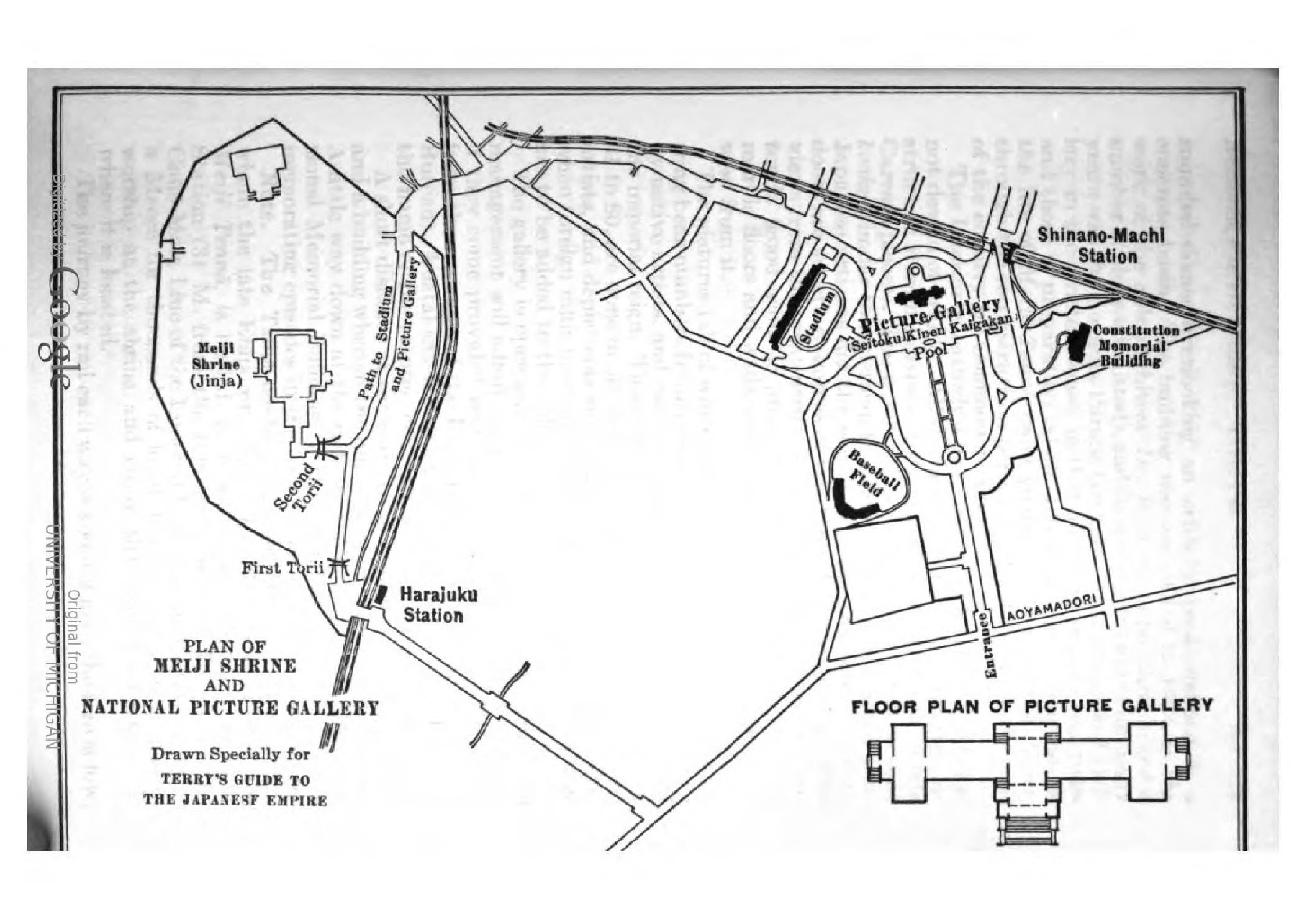
Plan of Meiji Shrine and National Picture Gallery
地図:明治神宮と聖徳記念絵画館
このページの翻訳・編集注
160ページと161–167ページの間に挿入された無番号の図版です。
rounded domes overlooking an artificial pool confined in a concrete basin. The building was completed in 1928, is the work of the able architect Dr. R. Sano (who harmonized a number of plans submitted), and occupies a site which for many years was the Aoyaraa Parade Grounds, It is a National Gallery in the strictest sense, in that all of the present paintings and those in preparation (about 100 in all) depict episodes in the life of Meiji Tenno (who guided the destinies of Japan through the reconstruction period which followed the opening of the country by Commodore Perry).
コンクリートの水盤に囲まれた人工プールを見下ろす丸いドーム。この建物は1928年に完成し、有能な建築家佐野博士の手によるもので(提出された多くの設計図を調和させました)、長年にわたり青屋のパレードグラウンドと呼ばれた場所に位置している。厳密な意味での国立美術館であり、現在の絵画および準備中の絵画(合計約100点)は、日本の運命を導いた明治天野の人生のエピソードを描いているペリー提督による国開国の後の再建期である。
The Interior is cathedral-like, and though coldly austere is not devoid of beauty. All the marble and onyx used in its construction is from Japanese (Gifu) quarries (excepting the white Carrara pieces). The woodwork is of the almost indestructible keake (similar to American hickory), stained a mahogany tint. Japanese artisans did the work. The massive bronze (front) doors are superb examples of this type of craftsmanship. The views from the great peristyle are admirable. The stately rotunda (good acoustic properties) is squared, with tessellated marble floors and walls, and opposing wings leading east and west from it.
内部は大聖堂のようで、冷たく厳めしいが、美しさを欠いてはいない。その造りに用いた大理石と縞瑪瑙はすべて日本(岐阜)の採石場のもので(白いカラーラの石を除く)、木部はほとんど朽ちぬ欅(アメリカのヒッコリーに似る)で、マホガニー色に染めてある。日本の職人が手がけた。重厚な青銅の(正面の)扉は、この種の工芸の見事な一例である。大きな列柱廊からの眺めは見事である。堂々たる円形広間(音響がよい)は方形で、大理石を寄せ張りした床と壁をもち、そこから東西へ向かい合う翼が延びる。
The pictures (all of which are about 8 by 10 ft.) in the right wing bear numbers from 1 to 40, are in the Japanese style, are by native artists, and portray episodes during the first part of the imperial reign. Those in the left wing are numbered from 41 to 80, are done in oil, in the European manner, by Japanese artists, and depict episodes in the latter half of the Meiji era, when foreign influence tinged the native life. Other paintings are to be added to the collection.
右翼の絵画(すべて約8×10フィート)は1から40までの番号が記されており、日本風で、現地の画家によるもので、帝政初期の出来事を描いている。左翼の作品は41点から80点まで番号が付けられており、日本人画家によるヨーロッパ風の油彩で描かれ、明治時代後半の外国の影響が現地の生活に影響した出来事を描いている。他の絵画もコレクションに加えられる予定である。
The gallery is open only on certain days, but the courteous management will admit interested travelers almost any time, if they come provided with a request card (easily obtainable from the manager of the Imperial Hotel or the Japan Tourist Bureau). A catalogue in English, giving the titles of the pictures, the name of the painter, etc., can be obtained at the gallery.
絵画館は特定の日にだけ開館するが、丁寧な管理者は、請求カード(帝国ホテルの支配人またはジャパン・ツーリスト・ビューローで容易に入手できる)を持参した関心ある旅行者なら、ほとんどいつでも入館させてくれる。絵の題名、画家名などを記した英語のカタログは館内で入手できる。
A short distance at the rear of the gallery is a circular space and a building wherein the imperial funeral services were held. A little way down at the right of the gallery is the Constitutional Memorial Building, with a number of paintings commemorating episodes in the framing of Japan's Constitution.
ギャラリーの奥の少し先には円形の空間と、皇帝の葬儀が行われた建物がある。ギャラリーの少し右側には立憲記念館があり、憲法の額装の出来事を記念する絵画が多数飾られている。
Note. The Tama-no-Misasagi, or Imperial Mausoleum, where the late Emperor, Yoshihito (1912-1926), son of the Meiji Tenno, is buried, is about 1£ M. from the Asakawa Station (31 M. from the lidamachi Station, Tokyo) on the Chuo Main Line of the Imperial Government Railways, and is a Mecca for thousands of loyal Japanese who go thence to worship at the shrine and enjoy the beautiful countryside where it is located.
注記。多摩陵、すなわち、明治天皇の子・故天皇嘉仁(1912〜1926)が葬られた御陵は、国有鉄道中央本線の浅川駅から約1マイル半(飯田町駅から東京経由で31マイル)にある。ここは、社に参り、美しい田園の景を楽しもうと訪れる幾千の忠実な日本人の聖地となっている。
The journey by rail each way is about 2 hrs.; the fare is low,
鉄道での移動は片道約2時間である。運賃は安い、
このページの翻訳・編集注
原本画像とOCRデータを照合して英文を校正し、固有名詞・数値・単位を確認したうえで日本語訳を校閲しました。歴史的な表現は原著の記録性を尊重して残しています。
Shiba Park.
芝公園。
and cheap and frequent motor-cars (and yet cheaper buses) wait at the station to carry travelers to the shrine enclosure.. The Japan Tourist Bureau (head office in the Central Railway Station at Tokyo; branch in the Imperial Hotel) will secure tickets for the traveler and supply all the needed information.
また、安価で頻繁に運行される自動車(さらに安いバスも)が駅で待機し、旅人を神社の囲いへ運んでいる。ジャパン・ツーリスト・ビューロー(中央駅東京本部、インペリアルホテル支店)が旅行者のためにチケットを確保し、必要な情報を提供する。
The Mausoleum is similar to that of the Meiji Emperor at Momoyama (see p. 550) and stands on a rounded hill about 720 ft. above sea level, in the midst of a charming and typical Japanese landscape At near-by Hachioji there are the remains of an old castle, and at the west is Mt. Takao, celebrated for its gorgeous, display of maples in Nov.
この霊廟は桃山の明治天皇の霊廟に似ており(550ページ参照)、標高約720フィートの丸い丘の上に建ち、魅力的で典型的な日本の風景の中に広がっている。近くの秋尾路には古い城の遺構があり、西側には高尾山がある。 11月には美しいカエデの展示で称賛されている。
The district is much enjoyed by Japanese for brief outings and picnics.
この地区は日本人にとって短い外出やピクニックにとても人気がある。
•Shiba Park (or Shiba Koen or koenchi ), a large, well-wooded plot dotted with temples, shrines, gorgeous mausolea, tombs, a pagoda, a lakelet, numerous monuments, pleasure-gardens, and what-not in the S.W. quarter of the city2 in Shiba-ku (PI. D, 6), flanks the car line (10 min. from Hibiya Park) and contains some mortuary temples of the Tokugawa shoguns and their consorts which, though rapidly decaying, still' rank with the finest structures of their kind in Japan, and are classed with the 'sights' of the capital. Though wastefully rather than tastefully splendid, they well deserve a visit, particularly by these who may not have seen the similar shrines of Nikko.
芝公園(芝公園、または公園地)は、市の南西部、芝区(図D・6)にある大きく樹木の多い一画で、寺院、神社、華麗な霊廟、墓、塔、小池、多数の記念碑、遊園などが点在する。電車線に沿い、日比谷公園から10分で行ける。ここには徳川将軍とその夫人たちの霊廟がいくつかあり、急速に朽ちつつあるものの、なお日本で同種の建造物の中でも最上級に数えられ、首都の名所とされている。趣味よいというより浪費的な壮麗さではあるが、とくに日光の同様の社殿をまだ見ていない人には、訪れる価値が十分ある。
Shiba Park dates its prosperity from 1596 when the first Tokugawa, shogun Ieyasu, — who had selected Yedo for his capital 6 yrs. before — caused the Zojoji Temple (the metropolitan headquarters of the powerful Jodo sect of Buddhists) to be moved hither and declared it the place where the funeral tablets ( ihai ) of himself and his descendants should be preserved. In course of time thirty or more temples and mortuary shrines sprang up in the Shiba inclosure, most of the latter dating from the 17th cent. Repeated fires destroyed a number of the minor buildings, and the great conflagration of 1874 burned the magnificent old Zojoji with most of its contents; leaving only the big outer gate (sammon) standing as a sole survivor of the original group. A smaller and less imposing structure was erected on the site of the burned temple, to be again destroyed in 1908. A newer and more elaborate fane is now being constructed. The steady expansion of Tokyo and its growing needs has resulted in the clipping off, from time to time, of sections of the erstwhile wide temple inclosure, so that the park, which was officially opened to the public in 1878, is now much smaller than formerly. One by one its glories are disappearing before the march of progress, utilitarianism, and the relentless greed of ages.
芝公園の繁栄は1596年に始まる。6年前に江戸を首都に選んでいた初代徳川将軍家康が、強力な浄土宗の本山である増上寺をここへ移し、自分と子孫の位牌を安置すべき場所と定めたのである。やがて芝の境内には30を超える寺院と霊廟が建ち、後者の多くは17世紀にさかのぼる。度重なる火災で小建築のいくつかが焼け、1874年の大火は壮麗な旧増上寺とその所蔵品の大半を焼き尽くした。元の一群で唯一残ったのは大きな外門(三門)である。焼けた寺の跡には、より小さく目立たない建物が建てられたが、1908年に再び失われた。現在は、より新しく、より精巧な堂が建設中である。東京の着実な拡大と増大する需要のため、かつて広かった寺域の一部は時々削り取られ、1878年に正式に一般公開された公園は、以前よりはるかに狭くなっている。その栄光は、進歩、実用主義、時代を超えた容赦ない貪欲の行進の前に、一つまた一つと消えつつある。
If possible the mausolea should be visited on a bright morning, as the clapboarding which partly incloses and protects them from the weather renders the brilliant interiors darksome, and this duskiness is enhanced by the
できれば霊廟は明るい朝に訪れるべきである。風雨から守るため部分的に囲う板張りが、輝かしい内部を暗くしており、その薄暗さは、入口の前に掛けられる竹簾によってさらに強められるからである。
このページの翻訳・編集注
原本画像とOCRデータを照合して英文を校正し、固有名詞・数値・単位を確認したうえで日本語訳を校閲しました。歴史的な表現は原著の記録性を尊重して残しています。
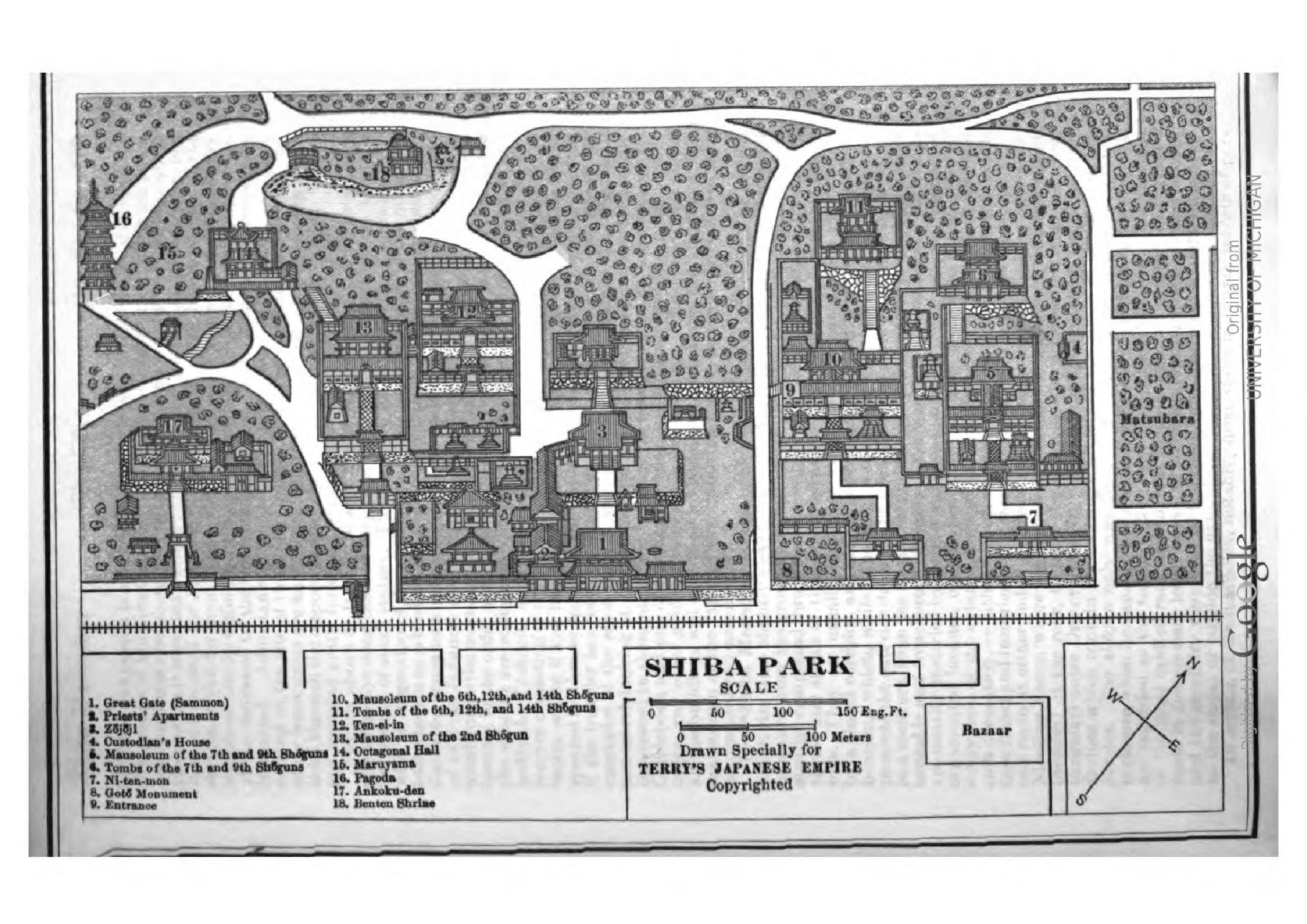
Map: Shiba Park
地図:芝公園
このページの翻訳・編集注
168ページと169ページの間に挿入された無番号の地図です。
Shiba Mausolea.
柴屋霊廟。
of 20 sen per person is exacted by the custodian (at the office) of each of the five groups of buildings, and for this an English-speuking guide is supplied, who conducts one about and then points the way to the next groqp, where the process is repeated. This small fee removes the necessity for tipping, but it is not unusual for Japanese to deposit small coins before certain of the shrines, which for them have a religious import. Upon leaving the mortuary temple of the 2d Shogun a ticket is handed the visitor and this is given up at the entrance to the Octagonal Shrine or tomb; without it a second fee is exacted. Admittance through the samnion to the temporary structure erected on the site of the Zojoji is free. With the exception of this gate, the other front gates are kept closed; the entrance to the mausolea being at the sides through the respective offices. Consult the accompanying plan. Covers are provided gratis for shoes, which do not have to be taken off.
五つの建物群それぞれで、管理人(事務所)が一人20銭の料金を徴収し、その代わりに英語を話す案内人がついて内部を案内し、次の建物群への道を示す。そこで同じ手順が繰り返される。この少額の料金によりチップの必要はなくなるが、日本人が宗教的意味をもついくつかの祠の前に小銭を置くことは珍しくない。第2代将軍の霊廟を出る際、訪問者には切符が渡され、八角堂または墓の入口でそれを渡す。これがなければ二度目の料金を徴収される。増上寺跡に建てられた仮建築へは三門を通って無料で入れる。この門を除き、他の正面門は閉じられており、霊廟への入口はそれぞれの事務所を通って側面にある。添付の図を参照のこと。靴には無料で覆いが用意され、脱ぐ必要はない。
Visitors above ft. tall will save themselves numerous bumps by keeping an eye on the door-cases as they pass through them, since they are all made for persons of small stature. Those pressed for time will perhaps be satisfied with an inspection of the mausoleum of the 2d Shogun, and of the octagonal hall wherein he is buried; the former is the finest and richest of the group, and the latter contains what is thought to be the largest and best specimen extant of antique Japanese gold lacquer in the shape of a tomb. Next in point of excellence is the mortuary temple of the 0th, 1 2th, and 14th Shoguns; and following, in the order named, is the Ten-ei-in, where the consorts of several of the shoguns are enshrined; the temple of the 7th and 9th Shoguns; and lastly the Toshogu. Architecturally they are all practically the same, the difference consisting of the varying richness of t heir interior decorations; nil are worth seeing if one has the time to spare, and all may be superficially inspected in 2 hrs. or less. All but the one first mentioned can be easily omitted if the traveler has seen the similar mausolea at Uyeno Park, since they are examples of the same class of architecture and decoration. The Pagoda is not worth looking at, nor are the other shrines, unless the visitor is specially interested in them and their worship. It remains to be said that with this Guidebook and one of the English-speaking bonzes supplied by the temple office, any other guide or cicerone is unnecessary. Those who plan to see all the buildings will save time by beginning their inspection of them at the mausoleum of the 7th and 9th Shoguns, then systematically following the course outlined hereinafter.
背の高い旅行者は、通り抜けるたびに鴨居に注意していれば、何度も頭をぶつけずにすむ。どれも小柄な人に合わせて作られているからである。時間に追われる者は、第2代将軍の霊廟と、彼が葬られている八角堂を見るだけで満足するかもしれない。前者はこの一群の中で最も立派で豪華であり、後者には、墓の形をした古い日本の金漆工芸として現存最大・最良のものと考えられる品が納められている。これに次いで優れているのは第6・第12・第14代将軍の霊廟であり、次に、数人の将軍の配偶者を祀る天英院、第7・第9代将軍の霊廟、最後に東照宮が続く。建築としてはどれもほぼ同じで、違いは内部装飾の豪華さの程度にある。時間があればどれも見る価値があり、2時間以内にざっと見て回ることができる。上野公園で同種の霊廟を見ていれば、最初に挙げたもの以外は省いてもよい。同じ種類の建築と装飾の例だからである。五重塔は見るほどのものではなく、他の社も、特にそれらやその信仰に関心がなければ見る必要はない。この案内書と寺務所が手配する英語を話す僧がいれば、他の案内人や通訳案内は不要である。すべての建物を見るつもりなら、第7・第9代将軍の霊廟から見学を始め、以下に示す順路を体系的にたどると時間を節約できる。
The *Shiba Mausolea consist of single isolated wood temples or shrines which rise from slightly elevated granite bases (a double protection against moisture from the ground and from fires), and are supported by a maze of sturdy compound brackets admirably adjusted to withstand the heavy thrust and strain of the ponderous and somewhat clumsy tile-roofed buildings. They are usually connected with the custodian's office ( Shamusho ) by a closed corridor, and are themselves protected by time-stained weather-boarding which, while imparting to them the bedraggled look of old barns, protects the exterior decorations from the fierce glare of a brilliant sun, and, in a measure, from the corrosive quality of the atmosphere in one of the most unstable and treacherous climates of the world. The single-story structures are usually encircled by narrow galleries flanked by classically low railings of ornamented lacquer, overshadowed by the deep projecting eaves. Almost every inch of the exterior walls of the temples is covered with some sort of rich decoration, — either carved, painted or lacquered, — but most of this is now faded and lusterless. The interiors are divided into three apartments — one room at either end of a narrow connecting corridor called the ainoma or Meeting Room, where the shogun and the abbot came from the inner shrine ( honden ) at the rear, to meet the daimyos who approached from the (rectangular) outer Oratory (haiden); the beautifully lacquered, temple-shaped shrines which contain the mortuary tablets of the deceased are kept in the honden. The shogun only was permitted to penetrate to this sacrosanct inclosure when he came to worship the deified shades of his forebears, who are regarded as the tutelary divinities of Japanese families. The daimyos of the most exalted rank and highest income occupied scrupulously graded mats in the ainoma; lesser ones had to be content with seats in the haiden; and the small fry were kept in the front yard (the most important nearest to the steps) or outside the gate.
芝霊廟は、やや高くした花崗岩の基壇上に立つ、独立した単棟の木造寺院または祠から成る。この基壇は地面からの湿気と火災に対する二重の防護であり、建物は、重くやや不器用な瓦屋根の大きな推力と重みに耐えるよう巧みに調整された、頑丈な複合組物の迷路に支えられている。通常は閉じた廊下で管理人の事務所(社務所)と結ばれ、建物自体は時代の染みを帯びた羽目板で守られている。この羽目板は古い納屋のようなみすぼらしい外観を与える一方で、外部装飾を強烈な日光のまぶしい照り返しから、また世界でも最も不安定で危険な気候の一つにおける大気の腐食性から、ある程度守っている。平屋建ての建物は通常、深く張り出す軒の陰に置かれた、装飾漆の低い高欄に挟まれた狭い回廊で囲まれている。寺院の外壁はほとんど一寸ごとに、彫刻、彩色、漆塗りのいずれかによる豊かな装飾で覆われているが、その大部分はいまでは色あせ、光沢を失っている。内部は三室に分かれる。相の間、すなわち会見の間と呼ばれる狭い連絡廊の両端に一室ずつあり、将軍と住職は奥の内陣(本殿)から来て、長方形の外側の礼拝堂(拝殿)から進む大名たちとここで会った。故人の位牌を納める、美しく漆塗りされた寺院形の厨子は本殿に置かれている。日本の家々の守護神と考えられた祖先の神格化された霊を拝むために来た時、この神聖な囲いへ入ることを許されたのは将軍だけであった。最も高位で収入も多い大名は相の間で厳密に等級づけられた畳席を占め、下位の者は拝殿の席で満足しなければならず、さらに小者は前庭、重要な者ほど階段に近い位置、または門外に置かれた。
In certain of the-tpausotea, notably those where mortuary tablets of per-
特に、ペル・パウソテアの葬儀用のタブレットが置かれたものには、
このページの翻訳・編集注
原本画像とOCRデータを照合して英文を校正し、固有名詞・数値・単位を確認したうえで日本語訳を校閲しました。歴史的な表現は原著の記録性を尊重して残しています。
Shiba MausolecL
芝霊廟。
scions of Imperial blood are enshrined, visitors are not allowed beyond a small railing placed athwart the ainoma, unless they hold special permits. This should not be considered in the light of a deprivation, as the shrine-rooms of the various temples differ but slightly one from the other. The actual Tombs (haka) beneath which the shoguns are buried, are customarily placed on a higher terrace near, or at the back of, the temples, and they are always at the rear of a little oratory, through the open doors of which the spirits of the august dead are reverenced. Though outwardly shabby, the interiors of some of these oratories are sometimes surprisingly ornate. They are not unusually closed to the casual visitor.
皇族の血筋を引く人々が祀られているため、特別許可証を持たない訪問者は、相の間を横切る小さな柵の先へ進むことを許されない。もっとも、これは大きな損失と考えるべきではない。各寺院の拝殿・神殿の内部は、互いにわずかしか違わないからである。将軍が葬られている実際の墓(haka)は、寺院の近く、または背後の一段高い壇上に置かれるのが普通で、常に小さな拝所の背後にある。その開いた扉を通して、尊い死者の霊が拝される。外観はみすぼらしくても、これらの拝所の内部は時に驚くほど華麗である。一般の訪問者に閉ざされているのは珍しいことではない。
The trained eye of the architect will not fail to observe in these Shiba temples the evidences of the architectonic law which pervades the designs of all of them — the adjustment of beams and joists, pillars and pilasters, arches and buttresses to an external but hidden necessity — that of protecting them against earthquakes — in the most active belt of which Tokyo stands. At first blush they appear unstable and lacking in organic coherence; the tremendously heavy, tile-weighted roofs, with their disproportionate overhang, seem too large for the slender walls, and one rather expects them to twist round during an earthquake and in falling grind their fragile supports into powder. Doubtless the impression made was deliberately aimed at, the startling effect of too much massiveness in the roof not seeming undesirable in the period when the temples were designed. An interior inspection always invalidates the impression of weakness gained from the outer view, for here the columns are startlingly solid and one readily understands how the structures could have successfully withstood not only the fifty or more subterranean jogglings which Tokyo receives every year, but the occasional big jolt which comes ever so often to remind the metropolitans of the exact nature of the earth beneath them. That these almost priceless relics of a period when the national art was uninfluenced by that of the West have so successfully withstood the assaults of centuries, is due in a great measure to the many coats of thick, glass-like lacquer with which the wood is covered, and which acts like a sheathing of some impermeable metal, also to the moisture-resisting granite which serves as bases. In these essentials they differ notably from the unpainted dwellings of the proletariat. The customary pantiles used on the roofs of the better class of the latter houses are replaced here by copper-bronze strips which time has coated with a fine patina that imparts a decided element of beauty and charm. The demon-faced ante-fixes, or the upright ornaments bearing crests which figure at the ends of the ridges, serve the double purpose of adornment and as expedients for covering the points where the imbrications end. A pleasing phase of extreme antiquity is noticeable about the brilliantly decorated doors, which are customarily swung on solid metal pivots let into soffits above, and projections from the sills below, and in this they recall the ponderous doors of Spanish and Mexican cathedrals.
建築家の訓練された目なら、これら芝の寺院に、すべての設計を貫く建築上の法則の証拠を見逃すことはない。梁と根太、柱と付柱、アーチと控え壁は、外からは見えない必然、すなわち東京が最も活動的な帯の上に立つ地震から建物を守る必要に合わせて調整されている。一見すると不安定で有機的なまとまりを欠くように見える。瓦で重くなった非常に重い屋根は、不釣り合いなほど深く張り出し、細い壁には大きすぎるように思われ、地震の際にはねじれて倒れ、脆い支えを粉にしてしまうのではないかと想像される。この印象はおそらく意図的に狙われたもので、寺院が設計された時代には、屋根に過度の量感をもたせる驚くべき効果は望ましくないとは思われなかったのだろう。内部を検分すれば、外観から受ける弱さの印象は必ず覆される。ここでは柱が驚くほど堅固で、東京が毎年受ける50回以上の地下の小揺れだけでなく、首都市民に足元の大地の正確な性質を思い出させる、時折の大揺れにも、構造がどうして耐えてきたのか容易に理解できる。国民的美術が西洋の影響を受けなかった時代の、ほとんど値のつけられない遺物が何世紀もの攻撃にこれほどよく耐えてきたのは、大部分、木材を覆う厚くガラスのような漆の多層塗りが、不透水性の金属被覆のように働いているためであり、また基壇に湿気に強い花崗岩を用いているためでもある。この要点において、これらは庶民の無塗装の住居とは著しく異なる。後者の上等な家の屋根にふつう用いられる桟瓦は、ここでは銅青銅の板に置き換えられ、時がそれに美しい緑青をまとわせ、美と魅力の明確な要素を与えている。棟の端に現れる鬼面の飾り、あるいは紋を帯びた立飾りは、装飾であると同時に、重ね葺きの端部を覆う工夫でもある。鮮やかに飾られた扉には、極めて古風な心地よい相が見られる。これらは通常、上の軒裏に埋め込まれた堅固な金属製の枢軸と、下の敷居からの突起で回転するように取り付けられており、その点でスペインやメキシコの大聖堂の重い扉を思わせる。
If an unpleasant quality be found in the lack of repose in some of the interiors, it is usually offset by the effect of exceeding richness and originality, The decorations of certain of the upright wall-panels arc sometimes disappointing to the foreigner, who may also be impressed by an indescribable uneasiness in the too lavish enrichment; but the general sense of unity is nevertheless apparent in the wonderfully barbaric fineries which greet the eye at every turn. Time has, in a measure, harmonized the conflicting colors, particularly in the upper structural parts of the exterior, and few can withstand the strange impressiveness of the mausoleum of the 2d shogun. This is at once the most magnificent and complete monument of ecclesiastical art that exists in Tokyo, and is undoubtedly the most beautiful of the large lacquered products of a high degree of perfection which have come down to us from the 17th cent. Contrasted with the spick-and-span newness of certain of the recently redecorated Nikko mausolea (where the buildings are regarded as national treasures and a special fund is set aside by the State for their up-keep), the Shiba buildings (which arc owned by the Tokugawa family and are left practically to care for themselves) look shabby and forlorn. This aspect is heightened somewhat by the complicated adventitious ornaments which have been grafted on to them, and which detract in a way their fine effect.
いくつかの内部に落ち着きのなさという不快な性質が見られるとしても、それはたいてい、過度なまでの豊かさと独創性の効果によって相殺される。直立した壁面パネルの装飾には、外国人を失望させるものもあり、あまりに贅沢な装飾に言いようのない不安を覚えることもある。しかし、目を向けるたびに現れるすばらしく野性的な華麗さの中に、全体としての統一感はやはり明らかである。時の経過は、相反する色彩をある程度調和させた。特に外部上部構造ではその効果が見られ、第二代将軍の霊廟が持つ奇妙な迫力に抗し得る者は少ない。これは東京に現存する宗教建築美術の記念物として最も壮麗かつ完全なものであり、17世紀から伝わる高度に完成した大規模漆工品の中でも、疑いなく最も美しい。近年再装飾された日光の霊廟の、ぴかぴかに新しい姿(建物は国宝とされ、維持のため国が特別基金を置いている)と比べると、徳川家が所有し、ほとんど自力で手入れするに任されている芝の建物は、くすんで侘しく見える。この印象は、後から付け加えられた複雑な装飾が接ぎ木され、建物本来の優れた効果をいくらか損なっていることによって、さらに強められている。
このページの翻訳・編集注
原本画像とOCRデータを照合して英文を校正し、固有名詞・数値・単位を確認したうえで日本語訳を校閲しました。歴史的な表現は原著の記録性を尊重して残しています。
Shiba Mausolea.
芝霊廟。
The Great Gate (Sammori) which admits one to the wide atrium of the Zojoji was redecorated in 1911, and is still a splendid and sturdy example of an old style Buddhist temple gateway. The rich Indian red lacquer with which it is entirely covered makes an impressive picture against the green of the environing trees; it is unusually plain, and the black metal ornaments which adorn it add dignity and beauty. There are three sets of heavy doors, six in all, each studded with metal bosses and display-hinges, and each swung on huge pivots let into soffits above and below. The massive upright pillars, which sit in bronze sockets resting upon granite bases, are of almost imperishable kcyaki, but smaller in circumference than certain of the superb timbers employed in the mausoleum of the 2d shogun. A maze of massive compound brackets support the twin roofs, which are tiled, with demon-faced antefixes at the salient angles. The upper story is reached by flights of stairs leading from the lateral wdngs; permits are necessary, but the images (gilded figures of Shaka, Fugen, Monju, and a few other divinities) contained therein are of no special interest, and will scarcely repay the time spent in seeing them.
増上寺の広い前庭へ入る大門(三門)は1911年に再装飾され、古い仏教寺院門の壮麗で堅固な例としてなお見事である。全面を覆う濃いインド赤の漆は、周囲の木々の緑を背景に印象的な景を成す。門は異例なほど簡素で、黒い金具の装飾が威厳と美しさを加えている。重い扉は三組、計六枚あり、それぞれ金属の鋲と飾り蝶番を備え、上下の軒裏に据えた巨大な軸で回る。花崗岩の台座上に置かれた青銅の受けに立つ太い柱は、ほとんど朽ちない欅材であるが、第二代将軍霊廟に用いられた見事な大材のいくつかよりは周囲が小さい。巨大な斗栱の入り組んだ組物が、鬼面の飾り瓦を突出部に持つ瓦葺きの二重屋根を支えている。上層へは側面の翼部から階段で上る。許可証は必要だが、内部の像(釈迦、普賢、文殊、その他数体の金箔像)は特に興味深いものではなく、見学に費やす時間にあまり報いない。
The Priest's Apartments stand at the left, within; and at the right, beneath a tawdry temporary tower, is the great bronze bell cast in the 16th cent. The new Zojoji stands on the terrace ahead; the chief idol, a richly gilded image of Amida is ascribed to Eshin. The white crest on the purple hangings of the fane is the mitsu-am, or three-leaved asarum which formed the crest (a symbol frequently employed in art expression) of the Tokugawa. At the right of the temple entrance stands a low gray stone bearing a chiseled impression of Buddha's foot, comparing in size and general grotesqueness to the diplodocus-like tooth revered in the Maligawa Temple at Kandy, in Ceylon, as one of Buddha's original grinders. The thousands of wood strips displayed roundabout show the names of the devotees who subscribed to the erection of the new temple. The black Amida preserved within the temple is ascribed to Eshin and is said to have been carried by leyasu as a mascot in his military campaigns.
内側の左手には僧坊があり、右手には粗末な仮設塔の下に16世紀鋳造の大きな青銅鐘がある。新しい増上寺は前方の壇上に立ち、本尊は恵心作とされる豪華に金箔を施した阿弥陀像である。堂内の紫の幕にある白い紋は三葵、すなわち三葉の葵で、徳川家の紋であり、美術表現にもよく用いられる。寺の入口右手には、仏足石を刻んだ低い灰色の石がある。その大きさと全体の奇怪さは、セイロンのキャンディにあるマリガワ寺で、仏陀の歯の一つとして崇拝されるディプロドクスの歯のようなものに比べられる。周囲に掲げられた何千枚もの木札は、新寺建立に寄進した信者の名を示す。寺内に保存される黒阿弥陀は恵心作とされ、家康が軍陣で守り本尊として携えたという。
We begin our inspection of the mausolea at the Mortuary Shrine of the 7th (. Ietsugu ) and 9th (Ieshige) Shoguns: the entrance is at the N. side of the inclosure (comp, the plan) opposite the pine grove called Matsubara. The office of the custodian is just within. On payment of the 20-sen fee the traveler is conducted through a long hall with faded decorations, to a side gallery which is followed until the main entrance is reached. The most conspicuous features of this are two resplendent tie-beams formed of intricately carved and gilded wood dragons; one, headed toward the shrine, called the ascending dragon; the other, facing the corridor, the descending dragon. The arcade is a maze of still rich but sadly faded
霊廟の見学は、第7代将軍家継と第9代将軍家重の霊屋から始める。入口は囲いの北側、松原と呼ばれる松林の向かいにある(平面図参照)。管理人の事務所は入ってすぐである。20銭を払うと、旅行者は色あせた装飾の長い廊下を通り、脇の回廊を進んで正面入口へ導かれる。最も目立つのは、精巧に彫られ金箔を施された木彫の龍で形づくられた、輝かしい二本の繋梁である。一つは霊屋へ向かう昇り龍、もう一つは廊下を向く下り龍である。回廊は、なお豊かではあるが悲しくも色あせた装飾の迷路である。
このページの翻訳・編集注
原本画像とOCRデータを照合して英文を校正し、固有名詞・数値・単位を確認したうえで日本語訳を校閲しました。歴史的な表現は原著の記録性を尊重して残しています。
172 Rout $ 10.
172 Route 10。
Shiha Mausolea.
芝霊廟。
polychrome decorations, in which many colors and much gold-leaf are felicitously blended; the entire structure shows the marks of time more plainly than the succeeding ones. There are some graceful old pine trees in the pebbled yard. The Oratory (21 by 27 ft.) still retains much of its former great beauty; the six wide wall-panels, each of one piece of solid camphor wood, display the Japanese conception of Korean lions (by Kano Chikanobu; 1660-1728) charging across a gleaming gold ground. The rectangular sculptured ornamental panels let into the architrave, also cut from single camphor wood strips, carry 100 different wave-patterns bewilderingly intricate and richly tinted in colors. The fine decorations on the sunken panels of the handsome coffered ceilings are thought by some to rank with the best in the entire group; polychromatic flowering peonies form the central figures, while encircling them are conventional butterfly wings, attractively and skillfully painted. The lacquered cross-sections are almost covered with delicately chased metal enrichments; the Tokugawa crest predominating. The bizarre compound brackets which extend quite round the room below the ceiling are each adorned with the head of the baku (a fabled animal said to swallow evil dreams). Every inch of surface between the bracket groups is ornamented with minutely perfect painted tracery in conventional designs. On the monthly festivals (12th and 13th) the abbot's seat beneath the swinging metal baldachin is occupied by him. The boxes which one sometimes sees ranged about the room are then placed near the seat, and the kneeling bonzes intone the ritual from the Buddhist sutras which they contain. In lieu of capitals the tops of the supporting columns are enriched with an intricately diversified drapery painted so skillfully as easily to deceive one into believing it finely colored silk brocade.
多彩な彩色装飾では、多くの色と金箔が巧みに調和している。建物全体には、後続のものよりも時の痕跡がはっきり見える。小石を敷いた庭には優美な老松がいくつかある。拝殿(21×27フィート)は、昔の大きな美しさをなお多く保っている。六枚の大きな壁面パネルは、それぞれ一枚板の樟材から作られ、輝く金地の上を駆ける唐獅子、すなわち日本人の考える朝鮮獅子を描く(狩野周信、1660〜1728年作)。長押にはめ込まれた長方形の彫刻装飾パネルも、一枚の樟材から彫り出され、100種類の波文様を持つ。文様は目もくらむほど精緻で、豊かな色彩を帯びている。美しい格天井の沈み込んだ区画の装飾は、この一群全体の中でも最高に数えられるとする人もいる。中央には多彩な牡丹の花が置かれ、その周囲には蝶の羽を定型化した文様が、魅力的かつ巧みに描かれている。漆塗りの横材は、繊細に彫金された金具でほとんど覆われ、徳川の紋が最も目立つ。天井下を部屋全体にめぐる奇妙な組物は、それぞれ獏の頭で飾られている。獏は悪夢を食うとされる伝説上の動物である。組物の間のあらゆる面は、定型化された細密な彩色唐草で飾られる。毎月12・13日の祭礼には、揺れる金属製天蓋の下にある住職の座に住職が着く。部屋に並べられている箱はその時、座の近くに置かれ、跪いた僧たちがその中の経典から儀式を唱える。支柱の上部は柱頭の代わりに、複雑に変化する垂れ布の絵で飾られており、あまりに巧みに描かれているため、色鮮やかな絹錦であると見まがうほどである。
The decorations of the corridor (15 by 30 ft.) which joins the haiden to the honden are similar to those of the outer room. Massive floors heavily lacquered in red or black underlie the soft mats. The gilded wall-panels with rampant lions are by Chikanobu. Seven lacquered and highly polished steps lead up to the room where, on exquisitely lacquered stands made for them, repose the sacred reliquaries — marvelous structures of rich yellow gold and other chased metal; lacquer, intricate sculpture, brilliant colors, and gleaming crests. Scarcely less remarkable are the superb red lacquered tables before them, on which the temple furniture and offerings are customarily set out. The shrine of the 9th shogun stands at the left; that of the 7th in the middle; and that of Tokugawa Tsunashige (father of lenobu, the 6th shogun) at the right. The sculptured wood images and mortuary tablets within were presented by. Mikados and are never shown. Excellently-carved wood statuettes of Kwannon, Benten, and the Gods of the Four
拝殿と本殿を結ぶ廊下(15×30フィート)の装飾は、外陣のものと似ている。柔らかな畳の下には、赤または黒の漆を厚く塗った重厚な床がある。獅子を描いた金地の壁面パネルは周信の作である。七段の漆塗りで磨き上げられた階段を上ると、精巧な漆塗りの台上に聖なる厨子が安置された部屋に至る。厨子は、豊かな黄金色の金属や彫金、漆、精緻な彫刻、鮮やかな色彩、輝く紋章から成る驚くべき構造である。その前に置かれ、寺具や供物がふつう並べられる見事な朱漆の卓も、ほとんど同じほど注目に値する。左に第9代将軍の厨子、中央に第7代、右に徳川綱重(第6代将軍家宣の父)の厨子が立つ。内部の木彫像と位牌は天皇から贈られたもので、決して公開されない。観音、弁天、四天王の精巧な木彫小像が、あらゆる邪気から厨子を守っている。
このページの翻訳・編集注
原本画像とOCRデータを照合して英文を校正し、固有名詞・数値・単位を確認したうえで日本語訳を校閲しました。歴史的な表現は原著の記録性を尊重して残しています。
Shiba Mausotea.
シバ・マウソテア。
Directions guard the shrines from all evil influences. The interior of the apartment is a maze of gilding and rich painting supplemented by carved phoenixes and the like. Fourteen years are said to have been spent at work on the building.
部屋の内部は、金箔と豊かな彩色に、彫刻された鳳凰などを加えた迷路のようである。この建物の工事には14年を要したと言われる。
Returning to the main entrance, we proceed to the arcade where many swinging bronze lanterns (the gifts of daimyos 9 wives) are displayed; the central gate is the Kara-mon (Chinese Gate): the Buddhist angel on the ceiling panel is by Chikanobu; the sculptured wood panels of birds and flowers are badly weather-beaten, and are inferior to certain of those in the other structures. The tall bronze lanterns in the inclosure beyond are a portion of the 212 which stand in the various compounds of this temple; most of them date from 1716-61, and were gifts by daimyos whose annual revenue exceeded 100,000 koku of rice. The old gate at the foot of the inclosure is the Chokugaku-no-mon (Imperial Tablet Gate), on the facade of which is a tablet placed there by one of the emperors; in the court beyond arc some of the 750 stone lan terns. presented to the shrine by daimyos whose income ranged lower than 100,000 koku; the outer gate is the Ni-ten-mon, or Gate of the Two Deva Kings, by whom it is guarded. The inner gate is a marvel of carving, with dragons, birds, pierced panels, and the like. The mythological phoenix is a popular and frequently recurring subject. From this point the traveler gains a fairly correct idea of what the approach to the shrine must have looked like in the old days, when glittering trains of daimyos approached it through the several gates (now closed) and the path leading up through the colonnade. The splendor increased as one neared the sacred reliquary, and the final outburst of Oriental magnificence was enough to dazzle the most stolid.
正面入口へ戻り、多くの吊り青銅灯籠(大名の妻たちからの贈り物)が並ぶ回廊へ進む。中央の門は唐門で、天井板の仏教天人は狩野周信の作である。鳥や花を彫った木彫パネルはひどく風化し、他の建物のいくつかのものには劣る。その先の囲いの高い青銅灯籠は、この寺の各区画に立つ212基の一部である。その多くは1716年から1761年のもので、年収10万石を超える大名からの寄進であった。囲いの下手にある古い門は勅額門で、正面には天皇の一人が掲げた額がある。その向こうの庭には、収入10万石未満の大名から奉納された750基の石灯籠の一部がある。外門は二天門、すなわち二天王に守られた門である。内門は彫刻の驚異で、龍、鳥、透かし彫りのパネルなどで飾られている。神話上の鳳凰は好まれ、頻繁に繰り返される題材である。ここから旅行者は、きらびやかな大名行列がいくつもの門(現在は閉じられている)と回廊を通る道を進んで神社へ近づいた昔、参道がどのように見えたかをかなり正確に想像できる。聖なる厨子に近づくにつれて壮麗さは増し、最後に噴き出す東洋的豪華さは、最も鈍感な者さえ眩ませるほどであった。
Passing to the rear of the shrine we come to the O-shikiri-mon or Great Dividing Gate, beyond which only the shogun and the abbot were allowed to go — the daimyos remaining in the temple garden and worshiping the August Tomb from afar. Though now but a shadow of its one-time richness the structure is still noteworthy, chiefly for the skillfully carved and gilded open-work panels in the wings. They are the work of Nakamura Izumi no kami; are each fashioned out of a single piece of keyaki-wood; and are so adroitly executed that the
霊廟の背後へ進むと、大仕切門、すなわち大きな区切りの門に出る。この先へ進むことを許されたのは将軍と住職だけで、大名たちは寺の庭に残り、遠くから御霊屋を拝した。かつての豊かさは今や影をとどめるにすぎないが、この建物はなお注目に値する。とくに両翼の、巧みに彫られ金箔を施された透かし彫りパネルが優れている。これは中村和泉守の作で、それぞれ一枚の欅材から作られ、非常に巧みに仕上げられているため、
running kirin show to equal advantage on either side. In the sunken pebbly court, which we now cross under the guidance of the temple bonze, are 44 headless bronze lanterns, the hoshuno-lama which originally ornamented them having been stolen by some vandal during the troublous period which immediately preceded and followed the Restoration — at which epoch iconoclasm was not considered reprehensible by certain misguided Japanese. The uniform gray pebbles of the court here are symbolic of the immoderate extravagance of the builders of these magnificent memorials to the dead shoguns. Because
麒麟が左右どちらにも同じ見栄えで走る。沈んだ小石敷きの庭——今、寺の僧の案内でこれを横切る——には、首のない青銅の灯籠が44基あり、もとそれを飾っていた宝珠の珠は、維新の直前直後の騒がしい時期に心ない破壊者によって盗まれた。その頃、偶像破壊は一部の心得違いの日本人には咎むべきこととは見なされなかった。ここの庭の一様な灰色の小石は、亡き将軍たちのこれらの壮麗な霊廟を築いた者たちの度を越した奢りを象徴する。なぜなら
このページの翻訳・編集注
原本画像とOCRデータを照合して英文を校正し、固有名詞・数値・単位を確認したうえで日本語訳を校閲しました。歴史的な表現は原著の記録性を尊重して残しています。
Shiba Mausotea.
シバ・マウソテア。
of their granitic character and their supposed quality of neither fading nor changing color when wet, they were all brought (as were the others in Shiba Park) from the distant province of Kii (S. of Kyoto), on horseback, at a tremendous outlay of time and effort.
花崗岩質であること、また濡れても色あせず変色しないと考えられていたことから、これらはすべて、芝公園の他のものと同じく、京都の南方にある遠い紀伊国から、莫大な時間と労力をかけ、馬で運ばれてきた。
At the top of the steps stands the small but gorgeous Oratory of the 9th shogun, well preserved despite 152 years of exposure to the changeable Japanese climate. The highly-polished floor is of deep black lacquer; the prancing kirin on the brilliant gold wall-panels are by Chikanobu (a great favorite of Yoshimune, the 8th shogun ), to whom is also ascribed the handsomely decorated sunken panels of the coffered ceiling. The crests on the folding outer doors are (top) the Tokugawa; ( center ) the Wheel of the Law and (below) a compound toko, or mace, held by Buddhist priests when praying. Eighteen stone steps lead up from the rear of the oratory to the pagoda-shaped granite tomb resting on its octagonal base and surrounded by a copper-sheathed fence. Twenty feet below the shrine-like structure, wrapped like that of a mummy and covered with artificial cinnabar and charcoal to arrest decay, lies the body of the 9th shogun. The strangely contorted teak tree (sharasoju) at the left of the inclosure is said to be 150 yrs. old (which is doubtful); to have come originally from India, and to have been presented to the shrine by a king of Korea. It resembles a sycamore, and the profusion of white flowers (June-July) are not unlike those of Camellia japonica. According to Buddhists (who often mention the tree in their sacred scriptures) the greenish-brown trunk of the original tree (under which Buddha is thought to have been born) turned white when he exchanged earth for nirvana. — The immense corner-stones of the wall supporting the terrace came from Osaka. — The tomb of the 7th shogun, on a similar terrace at the left, dates from 1716, when the unfortunate lad died, aged 7 yrs. Leaving the inclosure by the entrance gate, we skirt the front of the park for a short distance, turn up the lane (right) between the Main Gate and the Goto Monument, to
階段の上には、小さいながらも華麗な第9代将軍の拝所が立ち、日本の変わりやすい気候に152年間さらされてきたにもかかわらず、よく保存されている。磨き上げられた床は深い黒漆である。輝く金地の壁面パネルに描かれた跳ねる麒麟は、第8代将軍吉宗の大のお気に入りであった周信の作で、格天井の美しく装飾された沈み込みパネルも同人の作とされる。折戸の紋は、上が徳川家、中央が法輪、下が僧侶が祈祷の際に持つ複合の独鈷、すなわち金剛杵である。拝所の背後から18段の石段が、八角形の基壇に載り銅板張りの柵で囲まれた、宝塔形の花崗岩の墓へ続く。社殿のような構造物の20フィート下には、ミイラのように包まれ、腐敗を防ぐため人工の辰砂と炭で覆われた第9代将軍の遺体が眠る。囲いの左にある奇妙にねじれた沙羅双樹は樹齢150年といわれるが疑わしい。もとはインドから来て、朝鮮の王が霊廟に献じたとされる。プラタナスに似ており、6〜7月に咲き乱れる白い花は椿に似ている。仏教徒によれば、仏陀が生まれたとされる原木の緑褐色の幹は、仏陀が現世を離れて涅槃に入った時に白くなったという。壇を支える壁の巨大な隅石は大阪産である。左手の同様の壇上にある第7代将軍の墓は、1716年、薄幸の少年が7歳で没した時のものである。入口門から囲いを出て、公園の前を少し進み、正門と後藤記念碑の間の小道を右へ曲がる。
The Mausoleum of the 6th (Ienobu), 12th (Ieyoshi), and 14th (Iemochi) Shoguns. It is entered through an inconspicuous gateway in the plain side fence which leads from the outer street to the custodian's office opposite the Zojoji. One penetrates directly to the sumptuously decorated colonnade which extends quite across the inclosure and is supported by many lithe and graceful pillars, enriched by numerous swinging bronze lanterns, and adorned by some superbly sculptured and gilded panels through the interstices of which pour streams of yellow sunlight. The general effect of the cloister strongly recalls certain of those of the Alhambra. The motifs of the carved and polychromatic groups set into the panels of the closed side of. the structure are peacocks, flowers, shrubbery.
第6代(家宣)、第12代(家慶)、第14代(家茂)将軍の霊廟。外側の通りから増上寺向かいの管理人事務所へ通じる、目立たない素朴な側面の柵門から入る。そこからすぐ、囲いを横切って伸びる豪華に装飾された回廊へ進む。回廊は多くのしなやかで優美な柱に支えられ、多数の吊り青銅灯籠で豊かにされ、隙間から黄色い陽光が流れ込む、見事に彫られ金箔を施されたパネルで飾られている。回廊全体の効果は、アルハンブラ宮殿のいくつかの回廊を強く思わせる。建物の閉じた側面のパネルに組み込まれた彫刻と多彩色の群像の主題は、孔雀、花、灌木である。
このページの翻訳・編集注
原本画像とOCRデータを照合して英文を校正し、固有名詞・数値・単位を確認したうえで日本語訳を校閲しました。歴史的な表現は原著の記録性を尊重して残しています。
Shiba Mausolea.
芝霊廟。
birds, and the usual mythological emblems so profusely employed by the early craftsmen. Though extraordinarily attractive, they are nevertheless inferior to those of the shrine proper, where they have been protected from the insidious attacks of the weather. The sculptures of the Kara-mon are crisp, spirited, and equally elaborate on both sides. Through the apertures one glimpses the disused front yard with its many headless bronze lanterns and its fine old bronze-roofed bell-tower. The customary Chokugaku-no-mon stands between this and the outer inclosure, which in turn contains the usual quota of stone lanterns and is entered by the (now closed) Ni-ten-mon with its caged Nio — seen to advantage from the street. The flying tennin on the ceiling of the Kara-mon is attributed to Kano Yasunobu (1767-98). — The w'onderfully decorated and impressive curved arch above the entrance to the Oratory gives one an inkling of the surpassing magnificence of the interior adornments. Most noteworthy are the superbly carved and gilded rectangular wood panels above the folding doors, with Dogs of Fo and peonies in high relief; all pierced and artistically painted in a pleasing medley of harmonious colors that blend with those of the complicated series of compound brackets above them. The work is attributed to Kano Yasunobu, and is similar in detail to that of the mausolea at Uyeno Park.
鳥や、初期の職人たちが豊富に用いた神話的な紋章が続く。それらは非常に魅力的ではあるが、天候のひそかな侵蝕から守られてきた霊屋本体の装飾には及ばない。唐門の彫刻は鮮やかで活気があり、両面とも同じように精巧である。透かしの間から、頭部を失った多くの青銅灯籠と、美しい古い青銅屋根の鐘楼を持つ、使われなくなった前庭が見える。通例の勅額門はこの前庭と外囲いの間に立ち、外囲いには通常どおり石灯籠が並び、現在は閉じられた二天門から入る。檻に収められた仁王は、通りからよく見える。唐門天井の飛天は狩野安信(1767〜98年)の作とされる。拝所入口上の見事に装飾された印象的な曲線アーチは、内部装飾の比類ない壮麗さを予告する。とりわけ注目すべきは、折戸の上にある、見事に彫られ金箔を施された長方形の木彫パネルで、高肉彫りの唐獅子と牡丹を表す。すべて透かし彫りで、調和する色彩の快い混合に巧みに彩られ、その上に続く複雑な組物の色と溶け合っている。この作は狩野安信に帰され、細部は上野公園の霊廟に似ている。
The interior of the Oratory is astonishingly rich and effective. Each panel of the coffered ceiling carries a gold flying dragon surrounded by brilliant cloud effects on a blue ground: the interlacing bars are covered with heavy gold lacquer and delicately chased metal resembling fine niello, with the Tokugawa crest as the most prominent enrichment. The ceiling supports here take the form of successive groups of colored compound brackets adroitly employed as decorative expedients, each group with a salient baku head and between them such a variety of intricate tracery that the eye wearies in following it to a logical end. The supporting pilasters are heavily sheathed with gleaming gold foil that produces an effect of great opulence. In lieu of capitals their tops are covered with downward-flowing drapery painted to represent brocade falling in graceful folds and covering a third or more of their surface. The finest things in the somewhat restricted (21 by 48 ft.) room, with its low ceiling and its black lacquered, camphor-wood floors covered with soft rush mats, are the 20 rectangular carved wood panels of the architrave, representing 100 different birds and a like number of flowers, all exceptionally well done both as regards the sculpture and the decorating. The birds, in high relief, poised ready to fly, or in an attitude of flight or rest, are carved with such fidelity to nature that one regrets that the name of the artist (they are erroneously ascribed to Kano Yasunobu) who fashioned them is lost. The
拝所の内部は驚くほど豊かで効果的である。格天井の各区画には、青地に鮮やかな雲を従えた金の飛龍が描かれている。交差する桟は厚い金漆と、精緻なニエロを思わせる繊細な彫金で覆われ、徳川の紋が最も目立つ装飾となっている。天井を支える部分は、装飾手法として巧みに用いられた彩色組物の連続で、それぞれ突き出た獏の頭を持ち、その間には目で追うのに疲れるほど複雑な唐草がさまざまに走る。支えの付柱は輝く金箔で厚く覆われ、非常に豪華な効果を生んでいる。柱頭の代わりに、上部には、錦が優美な襞をなして垂れ下がるよう描かれた垂れ布の絵があり、表面の3分の1以上を覆う。低い天井と黒漆の樟材床、柔らかな畳を持つ、やや限られた部屋(21×48フィート)で最も優れているのは、長押の20枚の長方形木彫パネルで、100種類の鳥と同数の花を表す。彫刻・彩色ともに例外的に優れている。高肉彫りの鳥たちは、飛び立つ寸前、飛翔中、休息中などの姿をとり、自然に忠実に彫られているため、作者の名が失われたことを惜しまずにいられない。作者は誤って狩野安信とされている。
このページの翻訳・編集注
原本画像とOCRデータを照合して英文を校正し、固有名詞・数値・単位を確認したうえで日本語訳を校閲しました。歴史的な表現は原著の記録性を尊重して残しています。
Shiba Mausolea.
芝霊廟。
2d panel at the left of the entrance to the ainoma, with its beautiful white Japanese lilies (oddly enough an unusual theme with the native workmen), was considered by one of the shoguns so perfect that for many years a curtain hid it from the adoration of profane eyes. The rusted hooks still show in the wall above it. There is a delicate purity about the carving suggestive of the best work of Hidari Jingoro, and this is emphasized in the unvarying and natural trimness in the bodies of the little birds, which seem to lack only the life principle to start them hopping from twig to twig. The hydrangea, double cherry blossom, maple leaf, Japanese quince, bamboo, peony, chrysanthemum, and other motives, are faithfully portrayed in the different panels, all of which deserve close inspection.
相の間入口左手の第二のパネルには、美しい白い日本の百合が描かれている。これは不思議なことに、日本の職人には珍しい題材であった。ある将軍はこれを完全無欠と考え、長年、俗人の目に触れさせぬよう幕で隠したという。錆びた鉤はいまもその上の壁に残っている。彫刻には左甚五郎の最良の作を思わせる繊細な清純さがあり、小鳥の体の変わらぬ自然な引き締まりがそれを強めている。鳥たちは、枝から枝へ飛び移るための生命だけを欠いているように見える。紫陽花、八重桜、楓の葉、木瓜、竹、牡丹、菊などの意匠が各パネルに忠実に表され、いずれもよく観察する価値がある。
The six grandiose wall-panels, each 4 by 6 ft.; each cut from a single camphor-wood strip, and each with a gambolling Chinese lion on a gold ground, are ascribed to Yasunobu. The regal seat beneath the swinging baldachin is that of the abbot. The massive cross-beam over the entrance to the corridor carries rich ornamentations of gold on a black-lacquered ground, with huge salient baku heads at each end. The general decorative scheme of the room is continued in the corridpr, where anciently none except the relatives of the Tokugawa family were allowed. The traveler who wishes to see the inner shrine must come armed with a special permit, since the mortuary tablet of a princess of the blood (consort of the 14th shogun) is preserved here, and the public is debarred from going beyond the low railing near the foot of the steps. Within the sanctuary are three splendid and lovely shrines, two-storied marvels of gold lacquer and delicate sculpture. The reliquary of the princess (and of the 14th shogun) is at the extreme left. The purple altar frontal, of rich stuff embellished with gold chrysanthemum crests, was presented by the late Emperor (to whom the princess was aunt). The middle shrine is that of the 6th shogun, and that at the right of the 12th. The beautifully carved, lacquered, and gilded figurines of the Shi-tenno which guard the shrines are unusually graceful and pleasing, without the customary hideousness of face and mien.
六枚の壮大な壁面パネルは、それぞれ4フィート×6フィートで、一枚の樟材から切り出され、金地に戯れる唐獅子を描いたもので、安信の作とされる。揺れる天蓋の下の威厳ある座は住職の席である。廊下入口上の巨大な横木には、黒漆地に金の豊かな装飾が施され、両端には大きく突き出した獏の頭がある。部屋全体の装飾構想は廊下にも続き、かつては徳川家の親族以外は入ることを許されなかった。内陣を見たい旅行者は特別許可証を用意して来なければならない。ここには皇族女性(第14代将軍の配偶者)の位牌が保存され、一般の参拝者は階段下近くの低い柵から先へ進むことを禁じられている。内陣には、金漆と繊細な彫刻による二層の驚くべき作りの、美しく立派な厨子が三つある。皇女(および第14代将軍)の厨子は最左端にある。金の菊紋で飾られた豪華な布の紫の前掛けは、皇女の甥にあたる故天皇から贈られた。中央の厨子は第6代将軍、右の厨子は第12代将軍のものである。厨子を守る四天王の小像は、美しく彫られ、漆塗りと金箔が施され、通常の恐ろしい顔つきや姿を欠いて、珍しく優美で心地よい。
But slightly less attractive than the shrines themselves are the superb gold lacquered menses which stand before them and on which repose the usual sacred offerings. Note the lovely little black lacquered incense-burner adorned with small gold 16-petaled chrysanthemum crests; resting on a small table with similar decorations, before tjie altar of the princess. It is unusually dainty, and the black lacquer, though apparently ordinary, is of the richest and costliest kind; the crest denotes that it is an Imperial gift (one of several made on Sept. 2, the anniversary of the princess). The interior of the apartment fairly glows with richness; ornate sculptured panels adorn the walls; the beautiful panels of the coffered ceiling are painted
厨子そのものにわずかに劣るとはいえ、その前に置かれ、通常の供物を載せる見事な金漆の供物卓もたいへん魅力的である。皇女の祭壇前にある、小さな卓上の美しい黒漆の香炉に注目したい。小さな金の十六弁菊紋で飾られている。非常に優美で、黒漆は一見ふつうに見えるが、最も上質で高価な種類である。紋はこれが皇室からの賜物であることを示す(皇女の命日である9月2日に贈られた数点のうちの一つ)。室内はまばゆいほど豊かで、壁には華麗な彫刻パネルが飾られ、格天井の美しい区画には彩色が施されている。
このページの翻訳・編集注
原本画像とOCRデータを照合して英文を校正し、固有名詞・数値・単位を確認したうえで日本語訳を校閲しました。歴史的な表現は原著の記録性を尊重して残しています。
Shiba Mausolea.
芝霊廟。
with artistic phoenixes in colors on a gold ground (like those of the Nijo Castle at KySto), and the groups of compound brackets (which have not been repainted since they were placed in
金地に彩色された芸術的な鳳凰(二条城のものに似る)と、200年以上前に据えられて以来塗り直されていない組物が見られる。
position more than 200 yrs. ago) show colors such as the old European masters used in their finest and most enduring pictures. The long narrow gold panels at the right and left of the richly carved doors of the honden, with lotus leaves and flowers, are graceful and charming.
それらは、古いヨーロッパの巨匠たちが最良で最も長く残る絵画に用いたような色彩を示している。本殿の豊かに彫られた扉の左右にある、蓮の葉と花を描いた細長い金地のパネルは、優雅で魅力的である。
Some gnarled and stately pine trees rise above the flagged walk leading past the side of the mausoleum to the tomb. In the ceiling panel of the Dividing Gate there is a handsome white peacock worth looking at. The artistic bronze lanterns of the sunken court here have retained their koshu-no-tama tops. The view across the court to the twin flight of (37) stone steps beyond, surmounted by the fine old Kara-mon gateway with its now ruinous sculpture, is beguiling. The Oratory before the Tomb of the 6th ShQgun contains a coffered ceiling adorned with painted dragons, four big gold wall-panels embellished with kirin, and some carved ramma that produce a rich effect. The traveler should not miss seeing the tomb, embosomed in lofty cryptomerias on a terrace reached by 19 steps, as the gateway is one of the best things in the group. It is a magnificent casting of solid bronze, covered with intricate sculptures and called 'Korean bronze gate' from the belief that the panels were brought from Korea (in 1598) by Hideyoshi's soldiers. No bronze panels of comparable magnitude are to be found elsewhere in Tokyo, and none of equal merit were cast in Japan before 1890. The chief decorative motives are ascending and descending dragons (agari-ryu, and kudariryu) modeled in low relief; the former rising from waves, the latter emerging from clouds. Their positions on the inner side of the gate are reversed. The five crests on each face of the heavy swinging doors are in the form of Paterce. The inner side of the inclosing fence is sheathed with copper-bronze. Visitors must be content with a distant view of the richly chased bronze tomb (20 ft. below which the shogun lies buried), as they are not allowed within the inclosure. Note the curious metal locks. — Lined along this terrace, in separate inclosures each with its respective oratory below, are 3 sets of tombs, behind handsomely carved gateways and within bronze-roofed fences. That at the right, of plain granite, beyond a red gate, is of the 12th shogun. The tomb of the princess, with its Imperial chrysanthemum crests, is closed to the public. — Crossing the street and proceeding along the path at the rear of the Zojoji, then beneath a low gateway, we enter the compound described below.
節くれだった堂々たる松が、霊廟の脇を通って墓へ至る石敷きの道の上にそびえている。仕切門の天井パネルには、見る価値のある美しい白孔雀がある。ここの沈んだ中庭に立つ芸術的な青銅灯籠は、宝珠の玉の頂を保っている。中庭越しに、その先の二筋の石段(37段)と、いまは彫刻が荒廃した立派な古い唐門を望む景色は魅力的である。第6代将軍の墓前の拝所には、彩色龍で飾られた格天井、麒麟をあしらった四枚の大きな金地壁面パネル、豊かな効果を生む彫刻欄間がある。旅行者は、19段を上った壇上の高い杉に包まれた墓を見逃してはならない。その門はこの一群の中でも最良のものの一つである。精巧な彫刻に覆われた見事な総青銅鋳造で、パネルは秀吉の兵が1598年に朝鮮から持ち帰ったと信じられているため、「朝鮮青銅門」と呼ばれる。これほどの規模の青銅パネルは東京の他所に見られず、1890年以前に日本で鋳造された同等の出来のものもない。主な装飾意匠は低肉彫りの昇龍と降龍で、前者は波から上り、後者は雲から現れる。門の内側では位置が逆になる。重い開き戸の各面にある五つの紋は円盤状である。囲いの内側は銅青銅で覆われている。内部に入ることは許されないため、訪問者は、将軍がその20フィート下に葬られている、精緻に彫金された青銅の墓を遠くから眺めるだけで満足しなければならない。奇妙な金属製の錠にも注目したい。この壇に沿って、それぞれ下に拝所を持つ別々の囲いの中に、三組の墓が並ぶ。美しく彫られた門の背後、青銅屋根の柵の内側にある。右手、赤い門の向こうにある簡素な花崗岩の墓は第12代将軍のものである。菊の御紋を持つ皇女の墓は公開されていない。通りを渡り、増上寺の背後の道を進み、低い門をくぐると、以下に述べる区域へ入る。
The Reliquary ( Ten-ei-in; O-Tamaya; Sogen-in) of the consorts of the 2d, 5th, 6th, nth, and 13th ShSguns, stands near the temple of the 2d shogunt with a scintillating and beau-
第2代、第5代、第6代、第11代、第13代将軍の夫人たちの霊廟(天英院、御霊屋、崇源院)は、第2代将軍の寺の近くに、きらめく美しさをもって立っている。
このページの翻訳・編集注
原本画像とOCRデータを照合して英文を校正し、固有名詞・数値・単位を確認したうえで日本語訳を校閲しました。歴史的な表現は原著の記録性を尊重して残しています。
,
,
Shiba Mausolea,
芝場霊廟、
tiful interior differing but slightly from those already described. The outer gate is mournfully faded and is always closed; the row of stone lanterns along the front fence were gifts by petty daimyos. The custodian's house is at the left. The attendant conducts the visitor along a narrow, winding passage to the front porch of the oratory, or Hall of Worship (21 ft. by 42 ft.), which shows its age more than some of the other temples on account of having been one of the first (it antedates those of Nikko by 19 yrs.) mausoleum of its kind erected for the Tokugawa family. Time-resisting camphor-wood was employed throughout in its construction, and over much of this were placed 48 successive coats of thick black lacquer, which preserved it, but which to-day imparts a decidedly somber aspect to the interior. The haiden is further darkened by sudare so
美しい内部は、すでに述べたものとわずかに異なるだけである。外門は悲しげに色あせ、常に閉じられている。前面の柵に沿って並ぶ石灯籠は小大名からの寄進であった。管理人の家は左手にある。係員は訪問者を狭く曲がりくねった通路に導き、礼拝堂、すなわち拝殿(21フィート×42フィート)の正面ポーチへ案内する。この建物は、徳川家のために建てられた同種の霊廟の中でも最初期のものの一つであり、日光のものより19年古いため、他のいくつかの寺院よりも年古く見える。建築には全体に時に強い樟材が用いられ、その多くには厚い黒漆が48層重ねられて保存されたが、今日では内部にかなり沈んだ印象を与えている。拝殿は簾によってさらに暗くされ、
so laced as to preserve the interior from the effect of the too-bright sunlight, and by the broad overhang of the massive front 'porch. The almost endlessly diversified decorations on the black pilasters are attractive, as are also the fine panels of the architrave, with their customary carvings of birds in high relief. The Imperial chrysanthemum crest is here more in evidence than the trefoil emblem of the Tokugawa, indicating that the tablets of personages of royal blood are enshrined within. The delicately and beautifully chased metal clasps of the interlacing strips on the coffered ceiling are said to be of gold plate on a silver base. A splendidly relucent crossbeam covered with thick gold foil extends across the entrance to the ainoma and forms a bright and glittering note in the dusky environment. The elephant heads of some of the other temples are replaced here by those of minatory Dogs of Fo which seem to challenge one's right to pass to the sacred precincts beyond. In the oratory there may sometimes be seen a fine mandara depicting numerous saints of the Buddhist pantheon; this, with a gold screen and some bronze lanterns, completes the equipment.
内部を強すぎる日の光の影響から守るように張り出させ、また重厚な正面の向拝の広い差し掛けによって、内部は守られる。黒い付け柱のほとんど際限なく多彩な装飾は魅力的で、鳥を高浮き彫りにした例の彫りをもつ頭貫の見事な面もまた然りである。ここでは徳川の三つ葉葵の紋より皇室の菊の紋のほうが目立ち、王族の血を引く人の位牌が内に祀られていることを示す。格天井の組み格子の、繊細に美しく鏨を入れた金具は、銀地に金を着せたものという。厚い金箔で覆った見事に照り映える横梁が相の間の入口を横切って延び、薄暗い周りの中で明るくきらめく一点をなす。ほかの寺々の象の頭は、ここでは、その先の聖域へ進む権利を誰何するかに見える、威嚇する唐獅子のそれに替わる。拝殿には時に、仏教の多くの諸尊を描いた見事な曼荼羅が見られ、これに金屏風といくつかの青銅の灯籠が加わって、その設えが整う。
The decorations of the corridor (11 by 19 ft.) are similar to those of the oratory, and both are on a lesser scale of magnificence than those of the inner sanctuary, wdiich is a blaze of gold and glory. Each of the 100 panels of the coffered ceiling shows an artistically painted phoenix in an attitude differing slightly from that of its neighbor — the work of Kano Tanyu, who also did the fine shishi wall-panels at the right of the shrines. His skill in depicting this mythological animal — considered by the Japanese to be one of the most difficult subjects for a painter's brush — makes his fame enduring. Albeit the gold has worn away in places, the vigorous action of the subjects is still apparent, and they rarely fail to excite the admiration of the beholder. The richly fretted beams and splendidly carved and decorated wood ramma above the architrave are worth noting; likewise the shishi (ascribed to
廊下(11フィート×19フィート)の装飾は礼拝堂のものに似ており、どちらも内陣ほどの壮麗さではない。内陣は金色と栄光に燃え立つようである。格天井の100枚のパネルには、それぞれ隣とはわずかに異なる姿勢の鳳凰が芸術的に描かれている。これは狩野探幽の作で、彼は祠の右手にある見事な獅子の壁面パネルも手がけた。日本人が画家の筆にとって最も難しい題材の一つと考えるこの神話的動物を描く彼の技は、その名声を長く保たせている。金は所々すり減っているが、題材の力強い動きはなお明らかで、見る者の賞賛を誘わないことはほとんどない。豊かに透かし彫りされた梁、長押の上にある見事に彫刻・装飾された木の欄間は注目に値する。同じく獅子も
このページの翻訳・編集注
原本画像とOCRデータを照合して英文を校正し、固有名詞・数値・単位を確認したうえで日本語訳を校閲しました。歴史的な表現は原著の記録性を尊重して残しています。
Skiba Mausolea.
スキバ霊廟。
Hidari Jingoro) at the capital of the different gilded columns. The maze of jutting beam-ends, all brilliantly decorated; the countless metal enrichments of the entablatures; the graceful, Egyptian-like drapery decorations which flow down them; the subtle imagery displayed in the intricate diaper-work, and the almost endless minor ornamentation impart a gorgeousness which must be seen to be appreciated. Behind several of the reliquaries are fine gold lacquered wall-panels with paintings of beautiful lotus-blooms; the one at the rear of the shrine just at the right of the entrance, is 75 in. wide; 80 in. high; 5 in. thick; is said to be a single piece of camphor-wood, and is adorned with a great leaping shishi ascribed to some unknown painter of the Kano school. The three almost equally superb panels at the far end of the right-hand passage, behind the reliquaries, are attributed to Kano Yasunobu. The splendor of the profusely decorated flying buttresses or tie-beams above the ambulatory is noteworthy.
(左甚五郎の作の)さまざまな金箔の柱の柱頭にある。突き出た梁の端の迷路は、すべて鮮やかに飾られ、また、頭貫の無数の金具の飾り、それを流れ下る優美なエジプト風の垂れ布の飾り、込み入った襷文に見せる精妙な意匠、そしてほとんど際限のない細かな装飾が、実際に見なければ味わえぬ豪華さを与える。いくつかの厨子の奥には、美しい蓮の花を描いた見事な金蒔絵の壁の面がある。入口のすぐ右の厨子の奥のものは、幅75インチ・高さ80インチ・厚さ5インチで、樟の一枚板といわれ、狩野派の名の知れぬ画家に帰される、大きく跳ねる獅子で飾られる。右手の通路の突き当たり、厨子の奥の、ほとんど同じほど見事な三枚の面は、狩野安信に帰される。回廊の上の、ふんだんに飾った飛梁すなわち繋ぎ梁の壮麗は注目に値する。
The shrines themselves, each of which contains the posthumous names (inscribed on a tablet of bronze) of those to whom they are dedicated, are exquisite specimens of the finest work of the incomparable lacquerers of Old Japan — structures that bear a stronger resemblance to jewelry than to aught else, and wnich rank among the most perfect extant. Their dainty and refined beauty is enhanced by their rich and glowing setting. Each stands on a species of dais above which rises a splendid baldachin-like roof upheld by ten symmetrical and glowing columns, every millimeter of whose surface is thickly plated with shining gold over red lacquer. Artistic brass lanterns swing before the shrines, one of which has been placed at the end of the ambulatory because it contains the tablets of the favorite concubines of the 5th and 7th shoguns. — Certain of the interesting minor architectural details of the temple can be studied to advantage from the encircling porch; the great curved beams decorated in still lively colors; the brown ribs of the / oof all sheathed with metal caps adorned with Tokugawa crests and intricate tracery; the rich gold foil on the surface between them; the windows which resemble inverted bells and are often employed in domestic architecture, are all interesting. Upon leaving the sanctuary, note the quaint old flat bronze gong hanging against the right wall. The ornaments and relics contained in the wall-cases ranged along the passage from the shrine to the custodian's quarters, are the belongings of the defunct ladies — most of whom are buried in Uyeno Park.
厨子そのものは、おのおの、それが捧げられた者の戒名(青銅の板に刻む)を収め、古い日本のたぐいなき漆工の最も優れた仕事の精妙な見本で——ほかの何ものよりも宝飾品に似た造りで、現存する最も完璧なものに数えられる。その瀟洒で洗練された美は、豊かに照り映える周りによっていっそう引き立つ。おのおのは一種の壇の上に立ち、その上に、おのおのの面のすみずみまで赤漆の上に輝く金を厚く着せた、十本の釣り合いのとれた照り映える柱に支えられた、見事な天蓋のような屋根がそびえる。芸術的な真鍮の灯籠が厨子の前に揺れ、その一つは、第5代と第7代将軍の寵愛の側室の位牌を収めるため、回廊の端に置かれている。——寺の興味深い細かな建築の意匠のいくつかは、めぐる向拝からよく学べる。なお生き生きとした色で飾った大きな反り梁、徳川の紋と込み入った透かしを施した金属の笠ですべて覆った屋根の茶色の垂木、その間の面の豊かな金箔、伏せた鐘に似て住宅の建築にもよく用いられる窓は、いずれも興味深い。聖域を去る折、右の壁に掛かる趣のある古い平たい青銅の鉦に注目せよ。厨子から管理人の部屋へ続く通路に並ぶ壁のケースに収めた飾りや遺物は、亡き女人たちの持ち物で、その大半は上野公園に葬られている。
The Mausoleum of the 2d Shogun ( Hidetada ) is adjacent (S.) to the Ten-ei-in. The custodian's office stands between the two, at the top of a short flagged walk, just within the inclosure at the right. As it is the most profusely decorated of all the temples and shrines of the Shiba group, it is generally
第2代将軍秀忠の霊廟は、天英院の南隣にある。管理人の事務所は両者の間、短い石敷きの道を上った所、右手の囲いのすぐ内側に立つ。芝の寺社群の中で最も装飾が豊富なため、一般に
このページの翻訳・編集注
原本画像とOCRデータを照合して英文を校正し、固有名詞・数値・単位を確認したうえで日本語訳を校閲しました。歴史的な表現は原著の記録性を尊重して残しています。
Shiba Mausolea
芝廟
the most admired. Despite its somewhat gaudy character, it ranks as one of the well-nigh priceless relics of a period when ecclesiology was inseparably linked with the unique art of the Hermit Nation; demonology was oftentimes uppermost in the minds of the people; and their tutelars took the form of snarling dragons, impossible lions, and a host of mythological animals grafted upon eager minds by the Chinese Buddhists who a thousand years before had taken them under their mediaeval tutelage. The crested reptiles which with fiery eyes, rending claws, and watchful malice, guard the entrance to the temples; the surly, spiteful shishi which adorn the wonderful gold lacquered panels of the inner sanctuary, and the other emblems which the traveler may note, are merely fanciful symbols of a religion as mild in its way as that often represented by pictures of saintly men writhing under cruel tortures; horrifying roods; sanguinary figures of a gentle Christ suffering physical agony and mental anguish on a blood-stained cross; and of refined women stretched on the rack of the lnauisition, The wonderful art which finds physical expression here proves beyond all perad venture that so-called' paganism need not necessarily be confounded with barbarism.
最も称賛されている。ややけばけばしい性格はあるが、宗教建築が「隠者の国」の独特な芸術と切り離せなかった時代の、ほとんど値を付けられない遺物の一つに数えられる。悪魔学はしばしば人々の心の前面にあり、守護者たちは唸る龍、あり得ない獅子、千年前に中国仏教徒が中世的な保護のもとで人々の熱心な心に接ぎ木した多くの神話的動物の形を取った。炎のような目、裂く爪、油断のない悪意を持って寺の入口を守る冠をいただいた爬虫類、内陣の見事な金漆パネルを飾る不機嫌で意地悪な獅子、その他旅行者が目にする紋章は、ただの空想的な象徴にすぎない。その宗教は、聖人が残酷な拷問に身をよじる絵、恐ろしい十字架像、血に染まった十字架上で肉体的苦痛と精神的苦悩に耐える穏やかなキリスト、異端審問の拷問台に伸ばされた洗練された女性を描く宗教と同じほど、それなりに穏やかなものである。ここに物質的な形を得ているすばらしい芸術は、いわゆる「異教」が必ずしも野蛮と混同されるべきではないことを、疑いの余地なく証明している。
If the traveler finds certain of the interior adornment a bit too vivid to suit his taste, he may wish to remember that in the old days the fondness for display (another Chinese importation) was so deeply ingrained in the splendor-loving shoguns that for purposes of decoration, the costliest materials that money could buy were employed, whether or not they were always the most suitable. The people were, as a rule, impressed in proportion to the extravagance displayed. In the mechanical arts the simplest effects are oftentimes the most difficult to obtain; certain of the glossy black lacquers are considerably more expensive than others of rich and glowing tints, while the finest and most highly prized gold lacquers not unfrequently look cheap to the unpracticed eye. For many years common iron was imported into Japan, and was almost as precious as gold. The subtle Japanese derive genuine pleasure in the practice of these little deceptions, which are often discern* ble to the uninitiated only after close scrutiny. The decorations as a whole suggest that the purpose of the builder must have been to surpass everything of the kind previously done in Yedo, and to spare neither pains nor expense in doing it. No records exist of the cost, which would be difficult to estimate considering that in the 17th cent, money was perhaps a hundred times more valuable than it is to-day.
もし旅行者が内部装飾のいくつかを自分の趣味には少し鮮やかすぎると感じるなら、昔、華麗さを愛する将軍たちには、飾り立てへの愛好(これも中国からの輸入である)が深く染み込んでおり、装飾のためには、それが常に最も適していたかどうかにかかわらず、金で買える最も高価な材料が用いられたことを思い出すとよい。人々は概して、示された豪奢さに比例して感銘を受けた。工芸においては、最も単純な効果がしばしば最も得がたい。艶やかな黒漆の中には、豊かに輝く色調のものよりはるかに高価なものがあり、最高級で最も珍重される金漆も、慣れない目には安っぽく見えることが少なくない。日本では長年、ありふれた鉄が輸入され、ほとんど金と同じほど貴重であった。繊細な日本人はこうした小さな欺きの実践に真の楽しみを見いだし、それは門外漢には綿密に観察して初めてわかることが多い。装飾全体は、建築者の目的が、江戸でそれまで行われた同種のものすべてを凌駕し、そのために労も費用も惜しまないことにあったのだと示している。費用の記録は残っておらず、17世紀には貨幣価値がおそらく今日の百倍であったことを考えれば、見積もるのも難しい。
The mausoleum is seen at the left as we approach the office. The intricate metal enrichments and glistening finery; the maze of resplendent monsters and the mass of extraordinary carvings, clustering below the massive eaves of the steep-pitched, overhanging roof, amaze the beholder. Scores of glittering, basiliscine eyes glare down from red-throated dragons, Korean lions, and other fabulous beasts; reptilian heads protrude at every angle in the guise of corbels; and the wealth of fine gold; the astonishing medley of bright colors; the wild richness and barbaric splendor, make the structure one of unequalled Oriental attractiveness. — From the priests' apartment we enter a connecting hallway which terminates in a short flight of black lacquered steps leading to the temple bal-
事務所へ近づくと、左手に霊廟が見える。精緻な金属装飾ときらめく飾り、急勾配に張り出す屋根の巨大な軒下に群がる燦然たる怪物の迷路と驚くべき彫刻の塊は、見る者を驚かせる。赤い喉をもつ龍、唐獅子、その他の幻想的な獣から、バジリスクのようなきらめく目がいくつも見下ろす。爬虫類の頭部は持送りの形であらゆる角度から突き出し、精金の豊かさ、鮮やかな色彩の驚くべき混合、野性的な豊かさと野蛮な壮麗さが、この建物を比類ない東洋的魅力の一つにしている。僧侶の部屋から連絡廊に入り、黒漆塗りの短い階段を上って寺院の縁側へ
このページの翻訳・編集注
原本画像とOCRデータを照合して英文を校正し、固有名詞・数値・単位を確認したうえで日本語訳を校閲しました。歴史的な表現は原著の記録性を尊重して残しています。
Skiba Mausolea.
スキバ霊廟。
cony. The Oratory, 20 ft. long by 40 ft. wide, is entered from the side. The central columns, the pilasters, and the floor beneath the mats are covered with 48 coats of brilliant black lacquer which struggle with the lush colors of the interior to impart a somberness to it The pierced panels of the architrave are intricately carved with peacocks and phoenixes in high relief, and the delicate polychromatic diaper-work under the low ceiling suggests that of an Egyptian tomb. The coffered ceiling here differs from that of all the other temples in the Shiba group in that the sunken panels between the metal-adorned, interlacing strips, are of cloisonne and tortoise-shell work; less beautiful and imposing than those of the other buildings, but perhaps more costly. The sliding wall panels with their funereal slats are of heavily lacquered camphor-wood. The floor of the ainoma (12 by 30 ft.) is covered with many coats of rich Indian red lacquer. The highly polished black lacquered doors (51 in. wide by 82 high) are said to be single pieces of camphor-wood. The sculptured and gilded group of squirrels, grapes, and bamboos immediately above the entrance, is worth looking at; as well as the complicated maze of beams and rafter-ends just above it.
出る。礼拝堂は長さ20フィート、幅40フィートで、側面から入る。中央の柱、付柱、畳の下の床は48層の鮮やかな黒漆で覆われ、内部の豊かな色彩と拮抗して、そこに陰鬱さを与えている。長押の透かし彫りパネルには、孔雀と鳳凰が高浮彫で精巧に刻まれ、低い天井下の繊細な多彩色の地文はエジプトの墓を思わせる。ここの格天井は芝の他のすべての寺院と異なり、金属で飾られた絡み合う帯の間の沈み込みパネルが七宝と鼈甲細工でできている。他の建物のものほど美しく堂々としてはいないが、おそらくより高価である。葬送めいた格子をもつ引き戸状の壁板は、厚く漆塗りされた樟材でできている。相の間(12フィート×30フィート)の床は、濃いインド赤漆を何層も塗って覆われている。高度に磨かれた黒漆塗りの扉(幅51インチ、高さ82インチ)は、一枚の樟材から作られたものといわれる。入口のすぐ上にある、栗鼠、葡萄、竹を彫り金箔を施した群像は見る価値があり、そのすぐ上にある梁と垂木端の複雑な迷路も同様である。
No single room in the Shiba group is so richly decorated as the inner sanctuary, admittance to which is gained through massive metal-encrusted doors swung on huge pivots lot into soffits above and below. The reckless splendor of the display is astounding. Ten huge, symmetrical, metal-sheathed columns; like shafts of solid gleaming gold, rise from three sides of a central or inner dais (27 by 29 ft.) which is delimned by a black lacquered strip separating it from the outer aisle or ambulatory. From the inner side, two larger ones, 30 ft. high and 32 in. in diameter* called respectively Udaijin ('Minister of the Right') and Sadaijin ('Minister of the Left'), spring up at the right and left of the wide table on which the shrine stands. Each is said to have been hewn from a single keyahi trunk, and both rank among the largest in Japan. The custom of first wrapping these immense timbers with a sort of buckram to prevent the outer coating of gold foil flaking off through climatic influences at work in the wood, can be studied to advantage on certain of them, as the weight of the 275 or more years that rest'upon them have slightly marred them. In the center of the canopy-like ceiling held up by these wonderful glittering columns, on a huge latescent gold disk, is a great gleaming-eyed, minatory dragon, the work of Kano Doshun (1747-97). An almost endless maze of criss-crossing, intersecting beams, brackets, cornices, and sculptured dragon-heads painted in the brightest colors of the spectrum, are discernible in the dusky heights. From the lower and more ponderous cross-beams to the floor, every available foot of the shimmering walls carry some sort of glowing decoration — intricate arabesques, kev-pattem courses, complicated frets, or crests
芝の建物群の中で、内陣ほど豪華に装飾された一室はない。そこへは、上下の軒裏に設けられた巨大な枢軸で回転する、金属をまとった重厚な扉を通って入る。その思い切った壮麗さは驚くべきものである。金属で覆われた巨大で左右対称の10本の柱が、黒漆の帯で外側の通路または回廊から区切られた中央または内側の壇(27フィート×29フィート)の三方から、純金に輝く柱のように立ち上がる。内側からは、高さ30フィート、直径32インチのさらに大きな二本が、それぞれ右大臣、左大臣と呼ばれ、祠の置かれた広い台の左右に立つ。いずれも一本の欅の幹から切り出されたといわれ、日本最大級のものに数えられる。これら巨大な材をまず一種の硬布で包み、木材の中で働く気候の影響により外側の金箔が剥がれ落ちるのを防ぐ習慣は、275年以上の重みがわずかに損傷を与えているものもあるため、いくつかの柱でよく観察できる。これらの驚くべき輝く柱に支えられた天蓋状の天井中央、巨大な乳白がかった金色の円盤の上には、狩野洞春(1747-97)の作である、大きく光る目をもつ威嚇的な龍がある。薄暗い高みには、交差し絡み合う梁、組物、蛇腹、そしてスペクトル中最も鮮やかな色で塗られた龍頭彫刻の、ほとんど果てしない迷路が見分けられる。低く重い横梁から床まで、きらめく壁の使える面はすべて、複雑な唐草、雷文の帯、入り組んだ透かし模様、あるいは紋章など、何らかの輝く装飾を帯びている。
このページの翻訳・編集注
原本画像とOCRデータを照合して英文を校正し、固有名詞・数値・単位を確認したうえで日本語訳を校閲しました。歴史的な表現は原著の記録性を尊重して残しています。
Shiba Mausolecu
芝・マウソレク
and symbols. The rectangular carved and pierced wood friezes of the entablature, each formed of a single longitudinal strip of camphor-wood, and called sukashibori, from the open character of the work, are 10 ft. or more in length, and are extraordinarily effective. So wonderful are the sculptured phoenixes glistening in all the iridescence of natural color, that they seem ready to fly down from their perches amid the reeds and waves and clouds. The decorations of the superstructure blend perfectly and harmoniously with those below, the light here being tempered by the shadows above. Gorgeously painted drapery (an idea probably borrowed from woven tapestries) that recalls in its opulence the original cloth of gold, sweeps downward in graceful folds to envelop the upper halves of the columns, and simulates the soft curtains enfolding the couch of the sleeping shogun.
……と象徴である。縦方向の樟の一枚板から作った、長方形の彫って透かした木の頭貫の彫り物は、その透けた性質から「透かし彫り」と呼ばれ、長さ10フィート以上に及び、たいそう効果的である。彫った鳳凰は自然の虹色の輝きを帯び、まるで葦・波・雲の間から今にも飛び立ちそうである。上部構造の装飾は下の装飾と申し分なく調和し、光は上の影に和らげられる。美しく彩色した垂れ布の飾り(おそらく織りの綴織から得た着想)は、もとの金襴を豪奢に思わせ、柱の上半をしとやかに包んで、眠る将軍の臥所を覆う柔らかな帳を模す。
Many superb gold-splashed wall-panels of camphor-wood take the place of wainscoting, and most of them carry foliated lotuses in their natural colors. The immense wall-panel at the back of the shrine dais, with two angels of the Buddhist paradise hovering in mid-air above a wide lotus pool choked with flowers, is by Kano Doun (1625-94). The battered war-drum in one corner of the side aisle differs somewhat in form from the usual Japanese drum, and is said to be of Korean origin. The Tokugawa shogun, Ieyasu, is believed to have used * it at the sanguinary battle of Sekigahara (in 1600). The reliquary which contains the mortuary tablet of the great Hidetada is a magnificent specimen of gold-lacquer embellished with chased metal ornaments, on a special platform reached by flights of black lacquered steps and adorned with wood-carvings in bas-relief by Hidari Jingoro. Certain of the metal clasps are rare specimens of cloisonne work made when the art in Japan was in its infancy. The long and narrow red lacquered tables which stand before it are superb works of art; the ornamental bronze flambeaux upon them are worth looking at. The tall bronze crane standing on a tortoise's back, and the fat-paunched shishi in the form of an incense-burner, are said to have been brought from China by one of the Minamoto Clan upward of a millennium ago. The metal vases near the base of the Prime Minister's pillars contain 68 metal peonies symbolic of 68 early provinces of the Empire. They were given to the shrine by the 11th shogun, on the 200th anniversary of the death of the 2d shogun. The matchless stands are beautiful and perhaps unique specimens of splendidly embossed taka-makiye gold lacquer; the almost faultless character of the fine tracery (similar to the best niello) and the Tokugawa crests, rank them among the richest specimens extant of this antique work. The sweetly resonant tones of the fine old bronze gong near the entrance have been mellowed
多くの見事な金散らしの樟の壁の面が腰板の代わりを務め、その大半は葉のついた蓮を自然の色で載せる。厨子の壇の奥の巨大な壁の面は、花でいっぱいの広い蓮池の上に仏教の浄土の二人の天人が宙に浮かぶさまを描いた、狩野洞雲(1625〜94)の作である。脇の通りの一隅の傷んだ陣太鼓は、形が通例の日本の太鼓といくぶん異なり、朝鮮渡来といわれる。徳川将軍・家康が、関ヶ原の血みどろの戦い(1600年)でこれを用いたと信じられている。偉大な秀忠の位牌を収める厨子は、鏨を入れた金具で飾った金蒔絵の壮麗な見本で、黒漆の階段を上って達する特別の壇の上にあり、左甚五郎による浮き彫りの木彫りで飾られる。金具のいくつかは、日本でこの技がまだ揺籃期にあった頃に作られた七宝の珍しい見本である。その前に立つ細長い赤漆の机は見事な美術品で、その上の装飾的な青銅の燭台は一見の値打ちがある。亀の背に立つ丈高い青銅の鶴と、香炉の形の腹のふくれた獅子は、千年以上前に源氏の一族の一人が中国から持ち帰ったといわれる。宰相の柱の根もと近くの金属の花瓶は、帝国の初期の68の国を象徴する68の金属の牡丹を収める。これらは、第2代将軍の没後200年に当たって、第11代将軍が社に贈った。たぐいなき台は美しく、おそらく類のない、見事に打ち出した高蒔絵の金漆の見本で、その精緻な透かし(最良の象嵌黒金に似る)と徳川の紋のほとんど非の打ちどころのなさは、これらをこの古い細工の現存する最も豊かな見本に数えさせる。入口近くの見事な古い青銅の鉦の甘く響く音色は、和らげられて
このページの翻訳・編集注
原本画像とOCRデータを照合して英文を校正し、固有名詞・数値・単位を確認したうえで日本語訳を校閲しました。歴史的な表現は原著の記録性を尊重して残しています。
The Pagoda.
塔。
On leaving the mausoleum the traveler is given a ticket (free) to the Octagonal Hall ( Hakkaku-do ) which enshrines the tomb of the 2d shogun and stands on the hillslope a few hundred yards to the S. We cross the yard in front of the temple (note the big stone lavers in the yard), mount a succession of stone steps, and follow the flagged sunken way — a sort of open subway — between stone walls overshadowed by lofty cryptomerias. The red gate at the left., within the iron fence, was the one-time main gate to the tomb. In front of the latter is the uninteresting Oratory, and in the corner of the yard, at the right, is a monstrosity in the shape of a hinoki tree grafted into a camellia — one of those unhappy perversions of nature of which the Japanese seem curiously fond. Near it is an orange tree whose fruit, when broken from the stem, is said to exhibit a figure like the Tokugawa crest! An octagonal stone fence incloses the gloomy structure which shelters the Shogun's Tomb, which in turn is shaped like a hoto, or Buddhist pagoda, and is mounted on a tall granite base in the form of a lotus. Conventional lions and peonies (the king of beasts and of flowers) form conspicuous decorative figures among the intricate maze of enamel and crystal inlay. The scenes on the upper half represent the 4 Eight Views ' of Siao-Siang (China) and similar one of Lake Biwa. Within is a carved wood image of the shogun (who is buried 20 ft. beneath the base) and a bronze tablet with his posthumous title — Taitoku-in ('Great Virtuous Retired Chief'). Eight upright pillars sheathed with (sometime) gilded copper-bronze plates support the roof; the maze of decorated panels and gold-lacquer of the interior is now badly time worn. Visitors are generally barred from entering, but a small fee will secure the privilege of a closer inspection. At the right of the entrance are two curiously carved stones, one (the work of Yoshioka Buzenosuki, in 1645) representing Shaka's death and his entry into nirvana; the other, portraying 25 bosatsu advancing to welcome him.
霊廟を出ると、旅行者には第2代将軍の墓を納める八角堂への切符(無料)が渡される。八角堂は南へ数百ヤードの山腹に立つ。寺の前庭を横切り(庭の大きな石手水鉢に注意)、石段を次々に上り、背の高い杉に覆われた石壁の間を、敷石を敷いた掘割道、一種の開いた地下道に沿って進む。左手の鉄柵の中にある赤い門は、かつて墓への正門であった。その前には興味を引かない礼拝堂があり、庭の右隅には、椿に接ぎ木された檜という怪物めいたものがある。これは、日本人が奇妙に好むように見える、自然への不幸な倒錯の一つである。近くには橙の木があり、実を枝から折ると徳川家の紋に似た形を示すといわれる。八角形の石柵が、将軍の墓を覆う陰気な建物を囲む。墓そのものは宝塔、すなわち仏塔の形をし、蓮の形をした高い花崗岩台座の上に載っている。定型化された獅子と牡丹(獣の王と花の王)は、琺瑯と水晶象嵌の複雑な迷路の中で目立つ装飾図像である。上半部の場面は中国の瀟湘八景と、それに類する琵琶湖の景を表す。内部には将軍の木彫像(遺骸は基壇の20フィート下に埋葬されている)と、戒名である大徳院を記した青銅板がある。かつて金箔を施した銅青銅板で覆われた8本の直立柱が屋根を支える。装飾パネルと金漆の迷路のような内部は、今ではひどく時代に摩耗している。訪問者は一般に内部へ入ることを禁じられるが、少額の料金でより近くから見学する特典を得られる。入口の右手には奇妙に彫られた二つの石があり、一つは吉岡豊前介が1645年に作ったもので釈迦の死と涅槃入りを表し、もう一つは釈迦を迎えようと進む25菩薩を描いている。
The Pagoda (p. clxxxiii), which stands near the summit of Maruyama Hill, is weather-beaten, dilapidated, and not worth looking at. Near it are some popular tea-houses embowered in lovely cherry trees, and a handsome green bronze shaft erected in 1890 to commemorate the life-work of I no Today oshi, a celebrated historian and cartographer (1745-1821), who died after completing the first comprehensive map of Japan. The mound on which the monument stands is believed to be an artificial tumulus ( tsuka ) of the gourd-shaped kind used for imperial interments over a thousand years ago; there are two smaller tumuli close by. Princes of a family which reigned in Japan in very early times are thought to be buried here. The bronze statue (cast in the Military Arsenal in Koishikawa, and unveiled April 19, 1913) of Count Taisuke Itagaki (founder
丸山の頂近くに立つ塔(183ページ)は、風雪に古び、荒れ果てて、見る値打ちもない。その近くに、美しい桜に囲まれた人気の茶屋がいくつかと、名高い歴史家・地図作者・伊能忠敬(1745〜1821)の生涯の業績を記念して1890年に建てた見事な緑青の青銅の柱がある。彼は日本最初の総合的な地図を完成させて没した。記念碑の立つ塚は、千年以上前に天皇の埋葬に用いた瓢箪形の人工の塚と信じられ、すぐそばに二つの小さな塚がある。きわめて古い時代に日本を治めた一族の王子たちがここに葬られていると考えられている。(小石川の陸軍工廠で鋳造され、1913年4月19日に除幕された)板垣退助伯爵——
このページの翻訳・編集注
原本画像とOCRデータを照合して英文を校正し、固有名詞・数値・単位を確認したうえで日本語訳を校閲しました。歴史的な表現は原著の記録性を尊重して残しています。
TOKYO Ankokuden Temple.
東京安国伝寺。
of the Liberal Party) cost ¥71,000 and was erected in honor of the statesman responsible for the introduction of constitutional government in Japan. — From the hilltop, which is a favorite resort, a fine view is had of the sea and the S. section of the city along the shore.
——自由党の創設者——の青銅像は7万1000円を要し、日本に立憲政治を導いた立役者の政治家をたたえて建てられた。——人気の遊び場であるその丘の頂からは、海と、岸沿いの市の南の一帯の見事な眺めが得られる。
Descending the Maruyama by a winding path on the E. side, we soon come to the Ankoku-den Temple, known also as Toshogu, because Ieyasu, the 1st Tokugawa shogun, is worshiped here under that (posthumous) title. On the 17th-18th of each month a gay and picturesque festival is held here in his honor, and bizarre theatricals and dancing with masks are performed. The temple dates from about 1620, and though ostensibly Buddhistic, Shinto supremacy is indicated by the mirrors, the gohei, and the two wolf-like Korean lions which guard the entrance. In the front yard, near the entrance to the custodian's office (20-sen fee), are two tall icho trees said to have been planted by Iemitsu (3d shogun) about 1650. The cherry trees here are lovely in early April. Outwardly the temple is ornate and similar in design to others in the Shiba group, with malicious red-throated dragons, snarling lions and other fictitious beasts glaring out from the eaves. We enter the shrine by a long passage connected with the office; the most revered object in the sanctuary is a carved and seated wood image of Ieyasu made when he was 61 yrs. old; an antependium conceals it, but a request to see it will generally obtain the privilege. The shrine is about 4 ft. high 'with elaborate cornices and brackets and with walls of beautiful gold lacquer covered with designs in low relief; 8 small landscape views supplemented by dragons and cloud effects adorn the door panels, and bamboos and pines ornament the sides. At either side of the altar are standing screens on the top rails of which perch sculptured wood hawks in the form of incense burners; the one at the left formerly contained a silver receptacle (which has been stolen). The fragrant resin employed for incense is from the precious aloe ( Kyara. — Aquilaria Agallocha) which grows in the mountainous regions of Cochin-China and Assam. The great shoguns fondness for falconry is shown by the six wall-panels of gold-lacquer, on each of which is a painted hawk the original of which was owned by him: the work is attributed to Iemitsu, and it is considered so precious that curtains usually hide it from the public gaze. Hanging against one wall is a kakemono portraying Ieyasu (center), Minamoto Yoritomo (right), and Toyotomi Hideyoshi all great rulers of Old Japan. The panels at the rear of the shrine show imaginary birds of paradise ( gokuraku-jodo ), the work of some unknown artist of the Kano school. Particularly valuable to the Japanese is the painting representing Shaka, Monju and Fugen, (perhaps) by Kano Masanobu (1453-90). It is noteworthy because the slanting eyes look in all direc-
丸山を東側の曲がりくねった道で下ると、まもなく安国殿に至る。ここは東照宮とも呼ばれる。初代徳川将軍家康が、その諡号のもとに祀られているためである。毎月17・18日には家康を讃える華やかで絵のような祭礼が行われ、奇抜な芝居や仮面舞踊が演じられる。寺は1620年ごろに始まり、表向きは仏教寺院であるが、鏡、御幣、入口を守る二頭の狼のような高麗獅子が、神道の優位を示している。前庭の管理人事務所入口近く(20銭)には、1650年ごろ家光(第3代将軍)が植えたとされる高い銀杏が二本ある。ここの桜は4月初めに美しい。外観は華麗で、芝の他の建物と意匠が似ており、赤い喉の龍、唸る獅子、その他の架空の獣が軒からにらんでいる。事務所につながる長い通路から社殿へ入る。聖所で最も崇敬されるものは、家康61歳の時に作られた座像の木彫である。前掛けで隠されているが、見たいと頼めばたいてい許される。厨子は高さ約4フィートで、精巧な蛇腹と持送り、美しい金漆の壁を備え、低浮彫の文様に覆われている。扉のパネルには、龍と雲の効果を添えた八つの小景が飾られ、側面は竹と松で装われている。祭壇の両側には衝立が立ち、その上桟には香炉の形をした木彫の鷹が止まる。左のものにはかつて銀製の容器が入っていたが、盗まれた。香に用いる芳香樹脂は、コーチシナとアッサムの山地に育つ貴重な伽羅(Aquilaria agallocha)から得られる。大将軍の鷹狩り好きは、六枚の金漆壁面パネルに示されている。それぞれに家康が所持した鷹をもとにした絵が描かれ、作は家光に帰される。非常に貴重とされ、通常は幕で人目から隠されている。壁には、中央に家康、右に源頼朝、豊臣秀吉を描いた掛物が掛かる。いずれも旧日本の偉大な支配者である。社殿背後のパネルには、狩野派の無名画家による想像上の極楽浄土の鳥が描かれている。日本人に特に貴重とされるのは、狩野正信(1453〜90年)によるものかもしれない、釈迦、文殊、普賢を描いた絵である。斜めの目があらゆる方向を見ているため注目される。
このページの翻訳・編集注
原本画像とOCRデータを照合して英文を校正し、固有名詞・数値・単位を確認したうえで日本語訳を校閲しました。歴史的な表現は原著の記録性を尊重して残しています。
Keio University.
慶應義塾大学。
tions, from which circumstance it is called happo-niramiai (eyes that look in 8 directions). In the two red-lacquered cases at the sides of the shrine are 100 little stands on which are piled, on festival days, the 100 different non-flesh foods that the gods delight in. The bows and arrows (from the daimyo of Echizen Province) in the stands before the shrine are replicas of the weapons used by the great leyasu in his many battles; the metal vases (about 250 yrs. old) with their decorations of pure silver, are gifts from the daimyo of Owari Province.
このため八方睨み、すなわち八方向を見る目と呼ばれる。社殿の両側にある朱漆の箱には100個の小さな台があり、祭礼の日には神々が喜ぶ100種類の精進供物が積まれる。社前の台に置かれた弓矢(越前国の大名からのもの)は、偉大な家康が多くの戦いで用いた武器の複製である。純銀の装飾を持つ金属製花瓶(約250年前のもの)は、尾張国の大名からの贈り物である。
The Benten Shrine 5 min. walk from the Toshogu, round the base of Maruyama, is prettily located on a tiny islet in a lotus-pond (lovely in August) spanned by a bridge called Fuyo (hibiscus). The wistaria arbor facing the shrine is charming in May.
東照宮から丸山の麓を回って徒歩5分の弁天社は、蓮池(8月が美しい)の小島に愛らしく置かれ、芙蓉と呼ばれる橋が架かる。社に向かい合う藤棚は5月に魅力的である。
A short distance N. of Shiba Park (PL D, 6) stands a conical hill called (after Mt. Atago, at Kyoto) Atago-yama surmounted by a shrine (Atago-jinja) dedicated to Homusubi-no-Mikoto (last child of Izanagi and Izanami), the god supposed to protect towns against fire. From the adjacent tower (Atago-to) a far-reaching view of Tokyo, the sea, the matchless cone of Fujisan, the Hakone Range and a number of lesser mts. may be had. We approach the hill from Atago-machi, which skirts its E. base. The most difficult ascent is by the men's stairs (otoko-zaka), an almost perpendicular flight of 86 stone steps, with a heavy chain in the middle, from top to bottom, to aid in the toilsome ascent. The near-by women's stairs ( onna-zaka ), with 108 steps and 5 landings, are easier and more circuitous. A third ascent, considerably to the right of both, called shin-zaka, or ' new road/ is easier still. Many Japanese seek the spot in April when the cherry trees are in bloom, and also on New Year's Day, to get the first view of Fuji. The credulous believe that on a certain night in July, when the moon wanes, 3 distinct rays of light can be seen emanating from it at the moment of rising from the sea. Great good luck is supposed to abide with the wight fortunate enough to see them. The small Tokyo Hotel (native management) stands near the tower.
芝公園の北すぐ(図D・6)に、京都の愛宕山にちなむ円錐形の丘、愛宕山が立つ。その頂には、伊弉諾・伊弉冉の末子で、町を火災から守るとされる火産霊命を祀る愛宕神社がある。隣接する塔(愛宕塔)からは、東京、海、比類ない富士山の円錐、箱根連山、いくつかの小山を遠くまで望むことができる。丘の東麓に沿う愛宕町から近づく。最も困難な登りは男坂で、ほとんど垂直に近い86段の石段であり、苦しい登りを助けるため、中央に上から下まで重い鎖が通されている。近くの女坂は108段と五つの踊り場を持ち、より楽で回り道である。そのかなり右手にある第三の登路、新坂すなわち「新しい道」はさらに容易である。多くの日本人は桜の咲く4月、また元日に富士の初眺めを得るためこの場所を訪れる。信じやすい人々は、7月のある月の欠ける夜、月が海から昇る瞬間に三本のはっきりした光線が出るのを見られると信じている。それを見る幸運な人には大きな幸運が宿るとされる。小さな東京ホテル(日本人経営)が塔の近くに立つ。
The Keio University, known locally as the Keiogijuku (Keio Free School), on Mita Heights, a short distance S.W. of Shiba Park, in Shiba-ku (PI. C, 7), was founded in the Keio Era (1865-67) by a famous educator, Yukichi Fukuzawa, — frequently referred to as the 'Sage of Mita.' The original purpose of the school (which was first established in the compound of the Okudaira mansion, in 1858) was to teach the Dutch language to young men of the Okudaira Clan; but two years later English was substituted for Dutch. When in 1868 the grounds of the Okudaira mansion became a part of the Foreign Concession, the school was removed to Shinsenza, and later
慶應義塾大学は、地元では慶應義塾として知られ、芝区三田台、芝公園の南西すぐ(図C・7)にある。慶応年間(1865〜67年)に、しばしば「三田の賢人」と呼ばれる著名な教育者、福沢諭吉によって創設された。学校の当初の目的は、1858年に奥平邸内に開かれ、奥平家の若者にオランダ語を教えることであった。しかし二年後には英語がオランダ語に代わった。1868年に奥平邸の地所が外国人居留地の一部となると、学校は新銭座へ移り、のちに
(1871) to its present site. The institution is akin to Harvard
(現在の場所)に。この機関はハーバードに似ている
このページの翻訳・編集注
原本画像とOCRデータを照合して英文を校正し、固有名詞・数値・単位を確認したうえで日本語訳を校閲しました。歴史的な表現は原著の記録性を尊重して残しています。
The 47 Roniru
47ロニル
University in that it is endowed privately and owes neither its existence nor its maintenance to Gov't. The Public Speaking Hall, which was completed and dedicated in 1875, was the first in Japan to be used for this purpose. The splendid new (red brick and granite) Library building (open to the public) in the Gothic style of architecture, completed in 1912 at a cost of 360,000 yen, contains upward of 50,000 rare books in English, German, French, Chinese, etc. It stands on a commanding elevation whence one may enjoy a remarkable panorama of Tokyo city, the bay, Shiba Park, and environs. Beside the usual equipment of a first-class modern university there is a Ju-jutsu School, one for Physical Culture, etc. There are about 5000 students and a faculty of about 200 — chiefly trained abroad. During the 50 yrs. or more of its existence the institution has sent forth about 4000 men, a number of whom have become leaders in their respective fields of activity. The university confers 4 degrees: Bachelor of Political Science (Seiji Gakushi ); B. of Economic Science ( Rizai Gakushi ); B. of Laws ( Horitsu Gakushi ); and B. of Arts (Bun Gakushi). The annual tuition fees, including room, board, and other expenses, amount to approximately ¥227.
ハーバード大学に似て、私的な基金で運営され、存在も維持も政府に負わない。1875年に完成し献堂された演説館は、日本で初めてこの目的に用いられた建物である。1912年に36万円の費用で完成したゴシック様式の立派な新図書館(赤煉瓦と花崗岩、一般公開)は、英語、ドイツ語、フランス語、中国語などの稀覯書を5万冊以上収める。建物は見晴らしのよい高台に立ち、東京市、湾、芝公園とその周辺のすばらしい全景を楽しめる。一流の近代大学に通常備わる設備のほか、柔術学校、体育学校などがある。学生は約5,000人、教員は約200人で、多くは海外で訓練を受けている。50年以上の歴史の中で、約4,000人を世に送り出し、そのうち相当数が各分野の指導者となった。大学は政治学士、理財学士、法律学士、文学士の四つの学位を授与する。部屋代、食費、その他の費用を含む年間授業料は約227円である。
The Tombs of the Forty-Seven Ronin (Shi-ju-shichi-shi) are in the grounds of a small and uninteresting Buddhist temple known as Takanawa Sengaku-ji, about 1 M. S. of Shiba Park (PI. A-B, 7) and 1/2 M. N. of Shinagawa, near Kuruma-cho, in Shiba-ku. Travelers approaching Tokyo from Yokohama can alight at Shinagawa, board a tram-car proceeding N. along Kuruma-cho and its prolongations (to Ginza), and descend (in 5 min.) at a point 2 min. walk (left) from the temple; or it can be reached on foot in 15 min. — 1/2 hr. is sufficient to inspect the place, which is of no great interest to foreigners. The anniversary of the death of the Ronin, who (early in the 18th cent.) committed harakiri (p. clxx) after having revenged an insult to their feudal lord (Asano Takumi no Kami, of Ako, Harima Province), is celebrated every year from April 6 to May 5, at which time the place is often thronged. The shops flanking the approach are devoted to the sale of lurid chromos setting forth the carefully planned assault, and of novels and what-not relating to the occurrence. The curious old cart (niguruma) inside the gate at the left, has. ponderous wheels studded with iron, and iron tires an inch thick — a relic of early times. The war-trophies sitting about the yard are reminders of the late unpleasantness with the Muscovites. The gray building at the left, embowered in pine trees, is the Kanranjo, behind which stands the tombs (path at the left) and in which are enshrined (small fee) numerous bits of clothing, sculptured wood figures, etc., of the valiant worthies. The well where they washed the head of Kira Kozuke no Suke,
四十七士の墓は、芝公園の南約1マイル(図A-B・7)、品川の北約1/2マイル、芝区車町近くにある、高輪泉岳寺という小さく目立たない仏寺の境内にある。横浜から東京へ向かう旅行者は、品川で降り、車町とその延長(銀座方面)を北へ進む市電に乗って、寺から徒歩2分左手の地点で5分ほどで下車できる。徒歩でも15分で行ける。見学には30分で十分で、外国人には大きな興味を引く場所ではない。18世紀初めに、播磨国赤穂の浅野内匠頭という封建領主への侮辱の復讐を果たした後、腹切り(170ページ)をした浪人たちの命日は、毎年4月6日から5月5日まで祝われ、この時期にはしばしば人でいっぱいになる。参道脇の店は、周到に計画された討入りを描くけばけばしい石版画や、この事件に関する小説その他を売っている。門内左手の古い奇妙な荷車は、鉄鋲を打った重い車輪と厚さ1インチの鉄輪を持つ、古い時代の遺物である。庭に置かれた戦利品は、ロシア人との最近の不愉快な戦いを思い出させる。左手の松に囲まれた灰色の建物は観覧所で、その背後に墓があり(左手の道)、その中には勇士たちの衣類の断片や木彫像などが祀られている(少額の拝観料)。吉良上野介の首を洗った井戸は、
このページの翻訳・編集注
原本画像とOCRデータを照合して英文を校正し、固有名詞・数値・単位を確認したうえで日本語訳を校閲しました。歴史的な表現は原著の記録性を尊重して残しています。
The Hie-jinja.
平神社。
before placing it on the tomb of their dead master, is at the right of the path. A small offering is usually handed to the caretaker at the turnstile on entering the inclosure. The tombs are beyond, in a plot (right) girdled by a stone fence and overhung with tall pines. That of the chief ronin Oishi Kuranosuke is in the corner at the right, within a latticed shrine; the tomb of his master is hard by, on the other side of the fence. In a similar shrine, in the opposite corner, is the grave of Oishi's son, Chikara. The tablets on all refer to the exploits of the men. Incense burns incessantly, and many sentimental persons leave visiting-cards on the graves — which are chosen spots for those who wish to commit suicide. The story of the 47 ronin is told in Milford's Tales of Old Japan (New York, 1893).
亡き主君の墓に供える前にその首を洗った井戸は、道の右手にある。囲いに入る際、改札口の管理人に小さな賽銭を渡すのが普通である。墓はその先、右手の石垣で囲まれた区画にあり、高い松が覆いかぶさる。首席浪人の大石内蔵助の墓は右隅の格子のある祠の中にあり、主君の墓は柵の向こう側すぐ近くにある。反対側の隅の同じような祠には、大石の子、主税の墓がある。すべての碑銘は彼らの事績に触れている。線香は絶えず燃え、多くの感傷的な人々が墓に名刺を置いていく。この墓は自殺を望む者の場所として選ばれることもある。四十七士の物語は、Mitfordの『Tales of Old Japan』(ニューヨーク、1893年)に語られている。
The *Hie-jinja, a Shinto shrine (Pl.E, 5) often referred to as Sanno, in Hoshigaoka Park, in one of the most select districts (Nagata-cho) in the capital (known locally as Daimyo Koji, or * Noble's Quarter')) is in Kojimachi-ku (from which circumstance the park is called Kojimachi Park) about 1 M. back of the Foreign Office. While the annual festival (Sept.) ranks with the most important in the city (the shrine receiving the Imperial patronage and being dedicated to the Imperial ancestors), it is of less interest to strangers than the splendid display of cherry blooms, which attracts thousands in April. The narrow sloping lane overhung with these splendid trees flanks the Chinese Legation on the N. (right), and is seen to the best advantage from a point near the foot. On a faultless spring day when the buds have burst into flowers and a gay and colorful procession of brightly clad maids and matrons trip blithely beneath the lovely canopy, the scene is unusually pretty and appealing. The sanctity of the spot usually precludes the tipsy manoeuvres of the rattle-pated wights who not unfrequently spoil one's enjoyment of the cherry display at Mukojima, and to many the ensemble is far more pleasing. From the foot of the slope the road loops the hill as if a lariat were thrown round it; a tiny lakelet with carp and fluffy-tailed goldfish nestles in a dimple at the base, while to the right is a stone slab commemorating the brave men who died on sea and land during the Japan-Russia War. The maple trees on the face of the hill present an inspiring sight in the fall.
日枝神社は、しばしば山王と呼ばれる神社(図E・5)で、星ヶ岡公園内、首都の中でも最も選ばれた地区の一つである永田町にある。地元では大名小路、すなわち貴族の町とも呼ばれる。麹町区に位置し、そのためこの公園は麹町公園とも呼ばれ、外務省の背後約1マイルにある。毎年9月の例祭は市内でも重要な祭礼に数えられる(神社は皇室の庇護を受け、皇祖に捧げられている)が、旅行者にとっては、4月に何千人もの人を集める見事な桜の眺めの方が興味深い。これらの立派な木々が覆う狭い坂道は、北側、すなわち右手で中国公使館に沿い、麓近くから見るのが最もよい。申し分のない春の日、蕾が花に開き、明るい衣の少女や婦人たちの華やかな行列が美しい天蓋の下を軽やかに歩くと、その光景は格別に美しく、心をひく。この場所の神聖さのため、向島の桜見物をしばしば台無しにする酔った軽率な人々の振る舞いはたいてい避けられ、多くの人には全体としてこちらの方がはるかに快い。坂の麓から道は、投げ縄をかけたように丘を回り込む。底のくぼみには鯉とふさふさした尾の金魚のいる小さな池があり、右手には日露戦争で海陸に倒れた勇士を記念する石碑がある。丘の斜面の楓は秋に胸を打つ眺めを見せる。
The 52 steps leading up to the shrine are at the left; men usually mount those of the otoko-zaka, while the women seek the easier onnarzaka, a little farther beyond. A huge torii marks the foot of the incline, and here and there are graceful pines and some splendid cryptomerias; the two seated wood figures in the clipped loggias at the right and left of the great red gateway are the Imperial guards (zuijin)f which are to Shinto shrines what the Nio are to Buddhist temples. The host of spit-balls, or tiny wads of paper adhering to them are
祠へ上る52段の階段は左手にある。男性は通常、男坂を上り、女性は少し先のより楽な女坂へ向かう。坂の下には巨大な鳥居があり、ところどころに優美な松と見事な杉がある。大きな赤い門の左右の切り込まれたロッジアに座る二体の木像は随身で、神社における役割は仏寺の仁王にあたる。そこに付着している無数の紙つぶて、すなわち小さな紙の塊は
このページの翻訳・編集注
原本画像とOCRデータを照合して英文を校正し、固有名詞・数値・単位を確認したうえで日本語訳を校閲しました。歴史的な表現は原著の記録性を尊重して残しています。
prayers that have been popped in by some credulous (and perchance rascally) devotee seeking pardon for some offense committed, or praying for the furtherance of some personal aim. The funny little stone monkeys which squat demurely in the cages at the rear, enveloped in baby-clothes and painted in comic colors, are supposed to be the servants of Hei ('a warrior '), and are confreres of the many which figure on the altar, the screens and other fitments of the shrine. The old wheeled cannon between the two gates is a Russian war-prize. Black is the dominant note of the interior, the wood-carvings of which are very old — and worthless. The edifice is said to date from 1654, and it was long the chief tutelary shrine in Yedo of the Tokugawa Regents. The Imperial crest is much in evidence. In the yard is a small laurel (signboard) planted by Admiral Togo to commemorate the victory of his fleet over the Baltic squadron in 1905. The hilltop has the reputation of being cool in summer, and many are attracted hither; from the tea-houses which flank the inclosure fine views are obtainable. The Hoshigaoka-charyo (restaurant) — at one corner of the compound — is celebrated locally for its (native) cuisine and for tea- and flower-ceremonies conducted with stilted etiquette. The big red-brick structure visible at the S.W. houses the 3d Brigade of the Imperial Guard. From the flight of picturesque steps which lead down at the rear of the hill extensive views may be had.
ある信じやすい、あるいは悪賢い信者が、犯した罪の赦しを求め、または個人的な願いの成就を祈って投げ込んだ祈願である。奥の檻の中にかしこまって座り、赤子の衣に包まれ、滑稽な色に塗られた面白い小さな石猿は、日枝の使者とされ、祭壇、屏風、その他の神社の調度に数多く現れる猿の仲間である。二つの門の間にある古い車輪付き大砲はロシア戦争の戦利品である。内部の主調は黒で、木彫は非常に古く、価値はない。建物は1654年のものといわれ、長く江戸における徳川将軍家の主要な守護社であった。菊花紋が目立つ。庭には、1905年に東郷提督がバルチック艦隊に勝利したことを記念して植えた小さな月桂樹(標識付き)がある。丘上は夏に涼しいとの評判があり、多くの人がここに引き寄せられる。境内の両側に並ぶ茶屋からはよい眺めが得られる。境内の一角にある星ヶ岡茶寮(料理店)は、和食と、気取った作法で行われる茶の湯・生け花で地元に知られている。南西に見える大きな赤煉瓦の建物には近衛第3旅団が入っている。丘の背後へ下る絵のような階段からは、広い眺望が得られる。
Shimizudani Park, a short walk N. of Hoshigaoka Park, is noted for its fine double cherry blossoms and its splendid display of azaleas in season. Near the small pond with goldfish is a large monolith to the memory of Okubo Toshimichi, one of the builders of New Japan who was assassinated near the spot in 1878. Not far to the W. of this (PI. D, 4) is the wide and finely wooded park inclosing the Akasaka and Aoyama Palaces (sometime residence of the Crown Prince), with superb landscape gardens, lakelets, and groves; the annual Imperial Chrysanthemum Garden Party is held here. The region is high, clean, and healthy. A short walk to the W. of the park is the Military College, and near it the spacious Barrack and • Military Parade-Ground (Aoyama renpeiba), where resplendent military reviews are sometimes held and where the traveler may see battalions of infantry or cavalry maneuvering and practicing the adroit moves of military stratagem. S. of this is the Aoyama Cemetery ( hakaba ), where many Japanese notables are buried.
星ヶ岡公園の北へ少し歩くと清水谷公園があり、見事な八重桜と、季節の華麗な躑躅で知られる。金魚のいる小池の近くには、1878年にこの近くで暗殺された新日本の建設者の一人、大久保利通を記念する大きな一枚岩の碑が立つ。その少し西(図D・4)には、赤坂御所と青山御所(かつての皇太子の居所)を囲む、広くよく樹木の茂った公園があり、すばらしい庭園、小池、林を備える。毎年の観菊会はここで開かれる。この地域は高く、清潔で、健康的である。公園の西へ少し歩くと陸軍大学校があり、その近くには広い兵営と軍事練兵場(青山練兵場)がある。ここでは時折華やかな観兵式が行われ、旅行者は歩兵や騎兵の大隊が機動し、軍事戦術の巧みな動きを練習する様子を見ることができる。その南には青山墓地があり、多くの日本の著名人が葬られている。
The Northeast Quarter.
ノースイースト・クォーター。
The Koishikawa Arsenal Garden ( Hohei-kosho Koraku-en ), in Koishikawa-ku (PI. G, 3-4), within the precincts of the Arsenal (special permit from the embassy, legation, or War Do-
小石川区(図G・3-4)の小石川砲兵工廠庭園(砲兵工廠後楽園)は、工廠の構内にあり、大使館、公使館、または陸軍省からの特別許可を要する。
このページの翻訳・編集注
原本画像とOCRデータを照合して英文を校正し、固有名詞・数値・単位を確認したうえで日本語訳を校閲しました。歴史的な表現は原著の記録性を尊重して残しています。
The Gokoku-ji.
五角寺。
partment), though once the pride of Tokyo (on account of its superior design and construction), is now a sooty, blasted, and melancholy place with but faint traces of its former beauty. Tram-cars pass the Arsenal gate (take the Sotobori car) through which one is conducted to the garden; the bronze monument in the yard commemorates Lieutenant-General Oshiba. The proximity of the garden to the busy workshop (which is steadily encroaching on its one-time beautiful preserve) accounts for the many dead trees (killed by smoke and noxious gases) and the withered state of the semi-tropical vegetation. At times the blatant rat-tat-too of hurrying, pounding air-riveters, and the crashing of speeding machinery, coupled with the ear-splitting blasts from steam-whistles, almost deafen the visitor — who is supposed to fee the attendant that conducts him about. The spot upon which the present garden stands was once the residence of Tokugawa Yorifusa ( daimyo of Mito, and 9th son of the shogun, Ieyasu ), who transformed the entire region roundabout (between 1603 and 1661) into a beautiful park, with the garden as its finest achievement. This is now a sad reminder of the fact that militarism and utilitarianism are exercising a distressing effect on many of the sometime beauty spots of the Empire, and that they are one by one moving toward an ignoble and unmerited oblivion.
かつては優れた設計と造営によって東京の誇りであったが、いまでは煤け、荒れ、憂鬱な場所となり、昔の美しさはかすかに残るだけである。市電は工廠門の前を通り(外堀線に乗る)、そこから庭園へ案内される。構内の青銅碑は大島中将を記念する。庭園が忙しい工場に近く、その工場がかつて美しかった保護地を徐々に侵食していることが、多くの枯木(煙と有害ガスで枯れた)や亜熱帯植物のしおれた状態の理由である。時には、急いで打つ空気リベッターの騒々しい音、疾走する機械の衝撃音、蒸気汽笛の耳をつんざく音が重なり、案内人に謝礼を渡すことになっている訪問者をほとんど聾するほどである。現在庭園がある場所は、かつて水戸藩主で家康の九男であった徳川頼房の邸地であった。頼房は1603年から1661年の間に周辺一帯を美しい公園へ変え、その最大の成果がこの庭園であった。いまの姿は、軍国主義と実用主義が、かつて帝国の名所であった多くの美しい場所に苦しい影響を及ぼし、それらが一つまた一つと、不名誉で不当な忘却へ向かっていることを悲しく思い出させる。
Autumn is the best time to visit the garden, as the reddening maples are more beautiful than the spring blossoms or the summer blooms. The different views are supposed to be miniatures of famous vistas throughout Japan; all the formalities of cropped, grassy hills; clipped trees, tiny plunging cascades, and stiff moon-bridges are still observed, but the visitor needs a strong and working imagination to clothe them with romance or any special beauty. The attendant who conducts the visitor about is as full of legends as a pirate is full of oaths, and from him one may learn vastly more about the garden than the designer ever intended, or the present owners perhaps ever dreamed of. There are many winding walks, stone lanterns, flowering trees (the finest of the old trees arc dead), dilapidated summer-houses and arched bridges, all surrounding a fine lakelet: above them broods a despef ate melancholy which one is usually glad to leave behind.
この庭園を訪れる最良の季節は秋で、紅葉する楓は春の花や夏の花より美しい。さまざまな眺めは、日本各地の名勝を縮小したものとされる。刈り込まれた草の丘、整えられた木、小さな急流の滝、硬い月橋といった形式はなお守られているが、そこにロマンスや特別な美をまとわせるには、訪問者の強く働く想像力が必要である。案内人は、海賊が悪態に満ちているように伝説に満ちており、彼からは設計者が意図した以上、また現在の所有者が夢にも思わなかったほど多くのことを庭園について聞ける。曲がりくねった小道、石灯籠、花木(最も立派だった古木は枯れている)、荒れた四阿、反り橋が多くあり、すべてが美しい小湖を囲む。その上には、たいていの人が後にしてほっとするような、深い憂鬱が覆っている。
The Gokoku-ji (temple) of the Shingi branch of the Shingon sect (p. cc) of Buddhists, at the top of Otowacho, in Otsuka-Sakashitamachi, Koishikawa Ward (PI. G, 1), W. of the Koishikawa Arsenal Garden, though now weather-beaten and dilapidated, was once rich and powerful. It was founded (in the 17th cent.) at the instance of the mother of the 5th Tokugawa shogun, Tsunayoshi, and is chiefly noteworthy for an idol (of the Nyoirin Kwannon) made of amber, once the property of the 3d Tokugawa shogun, Iemitsu. The shabby interior of the big structure is not, as interesting as the fine ol cy trees
小石川区大塚坂下町、音羽町の上、砲兵工廠後楽園の西(図G・1)にある護国寺は、真言宗新義派(200ページ)の寺で、いまは風雨にさらされ荒れているが、かつては富裕で有力であった。17世紀に第5代徳川将軍綱吉の母の求めによって創建され、かつて第3代将軍家光の所有であった琥珀製の如意輪観音像で主に知られる。大きな建物のみすぼらしい内部は、立派な古木ほど興味深くない。
このページの翻訳・編集注
原本画像とOCRデータを照合して英文を校正し、固有名詞・数値・単位を確認したうえで日本語訳を校閲しました。歴史的な表現は原著の記録性を尊重して残しています。
TOKYO Lafcadio Hearn.
東京ラフカディオ・ハーン。
which adorn the yard and attract many visitors in spring. At the right and left of the stone steps leading up to the terrace on which the edifice stands are some fine banks of azaleas. Behind the temple is a cemetery used by the Imperial Family. Beyond, a few min. walk toward the W., along a good road flanked by a nursery of icho trees is
それらは庭を飾り、春には多くの訪問者を引き寄せる。建物の立つ段丘へ上る石段の左右には、見事なツツジの群植がある。寺の背後には皇族が用いる墓地がある。その先、西へ数分、イチョウの苗木畑に挟まれたよい道を歩いたところにあるのが
Lafcadio Hearn's Grave, in the Zoshigaya Cemetery (PI. G, 1). The stone which covers the ashes of the great stylist stands in a small inclosure (down the 8th side path at the left of the straight road leading in from the entrance), surrounded by a low, neatly trimmed bamboo hedge, and overshadowed by some beautiful flowering camellias, azaleas, red-berried nandina domestica, and a number of coniferous trees. A line of maki trees ( Podocarpus chinensis), of graceful stature and foliage, marks the inner side of the inclosure, which is entered through a small latticed gate. Standing within are a number of young oaks ( kashi-no-ki ) and flowering trees. Beneath a group of these is a small bench-like seat, and near it a rough, semicircular boulder, from which rises a modest gray granite shaft with incised Chinese characters. The inscription on the face, translated, reads: 'Grave of Koizumi Yakumo That on the right: 1 Shogaku In-den Joge Hachi-un Koji ' (which, liberally translated, means, 'Man of superior enlightenment who dwells like an undefiled flower in the mansion of the eight rising clouds) — the latter perhaps in poetic reference to the upstanding petals of the lotus, which always form the seat of Buddha. The inscription at the left advises that he ' Died the 26th day of the 9th month of the 87th Year of Meiji ' (Sept. 26, 1904). The grave is looked after by Hearn's family, which in turn has long been the object of the fostering care of a generous American gentleman ( Hearn's lifelong friend), Pay-Director Mitchell McDonald, of the U.S. Navy. The wood strips which rise behind the shaft are called sotoha (a Sanskrit word meaning 'noble '), and the inscriptions thereon are quotations from the Buddhist sacred books, placed here (on anniversaries and other special occasions) to please the spirit of the departed. Flowers in upright bamboo tubes stand near the base of the monument.
雑司ヶ谷墓地(図G・1)にあるラフカディオ・ハーンの墓。偉大な文体家の遺灰を覆う石は、入口からまっすぐ続く道の左、8番目の小道を入った小さな囲いの中に立ち、低くきちんと刈り込まれた竹垣に囲まれている。美しく花咲く椿、躑躅、赤い実を付けた南天、いくつもの針葉樹が影を落とす。優美な姿と葉を持つ槙(Podocarpus chinensis)の列が囲いの内側を示し、小さな格子門から入る。内部には若い樫や花木が立つ。その一群の下に小さなベンチ状の腰掛けがあり、近くの粗い半円形の巨石からは、控えめな灰色花崗岩の碑が立ち上がり、漢字が刻まれている。正面の銘は訳せば「小泉八雲之墓」、右側は「正覚院殿浄華八雲居士」で、おおまかには「八雲の館に汚れなき花のように住む、すぐれた悟りの人」の意である。後者は、おそらく仏陀の座を形づくる蓮の立ち上がった花弁を詩的に指すのだろう。左の銘は「明治37年9月26日没」(1904年9月26日)と告げる。墓はハーンの家族が守り、その家族は長年、ハーンの生涯の友人である米海軍主計監 Mitchell McDonald という寛大なアメリカ人紳士の援助を受けてきた。碑の背後に立つ木札は卒塔婆と呼ばれ、そこに記された文は仏典からの引用で、命日その他の特別な時に故人の霊を慰めるため置かれる。碑の基部近くには、竹筒に活けた花が立つ。
Perhaps no foreigner ever wrote so beautifully, so interestingly, so searchingly, and understandingly about Japan as Lafcadio Hearn. The popularity of his best books — which, with his Life and Letters (by Elizabeth Bisland), are published by Houghton Mifflin Co. of Boston, U.S, A. — increases in proportion as they become better known. The extraordinary brilliancy and lucidity of his style, coupled with the vast amount of information which he gives about the innermost life and thoughts of the Japanese, place his books in a class apart. He was born June 27, 1850, on the island of Santa Maura (of the Ionian Islands) and was called Lafcadio after the Greek name Levkas, or Lefcada, a corruption of the old Leucadia. Soon after his arrival in Japan in 1890 he began work as a teacher of English in the Middle School of Matsue, Izumo Province. In Jan., 1891, he was married there to Setsu Koizumi, a lady of high samurai rank, by whom he had several children. From her he took the name (by which he was afterward known to the Japan-
おそらく、ラフカディオ・ハーンほど美しく、興味深く、鋭く、理解をもって日本について書いた外国人はいない。彼の代表的著作の人気は、エリザベス・ビスランド編『生涯と書簡』とともに、米国ボストンのHoughton Mifflin社から出版されており、その知名度が高まるにつれて増している。文体の並外れた輝きと明晰さ、日本人の内面に対する深い共感、古い日本の妖しいものや民間伝承、哀感を帯びた美への鋭敏さが、彼の著作を特別なものにしている。
このページの翻訳・編集注
原本画像とOCRデータを照合して英文を校正し、固有名詞・数値・単位を確認したうえで日本語訳を校閲しました。歴史的な表現は原著の記録性を尊重して残しています。
ese) of Koizumi, which signifies 'Little Spring.' For personal title he chose the classical term (for Izumo Province), Yakumo, or 'Eight Clouds.'—From Matsue he went to Kumamoto (in search of a warmer clime), and 3 yrs. later (1895) to Kobe, where he joined the staff of the erudite Japan Chronicle. Ill-health and failing eyesight sent him, in 1896, to Tokyo, where, through the direct instrumentality of his friend Prof. Basil Hall Chamberlain, he became a Professor of English in the Imperial University. Later he accepted the chair of English in the Waseda University. After his death (caused by a general breakdown) the funeral ceremony was performed according to Buddhist rites at the Jito-in Temple, in Ichigaya. His remains were cremated. The modest house (No. 266 Nishi Okubo) in which he lived and died, and in which his family still lives, is about ¾ M. E. of the Shinjuku Station (Pl. D, 2), in a fenced inclosure with trees, about ½ M. at the right of the street called Naitoshinjuku-machi (descend a few min. before the tram-car reaches the station). Hearn's study is preserved in the state in which it was on the day he died. The stranger, desirous of completing the pilgrimage by visiting the grave, may proceed from Shinjuku Station (Belt-Line Rly.) to Ikebukuro Station (10 min., 5 sen), thence ¾ M. (jinriki, 10 sen) to the cemetery (at the E.). If the grave is visited first the trip can be made in inverse order.
日本名は「小さな泉」を意味する小泉とし、雅号には出雲国の古称で「八つの雲」を意味する八雲を選んだ。松江から温暖な土地を求めて熊本へ移り、3年後の1895年には神戸へ行って、学識ある英字紙『ジャパン・クロニクル』の編集に加わった。病弱と視力低下のため1896年に東京へ移り、友人バジル・ホール・チェンバレン教授の直接の尽力で帝国大学英文学教授となった。後に早稲田大学の英文学教授を務めた。全身の衰弱で没した後、市ヶ谷の自燈院で仏式の葬儀が行われ、遺体は火葬された。生前住み、没し、現在も家族が住む西大久保266番地の質素な家は、新宿駅(図D-2)の東約¾マイル、内藤新宿町通りから右へ約½マイル、木々のある囲いの中にある。ハーンの書斎は没した日の状態で保存されている。墓参りまで行う旅行者は、新宿駅から環状線で池袋駅(10分、5銭)へ行き、そこから東の墓地まで¾マイル(人力車10銭)。墓を先に訪ねる場合は逆順に回れる。
The Imperial University ( Teikoku Daigaku ) of Tokyo occupies a group of semi-classical buildings a short way S.W. of Uyeno Park, in Hongo-ku (PI. H, 4) in the extensive grounds of the one-time metropolitan residence (of which the old gate is the only remaining relic) of the daimyo of Kaga Province. Tram-cars run to within a short distance of the main gate, which is always open to those interested. Almost every one about the place speaks English, and not a few speak German, since Teutonic minds have left a strong impress upon the institution. This dates from March 1, 1886, when an Imperial Ordinance fused the Tokyo Daigaku (* university') and the Kobu Daigaku (both independent organizations). The present name was given it in 1897 to distinguish it from the sister institution at Kyoto. The Agricultural College (with a library of 60,000 miscellaneous books, in the Komaga suburb, 6 M. distant) represents the fusion of the Komaga Agricultural College and the Tokyo Dendrological College. The present College of Science dates from 1888. The new Library buildings were erected in 1892. The former fine Institute of Civil Engineering was burned in 1904, but was rebuilt (in 1907), along with the Institutes of Naval Architecture and Technology of Arms. The university is the center from which Western learning is disseminated throughout Japan, Korea, and China. As a sort of Japanese Oxford, it stands at the head of all the universities of the Empire. The gov't appropriation is ¥1,300,000 a year, and there are private endowments. There are 182 established chairs, and a faculty of 365 (directors, professors, and lecturers). The admission fee for students is ¥5, and the tuition fee for the 3 annual terms, ¥35 inclusive.
東京帝国大学は、本郷区(図H-4)、上野公園の南西近くに半古典様式の建物群を構える。加賀藩主の旧江戸上屋敷の広大な跡地で、旧門だけが遺構として残る。路面電車は正門近くまで通じ、関心のある者には常時開かれている。学内のほぼ誰もが英語を話し、ドイツ語を話す者も少なくない。ドイツの学風が大学に強い影響を残しているためである。1886年3月1日、勅令により東京大学と工部大学という二つの独立機関が統合され、1897年、京都の姉妹校と区別するため現在の名称となった。駒場郊外、6マイル先の農科大学(雑書6万冊の図書館をもつ)は、駒場農学校と東京山林学校の統合による。現在の理科大学は1888年、図書館新館は1892年。土木工学教室は1904年に焼失したが、造船学・兵器学の教室とともに1907年再建された。大学は日本、朝鮮、中国へ西洋学術を広める中心で、日本のオックスフォードともいうべき帝国最高位の大学である。政府支出は年130万円、私設基金もある。講座182、教職員365人。入学料5円、年3学期の授業料は計35円。
The well-equipped museum for Civil Engineering contains 136 models of railroads, bridges, canals, port-works, waterworks, etc.; that of Mechanical Engineering, 1800 models; Naval Architecture, 1230 models; Technology of Arms, 150 models; Electrical Engineering, 1800
設備の整った土木工学の博物館は、鉄道・橋・運河・港湾工事・水道などの模型を136、機械工学のそれは1800、造船は1230、兵器の技術は150、電気工学は1800
このページの翻訳・編集注
原本画像とOCRデータを照合して英文を校正し、固有名詞・数値・単位を確認したうえで日本語訳を校閲しました。歴史的な表現は原著の記録性を尊重して残しています。
Geological Museum.
地質博物館。
models; Architecture, 8600 models, plates, and drawings; Applied Chemistry, 8600; and Mining and Metallurgy, 12,500 specimens, etc. The Section of History embraces Japanese, Chinese, and Occidental History. That of Literature, Japanese, Chinese, Sanskrit, English, German, French, and Philology. In the Zoological Museum of the Natural Science Department, there is a rich and varied collection (about 6000 species) of invertebrates, including about 2500 specimens of Japanese birds distributed among 400 species (the best collection extant of the avifauna of the islands). Nearly all the common species of reptiles, amphibians, and fishes are represented, including many from Formosa and Korea. The collecton of Crustacea embraces some highly interesting specimens of the bizarre products of the Japanese coast, while the molluscs are also well represented. The valuable collection of shells was a gift from the Boston Society of Natural History. That of insects contains many bizarre specimens from the Loochoo Islands, and from certain volcanic regions of Japan. A noteworthy feature of the Museum is a collection of beautiful and remarkable glass-sponges discovered recently in the Sagami Sea. (See p. 35.)
の模型を、建築は模型・図版・図面8600、応用化学は8600、鉱業と冶金は標本1万2500などを収める。歴史の部門は日本・中国・西洋の歴史を含む。文学の部門は日本・中国・サンスクリット・英・独・仏の文学と文献学を含む。自然科学部の動物博物館には、無脊椎動物の豊かで多彩な蒐集(約6000種)があり、その中に、400種に分かれた日本の鳥の約2500の標本(島々の鳥類相の現存する最良の蒐集)を含む。爬虫・両生・魚のほとんど普通の種が、台湾や朝鮮の多くを含めて揃う。甲殻類の蒐集は、日本沿岸の奇怪な産物のたいそう興味深い標本を含み、軟体動物もよく揃う。貴重な貝の蒐集はボストン博物学協会の贈り物であった。昆虫のそれは、琉球諸島や日本のある火山地方の奇怪な標本を多く含む。博物館の注目すべき特色は、近ごろ相模灘で見つかった美しく注目すべき硝子海綿の蒐集である。(35ページ参照。)
The Geological Museum of the College of Science (with about 10,900 specimens) is on the ground floor of the Natural Science Department building, and comprises five sections: — Stratigraphical, Paleontological, Mineralogical, Petrographical, and a Section devoted to indigenous specimens of minerals, rocks, and fossils. Among these are to be found splendid specimens of Stibnite crystals from Shikoku; Anorthite crystals ejected from a volcano in Miyakojima; Cordierite in contact rocks from various localities; Danburite crystals from Obira; fine Topazes from Mino; large pseudomorphic crystals of Ferberite from Kai; Columbite crystals from Hitachi, and other interesting and beautiful things. Noteworthy in the palaeontological section are the Ammonites from Rikuzen, and the Hokkaido; the Mesozoic plants from Nagato, Tosa, and Kaga; Tertiary shells from Oji and the Hokkaido; impressions of plants of the same age from Mogi, Shiobara, and elsewhere; and the mammalian remains of the Stegodons, and a bison from Shodoshima. Many rare plants are included in the specimens kept in the Herbarium of the Botanical Institute. In the Anthropological Museum are interesting ethnographical collections from the little known and rarely visited island of Saghalien, and from the Hokkaido; others from the almost equally unfamiliar Loochoo Islands, and from Korea, China, Formosa, Micronesia, Melanesia, Polynesia, and America. The archaeological collections from Europe and America differ but little from those to be seen in American and Continental museums, but the relics of
理学部の地質博物館(約1万900の標本をもつ)は、自然科学部の建物の1階にあり、五つの部門からなる——層位・古生物・鉱物・岩石、そして土地産の鉱物・岩石・化石の標本に充てた部門である。その中に、四国産の見事な輝安鉱の結晶、宮古島の火山から噴き出した灰長石の結晶、各地の接触岩中の菫青石、大平産の方珪石〔ダンブライト〕の結晶、美濃の見事な黄玉、甲斐産の鉄重石の大きな仮晶、常陸産の鈮鉄鉱の結晶、その他の興味深く美しいものがある。古生物の部門で注目すべきは、陸前と北海道のアンモナイト、長門・土佐・加賀の中生代の植物、尾治と北海道の第三紀の貝、茂木・塩原その他の同じ時代の植物の印象、そしてステゴドンの哺乳類の遺骸と、小豆島のバイソンである。多くの珍しい植物が植物学研究所の標本館に保たれる。人類学博物館には、ほとんど知られずまれにしか訪れられぬ樺太や北海道の興味深い民族誌の蒐集、ほかに、ほとんど同じくなじみのない琉球諸島、また朝鮮・中国・台湾・ミクロネシア・メラネシア・ポリネシア・アメリカのものがある。ヨーロッパとアメリカの考古の蒐集は、アメリカや大陸の博物館で見るものとほとんど変わらないが、
prehistoric and proto-historic Japan arc unique.
先史時代および原始歴史時代の日本編は独自性がある。
このページの翻訳・編集注
原本画像とOCRデータを照合して英文を校正し、固有名詞・数値・単位を確認したうえで日本語訳を校閲しました。歴史的な表現は原著の記録性を尊重して残しています。
University Library.
大学図書館。
The Astronomical Observatory (in Azabu-ku, in a 2-acre park formerly occupied by the Naval Observatory) attached to the College of Science is the best equipped in the Far East. From it the mean standard time is distributed daily to all the telegraph stations of the Empire, and for the noon signal-stations at Tokyo, Yokohama, Kobe, and Moji.
理学部に付属する天文台は、麻布区の2エーカーの公園内、かつて海軍天文台があった場所にあり、極東で最も設備が整っている。ここから平均標準時が毎日、帝国内すべての電信局と、東京・横浜・神戸・門司の正午信号所へ配信される。
The Botanical Garden of the University, in Hakusan-Gotenmachi, Koishikawa-ku (PI. H, 2), about 1 M. to the N.W., has an area of 40 acres and is under control of the College of Science. There are 3000 or more native and foreign plants arranged according to Engler and Prantl's system of classification. Besides the various plant-houses in Japanese style, such as the Okamuro, Osakamuro, and Anamuro, there is a greenhouse, built in European style, with many interesting tropical plants. A beautiful pleasure-ground is a feature of the inclosure, which is open to the public (admission, 5 sen). Certain travelers may be interested in the seed-catalogue, published yearly and sent to foreign botanic gardens and universities, and to botanists in different parts of the world — with a view to the selection and exchange of seeds. The Alpine Botanic Garden at Nikko is a branch devoted to the cultivation and study of the rich flora for which the Nikko Mts. are celebrated.
北西約1マイル、小石川区白山御殿町(図H・2)にある大学植物園は、面積40エーカーで理学部の管理下にある。エングラーとプラントルの分類体系に従って、在来・外来合わせて3,000種以上の植物が配置されている。岡室、大坂室、穴室など日本式の各種植物室のほか、ヨーロッパ式の温室があり、興味深い熱帯植物を多く収める。囲いの中には美しい遊園地もあり、一般公開されている(入場料5銭)。旅行者の中には、毎年刊行され、種子の選定と交換を目的として、外国の植物園・大学、および世界各地の植物学者へ送られる種子目録に関心を持つ者もいるだろう。日光の高山植物園は分園で、日光連山が名高い豊かな植物相の栽培と研究に充てられている。
Besides an Experimental Farm, the College of Agriculture possesses 5 forests (intended for practical instruction in sylviculture), two in Tokyo-fu, one in Chiba Prefecture, one in the Hokkaido (of 57,000 acres), and one (of 144,000 acres) in Formosa.
実験農場のほか、農学部は森林を5つ(森林栽培の実践教育用)、東京府に2、千葉県に1つ、北海道に1つ(57,000エーカー)、台湾に144,000エーカーの森林を所有している。
The * University Library, with nearly a million volumes, is a veritable mine of wealth for the scholar and investigator. Upward of 250,000 of the books are in the Chinese and Japanese languages; 190,000 are of European or American provenience, and the remainder from various sources. The most important of the special collections are the Max Muller library of about 10,000 vols.; Prof. Engel's collection for the study of statistics, 5200 vols.; Prof. Dcnbcrg's Law' Library, 6400 vols.; Geography of Japanese counties and towns, 6400 vols.; Documents relating to Buddhist and Shinto Temples under the Tokugawa Gov't, 1100 vols.; Documents of the Supreme Court under the same, 9100 vols.; Documents relating to Korea during the same era, 1 100 vols. The most precious among the rare and valuable books are: The Great Chinese Encyclopaedia ( Kintei-Toshio-shusei)f about 10,000 vols.; the Tibetan Tripitaka, 350 vols.; the Mongolian Tripitaka, 106 vols.; the Rokuon and Onryu Diaries, about 220 vols. The numerous books relating to early Jesuit Missions in Japan, besides being priceless, are highly interesting records of a sorry page in the history of both the country and the misguided bigots who invaded it. — Athletes are usually interested in the schools for Judo (see
ほぼ100万冊を蔵する大学図書館は、学者や研究者にとってまさに豊かな鉱脈である。25万冊以上は中国語・日本語の書籍で、19万冊はヨーロッパまたはアメリカ由来、残りはさまざまな出所から来ている。特別コレクションの中で最も重要なものは、約1万巻のマックス・ミュラー文庫、統計研究のためのエンゲル教授旧蔵書5,200巻、デルンブルク教授の法律文庫6,400巻、日本の郡町地誌6,400巻、徳川政府下の仏教寺院・神社に関する文書1,100巻、同政府下の最高裁判所文書9,100巻、同時代の朝鮮に関する文書1,100巻である。稀覯・貴重書の中で最も貴いものは、約1万巻の『欽定古今図書集成』、チベット大蔵経350巻、モンゴル大蔵経106巻、『鹿苑日録』および『蔭涼軒日録』約220巻である。日本における初期イエズス会布教に関する多数の書物は、貴重であるだけでなく、この国の歴史と、ここに入り込んだ誤った偏狭な人々の双方における痛ましい一章を記録する、たいへん興味深い資料である。運動家は通常、柔道(
このページの翻訳・編集注
原本画像とOCRデータを照合して英文を校正し、固有名詞・数値・単位を確認したうえで日本語訳を校閲しました。歴史的な表現は原著の記録性を尊重して残しています。
194-196
194-196
Marine Biolog. Sta.
海洋生物学。シュタ。
p. clxiv), Baseball and Football, Archery, and Fencing. The University Boathouse is on the Sumida River (PI. I, 6). There is a well-equipped Swimming-Station at the Mihama Peninsula, in Izu Province.
164ページ)、野球、フットボール、弓術、フェンシングの各学校にも興味を持つ。大学の艇庫は隅田川沿い(図I・6)にある。伊豆国三浜半島には設備の整った水泳場がある。
The Marine Biological Station at Misaki, in the province of Sagami, dates from 1887., and for ten years served as the center of researches in marine zoology in Japan. Besides a small library there is an interesting aquarium. Situated at the extremity of the peninsula that juts out between the Bay of Sagami and the Gulf of Tokyo, the station has access to localities long famous as the home of some remarkable animal forms. Along the coast, all sorts of bottoms are found, yielding a rich variety of marine life. The 100 fathom line is within 2 or 3 M. of the shore, and depths of 500 fathoms are not difficult of access. The existence of a remarkable deep-sea fauna in these profounder parts has been ascertained within the last few years, and zoological treasures are now being constantly brought up. The warm Kuro-shiwo (p. cxlv) sweeps by, not many miles out, and a branch of it often comes very near the station, bringing exceedingly rich and interesting plankton. The mention of such names as Euplectella, Hyalonema, Pleurotomaria, Metacrinus, Macrocheirous, and the Chlamydoselachus Mitsukurina, Rhinochemaera, etc., will recall to the naturalist some of the characteristic forms of this region. The station is primarily intended for the use. of students and instructors of the University, but its facilities are extended to other persons who are qualified to avail themselves of the opportunities of research here afforded. Every summer a course of elementary zoology with laboratory work is given for the benefit of teachers of intermediate schools.
相模国三崎の海洋生物学実験所は1887年に始まり、10年間、日本の海洋動物学研究の中心として機能した。小さな図書室のほか、興味深い水族館がある。相模湾と東京湾の間に突き出す半島の先端に位置し、古くから注目すべき動物形態のすみかとして知られた地域へ容易に出られる。沿岸にはさまざまな海底があり、豊かな海洋生物をもたらす。100尋線は岸から2〜3マイル以内にあり、500尋の深さにも比較的容易に到達できる。近年、これら深い海域に注目すべき深海動物相が存在することが確認され、動物学上の宝が絶えず引き上げられている。暖かい黒潮(145ページ)は数マイル沖を流れ、その支流がしばしば実験所のすぐ近くまで来て、非常に豊かで興味深いプランクトンをもたらす。Euplectella、Hyalonema、Pleurotomaria、Metacrinus、Macrocheirous、Chlamydoselachus、Mitsukurina、Rhinochemaeraなどの名を挙げれば、博物学者はこの地域の特徴的な形態のいくつかを思い起こすだろう。実験所は主として大学の学生と教員の利用を目的とするが、ここで提供される研究機会を活用する資格のある者には、他の人にも施設が開かれている。毎夏、中等学校教員のために、実験を伴う初等動物学の講習が行われる。
A unique and sustainedly interesting adjunct to the University, and one which most travelers (who are welcomed — no fees) will wish to inspect (English spoken), is the *Seismological Observatory (Jishin-gaku Kyoshitsu) and its contents, — at present under the supervision of one of the greatest living authorities on earthquake phenomena.
大学の付属施設の中でも独特で、継続的な興味をそそるものに、地震学教室とその収蔵品がある。多くの旅行者が見学したいと思う場所で、歓迎され、料金は不要、英語も通じる。現在は、地震現象に関する存命中の最大権威の一人の監督下にある。
The study of this strange science was begun in Japan in a systematic manner soon after the Restoration; the eminent Prof. Milne (died, 1913) gave the impetus to it, and although earthquake observation began to be conducted in a scientific way in Tokyo in the 8th year of Meiji (1875), the existing Seismological Society was not founded until 1880. The many volumes of Transactions and the various copies of the Seismological Journal of Japan, since issued by this body, contain some highly valuable contributions to the advancement of seismology. In addition to the central station at Tokyo, there are many auxiliary stations scattered throughout the Empire, some of them well-equipped with valuable recording instruments. In connection with them is the Earthquake Investigating Committee ( Shinsai Yobo Chosakwai), established by an Imperial Ordinance in June, 1892; and the Vulcanological Survey, whose object is to study the new and old volcanoes of Japan as regards their internal structure, their rocks, foundations, modes of distribution, etc. Geotectonic maps are issued, and underground conditions are being constantly observed. The earthquake-proof brick building in the University grounds rests on a solid concrete foundation.
この不思議な科学の研究は、維新後まもなく日本で体系的に始まった。著名なミルン教授(1913年没)がその推進力となり、明治8年(1875)には東京で科学的方法による地震観測が始まったが、現在の地震学会が設立されたのは1880年である。同会がその後発行した『Transactions』の多くの巻や『日本地震学会誌』には、地震学の発展に大きく寄与する貴重な論文が含まれている。東京の中央観測所に加え、帝国内には多数の補助観測所が散在し、その中には貴重な記録機器を備えたものもある。これに関連して、1892年6月の勅令により設立された震災予防調査会(Shinsai Yobo Chosakai)と、日本の新旧火山について内部構造、岩石、基盤、分布様式などを研究する火山調査がある。地体構造図が発行され、地下の状態は絶えず観測されている。大学構内の耐震煉瓦造建物は、堅固なコンクリート基礎の上に立つ。
このページの翻訳・編集注
原本画像とOCRデータを照合して英文を校正し、固有名詞・数値・単位を確認したうえで日本語訳を校閲しました。歴史的な表現は原著の記録性を尊重して残しています。
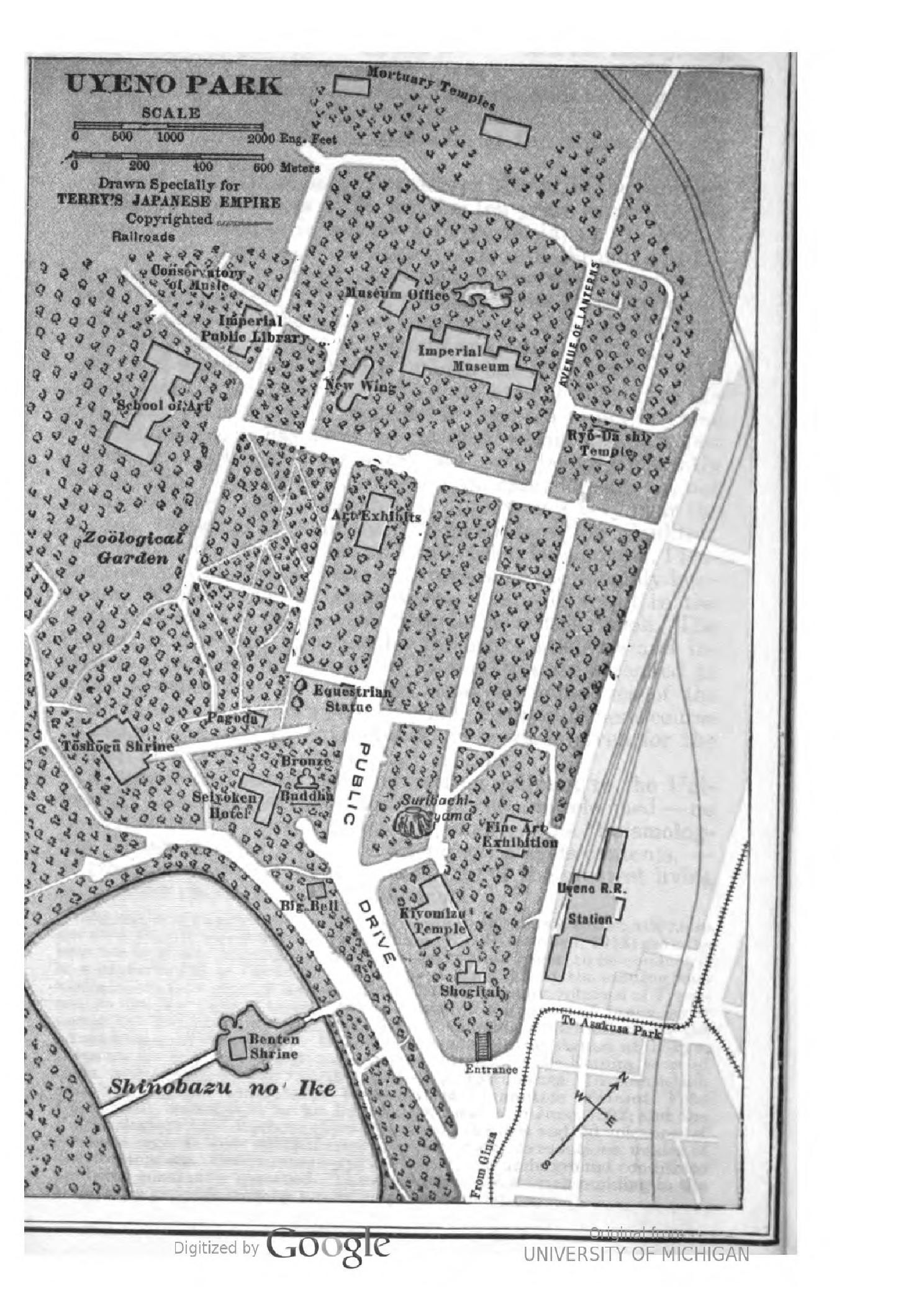
Map: Uyeno Park
地図:上野公園
このページの翻訳・編集注
194–196ページと197ページの間に挿入された無番号の地図です。
Uyeno Park.
上野公園。
A short walk W. of the University brings one to Prof. Kano's Jujutsu School (p. clxiv and PI. H, 3-4). The district to the W. contains a number of schools and colleges. The Waseda University (in Oshigome-ku, PL F, 2) was founded in 1902 (by Count Ofcuma) on the site of the Tokyo Academy established by him in 1882. It is an important and fully equipped private institution, with a fine library (152,000 vols.), 178 instructors, 5400 students, and an internationally celebrated baseball team.
大学の西へ少し歩くと、嘉納教授の柔術学校(164ページおよび図H・3-4)に至る。西側の地区には学校や大学がいくつもある。早稲田大学(牛込区、図F・2)は、1882年に大隈伯が設立した東京専門学校の跡地に、1902年に同伯によって創設された。優れた図書館(15万2,000冊)、178人の教員、5,400人の学生、国際的に知られた野球チームを備える、重要で設備の整った私立機関である。
Dangozaka (PI. 1, 3), a sometime popular resort (now falling into a decline) a short way N. of the Imperial University, is known for its annual Chrysanthemum Show (held in autumn), where growing and cut flowers are fashioned into samurai dancers, mythological characters, animals, junks, etc., or made to represent historical scenes. A small entrance fee is exacted at some of the. places. Curio-shops and story-tellers enliven the pretty neighborhood — to reach which, take the tram-car to the corner of Makicho and Hakusan, and walk 10 min. to the right. Or descend from the Belt-line Rly. at Nippori Station, climb the hill, and continue along the pretty lane (20 min.) called Yanaka Sansakimachi.
団子坂(図I・3)は、帝国大学の北少しの場所にあり、かつて人気の行楽地であったが、現在は衰えつつある。秋に開かれる毎年の菊人形で知られ、鉢植えや切り花が、侍、踊り手、神話上の人物、動物、和船などの形に仕立てられ、また歴史場面を表すこともある。一部の場所では少額の入場料を取る。骨董店や講談師が美しい界隈を賑わせる。行くには、牧町と白山の角まで市電に乗り、右へ10分歩く。または環状線の日暮里駅で下り、丘を登り、谷中三崎町と呼ばれる美しい小道を20分ほど進む。
Uyeno Park and Environs.
上野公園とその周辺。
*Uyeno (or Ueno) Park (PI. I, 4), the largest and handsomest of the Metropolitan Parks, at the N. edge of the capital, in Shitaya Ward, celebrated for the Imperial Museum (comp, the accompanying Park Plan), the Zoological Gardens, the beautiful Mausolea of the shoguns, the Time Bell, Bronze Daibutsu, and many minor attractions, is one of the brightest, cleanest, and highest points in the city, and from its eminences comprehensive views of the environing region are obtainable. A wealth of fine old trees flank the shaded avenues, many of which lead to dainty shrines and sequestered retreats. Vast throngs congregate nere in April to view the splendid cherry blossoms which overshadow the public drive; in Aug. to enjoy the wealth of lotus blooms on Shinobazu Pond; and at all times of the year to partake of the joyousness which pervades the place. The site belonged originally to the daimyo family of Todo (of Iga Province), and the name Uyeno is derived from the circumstance that its general situation is said to resemble the town of the same name in the above province. In the early days the place was considered unlucky and the common people called it Ki-mon, or Devil's Gate. As a sort of antidote, the shogun, Iemitsu, caused to be erected here (in 1625) a group of great temples, the chief one of which he called Kanei-ji (from the name of the era during which it was built). To the whole he gave the name To-ei-zan ('Hiei-zan of the East') to distinguish them from the Hiei-zan fanes near Kyoto.
上野公園(図I・4)は、首都北端、下谷区にある東京市公園の中で最大かつ最も美しい公園である。帝室博物館(付属の公園図参照)、動物園、美しい将軍霊廟、時の鐘、青銅大仏、その他多くの小名所で知られる。市内で最も明るく清潔で高い場所の一つであり、高台から周囲一帯の広い眺めが得られる。木陰の並木道の両側には立派な老木が豊かに立ち、その多くは優美な社や静かな隠れ場へ続く。4月には公道を覆う見事な桜を見るため、8月には不忍池の豊かな蓮を楽しむため、そして一年を通じてこの場所に満ちる陽気さを味わうため、大群衆が集まる。土地はもともと伊賀国の藤堂家のものだった。上野の名は、その全体の地勢が同国の同名の町に似ているとされたことに由来する。初期には不吉な場所と考えられ、庶民は鬼門、すなわち悪鬼の門と呼んだ。その対抗策として、将軍家光は1625年、ここに大寺院群を建てさせ、その主寺を建立時の年号にちなみ寛永寺と名づけた。全体には、京都近くの比叡山の堂宇と区別するため、東叡山、すなわち「東の比叡山」の名を与えた。
Memorial Arches to commemorate certain objects or occasions, and structures that house temporary displays of paint-
特定の物や出来事を記念する記念アーチ、そして一時的な絵の具展示を収める構造物
このページの翻訳・編集注
原本画像とOCRデータを照合して英文を校正し、固有名詞・数値・単位を確認したうえで日本語訳を校閲しました。歴史的な表現は原著の記録性を尊重して残しています。
Uyeno Park.
上野公園。
ings, industrial exhibits and whatnot, dot the park, but because of their fugitive character they are not described in the guide-book.
建物・工業の出品物などが公園に点在するが、それらは一時的なものなので、案内書では記さない。
Information relating to them can always be obtained from the manager of the Imperial Hotel or from any official of the Japan Tourist Bureau (offices in the Central Railway Station; also in the Imperial Hotel).
彼らに関する情報は常にインペリアルホテルのマネージャーやジャパン・ツーリスト・ビューローの役人(中央鉄道駅のオフィス、同じくインペリアルホテル内)から入手可能である。
The Subway ( chika tetsudo) Station of the underground railway between Uyeno and Asakusa Park is about 2 min. walk at the right of the park entrance, a little beyond the entrance to the Uyeno Rly. Station. The trains are popular with the proletariat. The subway was opened to traffic Jan. 1, 1928. The line is being extended.
上野と浅草公園を結ぶ地下鉄道(地下鉄道)の駅は、公園の入口の右、上野駅の入口を少し越えた所の、徒歩約2分にある。電車は庶民に人気がある。地下鉄は1928年1月1日に開通した。路線は延伸されつつある。
Good views over a certain section of the metropolis can be had from the right side of the park grounds.
公園の敷地の右側からは、都市の一部を見渡す良い眺めが楽しめる。
At the S. entrance to the park, where the tram-cars from Ginza turn to the right, pass the Uyeno Rly. Station and proceed along the broad Kurumazakamachi to Asakusa, there are 43 stone steps which lead to the upper level; strangers should read the regulations (in English) on the sign-board at the right.
公園南入口、銀座から来る路面電車が右折して上野駅を過ぎ、広い車坂町を浅草へ向かう場所に、上段へ通じる43段の石段がある。旅行者は右手の掲示板にある英語の注意書きを読むとよい。
The bronze statue at the right, of a bulky, material-looking man leading a small dog, stands to the memory of Saigo Takamori (1827-77), a prominent figure in the war for the Restoration.
右手の、小犬を連れたがっしりした現実的な姿の人物の銅像は、維新戦争の中心人物、西郷隆盛(1827~77)を記念する。
Takamori occupied a high position in the army of his daimyo, and in 1874 he was made marshal. Later, when the question of an intervention in Korean affairs was mentioned, it was found that Takamori's views were opposed to those of the Gov't. Retiring to Kagoshima (Rte. 41), he established a school to which many of the youth of Osumi and Satsuma flocked. The restored Gov't foresaw the rise of his power and made strenuous but vain efforts to bring him back to Tokyo. The insurrectionary movement (known as the Satsuma Rebellion) finally broke out in 1877, and on Feb. 15, Takamori, at the head of 15,000 men, took possession of Kagoshima. Marching N. he met the Kumamoto army, defeated it, and laid siege to that city—which was defended with great vigor by Colonel Tani. Thereupon the Gov't declared Takamori to have forfeited his princely rank and titles, and it sent Arisugawa Taruhito with a considerable body of men against him. The rebels had to withdraw before superior numbers, but making a supreme effort, Takamori succeeded in entering Kagoshima. There, surrounded on all sides, the insurgents prepared to sell their lives dearly. The last battle took place on Shiroyama, Sept. 24. Saigo was wounded by a ball, and one of his faithful retainers, Beppu Shinsuke, put an end to his life. The statue was erected to his honor in 1899. He was fond of hunting, and the dog at his right was his favorite and constant companion.
隆盛は藩主の軍で高い地位にあり、1874年には元帥となった。後に朝鮮への介入問題で政府と意見が対立した。鹿児島(Route 41)へ退き、大隅・薩摩の青年が多数集まる学校を設立した。維新政府はその勢力拡大を予見し、東京へ呼び戻そうと努めたが果たせなかった。1877年、ついに西南戦争が起こり、2月15日、隆盛は1万5千人を率いて鹿児島を占拠した。北上して熊本軍を破り、谷大佐が固守する熊本城を包囲した。政府は隆盛の位階と爵位を剥奪し、有栖川宮熾仁親王に大軍を率いさせて討伐した。反乱軍は優勢な官軍の前に退いたが、隆盛は最後の力を尽くして鹿児島へ入った。四方を囲まれた反乱軍は決死の覚悟を固め、9月24日、城山で最後の戦闘となった。西郷は銃弾に倒れ、忠実な家臣の別府晋介がその最期を介錯した。像は1899年建立。隆盛は狩猟を好み、右の犬は常に連れた愛犬であった。
The line of houses near the edge of the bluff at the right are popular native restaurants and tea-houses. Behind the small house near the monument is an elevated tomb called Shogiiai, above the remains of the soldiers who died defending the shogun's castle at the time of the Restoration. Hard by (left) is the Kiyomizu Temple (a copy of the famous one at Kyoto, described in Rte. 27). At the rear, surrounded by a low bamboo fence, is a much revered cherry tree called, the Shinskiki -
右の崖の端近くの家々の列は、人気のネイティブレストランやティーハウスである。記念碑近くの小さな家の背後には、復古期に城将軍を守って亡くなった兵士たちの遺骨の上にはショギアイと呼ばれる高台の墓がある。左側には清水寺がある(京都の有名な清水寺のコピーで、ルート27に記載されている)。裏手には低い竹の柵に囲まれた、崇敬される桜の木、シンスキーキ――
このページの翻訳・編集注
原本画像とOCRデータを照合して英文を校正し、固有名詞・数値・単位を確認したうえで日本語訳を校閲しました。歴史的な表現は原著の記録性を尊重して残しています。
Time Bell.
タイムベル。
Sakura, and near it, a well, both known to the people for a verse (written by Shinshiki, a celebrated poetess) to the effect that 'It is dangerous to have a well near a beautiful cherry tree, for while looking at one, a person may fall into the other! ' The temple is a cherished relic of feudal days — one of the lone survivors of the group erected by Iemitsu; the view from the front platform is attractive. The large picture at the right of the entrance (a portrait of a well-known teacher of the sword-dance) was given to the temple (by his pupils) to celebrate the 20th anniversary of the Japanese Constitution. Above the entrance within, hanging in a bad light, is a spirited picture of the battle referred to above. The chief divinity at the shrine is the Thousand-handed Kwannon, said to be more than a thousand yrs. old. The scores of dolls in the individual glass-fronted boxes at the left were presented by the mothers of children whose ailments were cured by the intervention of the benevolent goddess. The fine grove of cherry trees near the temple presents a beautiful sight in April, and gives the name Sakura-ga-oka (cherry plateau) to the section. The hill beyond the intersecting roadway is called Suribachi-yama because of the similarity in shape to a suribachi — an earthenware vessel in which bean-soup is prepared.
佐原と、その近くの井戸——いずれも、名高い女流歌人・真式の詠んだ歌、すなわち「美しい桜の木の近くに井戸があるのは危うい。一方を見ているうちに、人はもう一方に落ちかねぬからである」という趣の歌で、人々に知られる。この寺は封建の世の大切な遺物で、家光が建てた一群のうち数少ない生き残りの一つである。正面の床からの眺めは魅力的である。入口の右の大きな絵(名高い剣舞の師の肖像)は、日本の憲法発布20年を祝って、その弟子たちから寺に贈られた。内の入口の上に、悪い光のもとに掛かるのが、上に触れた戦いの生き生きとした絵である。社の主たる尊像は千手観音で、千年以上の古さといわれる。左手の、それぞれガラスをはめた箱に収めた数多くの人形は、慈悲深い女神の加護で病の癒えた子供の母たちが奉じたものである。寺の近くの見事な桜の林は4月に美しい眺めを見せ、この一帯に桜ヶ岡の名を与える。交わる道の向こうの丘は、その形が、豆の汁をすり合わせる土の鉢・すり鉢に似ていることから、すり鉢山と呼ばれる。
By bearing round to the right of this the traveler comes to the Fine Art building, where at certain seasons (usually spring and fall) art-exhibits of various kinds (admission, 10 sen) are displayed (and sold). From the open space beyond a superb view may be had of that section of the city lying to the E. of the Sumidagawa. The temple in the walled-in garden at the * left calls for no special mention.
この建物の右手へ回ると美術館に出る。ここでは特定の季節、通常は春と秋に、さまざまな美術展(入場料10銭)が開かれ、展示品は販売もされる。その先の開けた場所からは、隅田川の東に位置する市街の一部を見事に眺めることができる。左手の塀で囲まれた庭の中の寺は、とくに述べるほどのものではない。
By turning to the left beyond the iron bridge we come to the Ryo-Daishi Temple (Buddhist), dedicated to Jigen-Daishi and to the celebrated bonze (of the Tendai sect; b. 912; d. 985) Jie-Daishi, a great court favorite and sometime head of the Hiei-zan temples. His portrait is ascribed to Kano Tanyu. The swinging gongs which mark the entrance to the fane; the strikingly handsome roof; the superb laver, and the several bronze lanterns in the yard are worth noting. The double doors (with the Imperial chrysanthemum crest) at the side of the yard give access to the tomb of a prince (a one-time abbot of the Uyeno temples) who for some, time was retained here as a political hostage. The large building at the right of the front gate is a storeroom. The two housed images enveloped in baby's clothes are of the benevolent Jizo.
鉄橋を越えて左へ曲がると、両大師堂(仏寺)に至る。ここは慈眼大師と、天台宗の名僧慈恵大師(912年生、985年没)を祀る。慈恵大師は宮廷で大いに寵愛され、比叡山諸寺の長を務めたこともある。肖像は狩野探幽の作とされる。堂の入口を示す吊り鐘、ひときわ美しい屋根、見事な手水鉢、庭のいくつかの青銅燈籠に注目したい。庭の脇にある菊花紋付きの両開き扉は、かつて上野寺院の住職で、しばらく政治的人質としてここに留め置かれた皇族の墓へ通じている。正門右手の大きな建物は倉庫である。赤子の衣に包まれた二体の像は、慈悲深い地蔵である。
The Time Bell, a huge bronze instrument near the entrance to the Seiyoken Restaurant, is a sort of chronometer for many thousands of persons who live in the region roundabout and who usually synchronize their watches with its booming notes. Anciently it belonged to the temple (long since destroyed) to which the nearby origin.,*TM
精養軒レストランの入口近くにある巨大な青銅器、時の鐘は、周辺地域に住む何千もの人々にとって一種の時計であり、彼らは通常、その轟く音に自分の時計を合わせる。古くは近くにあった寺、すでに久しく破壊された寺に属していた。
このページの翻訳・編集注
原本画像とOCRデータを照合して英文を校正し、固有名詞・数値・単位を確認したうえで日本語訳を校閲しました。歴史的な表現は原著の記録性を尊重して残しています。
Shinobazu Lake.
篠波津湖。
Bronze Daibutsu, or Buddha, was an adjunct. The latter is 21 ft. high, was cast in 1695, and is in every way inferior to the great Daibutsu of Kamakura.
青銅の大仏が付属していた。後者は高さ21フィート、1695年に鋳造され、あらゆる点で鎌倉の偉大な大仏に劣る。
The Equestrian Statue of Prince Komatsu (a relative of the Emperor, and a descendant of the Fujiwara)f which stands near the big torii, on a handsome brown speckled granite base 16 ft. sq. (from Rokkozan); is 15 ft. 9 in. high; was designed by Shin-ichiro Okada; cast at the Koishikawa Arsenal; cost ¥100,000, and was unveiled March 18, 1912. — The Magnolia grandiflora in the fenced inclosure at the rear (right), called the Grant Giokuran, or Kinenju ('Keepsake Tree'), was planted Aug. 25, 1879, by Mrs. U. S. Grant. The one at the left, a Cupressus Lawsoniana, was planted by General Grant the same day.
大鳥居の近くに立つ小松宮の騎馬像は、天皇の親族で藤原氏の子孫である小松宮を表す。六甲山産の美しい褐色斑入り花崗岩の台座(一辺16フィート)に載り、高さは15フィート9インチ。岡田信一郎の設計で、小石川砲兵工廠で鋳造され、費用は10万円、1912年3月18日に除幕された。背後右手の柵内にあるMagnolia grandifloraは、グラント玉蘭または記念樹と呼ばれ、1879年8月25日にU. S. Grant夫人が植えたもの。左手のCupressus Lawsonianaは、同じ日にGrant将軍が植えたものである。
The Toshogu, a Shinto shrine dedicated to Tokugawa Ieyasu stands at the end of the shaded walk (fine cryptomeria trees) leading from the torii near the main drive; is a miniature of the Toshogu at Nikko, and was erected between 1624 and 1643. The tall stone lanterns were gifts of daimyos. The gateway was restored in 1890. The interior and exterior of the shrine display a maze of polychromatic carvings and diaper-work inferior to that of the mausolea described hereinafter. The coffered ceiling is latticed. The line of framed pictures around the oratory are of ancient court poets. The wood masks with gilded teeth are used on festival days. The tablet above the entrance to the inner sanctum carries Ieyasu's posthumous name, Tosho-gu, copied from an original written by the Emperor Go-Mizunoo (17th cent.). The square building between the shrine and the dilapidated old pagoda is the 'heavenly music hall.,
徳川家康を祀る神社、東照宮は、主園路近くの鳥居から続く木陰の道(見事な杉並木)の突き当たりに立つ。日光東照宮の縮小版で、1624年から1643年の間に建てられた。背の高い石灯籠は大名たちの寄進である。門は1890年に修復された。社殿の内外には、多彩な彫刻と地文装飾が迷路のように施されるが、後に述べる霊廟のものには及ばない。格天井は格子状である。拝所の周囲に並ぶ額絵は古代の宮廷歌人を描く。金歯を付けた木製の面は祭礼の日に用いられる。内陣入口上の額には、家康の諡号「東照宮」が掲げられ、後水尾天皇(17世紀)の宸筆原本から写したものである。社殿と荒れた古い塔の間にある四角い建物は、神楽殿である。
The Lake (Shinobazu-no-ike) or Pond, a shallow sheet of water at the left of the main entrance to the park, contains an island with a pretty shrine dedicated to the Goddess Benten, and a handsome granite bridge referred to by sentimental folks as the 'moon-gazing bridge/ In Aug. the water is almost
公園の正面入口左側にある浅い湖(しのばざの池)には、女神弁天に捧げられた美しい神社がある島と、感傷的な人々から「月見の橋」と呼ばれている美しい花崗岩の橋がある。8月には水はほとんど
hidden by splendid lotus blooms, and on a moonlit night the scene is singularly lovely. Hundreds of wild fowl frequent the spot in winter and are a delight to the children who come hither to feed the big carp and goldfish with which the water is alive. The view of the shrine from the hill behind the Seiyoken Restaurant is very attractive, particularly when the reddening maples flame in contrast with the greensward. The tall
美しい蓮の花に隠れ、月明かりの夜にその光景は特に美しい。冬には何百羽もの野生の鳥がこの地を訪れ、水に生きている大きな鯉や金魚に餌をやってくる子どもたちにとって喜びの場となっている。青陽軒レストランの背後の丘から神社の眺めはとても魅力的で、特に赤く染まったカエデの炎が緑の草原と対照的に輝く様子が際立っている。背の高い
bronze lute (biwa) in the temple atrium is symbolic of the celestial harmonies produced by the goddess. The brilliant fitments of the building date from 1911, when it was renovated. The bridge is reached by passing beneath the arch at the right. The group of buildings visible on the hill beyond forms a part of the Imperial University. The pond is a relic of the time when a large section of modern Tokyo was covered by the waters of Yedo Bay, and Uyeno was a knoll washed by the waves.
寺の前庭にある青銅の琵琶は、女神が奏でる天上の調和を象徴している。建物の華やかな調度は、改修された1911年にさかのぼる。橋へは右手のアーチの下を通って行く。向こうの丘に見える建物群は帝国大学の一部である。この池は、現在の東京の大部分が江戸湾の水に覆われ、上野が波に洗われる小高い丘であった時代の遺物である。
このページの翻訳・編集注
原本画像とOCRデータを照合して英文を校正し、固有名詞・数値・単位を確認したうえで日本語訳を校閲しました。歴史的な表現は原著の記録性を尊重して残しています。
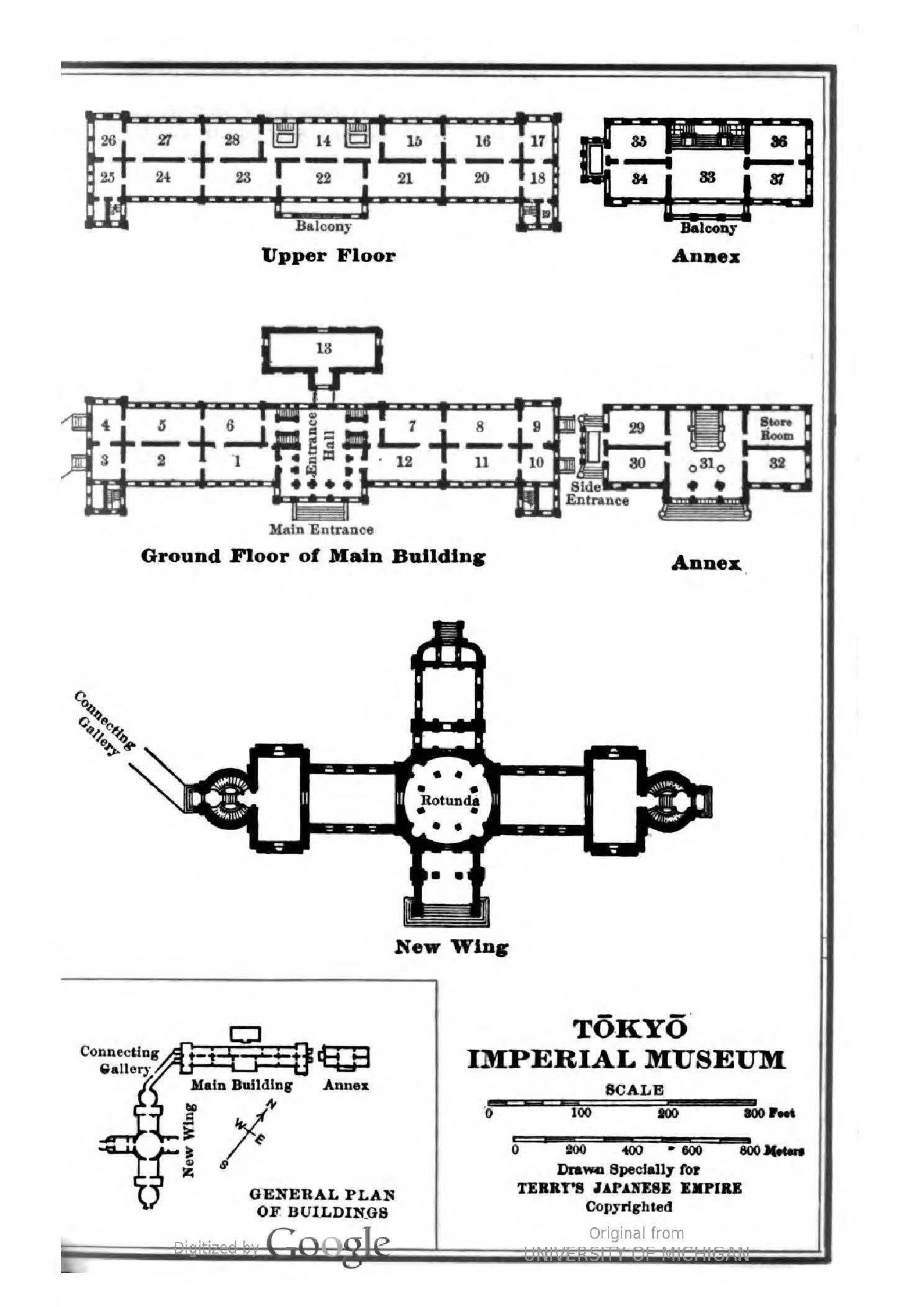
Plan: Tokyo Imperial Museum
平面図:東京帝室博物館
このページの翻訳・編集注
200ページと201ページの間に挿入された無番号の平面図です。
Imperial Library.
帝国図書館。
The * Imperial Library (Tosho-kwan), at the west side of the park, near the Imperial Museum (see the accompanying plan), was established in 1885 and stands at the head of the hundreds of public libraries, with their thousands of books, throughout the Empire. It is a priceless boon to the host of struggling and impecunious students who draw knowledge from its (approximately 600,000) volumes (in Japanese, English, Russian, Chinese, German, French, and Italian). More than a million persons visit it each year, several thousands of whom are foreigners. There are catalogues, a comprehensive card-system, special reading-rooms (some for # ladies exclusively), many newspapers on file, and practically all the fitments of the most modern library. A copy of every book printed in Japan must be sent to the library, which in a way is similar to the Congressional Library at Washington. There is a small annual membership fee for those who can pay it, and properly accredited persons can take books home to read.
公園の西側、帝国博物館の近くにある*帝国図書館(東章館)は1885年に設立され、帝国全土に広がる数百の公共図書館の中心に位置し、数千冊の蔵書を所蔵している。約60万冊の蔵書(日本語、英語、ロシア語、中国語、ドイツ語、フランス語、イタリア語)から知識を引き出す、苦労し困窮する多くの学生にとってかけがえのない恩恵である。毎年100万人以上が訪れ、そのうち数千人が外国人である。カタログ、充実したカードシステム、特別な閲覧室(中には#女性専用のものもある)、多くの新聞がファイルされており、最新の図書館のほぼすべての備品が揃っている。日本で印刷されたすべての書籍のコピーは図書館に送られなければならず、これはある意味でワシントンの議会図書館に似ている。支払える人には少額の年会費がかかり、正式に認定された人は本を持ち帰って読むことができる。
The original building was so badly damaged by the earthquake of 1923 that a new and better one was deemed advisable. It is a stately gray structure built on classical lines, and is as attractive to the eye as the institution is serviceable to the people. Near by is the new and handsome Fine Arts Hall (bijitsu-kwan), where from time to time temporary exhibitions of fine arts can be seen.
元の建物は1923年の地震でひどく損傷したため、新しく、よりよい建物を造るのが望ましいと判断された。古典的な線に沿って建てられた堂々たる灰色の建物で、施設が人々に役立つのと同じように、目にも魅力的である。近くには新しく美しい美術館(bijitsu-kwan)があり、時折、美術の臨時展覧会を見ることができる。
The * Zoological Garden ( dobutsu-en ) contains an assemblage of animals ranging from polar bears to wallabies. The uneven character of the hillsides Qver which the enclosure extends permits of numerous attractive terraces, lakelets, miniature landscape gardens and whatnot. The grounds are clean and inviting. The fauna and avifauna of the Japanese possessions are well represented. Open all day. Small entrance fee.
動物園(dobutsu-en)には、ホッキョクグマからワラビーまで多様な動物が集められている。囲いが広がる丘の斜面が起伏に富むため、魅力的なテラス、小池、小さな庭園などを多く設けることができている。園内は清潔で入りやすい。日本の領土に属する地域の動物相と鳥類相もよく展示されている。終日開園。入場料は少額である。
The * Tokyo Imperial Museum ( teikoku or Uyeno hakubutsukwari), a government institution standing back in a wide, attractive, 26-acre park with a pond, a fountain and many flowering trees, is near the center of Uyeno Park (see the plan) and is by far the most important museum of the Empire.
*東京帝国博物館(帝国または上野はぼぶつり)は、広大で魅力的な26エーカーの公園に位置し、池や噴水、多くの花の咲く樹木がある政府機関で、上野公園の中心近くに位置し(平面図参照)、帝国で最も重要な博物館である。
It is open daily (small admission fee) from 8-9 a.m. to 4-6 p.m. (except on the days following national holidays) and should be visited by everyone interested in the different Japanese epochs and the superb fine arts that characterized them.
毎日開館しており(入場料は少額)、午前8時から9時から午後4時から6時まで(国民の祝日の翌日を除く)、日本のさまざまな時代やその時代を特徴づけた素晴らしい美術に興味のある方ならぜひ訪れるべきである。
The imposing old gateway (full of shot holes) is the sole surviving relic of the original dwelling of the sometime splendid Kwanei-ji Temple (which is said to have been finer and more imposing than any of the present structures at Nikko).
弾痕に満ちたこの堂々たる古い門は、かつて壮麗であった寛永寺の旧境内に残る唯一の遺物である。寛永寺は、現在の日光のどの建物よりも立派で威厳があったといわれる。
In 1883 a semi-classical red brick and granite structure Alhambraic in appearance, with twin miradores on the roof and considerable polyfoil tracery about the Moorish windows, was erected to house the magnificent collection gathered in the manner described hereinbelow. In 1910 a new, stately, left
1883年、アルハンブラ風の外観の、屋根に双子の望楼をもち、ムーア風の窓の周りにかなりの多弁の透かしを施した、半ば古典風の赤煉瓦と花崗岩の建物が、後述のやり方で集めた壮麗な蒐集を収めるために建てられた。1910年には、新しい堂々たる、左の
このページの翻訳・編集注
原本画像とOCRデータを照合して英文を校正し、固有名詞・数値・単位を確認したうえで日本語訳を校閲しました。歴史的な表現は原著の記録性を尊重して残しています。
Imperial Museum.
帝国博物館。
wing (hyokei-kwan\ an Ionicized, triple-domed edifice of gray granite, charming in its classical simplicity, was built to accommodate the valuable additions acquired from time to time. Two handsome bronze lions, some bronze Greek vases, and other adornments were added, and the whole given by the Tokyo Municipality in congratulatory commemoration of the wedding (in 1900) of the Crown Prince ( Yoshihito ) who became Emperor in 1912 (and died in 1926).
翼(表慶館)——灰色花崗岩のイオニア式の三つの円蓋をもつ、古典の簡素さの魅力ある建物——が、折々に得た貴重な追加の品を収めるために建てられた。見事な青銅の獅子二頭、青銅のギリシア風の壺いくつか、その他の飾りが加えられ、全体は、1912年に天皇となり(1926年に没した)皇太子・嘉仁の婚礼(1900年)を祝って、東京市から贈られた。
The earthquake of 1923 ruined all the buildings except the left wing, and they are now being reconstructed. The exhibits, which were saved, will be replaced as soon as the rooms are ready for them. Hence the following description, which in a general sense again will apply when the buildings are restored, has been allowed to stand. It will be changed in the necessary minor details when the exhibits are again all in place.
1923年の地震は左翼を除くすべての建物を破壊し、現在それらは再建中である。救い出された展示品は、部屋の準備が整いしだい戻される。したがって、建物が復旧すれば大筋では再び当てはまる次の記述は、そのまま残してある。展示品が再びすべて所定の位置に戻った時、必要な細部だけが変更されることになる。
The nucleus of the splendid and sustainedly interesting collection (to which additions are constantly being made) was established in the later days of the shogunate, from whose hands it passed into those of the present Gov't. Since 1886 it has been under the control of the Household Department; its excellent organization is due to the indefatigable energy and foresight of Baron Kuki, Director of the Fine Arts at the close of the last century. There are upward of 170,000 articles (2000 of which are the personal property of the Emperor, and 4000 of which were contributed by various public-spirited citizens) classified under the heads of Departments of Industrial Art; Fine Arts; Natural Products; and History. Though practically free from forgeries the collection contains many copies of objects (particularly in sculptured wood) exhibited in other museums through the country, but these are usually so marked. Following the Japanese custom of retiring certain articles from view at stated times, and either storing them for a brief period or loaning them to other museums in the Empire, but few of the exhibits can be called permanent; those in the Department of Industrial Arts are admittedly temporary and are changed sometimes as often as twice a month. In cases where articles mentioned in this Guidebook have been temporarily withdrawn, if stored in the museum godown they can be seen on presentation of a letter from some one in authority, or on payment of a small fee if application be made at the museum office. Nearly 300,000 persons visit the museum each year, of which about 35,000 are school teachers and their pupils — who are all admitted free. A magnificent collection of gold coins was stolen from the rooms in 1911 and was not recovered. With characteristic and praiseworthy foresight, the patriotic men of the Gov't are sedulously adding to the assemblage of the now almost priceless relics of the early history of the race, and the museum now easily ranks (in a smaller way) with that of South Kensington, the Metropolitan Museum at New York,
壮麗で、見飽きることのない収蔵品の核は幕末に作られ、幕府の手から現政府へ移った。1886年以降は宮内省の管理下にある。その優れた組織は、19世紀末に美術行政を担った九鬼男爵の不屈の精力と先見による。収蔵品は17万点を超え、そのうち2,000点は天皇の私有品、4,000点は公共心ある市民からの寄贈品で、工芸、美術、天然産物、歴史の各部門に分類されている。贋作はほとんどないが、国内の他の博物館に展示されている品の複製、とくに木彫の複製も多く含まれ、通常はその旨が表示されている。一定の時期に特定の品を展示から下げ、短期間保管したり帝国内の他の博物館へ貸し出したりする日本の慣習に従っているため、常設と呼べる展示品は少ない。工芸部門の展示は明らかに臨時のもので、月に二度も入れ替わることがある。本案内書で触れた品が一時的に撤去されている場合でも、博物館の倉庫に保管されていれば、権限ある人物の紹介状を示すか、博物館事務所で申請して少額の料金を払えば見ることができる。博物館には毎年約30万人が訪れ、そのうち約3万5千人は学校教師と生徒で、いずれも無料で入場する。1911年には見事な金貨コレクションが室内から盗まれ、回収されなかった。政府の愛国的な人々は、特徴的で称賛すべき先見をもって、民族の初期史に関わる今ではほとんど値を付けがたい遺物を熱心に増やしており、この博物館は今や規模こそ小さいながら、サウス・ケンジントン博物館やニューヨークのメトロポリタン美術館に容易に肩を並べる。
このページの翻訳・編集注
原本画像とOCRデータを照合して英文を校正し、固有名詞・数値・単位を確認したうえで日本語訳を校閲しました。歴史的な表現は原著の記録性を尊重して残しています。
Imperial Museum.
帝国博物館。
and the Boston Museum of Fine Arts. The decree by which monasteries and temples throughout the Empire are compelled to make temporary deposits of their portable treasures in the museums of Tokyo, Kyoto, and Nara, is of great benefit to the public, particularly to those strangers who might be unable to visit certain of the most distant Buddhist repositories. Other excellent features are the special exhibits sometimes arranged to commemorate the birth of the death of a master whose work is shown, or to correspond to certain eras or a zodiacal symbol appropriated to each new year. Thus the year of the boar, the crane (a favorite symbol), or the pine, may be inaugurated by an exhibition of works of art in which these signs figure.
ボストン美術館の所蔵である。帝国内の寺院や寺院が、東京、京都、奈良の博物館に携帯宝物を一時的に預けることを義務付けるこの布告は、特に最も遠方の仏教の蔵書を訪れられないかもしれない見知らぬ人々にとって非常に有益である。その他の優れた特徴としては、展示される巨匠の生誕や死を記念する特別展示や、新年に割り当てられた特定の時代や星座のシンボルに対応する特別展示がある。このように、イノシシ年、鶴(お気に入りのシンボル)、松の年は、これらの象徴が登場する美術作品の展示によって幕を開けることができる。
The highly interesting collection of prehistoric objects is perhaps unique in that it is derived mainly from authentic finds made within the confines of the Empire. The series of archaic pre-Buddhist potteries found in the soil or in tombs is of great archaeological importance. Finds of this nature are made from time to time somewhere on the islands, and are not unfrequently presented to the museum — which also accepts deposits and temporary loans from private collectors. The fugitive character of the exhibits renders it impracticable to describe the contents of the museum in detail and be certain not to confuse or mislead the reader. The men in charge are making efforts properly to classify and label the more or less permanent objects, and to add bi-lingual annotations that will help the stranger to a proper understanding of them.
この非常に興味深い先史時代の遺物コレクションは、主に帝国内で発見された本物から派生している点で唯一無二のものかもしれない。土中や墓から発見された一連の古代仏教以前の陶器は考古学的に非常に重要である。このような発見物は島々のどこかで時折発見され、博物館に贈られることも珍しくない。博物館は個人コレクターからの寄託や一時的な貸出も受け付けている。展示品の曖昧な性質ゆえに、博物館の内容を詳細に説明し、読者を混乱させたり誤解させたりしないよう確実にすることは不可能である。責任者たちは、ほぼ恒久的な物体を適切に分類・ラベル付けし、見知らぬ人がそれらを正しく理解できるようにバイリンガル注釈を加える努力をしている。
The collections of porcelains and pictures are incomplete, and are inferior to those of certain private collectors; neither are representative of the evolution and development of these great arts in Japan, and in neither are there many rare or precious examples. In these, as well as in its collection of sculptures, the Tokyo Museum is inferior to those of Kyoto and Nara. The paucity of the widely famous color-prints (p. 231), now so much admired abroad, is due in a measure to foreign appreciation of their rare worth. While the Japanese were regarding the best work of the inimitable Hokusai, Hiroshige, and other native artists as mere playthings for children, and unworthy to be ranked with the national arts of Europe and the West, connoisseurs of those countries were showing their conception of their value by diligently collecting them. When the Japanese awoke to this fact many of the finest specimens had been expatriated beyond recall.
磁器と絵画のコレクションは不完全で、一部の個人収集家のものに劣る。いずれも日本におけるこれら偉大な芸術の進化と発展を代表しておらず、稀少または貴重な作例も多くない。これらの点、また彫刻コレクションにおいても、東京博物館は京都や奈良の博物館に劣っている。現在海外で非常に高く評価されている有名な色刷り版画(231ページ)の少なさは、ある程度、外国人がその稀少価値を認めたことに起因する。日本人が北斎、広重、その他の日本人画家の比類ない優作を子どもの玩具のように見なし、欧米の国民芸術と並べる価値がないと考えていた間に、欧米の鑑賞家は熱心に収集することでその価値を示していた。日本人がこの事実に気づいた時、多くの最良品はすでに国外へ流出し、取り戻せなくなっていた。
The Entrance Hall has for its largest object an equestrian statue in plaster (copy of the one in bronze, in the yard of the Staff Office) of the late Prince Arisugawa. The huge and fantastically decorated drum backed by a sort of tall gilded mandorla covered with Buddhist symbols, which usually stands just within th<jgfeat the left, wa spe-
玄関ホールで最も大きな展示物は、故有栖川宮の石膏騎馬像である。参謀本部の庭にある青銅像の複製である。通常、入口を入って左手に立つ、仏教の象徴で覆われた背の高い金色の光背を伴う巨大で奇抜な装飾太鼓も目を引く。
このページの翻訳・編集注
原本画像とOCRデータを照合して英文を校正し、固有名詞・数値・単位を確認したうえで日本語訳を校閲しました。歴史的な表現は原著の記録性を尊重して残しています。
TOKYO Imperial Museum.
東京帝国博物館。
cial festival occasions and is an alleged copy of the
シアル祭りの行事であり、主張されるコピーである
Room i, with a fine and extensive collection of ancient and modern bronzes, damascene and other metal pieces, enriched here and there with some notable specimens of Chinese 10th- cent. work. The inlaid bronzes (particularly the gold-bronze with damascening) are excellent examples of a difficult craft in which the Japanese excel. The ancient metal mirrors, of which there are a number, are partly of Chinese (14th cent.) and partly Korean origin; as are also the curious old bells. The various specimens of sword-furniture are ancient and modern.
第1室には、古代および近代の青銅器、象嵌細工その他の金工作品の優れた大規模な収集があり、ところどころに10世紀中国作品の注目すべき標本も加えられている。象嵌された青銅器、とくに金銅に象嵌を施したものは、日本人が秀でた難しい工芸の優れた例である。数多くある古代金属鏡は、一部が中国(14世紀)、一部が朝鮮の由来で、興味深い古鐘も同様である。各種の刀装具には古いものも新しいものもある。
Room 2 contains many authentic sculptured wood figures so highly prized as to be considered national treasures; prominent among them is a large but daintily slender, gold-flecked, seated figure of an Indian goddess, with a disk at the back, the right leg crossed over the left knee, and the right hand lifted to the face. There is little subtlety and less charm in this vermiculated figure (which came from the Horyuji, near Nara), the chief interest of which lies in the fact that it is of 7th-cent. workmanship and that it represents, with its manifest Hindu character, one of the earliest specimens of native sculpture after the introduction of Buddhism, — perchance the first lisping of the new art in Japan. Many statuesque carved and gilded figures in a standing or seated attitude are ranged round the room, some in glass cases and all badly mauled by the hand of time. Noteworthy among them are two splendid Buddhas of fine wood covered with gold foil, crowned and bejeweled, and on intricately carved bases., Both (the property of Count Tanaka) are superb examples of the flourishing art of the Ashikaga period, and they are among the best that the traveler will see in Japan. The magnificently carved and gilded mandorlas which back them, each displaying six flying tennin sculptured in bold relief, are executed with a skill no whit inferior to the best effort of Jose Churriguera. A curious Eleven-faced Kwannon, life-size, with tarnished jewels on her sometime gilded breast, stands in the same case with one of the Buddhas, and dates from the 9th cent. The misshapen, carved, colored, and lacquered wood figure (dating from the Kamakura epoch) which stands in the case with the other Buddha, and surmounts a venomous gnome (typifying pestilence and calamity) is Zochoten, one of the Gods of the Four Directions, who attacks and repels demons. The two flat, pierced, and sculptured wood panels framed against a white ground, in one of the wall-cases, are celebrated pieces ascribed to Kobo-daishi; the other ten that complete the original twelve are in
第2室には、国宝とされるほど高く評価される本格的な木彫像が多数ある。その中でも目立つのは、大きいが繊細に細い、金色の斑を散らしたインド女神の坐像で、背後に円光を負い、右脚を左膝に掛け、右手を顔へ上げている。奈良近くの法隆寺から来たこの虫食い状の像には、繊細さも魅力も乏しいが、7世紀の作であり、明らかなヒンドゥー的性格を帯び、仏教伝来後の日本彫刻の最初期の例、おそらく日本における新しい美術の最初のたどたどしい発声を示す点に主な興味がある。立像または坐像の彫刻・鍍金像が室内に並び、一部はガラスケースに入っているが、いずれも時の手でかなり傷んでいる。注目すべきものに、上質な木に金箔を施し、冠と宝玉を付け、精巧な台座に載る二体の見事な仏像がある。いずれも田中伯爵の所有で、足利時代の栄えた美術の優品であり、旅行者が日本で見る中でも最良の部類に入る。背後の壮麗な光背は彫刻と鍍金が見事で、それぞれ大胆な浮彫の飛天六体を表し、ホセ・チュリゲラの最良作にも少しも劣らない技量で作られている。実物大の奇妙な十一面観音像は、かつて金箔を施された胸にくすんだ宝玉を付け、仏像の一体と同じケースに立ち、9世紀の作である。もう一体の仏像と同じケースに立つ、鎌倉時代の歪んだ木彫彩色漆塗像は、疫病と災厄を表す毒々しい小鬼を踏む増長天で、悪鬼を攻め退ける四天王の一つである。壁面ケースの一つに白地を背景として額装された二枚の平らな透彫木彫板は、弘法大師作と伝えられる名高い作品で、もとの十二面を構成した残り十面は
このページの翻訳・編集注
原本画像とOCRデータを照合して英文を校正し、固有名詞・数値・単位を確認したうえで日本語訳を校閲しました。歴史的な表現は原著の記録性を尊重して残しています。
Imperial Museum.
帝国博物館。
the Nara Museum. In other cases in the room are a host of wood and metal Buddhas and other saints of the Buddhist pantheon, from Siam, Burma, China, India, and Tibet. Some are hung with tarnished dingle-dangles, others are dad in gracefully flowing draperies delicately carved out of the wood, and ail are more or less interesting examples of early craftsmanship. The small 12th-cent. figures of colored and lacouered wood ascribed to Unkei are more likely copies of the originals at Nara. A strikingly handsome 16th-cent. sculptured wood figure of Shaka (Sakyti-muni) stands on a finely colored wood base in one of the cases and is well worth looking at, a s it is the finest, in point of decoration, in the room. The superb drapery is picked out in an amazingly delicate and intricate pattern of gold-lacquer, and this design runs quite round the figure, the forehead of which is adorned with a white and a pink crystal boss. The features have a strong Hebrew cast, and the flame-tipped mandorla bears Sanscrit characters. The very ancient seated wood figure of a fierce deity backed by a flaming mandorla is Fudo, and the other big one in the same case, Jizo; both are fine specimens of the Fujiwara epoch. Another statue worth noting is that of the willowy, sylph-like Arya Avalokitesvara — 8th-cent. copper work. Also a richly chased and sculptured figure of Gitama Buddha, with a face which was formerly covered with bright gold foil, but which has turned black with extreme age. The crudely carved but highly prized figurine of the Empress Jingo (the alleged invader of Korea in a.d. 200) perhaps dates from the 3d or 4th cent, of the Christian era. A fine Hindu trimurti, with a face of Vishnu at the right, Siva at the left, and Brahma in the middle, is sometimes displayed in this room.
奈良博物館にある。この室の他のケースには、シャム、ビルマ、中国、インド、チベットから来た木製・金属製の仏像や仏教諸尊が多数収められている。くすんだ飾りを下げたものもあれば、木から繊細に彫り出された優美な衣文をまとったものもあり、いずれも多少なりとも初期工芸の興味深い例である。運慶作とされる彩色漆塗木像の小さな12世紀作品は、むしろ奈良の原作の写しであろう。16世紀の木彫釈迦像は、彩色の美しい木製台座に立ち、装飾の点ではこの室で最も優れており、見る価値が高い。見事な衣文は、驚くほど繊細で複雑な金蒔絵文様で描き出され、その意匠は像の周囲をめぐる。額には白と桃色の水晶の飾りが付く。顔立ちは強くヘブライ的な趣を帯び、炎形の光背には梵字が記される。炎の光背を背負う非常に古い木造坐像の忿怒尊は不動で、同じケースのもう一つの大きな像は地蔵である。いずれも藤原時代の優れた例である。注目すべき別の像に、柳のように細く精霊めいた聖観音、8世紀の銅造がある。かつて明るい金箔で覆われていた顔が、長い年月で黒く変じた、精緻に彫刻された釈迦仏像もある。粗い彫りながら高く評価される神功皇后像(紀元200年に朝鮮へ侵攻したとされる人物)は、おそらく紀元後3世紀または4世紀のものだろう。右にヴィシュヌ、左にシヴァ、中央にブラフマーの顔を持つ優れたヒンドゥーの三神一体像が、この室に展示されることもある。
Room 3 is devoted to an interesting assortment of miscellaneous articles; the cases full of carved wood masks used anciently in the sacred dances are perhaps the most worth inspecting; those of plain, unpainted wood are early specimens of the Tempyo era (8th cent.). The finest (those usually employed in the classic No dance) are lacquered in flesh tints of various shades, and express many degrees of human emotion. Some show furious faces with veins like swollen whipcord; others grimace, look calm, agonized, comic, or angry, and not a few display the hand of a master in their construction.
第3室は興味深い雑多な品々に充てられている。古く神聖な舞で用いられた木彫面を満たすケースが、おそらく最も見る価値がある。彩色されていない素木の面は天平時代(8世紀)の初期標本である。最も優れたもの、すなわち古典的な能で用いられる面は、さまざまな肌色で漆塗りされ、人間感情の多様な段階を表している。腫れた鞭紐のような血管を浮かべた激怒の顔を示すものもあれば、しかめ面、静かな顔、苦悶、滑稽、怒りを示すものもあり、その制作に名工の手を示すものも少なくない。
Room 4 has a superb collection of modern carvings in ivory, wood, lacquer, shell, and inlaid work. The corner closet entirely covered with arabesque and intricate tracery is of Indian origin. The netsukes exemplify a handicraft in which the Japanese display noteworthy manual skill and subtlety. The assortment of musical instruments is incomplete.
第4室には、象牙、木、漆、貝、象嵌による近代彫刻の見事なコレクションがある。アラベスクと精緻な透かし文様で全面を覆われた隅の戸棚はインド由来である。根付は、日本人が注目すべき手技と繊細さを示す工芸の好例である。楽器の収集は完全ではない。
Room 5. Old and modem lacquer and inlay work — much of the latter of Chinese provenience, and resembling the finest intarsia.
第5室。古いものと近代の漆器・象嵌細工。後者の多くは中国由来で、最良の寄木細工に似ている。
このページの翻訳・編集注
原本画像とOCRデータを照合して英文を校正し、固有名詞・数値・単位を確認したうえで日本語訳を校閲しました。歴史的な表現は原著の記録性を尊重して残しています。
Conspicuous among the exhibits here, a noteworthy object, is the remarkably well-preserved chest (the property of the Mikado) covered with mother-of-pearl inlay and dating from the 7th cent. It perhaps came originally from Korea, as there is a similar specimen, indubitably of Korean craftsmanship, in the Seoul Museum (Rte, 46). For nearly a millennium it was a prized relic in the Horyuji. Despite its great age the inlaid phoenixes and medallions are intact, and are remarkable examples of a nice skill in workmanship but little inferior to that of to-day. The Q.A. Shaw collection of lacquer (now the property of the museum) embraces a number of good 18th-cent. pieces, some in the oft-copied style of Korin, with superimposed pewter insets. The excellent copies of 13th-cent. work, particularly that showing mother-of-pearl in a gold ground, in imitation of the style known as Pusenryo are interesting. The almost imperishable nature of good gold-lacquer is exemplified in the exhibit which shows portions of the lot (of fine 17th- cent. work) sent by Japan to the International Exposition at Vienna. On the return voyage the S.S. Nile (of the French Mail) that bore them was lost off the Izu coast, and the articles remained uninjured at the bottom of the sea from Feb. 29, 1874, to July 18, 1875, when they were recovered. The best lacquered objects in the room are perhaps the beautifully colored boxes (18th-cent. work by Ogawa Ritsuo ) with raised work in lacquer and porcelain, both of which show in a highly interesting way the possibilities of the medium. The writing-box (for paper) portrays the Chinese Emperor Hsuan-Tsung, and Yang Tai-chen; the companion one (for the ink-stone) depicts the lissome and fascinating Hsi-Shih looking at her reflection in a mirror. Ogata Korin has some masterful pieces here, and modern craftsmen stand before the cases and copy his intricate and alluring designs in much the same way that amateur painters copy the pictures in European galleries. The gold-lacquered box with a black eagle on the top, by Kajikawa 1 (18th cent.), is worth looking at; also the small framed oval picture (in one of the wall-cases) done in mother-of-pearl, and showing Louis XVI working at the bench as a locksmith.
ここで目立つ展示品の一つは、7世紀のものとされる、螺鈿で覆われた非常によく保存された箱である。天皇の所有品で、ソウル博物館に疑いなく朝鮮工芸と分かる類品があることから、もとは朝鮮から来たものかもしれない。ほぼ千年にわたり、法隆寺の貴重な遺物であった。きわめて古いにもかかわらず、螺鈿の鳳凰と円形装飾は無傷で、今日の技術にもほとんど劣らない精妙な細工の見事な例である。Q. A. Shaw の漆器コレクション(現在は博物館所蔵)には、18世紀の良品がいくつか含まれ、しばしば模倣された光琳風の作で、錫の象嵌を重ねたものもある。13世紀作品の優れた写し、とくに Pusenryo として知られる様式を模した、金地に螺鈿を施したものは興味深い。良質な金漆のほとんど朽ちない性質は、日本がウィーン万国博覧会へ送った17世紀の優品の一部を示す展示で例証される。帰途、それらを積んだフランス郵船の S.S. Nile 号は伊豆沖で沈没し、品々は1874年2月29日から1875年7月18日に引き揚げられるまで、海底で無傷のまま残った。この室で最も優れた漆工品は、おそらく小川律雄による18世紀の美しく彩色された箱で、漆と陶磁による盛上げ細工があり、この素材の可能性を非常に興味深く示している。料紙箱には中国皇帝玄宗と楊太真が描かれ、対になる硯箱には、しなやかで魅力的な西施が鏡に映る自分の姿を見つめる場面が描かれる。尾形光琳の卓越した作もここにあり、現代の職人がケースの前に立って、その複雑で魅惑的な意匠を模写している。ヨーロッパの美術館で素人画家が絵を模写するのとほとんど同じである。梶川作(18世紀)の、上面に黒鷲を描いた金漆の箱は見る価値がある。また壁面ケースの一つにある、螺鈿で作られた小さな額入り楕円画も注目される。ルイ16世が錠前師として作業台で働く姿を示している。
Room 6 is dedicated to (uninteresting) engravings, embroideries, tapestries, old prints, and what-not. — Crossing the rear of the entrance hall we enter
第6室は、あまり興味を引かない版画、刺繍、タペストリー、古版画その他に充てられている。入口広間の奥を横切ると、
Room 7, with a collection of mineral specimens and pictures of mines and appurtenances similar, but inferior, to the display in the Mineral Museum destroyed in 1923. The huge petrified ivory tusk covered with barnacles was evidently brought up from the bottom of the ocean; the kindred relics — tusks of mammoths, plaster casts of prehistoric animals, and the like — need not detain the traveler. Among the mineral specimens in
第7室は、鉱物の標本と、鉱山やその付属の絵の蒐集をもち、1923年に失われた鉱物博物館の展示に似るが、それに劣る。フジツボに覆われた巨大な化石の象牙の牙は、明らかに海の底から引き上げられたものである。同類の遺物——マンモスの牙、先史の動物の石膏の型など——は旅行者を引き止めるに及ばない。その中の鉱物の標本のうち、
Room 8 are some meteorites worth looking at. The wax models of plants in Room g are chiefly for educational work.
第8室には見る価値のある隕石がいくつかある。第9室の植物蝋模型は主として教育用である。
このページの翻訳・編集注
原本画像とOCRデータを照合して英文を校正し、固有名詞・数値・単位を確認したうえで日本語訳を校閲しました。歴史的な表現は原著の記録性を尊重して残しています。
Imperial Museum.
帝国博物館。
Room 10 contains many specimens of the exceptionally rich marine flora of the Japanese coasts.
第10室には、日本沿岸の非常に豊かな海藻・海浜植物相の標本が多数収められている。
Room ii has a varied collection of stuffed birds from Japan and her island possessions, with others from the South Sea Is. Most noteworthy among the indigenous fowls are the handsome long-tailed Gallus Bankiva domesticus from Tosa Province. The tail feathers of the cockerels ( on-dori ) are phenomenally long, one measuring 14 ft. 6 in., another, 11 ft. 9 in.
第2室には、日本とその島嶼領、さらに南洋諸島からの剥製鳥類が多様に集められている。在来の鳥で特に注目すべきは、土佐国産の美しい長尾鶏(Gallus Bankiva domesticus)である。雄鶏(on-dori)の尾羽は驚くほど長く、一本は14フィート6インチ、別の一本は11フィート9インチに達する。
The Toba (or Brocade) Fowlb, from Shikoku Is., nre of various hues (sometimes pure white) and are produced by careful selection and in-breeding. The birds are obliged to sit on high, narrow perches, and are fed on rice and vegetables. The tail feathers are never moulted; those of the hen ( mendori ) are usually a trifle shorter than those of her extraordinary mate. Exceptional cockerels are said to sometimes produce tails 15-18 ft. long! When a fowl is taken out for exercise a man holds up the tail to prevent ita being soiled or mutilated.
四国産の土佐(または錦鶏)はさまざまな色を持ち、時には純白のものもあり、慎重な選抜と近親交配によって作られる。鳥は高く狭い止まり木にとまらされ、米と野菜を与えられる。尾羽は抜け替わらない。雌鶏(mendori)の尾は、並外れた雄のものより少し短いのが普通である。優れた雄鶏は、時に15〜18フィートもの尾を生じると言われる。運動のため鳥を外へ出す時には、尾が汚れたり損なわれたりしないよう、人が持ち上げる。
Conspicuous among the birds are some stuffed specimens of the splendid long-tailed Argus pheasant; the iridescent Reeves's pheasant; the golden, Amherstian, and others — some from China and some from Japan. The reptilia in this room lack interest.
鳥類の中で目立つものには、壮麗な長尾のアルグス雉、虹色に輝くリーヴス雉、金色のもの、アマースト雉その他の剥製標本がある。中国産のものも日本産のものも含まれる。この室の爬虫類はあまり興味を引かない。
Room 12 has many cases of stuffed animals ranging in size from mice to giraffes; the repulsively grotesque bat ( homori ) from the Bonin Islands, with a body as large as a good-sized pullet and a spread of naked, membranous wing 3 ft. across, is interesting in that the Japanese claim the folding fan was evolved from the idea suggested by the wings of this flying mammal. Live specimens of the native and Korean bears shown here may be seen in the near-by Zoo.
第12室には、鼠から麒麟まで、さまざまな大きさの剥製動物を収めたケースが多数ある。小笠原諸島産の不快なほど奇怪な蝙蝠(homori)は、よく育った若鶏ほどの胴体と、広げると3フィートに及ぶ裸の膜質の翼を持つ。日本人が、折り畳み扇はこの飛ぶ哺乳類の翼から着想されたと主張する点で興味深い。ここに展示されている日本産および朝鮮産の熊の生体標本は、近くの動物園で見ることができる。
Room 13, which completes the exhibits on the ground floor, contains mineral specimens, pictures, and working-models of antique and modern mines; maps showing the mineral distribution in Japan; rock-crystals in the rough; many ore samples; and a host of things interesting chiefly to mineralogists, — Ascending the winding stair at the right, we reach, on the upper landing,
第13室は1階の展示を締めくくるもので、鉱物標本、写真、古代および近代鉱山の動作模型、日本の鉱物分布図、未加工の水晶、多数の鉱石標本、そして主に鉱物学者に興味深い多くの品を収める。右手の螺旋階段を上ると、上の踊り場に達し、
Room 14, with a limited but interesting collection of vehicles illustrating methods of transportation during the days of the shogunate, prior to the introduction of the jinriki and other Western ideas. Among the ponderous objects are imperial carts, palanquins, models of state barges and other ships, etc. The red-and-gilt model or a double-decked ship with many oars (called the Tenchi Maru, or 'Ship of Heaven and Earth') is not unlike a Long Island Sound boat. The cumbersome palanquins ( horen ), surmounted by stiff, brass phoenixes, belonged to long dead mikados. The smaller and daintier ones ( norimono)j more like a sedan-chair in shape, were the gold-lacquered conveyances of the sometime grand dames of the shoguns and daimyos; when passing through the seaport towns men were wont to carry tljem, but maids are said to have performed the
第14室に入る。ここには、人力車その他の西洋的な考えが導入される以前、幕府時代の交通方法を示す、限られてはいるが興味深い車両の収集がある。重々しい品々の中には、御所車、輿、御座船その他の船の模型などがある。赤と金の、多数の櫂を持つ二層船の模型(天地丸、すなわち「天地の船」と呼ばれる)は、ロングアイランド湾の船に少し似ている。硬い真鍮の鳳凰を頂く重い鳳輦は、久しく亡くなった天皇たちのものであった。より小さく優美な乗物は、形としてはセダン椅子に近く、かつて将軍や大名の高貴な女性たちが用いた金漆塗りの乗物である。港町を通る際には男たちがそれを担ぐのが常であったが、
このページの翻訳・編集注
原本画像とOCRデータを照合して英文を校正し、固有名詞・数値・単位を確認したうえで日本語訳を校閲しました。歴史的な表現は原著の記録性を尊重して残しています。
arduous service on the mt. roads of the interior. The great awkward carts ( goshoguruma ) almost as large as a native house, ornamented with tasteless geometrical designs, and with widespread thills, belonged to royalty and were drawn by cattle. The very elaborate modern one (which may be here or in the entrance hall below) is the Jusha used at the funeral ceremonies of the Emperor Mutsuhito.
内陸の山道では女中たちがこのつらい役目を果たしたと言われる。日本家屋ほどの大きさがあり、趣味のよくない幾何学文様で飾られ、大きく広がった轅を持つ扱いにくい大車、御所車は、王族に属し牛に引かれた。非常に精巧な近代のもの(ここ、または下の入口広間にあるかもしれない)は、睦仁天皇の大喪に用いられた轜車である。
Rooms 15 to 18 contain interesting collections of costumes, implements, and other articles used in the daily lives of Koreans, Formosans, Ainus, and the Loochoo and South-Sea Islanders; the curious feather coats of the latter are inferior to the similar work of the Hawaiians and Aztecs. Most of the Formosan exhibits refer to the Chinese immigrants rather than to the aboriginals of that island. There is a small collection of fish-skin coats from Russian Asia; boomerangs; clubs, krises, and other war-implements of the Polynesian and Australasian tribes; odd bits of Pueblo Indian (U.S.A.) pottery; some rag figures from Mexico; and some nephrite axes (prehistoric Japanese) that are counterparts of similar tools found in the Mixtec and Zapotec Indian tombs of Southern Mexico! In Room 19 are some Egyptian relics — mummies and the like; and in Rooms 20 and 21 more South-Sea Islands, things, a collection of coins, toys, and other native objects. From the balcony of Room 22 — where there is a comprehensive assortment of musical instruments — one may enjoy a good view of the museum grounds. Room 23 contains lacquered articles of no particular interest.
15号室から18号室には、韓国人、台湾人、アイヌ、琉球族や南洋諸島民の日常生活で使われる衣装、道具、その他の興味深いコレクションが展示されている。後者の奇妙な羽根の被覆は、ハワイ人やアステカ人の類似した作品に比べて劣っている。台湾の展示の多くは、その島の先住民ではなく中国からの移民に言及している。ロシアアジア産の魚皮被毛の小さなコレクションがある。ブーメラン;ポリネシアおよびオーストラレーシア部族の棍棒、クリス、その他の戦具;プエブロ・インディアン(アメリカ)の陶器の奇妙な破片、メキシコのぼろ布の人物もいる。そして、南メキシコのミシュテカ族やサポテカ族のインディアン墓で発見された類似の道具に対応する、先史時代の日本のネフライト斧もいくつか見つかっている。19号室にはエジプトの遺物――ミイラなど――が展示されている。さらに20号室と21号室には、南海の島々、コイン、おもちゃ、その他の現地の物々のコレクションが展示されている。22号室のバルコニーからは、幅広い楽器が揃っており、博物館の敷地をよく眺めることができる。23号室には特に興味のない漆塗りの品々が収められている。
Rooms 24-25 exhibit a number of highly interesting life-size figures of shoguns, warriors, archers, hunters, musicians, and the like, begirt with the weapons, surrounded by many articles, and clad in the gorgeous habiliments of the epochs in which they lived. A dappled gray horse tricked out with wonderful war-panoply stands in one corner of the room, and in a big wall-case in room 25 there is a fetching little maid fashioned with amazing fidelity to nature and clad in beautiful raiment, sitting by the utensils formerly employed in the punctilious cha-no-yu (tea) ceremony. From a picturesque and historical viewpoint the exhibit is noteworthy. Room 26 contains a miscellaneous assortment of clothing, masks, musical instruments, and the like. Room 27 has war-implements and costumes, and some splendid armor, swords, and spears.
24〜25号室には、将軍、戦士、弓使い、狩人、音楽家などの実物大の非常に興味深い人物像が多数展示されており、武器を携え、多くの品々に囲まれ、彼らが生きた時代の華麗な装束を身にまとっている。部屋の一角には、美しい戦闘用のパンノプリー(装飾)を施した灰色の斑点模様の馬が置かれ、25号室の大きな壁掛けケースには、自然に驚くほど忠実に仕立てられ、美しい衣装をまとった魅力的な小さなメイドが、かつて厳格な茶道(茶道)で使われていた器具のそばに座っている。絵のように美しい歴史的な観点から見ると、この展示は注目に値する。26号室には衣類、マスク、楽器など様々な品揃えがある。27号室には戦闘用具や衣装、そして素晴らしい鎧や剣、アナの槍が置かれている。
Room 28 is of peculiar interest to foreigners because of the collection it contains of objects associated with the introduction of Christianity into Japan, and their suggestion of the momentous and sanguinary consequences of that transcendental adventure. There arc several cases filled with the saddening relics of certain of the unfortunate friars who suffered death and a distressful martyrdom in the holy cause, while in •thers arc displayed some of the methods adopted by the
28号室は、キリスト教の日本導入に関連する品々のコレクションと、その超越的な冒険の重大かつ血なまぐさい結果を示唆しているため、外国人にとって特異な関心を持つ。いくつかのアークには、聖なる大義のために死と苦しい殉教を経験した不幸な修道士たちの悲しい遺物が詰まっており、そのアークでは
このページの翻訳・編集注
原本画像とOCRデータを照合して英文を校正し、固有名詞・数値・単位を確認したうえで日本語訳を校閲しました。歴史的な表現は原著の記録性を尊重して残しています。
Imperial Museum,
帝国博物館、
Japanese to annul the effects of their zealous teachings. Time-stained (and indubitably tear-stained) amulets; pathetic little bronze, gold, mother-of-pearl and other crucifixes bearing the figure of the blessed Saviour; rosaries, porcelain figurines, and diminutive oil paintings of the Madonna and Child; little parchment prayer-books in Latin, Portuguese, Spanish, and Japanese; foreign coins found in the pockets of crucified priests; and a host of miscellaneous personal belongings are seen along with the celebrated trampling-boards (fumie ) which the foreigners (as well as Japanese) in Nagasaki and elsewhere were required by 'the authorities to trample upon as evidence that they did not belong to the Christian sects. Some of them are of metal, others of wood, an inch or more thick and about 6 by 10 in. in size, with insets of Christ in various attitudes — the Descent from the Cross; as he stood before Pontius Pilate; as he hung on the cross; and so on; as well as others showing the Virgin Mary and the Child Jesus. Here also is a long letter written by Date Masamune to the Pope, in 1614. Hard by is a biggish chapel bell, of bronze, with the date 1577 on it. In the same case with it are two of the notorious sign-boards ( kosatsu ) with their warnings to the people against practicing the doctrines of the ' Depraved Sect.' On one a reward is offered for information against those who practice the Christian religion ( Kirishitan-shu ), with the date of the 5th month of the 1st year of the Shotoku (the year of Our Lord, 1711). Another bears the date of the 3d month, 4th year of Keio (1868). Translated, the text (which is in raised letters) reads: 1 The practice of the perverse Christian religion is severely prohibited. Suspected persons are to be denounced. Awards shall be given. The above-mentioned decree must be rigorously observed. Council of State/ There are a number of Buddhist relics in the room, besides many other objects of religious import. — Descending the stairs and returning again to room 10, we cross the narrow passageway to the red brick annex containing rooms 29 to 37 inclusive. In
日本人に、彼らの熱心な教えの効果を打ち消させるための品々である。時代に染まり、疑いなく涙にも染まった護符、祝福された救い主の像を付けた哀れな小さな青銅・金・真珠母その他の十字架、ロザリオ、磁器像、聖母子を描いた小さな油絵、ラテン語・ポルトガル語・スペイン語・日本語の小さな羊皮紙祈祷書、磔にされた司祭の懐から見つかった外国貨幣、その他多くの身の回り品が、有名な踏絵(fumie)とともに展示されている。踏絵は、長崎その他の地で、外国人も日本人も、キリスト教徒でない証拠として当局から踏むことを求められたものである。金属製のものも木製のものもあり、厚さは1インチ以上、寸法は約6×10インチで、降架、ピラトの前に立つ姿、十字架に掛けられた姿など、さまざまな姿のキリスト像がはめ込まれている。聖母マリアと幼子イエスを示すものもある。ここには、1614年に伊達政宗がローマ教皇へ宛てた長い書簡もある。近くには1577年の年号を持つ、やや大きな青銅の礼拝堂鐘がある。同じケースには、キリスト教の教義を実践しないよう民衆へ警告した悪名高い高札(kosatsu)が二枚ある。一枚はキリシタン宗を行う者の密告に報奨金を出すもので、正徳元年(西暦1711年)5月の日付がある。もう一枚は慶応4年(1868)3月の日付である。浮き彫り文字の本文を訳すと、「邪宗キリシタンの実践は厳禁する。疑わしい者は訴え出ること。褒賞を与える。右の布告は厳守すべし。太政官」となる。この部屋には、ほかにも宗教的に重要な多くの品とともに、仏教関係の遺物も多数ある。階段を下り、再び第10室に戻って、狭い通路を渡り、第29室から第37室までを含む赤煉瓦の別館へ入る。
Room 29 are various prehistoric remains, pottery, arrowheads, etc. Room 30 is devoted to a rich and varied assortment of singular old Japanese bronze bells, and to numerous ancient objects associated with birth and death in the early years of the Empire. Rooms 31-32 are upstairs, and, besides articles similar to the above, contain a number of earthenware sepulchers in which notables were buried; the images of men, horses, fowls, and the like represent a period following the decree releasing retainers and servitors from being slain to accompany their master to the Great Beyond. In a glass case here are numerous specimens of magatama and kudatama — tubular beads of chalcedony, etc., worn by Japanese in the early twilight of time.
第29室には、さまざまな先史時代の遺物、土器、矢尻などがある。第30室は、特異な古い日本の青銅鐘の豊富で多様な収集と、帝国初期の誕生と死に関わる多くの古代遺物に充てられている。第31・32室は二階にあり、上記と同種の品のほか、名のある人々が葬られた土製の墓室をいくつも収める。人、馬、鳥などの像は、主人に殉じさせるために家臣や従者を殺すことをやめさせた勅令の後の時代を表している。ここではガラスケースに、多数の勾玉と管玉、すなわち日本人が太古に身に着けた玉髄などの筒状の玉が展示されている。
Room 33. The ship-like structure with decorated panels, in
33号室。装飾パネルが施された船のような構造物、
このページの翻訳・編集注
原本画像とOCRデータを照合して英文を校正し、固有名詞・数値・単位を確認したうえで日本語訳を校閲しました。歴史的な表現は原著の記録性を尊重して残しています。
TOKYO Mortuary Temples
東京 葬儀院
the center of the room, is the cabin of a one-time pleasure-boat (yakata-bune). The colossal statues of sculptured wood are skillful copies made from originals at the Nara Museum. The hanging panel pictures in Room 34 are of no great interest; the specimens of undecipherable chirography are relics of early emperors. The huge, handsomely colored wall-map, lithographed in Amsterdam in the 17th cent, and dedicated to Ludovico XIV, King of France and Navarre, shows in an interesting and comical manner the artist's conception of the world at that time. Of more interest are the painted folding screens in Room 35, portraying the first Portingalls and Dutchmen who came a-trading to Nippon. The native painters have given us a highly entertaining vision of these jaunty, swashbuckling, commercial adventurers, and the shaven-pated, vinous-faced friars who accompanied them in their ships; showing how strangely they looked and dressed in those far-off days. The screens and kakemono in Room 36, and the handsome pictures in Room 37, are loaned by Buddhist temples and are subject to withdrawal. Returning to the main entrance, thence to room 3, the visitor enters the corridor leading to
部屋の中央にあるのは、かつての遊覧船(屋形船)の屋形である。彫った木の巨大な像は、奈良博物館の原物から巧みに写したものである。第34室の掛けた額の絵はさして興味を引かない。読み解けぬ書の標本は、初期の天皇の遺物である。17世紀にアムステルダムで石版に刷り、フランスおよびナバラの王ルイ14世に捧げた、巨大で美しく彩色した壁の地図は、当時の画家の世界の捉え方を興味深く滑稽に示す。より興味深いのは、第35室の、日本へ商いに来た最初のポルトガル人とオランダ人を描いた彩色の折屏風である。土地の画家は、この、いきで豪胆な商いの冒険者と、その船に同乗した剃髪で酒焼けの顔の修道士たちの、たいそう面白い姿を見せてくれ、あの遠い昔に彼らがいかに奇妙に見え、また装っていたかを示す。第36室の屏風と掛物、第37室の見事な絵は、仏寺から貸し出されたもので、引き上げられることがある。正面入口に戻り、そこから第3室へ進み、参観者は次へ通じる廊下に入る。
The New Wing, with 8 rooms (4 on each floor) devoted to temporary exhibits loaned by individuals or institutions. Extraordinarily rich collections of fine old brocade silks, pictures, screens, costumes, and the like, are sometimes to be seen in the upper rooms, while numerous cases of porcelains, crystal-ware, lacquered objects, and various fine-art products are displayed on the lower floor. The marble rotunda is handsome; the fine old cherry tree in the yard is so aged that crutches are necessary to support its long, feeble arms. — Leaving the museum grounds by the main entrance, then bearing to the left (E.) we come to the broad avenue leading to the temples described below.
新館は8室、各階4室で、個人または機関から貸し出された臨時展示に充てられる。上階の部屋では、上質の古い錦織、絵画、屏風、衣装など、非常に豊富なコレクションが時に見られ、下階には磁器、水晶製品、漆器、さまざまな美術工芸品のケースが数多く並ぶ。大理石のロタンダは美しい。庭の立派な古桜はあまりに老いて、長く弱った腕を支えるための支柱を必要としている。博物館の敷地を正門から出て左(東)へ曲がると、以下に述べる寺々へ続く広い並木道に至る。
The Mortuary Temples of the Shoguns ( Tokuqawa Rcihyd) stand at the extreme N. end of the park in a fine grove of cryptomerias, £ M. from the entrance. While characterized by the same decorative delirium displayed in the brilliant shrines of Shiba and Nikko, they are smaller and less ornate, and the traveler whose time is limited, and who has inspected • those mentioned, will perhaps not feel repaid for the journey hither. With their respective tombs the structures form two adjacent groups, in separate compounds; both belong to, and are maintained privately by, the descendants of the Tokugawa family. Flanking each of the buildings is the office (shamnshd) of the custodian, to whom a fee of 20 sen per person must be paid. Like the Shiba mausolea, these are protected by an outer shell of clapboarding which renders the interior so' dusky that on a cloudy day the finer details of the decorations are apt to be missed. Long lines of mouldering, moss-grojyn stone lanterns.
将軍の霊廟(徳川霊廟)は、公園の北端、入口から半マイルの、見事な杉木立の中に立つ。芝や日光の華麗な廟に見られるのと同じ装飾的な熱狂を特徴とするが、こちらはより小さく装飾も控えめである。時間の限られた旅行者や、前述の廟をすでに見た者は、ここまで足を延ばしても報われたとは感じないかもしれない。墓とともに、建物は別々の囲いの中に隣接する二群をなし、いずれも徳川家の子孫に属し、私的に維持されている。各建物の脇には管理人の事務所(社務所)があり、一人20銭の料金を支払う必要がある。芝の霊廟と同様、これらも下見板張りの外殻で保護されているため、内部は非常に薄暗く、曇りの日には装飾の細部を見落としがちである。朽ちかけ、苔むした石灯籠の長い列が続く。
このページの翻訳・編集注
原本画像とOCRデータを照合して英文を校正し、固有名詞・数値・単位を確認したうえで日本語訳を校閲しました。歴史的な表現は原著の記録性を尊重して残しています。
of the Shoguns.
将軍の。
the gifts of various daimyos, mark the attractive approach to the one-time richly decorated and massive gates, now permanently closed. Time has dealt harshly with these once magnificent examples of 17th cent, art, and the hands of irreverent thieves have aided the iconoclastic years in their work of destruction. In general appearance the temples are almost alike, the one in the E. inclosure being known as Dai-ichi O-Tamaya, and that in the W., Dai-ni O-Tamaya. The latter is the most ornate and best preserved. So many nightingales nest in the lofty cryptomerias near by that the Japanese call the spot Uguisu-dani, or Nightingale Valley.
さまざまな大名の贈り物が、かつて豊かに飾られた重厚な、今は永く閉ざされた門への魅力的な参道を標す。時はこれらのかつて壮麗な17世紀の芸術の例を手荒く扱い、不遜な盗人の手が、破壊の歳月のその仕事を助けた。おおむね外観はほとんど似ており、東の囲いのものは第一御霊屋、西のものは第二御霊屋として知られる。後者が最も華やかで保存がよい。近くの丈高い杉にあまりに多くの鶯が巣を作るので、日本人はこの地を鶯谷、すなわち鶯の谷と呼ぶ。
Passing through the outer doorway the traveler finds himself in a long colonnade whose one-time rich coloring and crisp carvings are now faded and vermiculated — mere shadows of former grandeur. Sixteen square uprights sheathed in bronze sockets support the roof, from which pend a double line of bronze lanterns, the gifts of daimyos. Massive bronze lanterns and a disused bell-tower are the chief features of the inclosure at the left, where there are a number of granite bases whence other bronze lanterns were taken to be cast into cannon during the battles for the Restoration (of the Mikado). Evidence of the great beauty of the structure when it was new is shown by the many bits of gold foil that still cling to the copper-bronze imbrications of the roof — which perhaps at one time was entirely covered with the yellow metal. The many compound brackets which support the sanctuary roof show all the colors of the rainbow, now softened by time and exposure. Much of the gold has been rubbed off the swinging doors, and the red lacquer shows underneath. In lieu of capitals the upright columns carry many folds of intricate diaper-work and arabesques, painted to imitate rich hangings, and bearing a close resemblance to fine old brocade. Almost every inch of the surface of the cross-beams is adorned with polychromatic enrichments, the whole recalling certain ornate surfaces in the Alhambra, or some of the Byzantine interiors of Constantinople. The ends of many of the beams are sheathed in beautifully chased bronze caps, and from beneath them project conventional lion-heads in brilliant reds and golds.
外側の戸口をくぐると、旅行者は長い回廊に入る。かつて豊かだった色彩と鮮明な彫刻はいまや色あせ、虫食い状になり、昔日の壮麗さの影にすぎない。青銅の受け金具で覆われた16本の角柱が屋根を支え、そこからは大名の寄進による青銅灯籠が二列に垂れ下がる。左手の囲いの主な特徴は巨大な青銅灯籠と使われていない鐘楼で、そこには花崗岩の基壇がいくつもある。王政復古の戦いの際、他の青銅灯籠はここから運ばれ、大砲に鋳造されたのである。新築当時の建物の大きな美しさは、屋根の銅青銅の重ね板に今も付着する多くの金箔片に示されている。おそらく一時は屋根全体が黄色い金属で覆われていたのだろう。聖所の屋根を支える多数の複合組物は、時と風雨でやわらげられた虹のすべての色を示している。吊り戸からは金の多くが擦り落ち、下の赤漆が見えている。柱頭の代わりに、直立柱は、精緻な地文と唐草の幾重もの襞を帯び、それは豊かな掛け布をまねて彩色され、上質な古い錦に非常によく似ている。横梁の表面はほとんど一寸ごとに多彩色の装飾で飾られ、全体はアルハンブラ宮殿のある華麗な面、あるいはコンスタンティノープルのビザンチン内部のいくつかを思わせる。多くの梁端は美しく彫金された青銅の金具で覆われ、その下から鮮やかな赤と金の定型化された獅子頭が突き出している。
An almost endless diversity of faultless imagery in metal, lacquer, paint, and gold characterizes the interior of the oratory, which in turn is but a faint reflection of the lavish Oriental splendor displayed in the inner sanctuary beyond. The most conspicuous feature of this kaiden (21 by 48 ft.) is the superb coffered ceiling, with its interlacing twin strips heavily lacquered and embossed with Tokugawa crests in rich gold; and its sunken panels, on each of which is a writhing dragon on a blue ground; fine blue-and-gold cloud effects are features of the panel corners. The wide wall-panels, of single pieces of camphor-wood, are covered with gleaming gold foil across
金属・漆・彩色・金の、ほとんど際限のない多彩な非の打ちどころのない意匠が、拝殿の内部を特徴づけるが、それとてその奥の内陣に示される、惜しみない東洋の壮麗のかすかな反映にすぎない。この拝殿(21フィート×48フィート)の最も目立つ特色は、組み格子の双子の帯を厚く漆塗りして豊かな金で徳川の紋を浮き出させた見事な格天井と、おのおの青地にうごめく龍を描いた沈んだ面である。面の隅の見事な青と金の雲の効果も特色である。樟の一枚板の広い壁の面は、輝く金箔で覆われ
このページの翻訳・編集注
原本画像とOCRデータを照合して英文を校正し、固有名詞・数値・単位を確認したうえで日本語訳を校閲しました。歴史的な表現は原著の記録性を尊重して残しています。
whose luminous surface charge prancing Korean lions — the work of some painter of the Kano school. The resplendent seat of the abbot, with its many fitments, occupies the center of the room and is worth looking at.
輝く表面には、狩野派の画家の手になる、跳ねる唐獅子が描かれている。多くの調度を備えた華麗な住職の座が部屋の中央を占め、見る価値がある。
The connecting corridor, from which all but the shogun and the richest of the great feudal barons of his time were barred, Is 12 ft. wide and 24 ft. long, with decorations similar to those of the oratory, but with a coffered ceiling showing white and black phoenixes on the gold ground of the sunken panels, and cloud effects at their corners. The massive doors of the inner sanctum sanctorum are profusely carved in intricate arabesque pat terns, and are excellent specimens of 17th-cent. work.
接続廊下は幅12フィート、長さ24フィートで、将軍と当時の大封建領主の中でも最も富裕な者を除き、立ち入りが禁じられていた。装飾は拝所と似ているが、格天井には、沈み込んだ区画の金地に白と黒の鳳凰が描かれ、その隅には雲の表現がある。内陣の重い扉は、複雑な唐草文様で豊かに彫られ、17世紀の優れた作例である。
The Honden (21 by 33 ft.) sparkles with gold and color; metal canopies hang from the ceiling — which is coffered and covered with a delicate lattice-work through which the sheen of rich gold is visible — and the gold-lacquered shrines with their regal equipment impart an air of great opulence. These are of the 3d shogun, Iemitsu (who is buried at Nikko); the 4th (Ietsuna); 10th (Ieharu), and 11th ( Ienari ). The reliquaries are exquisite specimens of raised gold-lacquer; temple-shaped, with quaint locks, and emblazoned with Tokugawa crests. Between these superb and now priceless relics of the golden past are splendidly carved and richly appareled figurines of the deities who guard the august tablets within. Here also are handsome metal flambeaux, lotus-flowers, and what-not; while facing them are series of red lacquer tables on which gold-plated and other incense-burners stand. In a sumptuous little shrine on the floor at the left are sutras, or rolls of the Buddhist scriptures.
本殿(21フィート×33フィート)は金と色彩で輝き、金属の天蓋が天井から垂れる。天井は格間をなし、繊細な格子細工で覆われ、そこから豊かな金の輝きがのぞく。金蒔絵の厨子は荘厳に飾られ、豪奢な趣をたたえる。ここに祀られるのは、第3代将軍・家光(日光に葬られる)、第4代・家綱、第10代・家治、第11代・家斉である。厨子は、盛り上げた金蒔絵の精巧な見本で、寺の形をし、風変わりに飾られ、徳川の紋を頂く。これらの黄金の過去の、見事で今やかけがえのない遺物の間には、荘厳な石の板を守る神々の、見事に彫って豪華な装いを施した小像が置かれる。ここには美しい金属の燭台や蓮の花なども飾られる。正面には赤漆の机が並び、その上に鍍金その他の香炉が置かれる。左の床の豪奢な小さな厨子には、経典、すなわち仏典の巻物が収められる。
Of the several Tombs in the garden at the rear of the compound, the bronze one (of Ietsuna) is worth noticing. It is splendidly massive, intricately carved, and surmounts a circular granite base of graceful proportions. The granite door replaces one of bronze that was stolen during the Revolution of 1868, when everything available in the shape of base metal was cast into cannon. The impressive gateway and its housings weigh many tons. Sculptured bamboo phoenixes, and mythological unicorns, as well as illuminated Sanscrit characters adorn it, while above all, in glittering emblazonry, are numerous Tokugawa crests. The great stones which form the inclosing garden walls are like those of some castle keep. In this sheltered spot the beautiful Camellia Japonica blooms extravagantly, and in their seasons come and go the exquisite azaleas, double-petaled cherry blossoms, the plum-leafed spiraea (kogome-bana), with its fragrant white flowers and handsome silky leaves; and many other flowers; prominent among them the purple glories of the tree-lotus. Ienari, the 11th shogun, was as passionately fond of flowers as he was of children (of which he had 51, 31 of whom died in their youth), and to com-
囲い裏手の庭にあるいくつかの墓の中では、青銅製のもの(家綱の墓)が注目に値する。壮麗なほど重厚で、精巧に彫刻され、優美な比率の円形花崗岩台座の上に載っている。花崗岩の扉は、1868年の維新の際に盗まれた青銅扉に代わるもので、その時には卑金属の形をした利用可能なものはすべて大砲に鋳造された。印象的な門とその覆屋は何トンもの重さがある。彫刻された竹、鳳凰、神話上の一角獣、彩飾された梵字がそれを飾り、何よりもきらびやかな装飾の中に多数の徳川家紋が掲げられている。囲い庭の壁をなす大石は、どこかの城の天守台のようである。この守られた場所では美しい椿が盛んに咲き、季節には精妙な躑躅、八重桜、香り高い白い花と美しい絹のような葉をもつ小米花、その他多くの花が現れては去る。その中でも木蓮の紫の見事さが目立つ。第11代将軍家斉は、子供を愛したのと同じほど情熱的に花を愛した。彼には51人の子がおり、そのうち31人は若くして死んだ。そして
このページの翻訳・編集注
原本画像とOCRデータを照合して英文を校正し、固有名詞・数値・単位を確認したうえで日本語訳を校閲しました。歴史的な表現は原著の記録性を尊重して残しています。
the Shoguns.
将軍たちだ。
memorate the former, a graceful cherry tree overshadows his tomb. His posthumous title was Bunkyd-int or 'Great Retired Moral Teacher'! — Though almost in the center of the great throbbing heart of 20th-cent. Tokyo, this sequestered retreat seems a thousand miles from its rush and clangor. Save for the hoarse cawing of noisy rooks in the adjacent groves, a restful silence broods above its century-old walls and its ponderous tombs. Here in this sun-warmed spot perfumed by lush, semi-tropical flowers, and hallowed by the memories of the mellow sunset flamings of the golden shogun days, the dead regents sleep their last sleep, surrounded by the graves of those who loved them, and perchance dreaming sweetly of the halcyon, never-to-be forgotten days of Old Japan.
前者を記念して、優美な桜が彼の墓を覆っている。彼の戒名は文恭院、すなわち「偉大なる隠退した道徳教師」であった。20世紀の東京という大きく脈打つ中心のほとんど真ん中にありながら、この隔絶した隠れ場所は、その急ぎと喧騒から千マイルも離れているように思われる。隣接する林の騒がしいカラスのしわがれた鳴き声を除けば、百年を経た壁と重々しい墓の上に安らかな静寂が漂う。豊かな半熱帯の花々に香り、黄金の将軍時代の柔らかな夕焼けの炎の記憶に聖別された、この陽に温められた場所で、亡き統治者たちは、彼らを愛した者たちの墓に囲まれて最後の眠りにつき、古い日本の、穏やかで忘れがたい日々を甘く夢見ているのかもしれない。
Regaining the main road we proceed to the adjoining compound, where the Second Shrine (sometimes called Go Ryoya) stands. A second fee is paid and the traveler is ushered into a similar cloister where hang 28 quaint bronze lanterns amid decorations that are almost a replica of those of the Dai-ichi O-Tamaya. The intersecting colonnade, which is newer and brighter than the other, is supported by columns covered with intricate carvings like those of Pekin lacquer; the porch of the oratory is of brilliant Indian red lacquer, while the cross-beams are covered with rich diaper-work resembling imperial brocade. The haiden is 48 ft. wide by 21 deep, with enrichments similar in many details to those of the adjacent building. The connecting corridor (12 by 24 ft.) terminates at the honden (33 by 21 ft.), which is entered through beautiful doors carved in bas-relief. The superb gold lacquered reliquaries contain the mortuary tablets of the 5th ( Tsunayoshi ), 8th ( Yoshimune ), and 13th (Iesada) shoguns; of Kokyo-in (son of the 10th shogun ); and of 8 concubines — all mothers of shoguns. The fierce figures which guard the shrines are the Gods of the Four Directions. — In this room there is an exquisite little gold-lacquered, pagoda-like sacrarium in whose duskily gleaming depths is a tiny seated figure of Buddha, a veritable little chiseled gem of artistic excellence. It would be difficult to find a more bewitching example of perfect Japanese workmanship than this dainty, jewel-like structure with its thousands of polished and gilded segments, finished and fitted with the scrupulous care and patience which certain of the early craftsmen knew how to employ. Such elegant little reliquaries are usually intended for the precious bones or similar priceless relics of revered saints, and this one, with its tiny, flawlessly fashioned personification of the wonderful, mystical, inscrutable 'Light of Asia,1 is one of their most satisfying examples. — Among the granite tombs in the garden is a massive and beautiful bronze one (of the 5th shogun) which is a replica of the one in the adjacent compound. The remainder are scarcely
本道へ戻り、隣の囲いへ進むと、第二御霊屋と呼ばれることもある第二の霊廟が立つ。二度目の料金を払い、旅行者は同じような回廊へ案内される。そこには28基の趣ある青銅灯籠が掛かり、装飾は第一御霊屋のものをほとんど写したようである。交差する回廊は他方より新しく明るく、北京漆のような精巧な彫刻で覆われた柱に支えられている。礼拝堂のポーチは鮮やかなインド赤漆で、横梁は錦を思わせる豊かな地文で覆われている。拝殿は幅48フィート、奥行き21フィートで、装飾は多くの細部で隣の建物と似ている。連絡廊(12フィート×24フィート)は本殿(33フィート×21フィート)に至り、そこへは美しい浅浮彫の扉を通って入る。見事な金漆の厨子には、第5代綱吉、第8代吉宗、第13代家定の将軍、孝恭院(第10代将軍の子)、そして8人の側室、いずれも将軍の母である女性たちの位牌が納められている。祠を守る恐ろしい姿は四方の神々である。この部屋には、金漆塗りで塔のような小さな見事な厨子があり、その薄暗く輝く奥に、小さな座仏が置かれている。まさに芸術的卓越を刻んだ小さな宝石である。磨かれ金箔を施された幾千もの部材をもち、初期の職人たちが用いるすべを知っていた細心の注意と忍耐によって仕上げられ、組み合わされたこの繊細な宝石のような構造物以上に、完全な日本工芸の魅惑的な例を見つけるのは難しいだろう。このような優美な小厨子は通常、崇敬される聖者の貴重な遺骨または同様に値のつけられない遺物を納めるためのものであり、この一つは、驚くべき、神秘的で不可解な「アジアの光」を、小さく欠点なく形作った擬人像を備えた、最も満足すべき例の一つである。庭の花崗岩墓の中には、隣の囲いのものの複製である、巨大で美しい青銅の墓(第5代将軍のもの)がある。残りはほとんど
worth seeing.
見る価値がある。
このページの翻訳・編集注
原本画像とOCRデータを照合して英文を校正し、固有名詞・数値・単位を確認したうえで日本語訳を校閲しました。歴史的な表現は原著の記録性を尊重して残しています。
TOKY 0 Higashi Hongwanji.
東京 0 東本願寺。
The Higashi (Eastern) Hongwanji (PI. J, 5), a Buddhist temple of commanding proportions about 1 M. E. of Uyeno Park (follow the tramway along Inari-cho), in the Asakusa district, is headquarters of the powerful Shin-shu, was founded in 1657, and is a companion structure to the Nishi Hongwanji (p. 234). The present building, one of the chief religious edifices of the metropolis, dates from the 19th cent, and stands at the foot of a long, pebble-strewn yard crossed by a high wall that runs parallel with the street. The twin gates are less interesting than the handsome green bronze, lotus-shaped water-basins, on granite bases in the yard. The several buildings within the compound are dependencies of the main temple; the one on the right just within the gate is the Taiko-dd, or Drum-Hall, where the huge temple drum is kept. In the extreme left corner is a kindergarten. The big bronze lanterns on sculptured granite bases in the atrium near the steps are worth looking at. The most striking features of the massive entrance are the four immense square pillars, cut from single keyaki trees and set in elaborately embossed bronze sockets. Nine bronze-sheathed steps lead to the upper platform, which is also of immensely heavy keyaki timbers, some of them 4 ft. wide and of unusual thickness. Shoes must be removed at the foot of the steps, where they are taken care of (fee, 1 sen ) by a woman stationed there for the purpose. At the extreme right of the porch, which extends quite around the structure, in a huge hexagonal glass case, is a sanctified rope used in the construction of the mother fane at Kyoto. Noteworthy hereabout is the profusion of carefully sculptured brackets and cross-beams in the natural wood, carrying a network of chrysanthemums, peonies, dragons, elephants, lions, and what-not — the whole ranked among the best wood-carvings in the capital. The white beam-ends show a form of decoration popular in temples of this sect. The immense wire mesh which pends from the handsome sloping roof, and encircles the structure as a protection against fire, gives it the look of a vast aviary. The massive front doors, enriched with sturdy bronze nails and ancient bosses after the Arabian style adopted in Spanish cathedrals, when open are replaced by paper shoji which slide to and fro and shut out the miniature gales that sweep through the vast, unobstructed nave. The steps which lead down from the right connect the temple with the Jiki-do, or preaching-hall.
東本願寺(図J・5)は、上野公園から東へ約1マイル、稲荷町沿いに市電を進んだ浅草地区にある、堂々たる規模の仏寺である。強大な真宗の本拠で、1657年に創建され、西本願寺(234ページ)と対になる建物である。現在の堂は首都の主要宗教建築の一つで、19世紀のものであり、通りと平行に走る高い塀を横切る、長く小石を敷いた庭の奥に立つ。二つの門は、庭の花崗岩台座上に置かれた、美しい緑青銅の蓮形水盤ほど興味深くない。境内のいくつかの建物は本堂の付属で、門を入ってすぐ右の建物は太鼓堂で、巨大な寺太鼓を納める。左端には幼稚園がある。階段近くの前庭にある、彫刻花崗岩台座上の大きな青銅灯籠は見る価値がある。巨大な入口で最も目を引くのは、一本の欅から切り出され、精巧な浮彫の青銅受けに据えられた四本の巨大な角柱である。青銅で覆われた九段の階段が上壇へ通じ、そこも非常に重い欅材でできており、中には幅4フィート、異例に厚い材もある。階段下で靴を脱がねばならず、そこにいる女性が預かる(料金1銭)。建物をほぼ一周する縁の最右端、巨大な六角形のガラスケースの中には、京都の本山建設に用いられた聖なる綱が納められている。このあたりで注目すべきは、自然木に精巧に彫られた持送りと横梁が豊富なことで、菊、牡丹、龍、象、獅子などの網目模様を担い、全体として首都でも最良の木彫の一つに数えられる。白い梁端は、この宗派の寺院で好まれる装飾形式を示す。美しい傾斜屋根から垂れ、建物を取り巻いて火災を防ぐ巨大な金網は、堂に大きな鳥籠のような外観を与えている。頑丈な青銅釘と、スペイン大聖堂に取り入れられたアラビア風の古い鋲で飾られた重い正面扉は、開かれると紙障子に替わる。障子は左右に滑り、広大で遮るもののない身廊を吹き抜ける小さな突風を遮る。右手から下りる階段は、寺を食堂、すなわち説教堂につないでいる。
The capacious Interior with its 140 mats is divided into a big central and two lateral naves with an ambulatory. The 14 ponderous, highly polished round keyaki columns, and the numerous pilasters support a network of handsomely carved cross-beams, and impart an air of decorous solemnity to it. The usual quadrangular brass lanterns, assemblage of banners, texts, and what-not adorn the pillars and walls, and the notices mix piety with materialism by admonishing devotees neither
広々とした内部は140枚のマットを持ち、中央の大きな身廊と2つの側廊、そして回廊に分かれている。14本の重厚で磨かれた丸いケヤキ柱と多数のピラスターが、美しく彫刻された横梁のネットワークを支え、そこに礼儀正しい厳粛さを醸し出している。柱や壁には、通常の四角形の真鍮製ランタンや旗、文字などの装飾が飾られ、掲示は敬虔さと物質主義を混ぜ合わせ、信者を戒めることもない
このページの翻訳・編集注
原本画像とOCRデータを照合して英文を校正し、固有名詞・数値・単位を確認したうえで日本語訳を校閲しました。歴史的な表現は原著の記録性を尊重して残しています。
Asakusa Kwannon.
観音浅草。
to smoke nor sleep on the mats. The sunken panels of the plain coffered ceiling are of keyaki; the panels above the chancel rail carry heavy open-work carvings of tennin and phoenixes. The high altar is a bulky structure lacquered red and picked out with black and gold. Against the gilded walls at the sides hang pictures of Buddhist saints; at the right is a posthumous tablet of Tokugawa Ieyasuf which is brought out for special veneration on the 17th of each month. The tall, handsome black Amida in the gold-lacquered reliquary, in the center of the high altar, is worthy of note. The contribution-box in the sunken space before the altar is big enough to bury a horse in. Imposing services are held in the temple the 4th week in Nov., in honor of the founder of the sect. On this day the men are supposed to wear the special kataginu (a sort of silk coat anciently worn by samurai), and the women the headdress called tsunokakushi (a peculiar bonnet with antennae), referred to in the Buddhist texts under the dictum that 'A woman's exterior is that of a saint, but her heart is that of a demon!' Minor services are held at various other times during the year. — The big bronze temple bell stands beneath a quaint tower in the temple yard, at the left, near a quiet pool. Hard by are two stone monuments to the memory of the soldiers who died during the Japan-China War; the white shaft refers specially to those killed in the Pescadores.
畳の上で喫煙したり眠ったりしてはならない。簡素な格天井の沈み込みパネルは欅でできている。内陣手すりの上のパネルには、天人と鳳凰の重厚な透かし彫りが施されている。高壇は赤漆を塗り、黒と金で縁取った大ぶりな構造である。側面の金箔の壁には仏教聖人の絵が掛かり、右手には徳川家康の位牌があって、毎月17日に特別な礼拝のために出される。高壇中央の金漆厨子にある、背が高く端正な黒い阿弥陀像は注目に値する。祭壇前の沈み込んだ空間にある賽銭箱は、馬を埋められるほど大きい。11月第4週には、宗派の開祖を敬う盛大な法要が寺で行われる。この日、男性は特別な肩衣(古く武士が着た一種の絹の上衣)を着け、女性は角隠しと呼ばれる頭飾りを着けることになっている。仏教文献では「女性の外面は聖者だが、その心は悪魔である」という言葉のもとに言及されるものだという。小規模な法要は年内の他の時期にも行われる。大きな青銅の梵鐘は、寺庭の左手、静かな池の近くの趣ある鐘楼の下に立つ。近くには日清戦争で死んだ兵士を記念する二つの石碑があり、白い碑柱はとくに澎湖諸島で戦死した者を指す。
The * Asakusa Kwannon, or Temple of Sensoji (the Chinese name for Asakusa), a huge Buddhist fane (of the Tendai sect) in Asakusa Park (PI. J, 5-6), in the ward of the same name, a short walk E. of the Higashi Hongwanji, is one of the most popular and typical of the metropolitan temples.
浅草観音、すなわち浅草寺(浅草の漢字音による寺名)は、浅草区の浅草公園(図J・5-6)にある天台宗の大きな仏教寺院で、東本願寺の東、歩いてすぐの所に位置する。首都の寺院の中でも最も人気があり、典型的なものの一つである。
The vast inelosure is divided into numerous sections, one of which is a sort of Coney Island with a score or more cheap theaters, aquariums, cycloramas, wax-work shows, 'movies,' and whatrnot. A host of beautiful cherry trees clothe themselves in their loveliest garb in early April and help to idealize the lakelets, fountains, wooded islets, fantastic pine trees, etc. Innumerable oriflammes, paper fishes, flags, ideographic pennants, vari-colored paper lanterns ( chochin ), and the like adorn the houses and add gayety and color. Perhaps nowhere in the big city can the native life be seen to better advantage. The tourist should not leave Tokyo without spending at least a few hours at this popular resort of the proletariat, where no entrance fee is charged; no guides pester one; no skin-games are practi<*ed on the unsuspecting uitlander, and where the toys and catch-penny devices are so ingenious, cheap, and attractive, that the liberal-minded is tempted to buy out the whole show and give it back to the amiable folks who work so indefatigably for the small copper tokens of the realm. Instead of proving an ordeal the multitude of people combine to form a huge free side-show. It would be difficult to find a brighter, more orderly, a more effervescently happy and less mischievous assemblage, for the Japanese masses possess a self-restraint perhaps unparalleled, and only the watchful, underpaid police discern any silent undercurrent of lawlessness.
広大な境内はいくつもの区画に分かれ、その一つはコニーアイランドのようで、安芝居の小屋、水族館、サイクロラマ、蝋人形見世物、映画などが二十以上並ぶ。多くの美しい桜は4月初めに最も華やかな装いとなり、池、噴水、木立の島、風変わりな松などを理想化して見せる。無数の幟、紙の魚、旗、文字入りの幟、色とりどりの提灯(chochin)などが家々を飾り、賑わいと彩りを添える。大都市の中で、庶民の生活をこれほどよく観察できる場所はおそらくない。旅行者は、入場料がなく、案内人に煩わされず、警戒心の薄い外国人に詐欺的な遊戯が仕掛けられることもないこの庶民の人気行楽地で、少なくとも数時間を過ごさずに東京を去るべきではない。玩具や小銭目当ての工夫は実に巧妙で、安く、魅力的であり、寛大な気持ちの者なら、見世物全体を買い取り、国の小さな銅貨のために休みなく働く愛想のよい人々へ返してやりたくなるほどである。人の群れは苦行どころか、巨大な無料の余興を形作る。これほど明るく、秩序正しく、泡立つように幸福で、害意の少ない集まりを見つけるのは難しい。日本の大衆はおそらく比類のない自制心を持ち、無法の静かな底流を見抜くのは、警戒を怠らない薄給の警察だけである。
The street-cars (5 sen) put one down at the S. end of a long, narrow lane that leads from the street to the inner gate. The rows of one-story red-brick shops flanking the thronged thoroughfare are known as naka-mise (' middle shops'), because they stand between the one-time outer gate (burned 50 yrs. ago) and the inner gate to the temple inclosure. Behind them run paralleling lanes so narrow that they remind one of certain the darksome by-
路面電車(5銭)は、通りから内門へ続く長く狭い参道の南端に客を降ろす。混雑した通りの両側に並ぶ一階建て赤煉瓦の店は仲見世(naka-mise、「中の店」)として知られる。かつての外門(50年前に焼失)と寺の囲いの内門との間に立つためである。その背後には並行する細い路地が走り、その狭さは、スペインのトレドにある暗い小路を思わせる。
このページの翻訳・編集注
原本画像とOCRデータを照合して英文を校正し、固有名詞・数値・単位を確認したうえで日本語訳を校閲しました。歴史的な表現は原著の記録性を尊重して残しています。
The Red Pagoda.
赤い塔だ。
ways of Toledo, Spain. Here stand scores of tiny restaurants ( ryariya ) that cater to the swarms of hungry visitors and fill them for a few sen with all manner of strange comestibles — and perhaps a few microbes. The scraping of thousands of pairs of wooden clogs ( peta ) on the stone flagging of the central way is deafening at first, but one soon forgets it in the attractions of the small shops filled with their multitude of tiny toys and replicas of articles used in the daily lives of the people. Peanuts and popcorn; flapjacks and lolly pops; lurid books and chromos; and a host of gaudy baubles to wheedle the pennies from the pockets of the county bumpkins are displayed on all sides — a small world of miniature arts and crafts priced to please the thin purses of the people.
ここには、空腹の参詣客の群れを相手に、数銭であらゆる奇妙な食べ物、そしておそらく少々の微生物まで食べさせる小さな料理屋(ryoriya)が数多く並ぶ。中央の石畳の道を何千足もの木履(peta)がこすっていく音は、最初こそ耳をつんざくが、やがて、人々の日常生活で使う品の小さな玩具や模造品でいっぱいの小店の魅力に気を取られて忘れてしまう。落花生やポップコーン、薄焼き菓子や棒付き飴、派手な本や色刷り絵、田舎者のポケットから小銭を誘い出すけばけばしい小間物が四方に並ぶ。庶民の薄い財布に合わせて値を付けた、小さな美術工芸の世界である。
The big Denbo-in Temple behind a gate marked Daisan-Ku, midway of the lane, is uninteresting. The elaborate gold-bronse statue just within the first gate is a Kwannon. The shrine at the left of the end of the lane, near the main gate to the chief temple, is dedicated to Fudo. The pathetic figure at the right of the atrium, enveloped in dead childrens' garments, is the benevolent Jito. The stone praying-wheel near by is found usually in the yards of temples of the Skingon and Tendai sects.
大山区と書かれた門の向こうにある大きな電宝院は、路地の真ん中にあるが、あまり面白くない。最初の門のすぐ内側にある精巧な金色の青銅像は観音である。小道の端左側、正寺の正門近くにある神社は、不動に捧げられている。アトリウムの右側で、死んだ子供の服に包まれた哀れな人物は慈悲深いヒトである。近くの石の祈り輪は通常、真言派や天台派の寺院の庭にある。
The credulous believe that ingwa (the Sanskrit karma — from in, cause; and kwa, the fruit or effect) pay in this life for effects produced in the last, and when they wish to be cleansed of any sin they turn the wheel with the request to Jizo to let fate take its course — the course resembling the perpetual revolutions of a wheel. (From this belief conies the expression so frequently heard in Japan: Nan no ingwi de konna ni kurd aura daro. * What have I done in my previous existence to lead such a wretched life? ') It is not unusual for certain of the Japanese Buddhists to follow the Tibetan custom of preparing a type of wheel which can be fixed in the bed of a stream and turned by the action of the current. Each revolution of the wheel counts as an uttered prayer, and by the aid of this contrivance prayers are sent up night and day for the person who placed it there. Formerly there existed in the Asakusa grounds a huge revolving tower so arranged on a pivot that a slight shove would set it going. Prayers were attached to the cylinder, which was kept almost constantly in motion. The same idea (sometimes called 'Wheel of Fortune') is expressed in Spanish churches by a wheel, in the felloe of which a number of small bells are inserted; it was set in motion during mass or on diasde fiesta, and its position, on coming to rest, was supposed to denote a favorable or an unfavorable response to the prayer of the applicant.
信心深い人々は、因果(ingwa、サンスクリット語のkarma。因すなわち原因と、果すなわち結果から)が、前世で生じた結果をこの世で償わせると信じている。罪を清めたい時には、地蔵に運命の成り行きに任せてくれるよう願いながら車を回す。その成り行きは、車輪の絶え間ない回転に似ている。この信仰から、日本でよく聞かれる「何の因果でこんなに苦労するのだろう」という言い回しが生まれる。日本の仏教徒の中には、チベットの習慣にならい、川床に固定して水流で回す車輪を作る者もある。車輪が一回転するごとに一度の祈りと数えられ、この仕掛けによって、それを置いた人のための祈りが昼夜を問わず捧げられる。かつて浅草境内には、軸に載せられ、軽く押すだけで回る巨大な回転塔があった。祈祷文が円筒に付けられ、ほとんど絶えず回されていた。同じ考え方は、スペインの教会では「運命の車輪」とも呼ばれる車輪で表される。外輪に小さな鐘がいくつもはめ込まれ、ミサや祝日に回され、止まった位置によって、祈願者の願いに対する好ましい、または好ましくない答えを示すとされた。
At the right of the main entrance, on a hill back from the street, is the Big Bell whose sonorous voice can be heard over a wide area. Between it and the st. are two big bronze Kwannons, seated on lotus blooms. The immense two-storied gateway with its high tiled roof, huge boss-studded doors, and bulbous lanterns, is very striking. On either side, in tall loggias, stand fiercely stern, colossal carved wood Nid (p. ccvii), personifications of His Satanic Majesty; while to the left of the left figure, hanging against the structure, are grouped exaggerated straw sandals hung there by credulous persons desirous of becoming good walkers. The huge paper lanterns are gifts from the local fish-market and were placed here partly for pious, partly commercial reasons, since the donors have their advertisements oil them. The sign-board high up on the gateway facade bears the name of the temple.
正面入口の右手、通りから奥まった丘の上に大鐘があり、そのよく響く声は広い範囲で聞こえる。その鐘と通りとの間には、蓮華座に坐す二体の大きな青銅観音がある。高い瓦屋根、巨大な鋲打ち扉、丸く膨らんだ提灯をもつ巨大な二層門はたいへん印象的である。両側の高いロッジアには、厳しく恐ろしい巨大な木彫の仁王(207ページ)が立つ。これは悪魔王の擬人像である。一方、左の像のさらに左には、よい歩き手になりたいと望む信じやすい人々が掛けた、誇張された藁草履が建物に沿って並べられている。巨大な紙提灯は地元の魚市場からの寄進で、寄進者の広告がそこに記されているため、信心上の理由と商業上の理由の双方からここに置かれた。門の正面上部の額には寺の名が記されている。
The red Pagoda (p. clxxxiii) at the right of the gateway, inside the temple grounds, is a relic of the Buddhism which filtered through China on its way to Japan. The pair of ugly octagonal light-towers were presented by devotees whose names are incised in the stone segments. The square structure
寺の境内、門の右の赤い塔(183ページ)は、中国を経て日本へ伝わった仏教の遺物である。醜い八角の二基の灯籠は、石の各面に名を刻んだ信者の奉じたものである。四角い建物は
このページの翻訳・編集注
原本画像とOCRデータを照合して英文を校正し、固有名詞・数値・単位を確認したうえで日本語訳を校閲しました。歴史的な表現は原著の記録性を尊重して残しています。
The Red Pagoda.
赤い塔だ。
at the left of the pagoda is the Revolving Library ( rinzo ), with numerous sculptured Dogs of Fo under the eaves, and an inner receptacle with a complete set (6771 vols.) of the Buddhist scriptures. The square edifice between the rinzo and the E. gate is the dance-hall (kagura-den). The large iron 'heaven-water receptacles' beyond the tall stone torii hoard up rain-water against a possible fire. The two bulky stone lions on pedestals flanking the walk, and the pair of bronze ones, guard the adjacent Asakusa Jinja, a brilliantly decorated structure with a red porch, a straight-pitched, picturesque roof, and many swinging lanterns. Around to the right, behind a group of torii, is a small Fox Shrine with many bizarre fitments. Turning to the left, and passing along the highly decorated rear of the jinja, we come to a small, hexagonal building (just behind the main temple) called the Jizd-ddwith a big gilded and seated figure of that divinity surrounded by a host of smaller stone ones, seated and standing on semi-circular tiers; the red ribbon adornments are emblematic of maternal petitions that have been answered. The new building at the left, Daiho-dd, with a tall sloping tiled roof, is an annex of the main temple, where special petitions from pilgrims are received. The sacred white horse, the fountain with its mythological figure in bronze, and the shrine of Ema-othe King of Hades, with the commanding figure of this worthy, call for no mention other that these bean-eating equines seem curiously out of place in an intelligent Japanese community. The big Daibutsu is inferior to that of Kamakura. The small red building hard by is the Yakushi-ddt or shrine dedicated to the Buddhist God of Medicine and mitigator of man's woes.
塔の左側には回転図書館(リンゾウ)があり、軒下には多数の彫刻された唐獅子像があり、内側には仏教経典の全巻(6771巻)が収められている。輪蔵と東門の間の四角い建物は、舞踊堂(かぐら伝)である。高い石の向こうにある大きな鉄製の「天水の容器」鳥居雨水を蓄え、火事の可能性に備えている。歩道の両脇に台座に立つ二体の大きな石のライオンと、青銅のライオンのペアが隣浅草接する神社を守っている。神社は赤いポーチ、まっすぐな景気の屋根、そして多くの揺れるランタンを持つ華麗に装飾された建物だ。右手の鳥居の後ろには、奇妙な装飾がたくさんある小さな狐の祠がある。左に曲がり、装飾が施された神社の後方を通り過ぎると、主寺院のすぐ後ろにある小さな六角形の建物「地蔵堂」に出会い、そこにはその神の大きな金箔を施した座像があり、その周囲には多くの小さな石像が半円形の段に座ったり立ったりしている。赤いリボンの装飾は、母性の願いが応答された象徴である。左手の新しい建物、大日堂は高い傾斜瓦屋根を持ち、本神殿の別館で、巡礼者からの特別な願いを受け付けている。神聖な白馬、青銅の神話上の人物が描かれた噴水、そしてこの尊き者を威厳ある姿に祀る冥界の王閻魔王の祠は、これらの豆を食べる馬たちが知的な日本のコミュニティには奇妙に場違いに見える以外に言及する必要はない。大きな大仏は鎌倉のそれより劣っている。すぐそばにある小さな赤い建物は薬師の神(薬師の神)であり、人間の苦難を和らげる神に捧げられている。
On this side of the temple is a group of attractive pine trees overshadowing a winding streamlet spanned by a quaint arched stone bridge and harboring many sacred turtles. The flanking bronze lanterns are worth looking at. The red shrine is dedicated to the Goddess Benten. The Hokyo-in-to (' tower of the sacred box and seal') shaped like a bronze lantern and standing behind a tall iron railing was erected to commemorate the soldiers who died in the Japan-China War. The striking saber-shaped bronze shaft rising near by from a broad granite plinth, whose base is girdled by massive chains, is the Chukon-hi, and is a gift of the people of Asakusa Ward in memory of the loyal soldiers who died during the Russian War. — The flagged walk between the main gateway and the entrance to the temple proper leads between lines of stone and bronze lanterns, and small stands where a petty commerce is transacted in grain with which to feed the tame pigeons and the lusty cockerels that infest the place. The former are as numerous as at San Marcos, or at certain of the Jeypur temples, and the soiled condition of the finely chiseled lantern and temple fitments is due to their careless habits. The big bronze water
寺のこちら側には、曲がりくねる小川を覆う美しい松の一群があり、小川には趣あるアーチ形の石橋がかかり、多くの聖なる亀が棲む。両側の青銅燈籠も見る価値がある。赤い社は弁天に捧げられている。青銅燈籠のような形をし、高い鉄柵の背後に立つ宝篋印塔は、日清戦争で戦死した兵士を記念して建てられた。近くの広い花崗岩の台座から立ち上がる、刀身のような印象的な青銅柱は、基部を太い鎖で囲まれた忠魂碑であり、日露戦争で戦死した忠勇な兵士を記念して浅草区民が寄贈したものである。正門と本堂入口の間の石畳の参道は、石燈籠と青銅燈籠の列、そして飼い慣らされた鳩や境内にはびこる元気な雄鶏に与える穀物を売る小さな店の間を通る。鳩はサン・マルコやジャイプルの寺々と同じほど多く、精巧に彫られた燈籠や寺の金具が汚れているのは、彼らの無頓着な習性のせいである。
このページの翻訳・編集注
原本画像とOCRデータを照合して英文を校正し、固有名詞・数値・単位を確認したうえで日本語訳を校閲しました。歴史的な表現は原著の記録性を尊重して残しています。
jars in lotus-leaf design near the entrance are worth noting. The properties of the many tall icho trees, which stand in the temple yard (beautiful golden foliage in autumn) are referred to at p. 471. The facade is almost covered with signs and inscriptions; the large picture on the wall at the right, showing two men and a tiger asleep, and a Buddhist priest, symbolizes the idea that life is a dream and that religion is the only living thing.
入口近くには蓮の葉模様の壺が置かれているのも注目に値する。寺院の庭に立つ多くの高い一長の木(秋の美しい黄金色の葉)の性質は471ページで言及されている。正面はほぼ標識や碑文で覆われている。右側の壁に掛かっている大きな絵は、眠る二人の男と虎、そして仏教の僧侶を描いており、人生は夢であり、宗教こそが唯一の生き物であるという考えを象徴している。
The Temple is 108 ft. square, is surrounded by a wide gallery, and stands on the site of a similar structure destroyed by fire about 1650; the theory that the original structure was built in the 6th cent, is untenable. It owes its existence to the shogun, Ietsuna, and is a fine example of the strength and solidity which characterized many of the 17th-cent. edifices. Four immense red lacquered keyaki pillars set in bronze sockets support the great porch, back from which slopes a splendid, tile-covered roof of fine proportions. The rich adornments beneath the king-post at each end are worth looking at. From the platform, reached by a flight of bronze-sheathed steps, one commands an interesting view of the massive front gate and of the swarm of people pulsing through it. The interior of the fane is not overly clean, and it looks more like an untidy junk-shop than a place for worship. The grotesque figures of grumpy-looking saints, — perhaps so because badly bespattered by the careless pigeons, — the fantastic lanterns, curious bronzes, bizarre furniture, Buddhist sutras, emblems, banners, and what-not, add to the general stuffiness; which is accentuated in a way by the incessant sound of clapping hands, jingling coins, scraping geta, and the general hubbub caused by a moving, chattering multitude. Flapping pigeons dart to and fro, defile the temple adornments, and deftly escape capture at the hands of the children who make a business of trying to surprise them. Crying babies, yelping pariah dogs, and ailing people crying aloud to Amida to help them, add to the general clatter. Facing the middle entrance is a bronze receptacle surmounted by a prancing shishi; a fire burns within, fed by inflammable incense, and aromatic steam hisses as it escapes from the crevices. A host of huge lanterns pend from the cross-beams, and the hurtling wind sways them to and fro and imparts an air of instability to the structure. A number of shrines stand within, and near them tiny kakemonos bearing inscriptions from Buddhist texts are sold, by the priests. Certain of the ideographic banners are petitions for the happiness of persons who have already visited the 188 most celebrated temples and shrines throughout the Empire, and who now lodge their concentrated requests here at the last of the series; others are handsomely executed by artists who pray for a benediction on their profession, and for more customers.
本堂は一辺108フィートの正方形で、広い回廊に囲まれ、1650年ごろ火災で失われた同種の建物の跡に建つ。原初の建物が6世紀に建てられたという説は成り立ちにくい。現在の建物は将軍家綱によるもので、17世紀の多くの建物を特徴づける強さと堅牢さの好例である。青銅の礎受けに据えられた四本の巨大な赤漆塗りの欅柱が大きな向拝を支え、その背後には均整の取れた見事な瓦屋根が傾斜している。両端の真束の下の豊かな装飾は見る価値がある。青銅で覆われた階段を上った壇上からは、巨大な正門と、そこを脈打つように行き交う群衆を興味深く眺められる。堂内はさほど清潔ではなく、礼拝の場というより散らかった古道具屋のように見える。不機嫌そうな聖人像は、おそらく無頓着な鳩にひどく汚されたためでもあろうが、奇妙な燈籠、不思議な青銅器、風変わりな家具、仏典、紋章、幟その他とともに、全体の息苦しさを増している。絶え間ない拍手、銭の音、下駄の擦れる音、動き回りしゃべる群衆のざわめきが、それをさらに強める。鳩は羽ばたいて飛び回り、寺の装飾を汚し、捕まえようとする子どもたちの手を巧みに逃れる。泣く赤子、吠える野良犬、阿弥陀に助けを求めて大声で祈る病人たちも、騒がしさを増す。中央入口の正面には、跳ねる獅子を頂いた青銅の香炉があり、中では燃えやすい香が燃え、芳香のある煙が隙間から音を立てて漏れる。横木からは巨大な燈籠がいくつも下がり、吹き込む風に揺れて、建物に不安定な印象を与える。堂内にはいくつもの祠があり、その近くでは、僧侶が仏典の文句を書いた小さな掛物を売っている。文字入りの幟の中には、帝国内の有名な188の寺社をすでに巡り、巡拝の最後にここで願いを集中的に託す人々の幸福を祈るものがある。また、画家たちが自分の職業への加護と、より多くの注文を祈って、美しく描いたものもある。
At the right of the inner shrine is a huge framed picture
内殿の右側には大きな額縁入りの絵画がある
このページの翻訳・編集注
原本画像とOCRデータを照合して英文を校正し、固有名詞・数値・単位を確認したうえで日本語訳を校閲しました。歴史的な表現は原著の記録性を尊重して残しています。
The Inner Shrine.
内なる祠。
representing an ancient lyric drama in which Shojo, a fabulous being with a human form, red hair,, and a vinous complexion, plays the chief part. Below it is a seated figure of Binzuru, the helper of the ailing, with a bib round his neck and his face partly rubbed away; the figure is ascribed to the celebrated bonze, Jikaku-Daishi (794-864). The carved and painted picture in relief on the opposite wall represents three Chinese heroes of anti quit v; the time-stained tennin on the ceiling are ascribed to Kano Doshun. At the tables in front of the main shrine pictures of Kwannon are bought by the credulous as talismans against sickness, and as aids to women in childbirth. Tickets are sold here that purport to tell the sex of an unborn child!
これは、人の姿、赤い髪、酒に染まったような顔色を持つ伝説上の存在、猩々が主役を務める古い謡曲を表している。その下には、病む者を助ける賓頭盧の座像があり、首に前掛けを掛け、顔は一部が撫でられてすり減っている。この像は名僧慈覚大師(794〜864)の作とされる。向かいの壁の彫彩色の浮彫は、古代中国の三英雄を表している。天井の古びた天人は狩野洞春の作とされる。本尊前の台では、観音の絵が、病気除けの護符や安産の助けとして、信心深い人々に買われている。ここでは胎児の性別を告げると称する札まで売られている。
Albeit the Inner Shrine is supposed to be inaccessible to the general public, a courteous request accompanied by 25-50 sen will secure admission and the service of a priestly guide. As the floor is covered with fine matting, shoes must be removed, and it is advisable to ask some one to watch them, as they must be left outside the sanctum; the attendant who guards them expects 10 sen. The darksome, mystical interior is a maze of gold-lacquer, metal lotus-flowers, lanterns, figurines of Kwannon, and a small army of diverse devils and divinities, all peering out from the dusky depths of their niches. The chief object of veneration (never shown) is a small gold statuette (1 ft. high) of the Goddess Kwannon, attributed (erroneously) to Gyogi-bosatsu, a learned 7th-cent. Korean bonze. Every 10 yrs. a spurious and alleged miraculous image is shown to the gullible; and on Dec. 13 of each year a duplicate is paraded before the uncritical. According to the legend the original image was found sometime during the 7th cent, by three fishermen, near the mouth of the Sumida River, and because it was drawn up in their net, a crest formed of 3 nets adorns parts of the temple. In March, 1911, the image and its repository (along with the pagoda near the outer gate) were elevated to the rank of national treasures, and were made over to the Gov't. The beautiful red, black, and gold-lacquer shrine which incloses it — one of the finest examples extant of choice 17th-cent. workmanship — contains 9 other nested reliquaries, each increasing in richness with the diminution of size; the image is said to repose in the 10th and smallest. According to the temple records, the building has been burned 4 times since its establishment (perhaps in the 15th cent., coincident with the expansion of old Yedo), but each time the shrine and its contents have been saved through a special door cut through the wall at the back. The guardian figures are the Gods of the Four Directions, supplemented by the Thirty-three Terrestrial Manifestations of Kwannon. The two pictures displaying gold-lacquered horses, which hang at the right and left of the shrine, were gifts from the shogun, Iemitsu, at
内陣は一般には入れないことになっているが、25〜50銭を添えて丁寧に頼めば、入場し、僧侶の案内を受けられる。床は上質な畳で覆われているため、靴は脱がなければならない。靴は聖域の外に置くので、誰かに見張ってもらうのがよく、見張る係は10銭を期待する。暗く神秘的な内部は、金漆、金属製の蓮華、灯籠、観音像、さまざまな鬼神の小さな群れが、暗い龕の奥からのぞく迷路のようである。主な礼拝対象は決して示されない小さな金の観音像(高さ1.5インチ)で、7世紀の博学な朝鮮僧、行基菩薩に誤って帰されている。10年ごとに、偽物で奇跡の像と称されるものが信じやすい人々に公開され、毎年12月13日には複製が無批判な人々の前を練り歩く。伝説によれば、原像は7世紀のある時、隅田川河口近くで三人の漁師により見出され、網で引き上げられたため、三つの網から成る紋が寺の一部を飾る。1911年3月、像とその厨子は、外門近くの塔とともに国宝に列せられ、政府の管理に移された。これを納める赤・黒・金の美しい漆塗厨子は、現存する17世紀の優品の中でも最良の例の一つで、さらに九つの入れ子の厨子を含み、サイズが小さくなるにつれて豊かさを増す。像は十番目の最小の厨子に安置されるという。寺の記録によれば、この建物は創建以来四度焼けているが(おそらく15世紀、古江戸の拡大期に当たるころの創建)、そのたびに背後の壁に開けられた特別な扉から厨子と内容物は救い出された。守護像は四天王で、観音の三十三応現が添えられている。厨子の左右に掛かる金漆の馬を描いた二枚の絵は、将軍家光の寄進であり、
このページの翻訳・編集注
原本画像とOCRデータを照合して英文を校正し、固有名詞・数値・単位を確認したうえで日本語訳を校閲しました。歴史的な表現は原著の記録性を尊重して残しています。
The Inner Shrine.
内なる祠。
whose initiative the present temple was constructed, — although it was completed during the reign of Ietsuna. Above the lateral shrine at the right, where 18 of the figures of Kwannon are ranged, there may be seen on a bright day a huge painting of a dancing angel; the work of Kano Yasunohu, one of the most celebrated artists of the old times. To the right is a shrine to Fnddwith an image of the Fire God attributed to the inimitable Unkei, and a tall, gilded figure of Kivannon presented to the temple by a Tokugawa shogun. A number of bizarre objects are scattered about this room, among them a fine Indian goddess seated on a water-buffalo. The handsome brass and bronze incense-burners at the foot of the shrine are worthy of notice.
現在の寺はその発意により建てられたが、完成したのは家綱の治世であった。右側の脇壇の上には観音像18体が並び、晴れた日には、昔の最も名高い画家の一人、狩野安信の作である踊る天女の大きな絵を見ることができる。右手には、不動を祀る祠があり、比類ない運慶作とされる火の神像と、徳川将軍が寺に寄進した背の高い鍍金の観音像がある。この室には奇妙な品々がいくつも置かれ、その中には水牛に乗る見事なインド女神像もある。祠の足元にある美しい真鍮および青銅の香炉は注目に値する。
The priest now conducts the visitor to the' rear of the main shrine where there is an Ura Kwannon, or rear shrine guarding the door in the wall through which the sacred figurine is removed in case of fire. On the door-posts are inscriptions to the effect that the image was 1072 yrs. old at the time of the Genroku Era (1688-1704). The big time-stained painting on the rear wall depicts the Dragon Goddess receiving from Fugen-bosatsu (the Universally Wise and Benevolent Goddess) a hokekyo, or roll of the Buddhist scriptures; Buddha, Amida, and a host of other personages appear in the perspective. On the corridor walls are two huge paintings on lacquered wood, 10 by 20 ft., and 20 by 40 ft,, depicting the 28 vols. of the Buddhist scriptures.
僧侶は次に訪問者を本尊の背後へ案内する。そこには裏観音、すなわち背後の祠があり、火災時に聖像を取り出すための壁の扉を守っている。扉の柱には、この像が元禄時代(1688〜1704年)にはすでに1072年を経ていた旨の銘がある。背後の壁にある時代色を帯びた大きな絵は、龍女が普賢菩薩、すなわち普く賢く慈悲深い菩薩から法華経の巻物を受け取る場面を描く。遠景には仏陀、阿弥陀、その他多数の人物が現れる。廊下の壁には、漆塗りの木板に描かれた二枚の巨大な絵があり、10×20フィート、20×40フィートの大きさで、仏典28巻を表している。
The altar at the left of the main shrine is dedicated to Aizen Myo-d (the Goddess of Love); 15 of the manifestations of Kwannon stand here, while farther at the left, in a shrine corresponding in location to the Fudo shrine at the right, is a beautiful little pagoda, rich in reds and blues and gold-lacquer, with a tiny Buddha inside it. There is also a handsome Kokuzo-bosatsiij in a small glass case. Farther along, in a bulky wall-case with a metal screen, are 1000 seated images of Kwannon; the image at the right, on a red drum, is a Chinese importation. The large plate-glass mirror (one of the first brought to Japan) was given to the temple (by an association of wrestlers) just after the Restoration, at a time when it was regarded as a Western marvel. The seated image of the abbot Zennin Shdninf which formerly stood here, is now in a narrow room at the right of the main shrine.
本尊左側の祭壇は愛染明王(愛の女神)に捧げられている。ここには観音の化身15体が立ち、さらに左、右手の不動堂に対応する位置の祠には、赤、青、金漆に富む美しい小塔があり、その中に小さな仏像を納める。小さなガラスケースには見事な虚空蔵菩薩像もある。さらに進むと、金属格子付きの大きな壁面ケースに、坐像の観音千体がある。右手の赤い太鼓の上の像は中国からの輸入品である。大きな板ガラス鏡は、日本にもたらされた最初期のものの一つで、維新直後、西洋の驚異と見なされていた時代に、相撲取りの団体から寺へ寄贈された。かつてここにあった善人上人の坐像は、現在、本尊右側の狭い部屋に置かれている。
We leave the temple grounds by the wide avenue leading W. toward the lake; the low cream-colored brick structure (cost, ¥32,000) at the left, crowned by a hoshu no tama contains an Indian Buddha and was erected in 1912. The scores of tiny shops hereabout do a roaring trade with yokels on holidays. The pretty lakelet is said to be the residue of the waters of Tokyo Bay which once covered the temple grounds. In substantiation of this fact the locally celebrated Asahusa-nori
湖へ向かって西に続く広い参道から寺域を出る。左手の低いクリーム色の煉瓦造建物(費用32,000円)は、宝珠の玉を頂き、インド仏を納め、1912年に建てられた。このあたりの小店は、休日の田舎客を相手に大いに繁盛する。美しい小湖は、かつて寺域を覆っていた東京湾の水の名残とされる。その事実を裏づけるものとして、地元で名高い浅草海苔が挙げられる。
このページの翻訳・編集注
原本画像とOCRデータを照合して英文を校正し、固有名詞・数値・単位を確認したうえで日本語訳を校閲しました。歴史的な表現は原著の記録性を尊重して残しています。
The Yoshiioara.
吉尾浦。
(laverwort), a palatable seaweed ( Porphyra vulgaris) which is now gathered near Shinagawa Bay, retains the name because it was once gathered here. On the W. side are many cheap theaters, platforms for jugglers, acrobats, etc. The lofty tower at the right (220 ft. and 50 ft. in diameter), popularly called Ju-ni-kai (12 stories), was erected in 1890 and is devoted to picture-shows, etc. The new structure at the left of it is used for wrestling-matches. There is a small aquarium in the Koenchi (park), and numerous wax-work displays. — The low hill called Matsuchi-yama, between Asakusa Park and the Sumida, is a favorite rendezvous of certain Tokyoites, who foregather here in springtime to enjoy the view of the opposite Mukojima and its cherry trees.
海苔(laverwort、Porphyra vulgaris)は食用に適した海藻で、現在は品川湾近くで採られているが、かつてここで採られていたため、その名を残している。西側には安芝居、曲芸師や軽業師の舞台などが多い。右手の高塔(高さ220フィート、直径50フィート)は十二階と通称され、1890年に建てられ、絵画見世物などに用いられる。その左の新しい建物は相撲に使われる。公園地には小さな水族館と多数の蝋人形見世物がある。浅草公園と隅田川の間にある待乳山と呼ばれる低い丘は、一部の東京市民の好む集合場所で、春には対岸の向島とその桜を眺めるために集まる。
The Yoshiwara (PL J, 5), or prostitute quarter, known colloquially as Naka, a widely celebrated relic of feudal times and an unusually interesting example of the efforts of a sane and highly civilized gov't to regulate (by segregation) one of the most potent and delicate sociological evils inherited from all the ages (and incidentally to prevent the spread of one of the most fearsome scourges that afflict humanity), lies about ½ M. northward of Asakusa Park (rikisha in 10 min.; fare, 15 sen ) and an almost equal distance W. of the Sumida River, near the N. outskirts of the metropolis, in the midst of a labyrinth of dusty streets and tawdry houses, grouped in a walled inclosure (about ¼ M. square) entered through guarded gateways and policed by a squad of specially picked men. Though supposedly the most grossly wicked spot in Japan, this handsome intramural settlement is at once bizarre and brilliant — notwithstanding its character of a self-confessed Sodom wholly given over to bawdry and hetaerism; (and to the mercenary men of low morals who employ the misguided women for their own financial aggrandizement); to the dominating influence of courtezans and geisha; to paramours and panderism; and to the small army of shopkeepers, restaurateurs, and the lesser fry who meretriciously cater to the unbridled instincts of the licentious element.
吉原(図J・5)、すなわち公娼街は、俗に「仲」と呼ばれる。封建時代の遺物として広く知られ、あらゆる時代から受け継がれてきた強力で扱いにくい社会悪の一つを、隔離によって規制しようとする、理性的で高度に文明化した政府の努力を示す、きわめて興味深い例でもある。また副次的には、人類を苦しめる最も恐ろしい災厄の一つの拡大を防ぐ意図もあった。浅草公園の北約半マイル(人力車で10分、運賃15銭)、隅田川の西にもほぼ同じ距離、首都北端近くにあり、埃っぽい通りとけばけばしい家々の迷路の中、周囲を塀で囲まれた区画(ほぼ四角形)にまとまっている。入口は警備された門で、特に選ばれた警官隊が取り締まる。日本で最もひどく邪悪な場所とされながら、この塀内の整った集落は奇妙で華やかでもある。猥雑と遊女稼業に完全に身を委ねた自認のソドムであり、迷える女性たちを自分の金銭的利益のために使う低い道徳の男たち、遊女と芸者の支配的な影響、情夫と斡旋、そして放縦な者たちの本能に見せかけの華やかさで応える店主、料理屋、その他多くの小商人たちによって成り立っているにもかかわらずである。
It is perhaps needless to mention that* the Tokyo municipality and the better element of the capital are not a bit proud of this ignoble appendage of Japan's greatest city. The thoughtful traveler who visits this spot so far-famed for its ill-fame, will view it not as a wanton flowering of the incontinence which in a greater or less degree is a restrained characteristic of other nations besides the Japanese, but rather as a noteworthy success in preventing immorality from sauntering, soliciting, and elbowing one aside in the city's thoroughfares; from ogling and enmeshing strangers; and from flaunting immodesty and lewdness in the faces of those who are not looking for it and who might otherwise remain unconscious of it. The present enlightened Gov't has repeatedly distinguished itself by drastic legislation against transactions that pledged unfortunate women to a life of shame. It has promulgated laws dissolving, without reserve, all covenants, and annulling all monetary obligations, between harlots and their masters, and it has decreed that all capital invested in enterprises inconsistent with the moral law should be treated as stolen. In one decree prostitutes and geisha were considered as having dehumanized themselves, and therefore money due by them, or by
東京市と首都の良識ある層が、この日本最大の都市に付随する不名誉な場所を少しも誇りにしていないことは、あえて言うまでもないだろう。この悪名で遠く知られた場所を訪れる思慮ある旅行者は、それを日本人だけでなく他国民にも多かれ少なかれ抑制された特徴として存在する放縦が、むき出しに花開いたものとは見ないだろう。むしろ、不道徳が市中の大通りをぶらつき、客を誘い、通行人を押しのけ、旅行者を色目で絡め取り、それを求めていない、あるいは知らずにいられた人々の面前で慎みのなさや猥雑さを誇示することを防ぐ、一つの注目すべき成功例と見るはずである。現在の開明的政府は、不幸な女性を恥の生活に縛りつける取引に対し、たびたび厳しい立法を行ってきた。娼婦と主人との間のすべての契約を無条件に解消し、すべての金銭債務を無効とする法律を公布し、道徳律に反する事業へ投じられた資本はすべて盗品として扱うべきだと定めた。ある勅令では、娼婦と芸者は自らを人間性の外に置いたものとみなされ、したがって彼女たちが、または
このページの翻訳・編集注
原本画像とOCRデータを照合して英文を校正し、固有名詞・数値・単位を確認したうえで日本語訳を校閲しました。歴史的な表現は原著の記録性を尊重して残しています。
The Yoskiwara.
ヨスキーワラ。
others on their account, could not be recovered. Severe penalties were prescribed for any attempt to bind a girl to degrading and dissolute service in a joroya, or licensed house of ill-fame. History, however, again repeated itself; age-worn traditions proved too strong for legislation; and finding that the world-old social evil could not be suppressed, the lawmakers adopted the middle course and regulated it.
彼女たちのために支払われた金も、取り戻せなかった。認可された遊女屋(joroya)で、少女を屈辱的で放縦な奉仕に縛り付けようとする行為には、重い罰が定められた。しかし歴史は再び繰り返された。古くからの慣習は法律よりも強く、世界古来の社会悪を抑え込むことはできないと知った立法者たちは、中道を取り、それを規制することにした。
It was not until Yedo had become the seat of the Tokugawa Shogunate that regular brothels were established, and up to 1614 there was no fixed place set apart for sexual commerce, The first 'red light' district to be inhabited by these 'priestesses of humanity' in the ancient capital was founded in a wide swampy area overrun with reeds and rushes. From the prevalence of the latter the place was called yoshiwara, or ' rush-moor.' So that the locality might have a more auspicious title the name was afterwards adroitly changed to yoshi-wara, or 'good-luck moor.' In 1626 all the stews of the growing metropolis were transferred hither, and among them many bathhouses presided over by Jezebels semi-euphemistically termed Jigoku, or 'hell-women,' chosen usually for their beauty and attractiveness. In 1657 this 'Hell's Kitchen' was swept by fire, and the new houses of the present site erected. Later this became known as the shin, or 'new' yoshiwara (a generic term now applied to many such ' Flower Districts ' in the Empire), in contradistinction to the moto, or 'old' yoshiwara. Between 1655 and 1897 the raging, purifying flames of 30 great conflagrations destroyed the unhallowed settlement. Each time, and with incredible rapidity, a larger and more resplendent one has risen from the ruins, until the final great fire of April 10, 1911, burned all the palatial buildings in the inclosure and over 6000 in the immediate neighborhood; killing an unlisted number of people (among them many inmates of the houses), injuring 134, and causing a monetary loss of ten million yen. The fire was the signal for a national discussion almost as heated; but despite many protests and suggestions to eradicate the evil and definitely to consign it to a merited oblivion, or at least to a site beyond the city limits, the present yoshiwara sprang once more into being, _ and on a scale of gilded grandeur outclassing all previous efforts. Building operations began as soon as the ruins were chilled enough to handle, and the Tokyo builders established a record for speed never before accomplished in secular operations!
定まった遊女屋が設けられたのは、江戸が徳川将軍家の本拠となってからのことであり、1614年までは性の取引のために区切られた場所はなかった。古都でこれら「人類の巫女たち」が最初に住んだ赤線地区は、葦や藺草の茂る広い湿地に作られた。藺草が多かったことから、その場所は葦原、すなわち「葦の野」と呼ばれた。地名をより縁起よくするため、のちに巧みに吉原、すなわち「幸運の野」へ改められた。1626年、成長する大都市の遊里はすべてここへ移され、その中には、しばしば美貌と魅力で選ばれ、「地獄女」と半ば婉曲に呼ばれた女性たちが取り仕切る浴場も多かった。1657年、この「地獄の台所」は火災で一掃され、現在地に新しい家々が建てられた。のちにこれは、元の、すなわち「古い」吉原と対比して、新吉原として知られるようになった。この語はいまや帝国内の多くの「花街」に総称的に用いられている。1655年から1897年までの間に、激しく、浄化するような30回の大火がこの不浄な集落を焼き尽くした。そのたびに、信じがたい速さで、より大きく華麗なものが廃墟から立ち上がった。最後の大火は1911年4月10日で、囲い内の宮殿のような建物をすべて焼き、近隣の6,000棟以上を焼失させ、家々の住人を含む数知れぬ人々を死なせ、134人を負傷させ、1,000万円の損害を出した。この火事は、ほとんど同じほど熱い全国的議論の合図となった。しかし、この悪を根絶し、当然の忘却へ、あるいは少なくとも市域の外へ追いやるべきだという多くの抗議や提案にもかかわらず、現在の吉原は再び姿を現し、以前のどの試みをもしのぐ金色の壮麗さをもって作られた。焼け跡が扱えるほど冷えるとすぐに建設が始まり、東京の職人たちは世俗の工事ではかつてない速さの記録を打ち立てた。
Though architecturally a medley of many styles — coupled with a host of efforts far from stylish — the settlement possesses a striking individuality. The houses are more solidly built than were any of those in former times, and so fearful are the people, that now when a high wind prevails, the local bathhouses (the foci of most of the fires) are made to suspend business till it dies away. Floridity and Pompeiian voluptuousness are the dominating notes; flower-adorned balconies, stucco-figures, tiled insets, and various caprices distinguish certain of the temple-like facades, into which are let the oftentimes coarsely vulgar names of the establishments. Certain of the entrances are striking and elaborate; resplendent gilded dragons adorn the ceilings, and great masses of real flowers in season (and artificial cherry or plum blossoms out of season) grouped with all the indubitable skill of native horticulturists, impart an artistic effect. The libidinous masters of the houses practice all the allurements known to them to enmesh the senses of the passerby. Gold, mother-of-pearl, marble, rich green bronze and highly polished brass; native woods of beautiful grain and finish; huge cheval-glasses; colossal gilded temple-drums; red-and-gold lacquer of exquisite native workmanship; and other emblems of wealth are skillfully disposed to entice the wayfarer, the while dulling his senses to the wickedness concealed beyond. Through these sometimes palatial entrances, hung with rich satin brocades, one glimpses alluring vistas of reposeful interiors; of lotus-pools and tinkling fountains; tiny landscape gardens and arched bridges; of cool, flower-embowered, perfumed retreats, dimly lighted, through which barefooted women patter; or, reclining with studied carelessness, suggest Ionian bathing-scenes or other spectacular situations that disturb the shallow noddle of the salaciously disposed.
建築的には多くの様式の寄せ集めであり、しかも洒落ているとは言いがたい試みも多いが、この集落には強い個性がある。家々は以前のものよりはるかに堅固に建てられている。人々は火を非常に恐れており、強風が吹くと、火災の発生源となりがちな地元の浴場は、風が収まるまで営業を止めさせられる。華麗さとポンペイ風の官能性が支配的な調子である。花で飾られたバルコニー、漆喰の人物像、タイルのはめ込み、さまざまな気まぐれな装飾が、寺院のような正面を特徴づけ、そこにはしばしば粗野で下品な店名がはめ込まれている。入口の中には印象的で凝ったものもあり、天井には金色に輝く龍が飾られ、季節には本物の花(季節外れには造花の桜や梅)が、日本の園芸家の確かな技量で大きく生けられ、芸術的な効果を生む。家々の好色な主人たちは、通行人の感覚を絡め取るために、知りうる限りの誘惑を用いる。金、真珠母、大理石、深い緑の青銅、高度に磨かれた真鍮、美しい木目と仕上げを持つ国産材、巨大な姿見、巨大な金色の寺太鼓、精巧な日本の職人技による赤と金の漆、その他の富の象徴が巧みに配置され、旅人を誘いながら、その奥に隠された悪への感覚を鈍らせる。豪華な緞子を掛けた、時に宮殿のような入口の奥には、落ち着いた室内、蓮池と水音のする噴水、小さな庭と反り橋、薄暗い明かりの中を裸足の女性が歩く涼しく花に囲まれ香り高い隠れ場所、または計算された無造作さで横たわり、イオニア風の水浴場面や、浅薄な好色心をかき乱す他の見世物めいた情景を思わせる姿が、魅惑的に垣間見える。
The entrances of the pseudo-' aristocratic ' establishments resemble theater lobbies, in that behind deep plate-glass windows one sees successive rows of enlarged photographs, plain or colored, or full-length pictures of women, and landscape views in which the latter figure with skillfully reproduced
疑似『貴族的』施設の入口は劇場のロビーに似ており、深い板ガラスの窓の向こうには拡大された写真、素朴・カラー、または全身写真の女性の連続した列や、後者が巧みに再現された風景写真が見られる
このページの翻訳・編集注
原本画像とOCRデータを照合して英文を校正し、固有名詞・数値・単位を確認したうえで日本語訳を校閲しました。歴史的な表現は原著の記録性を尊重して残しています。
The Yoshiwara.
吉原。
faces. These pictures replace the 'dressed shop-front' referred to hereinafter. The likeness to a theater is accentuated by the box-office which stands near the door and which is presided over by a cashier, or ticket-taker. A fter inspecting the photographs, and making a mental choice, the visitor sidles up to the box, pays the customary fee, and whisks briskly into the house and out of sight of the cynical loungers without.
顔である。これらの写真は、後述する「着飾った店先」に代わるものである。劇場に似た印象は、入口近くに立ち、会計係または切符係が控える切符売場によっていっそう強められる。写真を見て心の中で選ぶと、訪問者は箱口へそっと近づき、所定の料金を払い、外で冷笑的にたむろする者たちの視線から逃れるように、さっと家の中へ入って姿を消す。
The Airoku published, in 1912, some statistics concerning licensed prostitutes in Japan, and particularly in Tokyo. According to the latest returns there are 48,769 licensed prostitutes in the whole country, of whom 6000 are in Tokyo. To this latter number Niigata Prefecture (Echigo) contributes the largest share, followed by Tokyo, Gifu, Aichi, Ibaraki, Yamagata, and Mie Prefectures in the order named. Fukushima Prefecture shows the smallest number. The common price charged for each customer is 35 sen, of which one half goes to the employer or keeper of the house. Of the remaining 17sen, 10 sen is applied for the repayment of the loan raised from the employer at the start, the balance, 7sen, being the net profit. This latter sum, however, is still liable to levies in the shape of funds for the purchase of furniture and table utensils and the residue is spent on toilet powder, and paper, hair-dressing, tooth-powder and brushes for the use of the guest. The employer provides the inmate's food twice a day, consisting of rice and another dish worth from 1 to 1sen a day. How it tastes can be better imagined than described. The woman is naturally obliged to buy something palatable for herself out of her own pittance. Her earnings amount to about 14 sen a day, w hich is insufficient to supply her wants. She gets a rebate of £ sen for every plate of fish or other eatable ordered by the guests (which usually costs them 25 sen, but the vender gets from 8 to 15 sen only, the difference going to the keeper of the house-). The number of men and women who subsist on these poor creatures is quite formidable,.there being in the Yoshiwara 680 men and 840 women, their nomenclature being yarite (governess), shinzo (maidservants), banto (clerks and menservants), and naka bataraki (assistants). There are sixty-four tea-houses where the better classes of guests take their meals or call geisha before repairing to the brothels, and here their accounts are settled, payment being made after the spree, although running accounts arc kept by some frequenters. There are a large number of eating-houses, and those dependent for their support on the custom of mere sight-seers include 40 oden-sellers, 15 sweetmeat-sellers, and over 50 vendors of tsujiura (small pieces of paper with some words printed on them telling the buyer's fortune, or words supposed to come from his sweetheart). The people employed at the brothels are not paid for by the keepers, being dependent for their support on 'tips' which average from 30 yen to 100 yen per month.
『Airoku』は1912年に、日本、とくに東京の公娼に関する統計を発表した。最新の報告によれば、全国の公娼は48,769人で、そのうち6,000人が東京にいる。この東京の数に最も多く寄与しているのは新潟県(越後)で、以下、東京、岐阜、愛知、茨城、山形、三重の各府県が続く。福島県が最も少ない。客一人あたりの普通の料金は35銭で、その半分は雇主または楼主に渡る。残る17銭のうち10銭は、最初に雇主から借りた前借金の返済に充てられ、残る7銭が純益となる。しかしこの金額にも、家具や食器の購入資金としての徴収がかかり、残りは客用の白粉、紙、髪結い、歯磨き粉、歯ブラシなどに費やされる。雇主は住み込みの女性に一日二度、米と、一日1〜1銭相当の一品から成る食事を与える。その味は説明するより想像に任せる方がよい。女性は当然、自分のわずかな取り分から、口に合うものを買わざるを得ない。一日の収入は約14銭で、必要を満たすには足りない。客が注文する魚その他の食べ物一皿ごとに、彼女は5銭の戻しを得る(客には通常25銭かかるが、売り手に入るのは8〜15銭だけで、差額は楼主に渡る)。こうした哀れな女性たちに依存して暮らす男女の数は相当なもので、吉原には男680人、女840人がいて、役名は遣手、 新造、番頭、中働きなどである。上客が遊女屋へ行く前に食事をしたり芸者を呼んだりする茶屋が64軒あり、勘定はここでまとめられ、遊興の後に支払われる。ただし常連客の中には掛けにする者もいる。飲食店も多く、単なる見物客の客足に頼って暮らす者には、40人のおでん売り、15人の菓子売り、50人以上の辻占売り(買い手の運勢、または恋人からの言葉とされる文句を印刷した小片を売る者)が含まれる。遊女屋で働く人々は楼主から給料を受け取らず、月30円から100円ほどの「祝儀」に頼って暮らしている。
No section of Tokyo is cleaner superficially, outwardly more decorous, and freer from ribaldry and pornographic offensiveness than th cjdro quarter; one who sees it in the daytime will find alert gendarmes patrolling the streets, and perfect order prevailing. The same lanterns and flags and banners; the same pleasing medley of color; and the same all-pervading winsomeness characteristic of the streets of most of Japan's well-regulated cities are in evidence; and withal a surprising and noteworthy lack of the degradation one naturally associates in the mind with a region confessedly given over to unchastity. It has rather the general aspect of a handsome, vivacious bazaar; particularly on locally celebrated festival-days, when throngs of sight-seers flock into the compound to witness the various brilliant displays and ingenious advertising dodges (direct advertising is inhibited) evolved by the proprietors of the different establishments. [One of the most popular is the Niwaka, a sort of comic play held on summer nights.]
この遊廓ほど、表面的には清潔で、外観上は礼儀正しく、卑猥さや猥褻な不快さから自由な東京の地区はない。昼間に見る者は、機敏な憲兵が街路を巡回し、完全な秩序が保たれていることに気づく。同じ提灯、旗、幟、同じ快い色彩の混ざり合い、そして日本のよく統制された都市の街路に特有の、あたりに満ちる愛嬌が見られる。しかも、明らかに不貞に委ねられた地域と聞いて自然に思い浮かべる堕落感が、驚くほど欠けている。むしろ全体としては、美しく活気ある市場のような姿である。とくに当地で祝われる祭の日には、多くの見物人が囲い内へ押し寄せ、各店の主人が考案した華麗な展示や巧妙な宣伝の工夫(直接広告は禁止されている)を見る。最も人気のあるものの一つに、夏の夜に行われる喜劇風の芝居、俄がある。
An unkempt thoroughfare, the Nihon Tsutsumi Japan
乱れた街、日本堤日本
このページの翻訳・編集注
原本画像とOCRデータを照合して英文を校正し、固有名詞・数値・単位を確認したうえで日本語訳を校閲しました。歴史的な表現は原著の記録性を尊重して残しています。
The Main Street
メインストリート
dyke1), — formerly flanked by poisonous lacquer trees, — leads past the main entrance to the yoshiwara on the E., and from it there branches off at the left, as one approaches it from the Sumida River, a short, lively, sloping street flanked on both sides by small shops and tea-houses — some of the latter dedicated to illicit intrigues. The first half of this approach is called Emon-zakij or Dress Hill, from the circumstance that visitors to the gay abode of vice beyond are supposed to adjust neckties and make tentative efforts to spruce up a bit as the jinriki whirls them onward toward the O-Mon (great gate). At the right of Emon-zaki is a small Shinto shrine (a permanent adjunct to all such places) called the Yoshiwara Jinja; hence to the gate the division 13 called Go-jik-ken-michi (50-house street), from the 50 tea-houses which originally faced it. Before the last great fire a graceful arch, surmounted by a gilded figure of a woman supposed to typify the Venuses within, spanned the space between the iron gate-posts — the inscriptions on which (by a popular playwright) convey a subtle meaning to those versed in the classic poetry of Japan and China. Liberally interpreted they mean: 1 A dream of springtide when the air is filled with cherry blossoms. Tidings of the autumn when the streets are flanked with lighted lanterns/ The couplet refers to the former line of splendid flowering cherry trees which grew in graceful attitudes through the center of the main thoroughfare; and to the oddly-shaped lanterns on upright bamboo stakes which stood at the base of each tree. When the lamps were lighted in the soft dusk of an April night, and a gentle and caressing breeze shook the downy blossoms in clouds from the trees, the scene was one of singular beauty; even though it showed to what base uses art could be put. The charm of this and of the Yo-zakura, or * Night Cherries1 (a poetical name applied to the women of the resort), is celebrated throughout Japan, and has long been enshrined in song and poetry.
かつて有毒な漆の木が両側に並んでいた堤は、東側の吉原正門を過ぎて続く。隅田川から近づくと、そこから左へ短く賑やかな坂道が分かれ、両側に小店や茶屋が並ぶ。後者の中には密会に使われるものもある。この近道の前半は衣紋坂、すなわち「衣装の坂」と呼ばれる。というのも、その先の華やかな悪徳の住まいへ向かう客は、人力車が大門へ運んでいく間に、ネクタイを直し、少し身なりを整えようとするからである。衣紋坂の右手には、吉原神社という小さな神社がある(この種の場所には常設の付属物である)。そこから門までの区画は、もともと50軒の茶屋が面していたことから五十間道と呼ばれる。最後の大火の前には、内部のヴィーナスたちを象徴するとされた金色の女性像を頂く優雅なアーチが、鉄の門柱の間に架かっていた。そこに刻まれた、人気劇作家による銘は、日本と中国の古典詩に通じた者には微妙な意味を伝える。自由に解すれば、「桜の花で空気が満ちる春の夢。灯籠が通りを縁取る秋の便り」というほどの意味である。この対句は、かつて大通りの中央を優雅に伸びていた見事な桜並木と、各木の根元に立てられた竹杭の上の奇妙な形の灯籠を指している。4月の柔らかな夕暮れに灯がともり、やさしい風が木々から綿毛のような花を雲のように揺り落とす時、その光景は並外れて美しかった。たとえそれが、芸術がどれほど卑しい用途に用いられ得るかを示していたとしてもである。この魅力と、遊里の女性たちに付けられた詩的な名である夜桜の魅力は、日本中で称えられ、長く歌や詩に詠まれてきた。
The Main Street, Naka-no-cho, runs straight for 716 ft. from the wide entrance gate, through the compound to the Medical Inspection Bureau, where physical examinations are held each week. Branching off at right angles are short side streets- — Yedo-chd, Sumi-cho, Kyd-machi. and Ageya-machi — some of which terminate at gates closed at night and used as exits in the day-time. Connecting these side streets (on which are some of the finest houses) are certain cool, sequestered byways that recall the narrow, shaded lanes of Cairene and Syrian bazaars, flanked by tali houses whose upper balconies almost touch. These are the most picturesque within the inclosure; at night they are rendered brilliant and strikingly vivid by the slatted cages (deep and wide-barred front windows innocent of glass), backed each by its row of gorgeously clad, black-eyed, enameled houris sitting like wax figures on a
中之町という大通りは、広い入口の門から囲い内をまっすぐ716フィート進み、毎週身体検査が行われる検黴所へ至る。そこから直角に、江戸町、角町、京町、揚屋町といった短い脇道が分かれ、その一部は夜に閉じられ昼間は出口として用いられる門で終わる。これらの脇道、そこには最上級の家々もある、を結ぶ涼しく奥まった小径は、カイロやシリアの市場の狭い日陰の路地を思わせ、両側には上階のバルコニーがほとんど触れ合う高い家々が並ぶ。これらは囲い内で最も絵になる場所で、夜には、ガラスのない深く広い格子窓、すなわち格子の檻によって鮮やかに輝き、目を引く。各窓の背後には、華やかに装い、黒い目をした、陶器のような遊女たちが蝋人形のように一列に座っている。
このページの翻訳・編集注
原本画像とOCRデータを照合して英文を校正し、固有名詞・数値・単位を確認したうえで日本語訳を校閲しました。歴史的な表現は原著の記録性を尊重して残しています。
of the Yoskiwara.
ヨスキワラの。
proscenium, before wonderful dead gold screens or polished mirrors that add limitless depth to the apartments and reflect again and again the bars themselves and the silent, eager, staring faces between them. In the morning they are often filled with heavy-eyed, languorous women being coiffed and barbered for the evening orgy, or with lively, chaffing ones who impatiently await the breakfast which a scurrying maid is bringing steaming on a tray from a near-by restaurant, and who shrill out mutilated salutations in English to the sauntering stranger. In the first-class houses, some of which are supposed to be celebrated for the charm and beauty of their courtezans, there is no such thing as this hari-mise, or 1 dressed shop-front,' and patrons, instead of seeing the women from the street, and there making their choice, must be introduced by a professional go-between — usually a woman. There are many such 1 introducing-houses * in the inclosure, and some of the celebrated restaurants and chayas are said to be dedicated to this purpose. -- During the forenoon of a sunny day brilliantlv colored sleeping-garments are hung out to air from the balconies of many of the houses, while the capricious sultanas, if not sauntering through the streets accompanied by fresh young women attendants, are reposing in the crepuscular shadows of the inner rooms.
舞台口のような前面の奥には、くすんだ金色の見事な屏風や磨き上げた鏡があり、部屋に限りない奥行きを与え、格子そのものと、その間から黙って熱心に見つめる顔を何度も映し返す。朝には、夜の宴に備えて髪を結われ理髪されている眠たげで物憂い女たちや、近くの料理屋から女中が盆に載せて湯気立つ朝食を急いで運んでくるのを待ちきれず、通りすがりの外国人に崩れた英語で鋭く挨拶する快活でからかい好きな女たちで満ちていることが多い。遊女の魅力と美しさで名高いとされる一流の家々には、このような張見世、すなわち「着飾った店先」はない。客は通りから女を見て選ぶ代わりに、専門の仲介人、通常は女性、によって紹介されなければならない。囲い内にはこうした紹介所が多く、有名な料理屋や茶屋の中にもこの目的に用いられるものがあると言われる。晴れた日の午前には、多くの家のバルコニーから鮮やかな寝衣が干され、気まぐれな女主人たちは、若い女中を従えて通りを歩いていなければ、奥の部屋の薄明かりの中で休んでいる。
At night when the short streets are a blaze of electric light, and throngs of men, women, and children — the latter usually with bead-eyed, shaven-pated, babies pick-a-back — pulsate through the settlement, the scene is as singular as any the traveler will see in the Eastern world. Foreigners, metropolitans, country yokels, soldiers, fortune-tellers, harlequins, blind-shampooers, female hair-dressers, beggars, venders of rice-dumplings, boiled red-beans, cigarettes, and a score of native goodies, elbow their way good-naturedly through the compound milling with iniquitous humanity. Dapper little policemen clad in spick-and-span uniforms, helmets, and white gloves, and equipped with swords, spectacles, lanterns, and notebooks, are on the spot to repress all coarseness or brutality, and to keep a keen eye out for brawlers, tipsy visitors, or other disturbers of the remarkable order of the place. Frequently one hears their sharp, staccato Kora, Kora! (lit,, ye, but figuratively: 1 Move along there now, step lively! *) shrilling above the din, forbidding frolicsomeness and enjoining decorum. Soon after dusk a curiously feverish but suppressed animation thrills through the place — a precursor of the mise wo haru (lit., to arrange goods in order and expose them for sale), or the filing into their cages of the 'bud and blossom* of the most celebrated joroya in Japan. Then the whole yukaku (group of visitors) seethes with subdued excitement. In the more pretentious houses the women form a gaudy assemblage in a richly decorated room visible from just inside the entrance,
夜、短い通りが電灯で燃えるように明るくなり、男、女、子どもの群れが、後者はたいてい丸い目の剃髪した赤子を背負って、遊廓の中を波打つように行き来する時、その光景は東洋で旅行者が目にするものの中でもひときわ特異である。外国人、都会人、田舎者、兵士、占い師、道化、按摩、女髪結い、乞食、団子、煮豆、煙草、その他多くの日本の食べ物を売る者たちが、不道徳な人々で混み合う区画を、気のよい様子で肩をぶつけながら進む。ぴかぴかの制服、ヘルメット、白手袋を身に着け、刀、眼鏡、提灯、手帳を携えた小柄できびきびした警官がその場にいて、粗暴や残忍を抑え、喧嘩をする者、酔った客、その他この場所の驚くべき秩序を乱す者を鋭く見張っている。しばしば、彼らの鋭く短い「こら、こら!」という声が騒音の上に響き、ふざけを禁じ、礼儀を守らせる。日暮れ後しばらくすると、奇妙に熱を帯びながらも抑えられた活気が場所全体を走る。それは見世を張る、すなわち「品物を並べて売りに出す」こと、日本で最も有名な女郎屋の「つぼみと花」が格子の中へ入っていくことの前触れである。すると遊廓全体が抑えた興奮で沸き立つ。より格式ばった家では、入口のすぐ内側から見える豪華な部屋に、女性たちがけばけばしい一団となって並ぶ。
このページの翻訳・編集注
原本画像とOCRデータを照合して英文を校正し、固有名詞・数値・単位を確認したうえで日本語訳を校閲しました。歴史的な表現は原著の記録性を尊重して残しています。
but not from the street. Clad in gorgeous costumes of silk or satin which cover them completely from throat to heel; rigged out in sumptuous coral and metal, porcelain, or tortoise-shell hairpins ranged round their heads like a halo; with penciled eyebrows; lips splashed with crimson; be-powdered and freshly coiffed; these statuesque Eves seat themselves submissively each on her silken mat, where, like some resplendent impersonal merchandise, she waits patiently beside a circular, brilliantly polished brass hibachi, before a glistening cheval-glass that reflects every line of her back and her sloe-black, elaborate, and distinctive coiffure. An assumed look of modesty and candor masks the soul-besmirching traffic in which each is engaged. There is nothing in the outward display that would startle the most prudish. Later, as one by one they are beckoned out and glide noiselessly to some deeper recess of the house, there floats out on the soft night air the tinkling notes of samisen; the melancholy thrumming of silken-girdled drums; the soft pounding of fafci-shod dancing feet; the swish of voluptuous garments; and the hoarse, throaty, contralto tones of artificially trained geisha voices.
ただし通りからは見えない。喉から踵まで完全に覆う絹や繻子の華やかな衣装をまとい、珊瑚、金属、磁器、鼈甲の豪華な簪を後光のように頭の周りへ並べ、眉を描き、唇を紅に染め、白粉をはたき、髪を結い直した彫像のような女たちは、それぞれ絹の敷物の上に従順に座る。まるで光り輝く無人格の商品であるかのように、丸く見事に磨かれた真鍮の火鉢のそば、背中の線と、黒く凝った独特の髪型を映す大きな姿見の前で、忍耐強く待っている。控えめで率直そうな仮の表情が、それぞれが従事する魂を汚す取引を覆い隠している。外から見える展示には、最も潔癖な人を驚かせるものは何もない。のちに一人また一人と呼ばれて、家のさらに奥へ音もなく滑り込むころ、柔らかな夜気の中に三味線の澄んだ音、絹帯を締めた太鼓のもの悲しい響き、足袋を履いた踊り手の足が柔らかく踏む音、官能的な衣擦れ、人工的に鍛えられた芸者のかすれた喉声のアルトが漂ってくる。
Of the 3000 or more tawareme in the shin-yoshiwara (the next largest in Tokyo is the Susaki, in Fukagawa Ward, with 2000 inmates) but few are Tokyo women; they are chiefly recruited from provinces where the conditions of life are considered hard and grinding. Poverty, personal misfortune, and calamities resulting from eathquakes, crop-failures, tidal waves, and the like are said to be the chief causes for girls entering upon a life of shame. [Certain Japanese do not consider it a disgrace for a girl to show her filial love by selling herself for a few years to help her poverty-stricken parents, but rather as an act of heroism.] The people like to believe that there are few if any voluntary victims, and that no one adopts the career if an alternative offers: only the pressure of dire necessity is held to justify the sacrifice. This is generally counted a grievous affliction by these who must have recourse to it, and by friends it is regarded with profound pity. The life of gilded misery led by the women is referred to as 'the painful world/ and each one is said to live in the hope of being redeemed (from the debt owed to the brothel-keeper) by some rich man or lover. Unless this redemption comes early, malignant diseases, premature old age, or a suicide's grave usually dissolves the tie.
新吉原の3,000人以上の遊女(東京で次に大きいのは深川区の洲崎で、2,000人の住み込み女性がいる)のうち、東京出身の女性はほとんどいない。彼女たちは主に、生活条件が厳しく過酷とされる地方から集められる。貧困、個人的な不運、地震、不作、津波などによる災害が、少女たちが恥の生活に入る主な原因だと言われている。日本人の中には、貧しい両親を助けるために数年間自分を売って孝心を示すことを、恥ではなくむしろ英雄的行為と考える者もある。人々は、自発的な犠牲者はほとんど、あるいは全くおらず、代替の道があれば誰もこの職業を選ばないと信じたがる。犠牲を正当化するのは、切迫した必要だけだとされる。これに頼らざるを得ない者にとっては重い苦難であり、友人たちは深い憐れみをもって見る。女性たちの金色に飾られた悲惨な生活は「苦界」と呼ばれ、それぞれが富裕な男や恋人によって(楼主への借金から)身請けされることを望んで生きているとされる。身請けが早く来なければ、悪性の病、早すぎる老い、または自殺の墓が、たいていその結び目を解く。
Among themselves the women of this underworld call each other ' sister.7 To outsiders they are generally known by fictitious names, such as: Little Purple; Faint Cloud; Pine Mountain; Double-blossomed Plum; Floral Fan; Whispering Wind; Jewel River, and the like. Superior women are termed oiran; the principal girl, oshoku. Poets and novelists have thrown a halo of tender romance over their sad lives, and many 3
この地下世界の女性たちは、互いを「姉妹」と呼ぶ。外部の者にはふつう仮名で知られ、例えば小紫、薄雲、松山、八重梅、花扇、ささやく風、玉川などがある。格上の女性は花魁(oiran)と呼ばれ、筆頭の女性はお職(oshoku)と呼ばれる。詩人や小説家は、彼女たちの悲しい生活にやさしい恋物語の後光を投げかけ、多くの
このページの翻訳・編集注
原本画像とOCRデータを照合して英文を校正し、固有名詞・数値・単位を確認したうえで日本語訳を校閲しました。歴史的な表現は原著の記録性を尊重して残しています。
The Sumidagawa.
住田川。
touching love-story has been told and written about them. The women dress in accordance with their own wishes or those of their master; some adorn themselves in fine brocade silks heavy with gold or silver enrichments (and thus sink deeper into the debt of their exploiters); others affect the bizarre fashions of bygone days; while others yet affect gaudy red crape with elaborate collars and exaggerated satin obi (sashes) tied in front (the distinctive badge of shame of the joro). Others essay to make themselves appear younger and prettier by wearing silk crape adorned with intricate figures, purple satin collars, and a maki-obi, or narrow sash, wound round and round the waist and merely tucked in to hold it in place. A significant fancy of certain of these sirens is to wear a costume (long celebrated as distinctively yoshiwaresque)-of fine purple satin richly embroidered with great sprawling red lobsters! Others wear plain crested clothes to imitate special styles favored by their first cousins, the geisha (p, clxi). Musk is the favorite perfume. The studied display of physical charms that are usually concealed is rarely resorted to.
胸を打つ恋物語が彼女たちについて語られ、書かれてきた。女性たちは自分の望み、または主人の望みに従って装う。金銀の飾りを重く施した上等な錦の絹をまとい、そのために搾取者への借金をさらに深める者もいれば、昔の奇抜な流行を好む者もある。派手な赤縮緬に凝った襟を付け、誇張された繻子の帯を前で結ぶ者もいる(これは女郎の恥のしるしである)。また、複雑な模様の絹縮緬、紫の繻子の襟、腰に何重にも巻いて差し込むだけの細帯、すなわち巻帯を身に着け、若く美しく見せようとする者もいる。これらの妖婦の中には、上等な紫繻子に大きく広がる赤い海老を豪華に刺繍した衣装を着ることを好む者がいる。この装いは長く吉原らしいものとして知られてきた。ほかには、従姉妹のような存在である芸者(161ページ)が好む特別な様式をまね、紋付きの地味な衣を着る者もある。香水は麝香が好まれる。ふつう隠される身体的魅力を計算して見せることは、めったに行われない。
To the shin-yoshiwara and the 4 lesser resorts of a similar nature in the capital come annually about million visitors, who squander upward of 2 million yen on the inmates. Most of the robberies, murders, and suicides of the metropolis are in some way related to these plague-spots, the common name for which with many is doku (poison). Some parents warn their children to beware of their inmates as they would cayenne pepper, and supplement the injunction by a reference to the proverb, 1 Pleasure is the seed of trouble.5 Others exist who are willing to allow their daughters to serve the yoshiwara inmates, and by having them trained in the arts of Aspasia eventually dedicate them to Aphrodite. When certain persons are obliged to mention the joroyathey prefer to call it Fuyajo, or 'Nightless Castle; Hana-no-chimata, 'Flowery streets 5; 'Kutsuwa,5 etc. The gossamer wantons who inhabit it are referred to as 'barren virgins 5; 'strumpets; and by other opprobrious epithets. Certain municipal rules are enforced rigorously in the different houses. A minute description is taken of every visitor — the name, profession, height, facial characteristics, color of hair and eyes, general figure and build, style of clothes worn, personal defects, and the like. When the official blank is filled in it forms an excellent description of the person and is filed for reference. — The numerous towns of Japan named Yoshiwara have nothing to do with the above-mentioned establishment.
新吉原と、首都にある同種の四つの小遊里には、毎年約100万人の客が訪れ、住み込みの女性たちに200万円以上を浪費する。首都の強盗、殺人、自殺の多くは、何らかの形でこうした病巣に関係しており、多くの人はそれを毒(doku)と呼ぶ。親の中には、唐辛子に気をつけるように子どもへ遊女に注意せよと警告し、「快楽は災いの種」という諺を添える者もある。一方で、娘を吉原の住人に仕えさせ、アスパシアの技を仕込ませ、最終的にはアフロディテへ捧げることを許す者もいる。ある人々は、女郎屋(joroya)に触れざるを得ない時、それを不夜城(Fuyajo、「夜のない城」)、花の巷、轡などと呼ぶことを好む。そこに住むはかない放蕩の女たちは、「産まず女」「売女」その他の侮蔑的な名で呼ばれる。各家では市の規則が厳格に施行される。訪問者一人ひとりについて、氏名、職業、身長、顔つき、髪と目の色、体格、服装、身体的特徴など、細かな記述が取られる。公式用紙が埋められると、その人物の優れた人相書きとなり、参照のため保存される。なお、日本各地にある吉原という町名は、ここで述べた施設とは関係がない。
The Sumidagawa, the 2d river of importance on the Yedo plain, has its sources N.W. of Tokyo, on the border of Musashi and Kai Provinces, and it is to Japan 5s capital what the Thames is to London and the Seine to Paris. Entering the city from the N.Eit flows oast the Asakusa, Nihonbashi, and
江戸平野で二番目に重要な川である隅田川は、東京の北西、武蔵国と甲斐国の境に源を発し、日本の首都にとって、ロンドンに対するテムズ川、パリに対するセーヌ川にあたる。北東から市内に入り、浅草、日本橋、
このページの翻訳・編集注
原本画像とOCRデータを照合して英文を校正し、固有名詞・数値・単位を確認したうえで日本語訳を校閲しました。歴史的な表現は原著の記録性を尊重して残しています。
Transpontine.
トランスポンチン。
Kyobashi Wards, separating them from Honjo and Fukagawa (placing the latter in the same relative position to Tokyo that the Thames does with Surrey), before washing the shores of Tsukishima Island and emptying into Tokyo Bay. While for the Tokyoites the river possesses all the charm that the Seine holds for the Parisians, it does not appeal strongly to foreigners. The boats which ply up and down it are small, tippy, and stuffy; the refuse which the converging canals bring into it is objectionable to the senses; the dreadful night-soil boats which glance along its surface and leave a trail of grease behind recall glue-factories and sulphureted hydrogen; and the tawdry houses which back up to its shores and insult it with their drainage add but little charm or picturesqueness. It is perhaps prettiest and liveliest off Mukojima Embankment, during the cherry-blossom season, when collegiate boat-races, local regattas, and the like add life to it. 'The citizen's ideal of summer pleasure is to hire a yanebune (a boat having its middle part covered by a roof — yane — under which the pleasure-seekers sit), engage two or three geisha, and travel lazily upstream, with scull or sail, debarking at one of the many famous restaurants that line both banks of the river, whence he drifts home, after dinner, along the path of the moonbeams, merry, musical, and perhaps love-sick. These delights culminate at a fête called the "river opening" ( kawa-biraki ) which takes place nominally on "moon-night" in midsummer. Those for whom the fête is organized contribute nothing to the preparations. All that part of the affair is undertaken by the riverside restaurants and boat-house keepers, who, for the sake of the throng of customers that the celebration brings, put up a considerable sum to purchase fireworks.' At this time the long Ryogoku Bridge is packed with spectators, the surface of the turgid river is almost covered with canopied craft adorned with colored paper lanterns, the air vibrates with the shouts of roysterers; the clapping of hands; the tinkling of samisen; the tuneless voices of singing geisha; and the thrumming of unsympathetic drums, and the whole represents one of Tokyo's most popular festivals. Boats should be engaged in advance. Consult the hotel manager. There is a funayado, or place where boats can be hired, near the Ryogoku Bridge, on the Nihonbashi side.
京橋の各区に沿って流れ、本所・深川と東京中心部を隔てる。後者は、テムズ川に対するサリーの位置と同じような関係に置かれている。その後、月島の岸を洗い、東京湾へ注ぐ。東京市民にとってこの川は、パリ市民にとってのセーヌ川が持つ魅力をすべて備えているが、外国人にはあまり強く訴えない。川を上下する舟は小さく、揺れやすく、むっとする。合流する運河が運び込む汚物は感覚に不快である。水面をかすめ、油の跡を残していく恐ろしい汲み取り舟は、膠工場や硫化水素を思わせる。岸に背を向けて建ち、排水で川を侮辱する安っぽい家々も、魅力や絵になる趣をほとんど加えない。桜の季節の向島堤の沖合では、大学のボートレースや地元のレガッタなどが活気を添え、おそらく最も美しく賑やかである。市民の夏の楽しみの理想は、屋根舟(yanebune、中央部に屋根yaneがあり、その下に遊客が座る舟)を借り、二、三人の芸者を雇い、櫓または帆でゆっくり上流へ行き、川の両岸に並ぶ有名な料理屋の一つに上がることだ。夕食後は、月明かりの道を、陽気に、音楽を伴い、時には恋わずらいめいて漂うように帰る。こうした楽しみは、川開き(kawa-biraki)と呼ばれる祭で頂点に達する。名目上は盛夏の月夜に行われる。この祭のために催される側の人々は、準備に何も寄与しない。準備はすべて川沿いの料理屋と船宿が引き受け、祝祭が呼び寄せる客の群れのために、相当の金を出して花火を買う。この時、長い両国橋は見物人でいっぱいになり、濁った川面は色紙の提灯で飾られた屋形船でほとんど覆われる。空気は酔客の叫び、手拍子、三味線の音、歌う芸者の調子外れの声、無愛想な太鼓の響きで震え、全体が東京で最も人気ある祭の一つとなる。舟は事前に予約しておくべきである。ホテルの支配人に相談するとよい。日本橋側の両国橋近くには、舟を借りられる船宿がある。
Transpontine Tokyo (Pl.I-J, 7-8), a wide, unkempt region delimited by the Honjo and Fukagawa Wards and separated from Tokyo proper by the wide and swift Sumida River, possesses but few attractions for foreigners. Several big bridges — the Azuma-, Umaya- and Ryogoku-bashi ('two-province bridge,' so-called because Honjo-ku belonged formerly to another province) — link the latter ward and its dull streets to the lively Asakusa; while farther to the S. the Shin-Ohashi ('new great bridge,' 676 ft. long, begun in 1909 and completed
川向こうの東京(図I-J・7-8)は、本所区と深川区に区切られ、広く流れの速い隅田川によって東京中心部から隔てられた、広大で手入れの行き届かない地域である。外国人にとっての見どころは少ない。吾妻橋、厩橋、両国橋(本所区がかつて別の国に属していたため「二つの国の橋」と呼ばれる)などの大きな橋が、この区の退屈な通りを活気ある浅草へ結びつけている。さらに南には新大橋(長さ676フィート、1909年着工、
このページの翻訳・編集注
原本画像とOCRデータを照合して英文を校正し、固有名詞・数値・単位を確認したうえで日本語訳を校閲しました。歴史的な表現は原著の記録性を尊重して残しています。
Kameido.
亀戸。
in 1912 at a cost of ¥590,000) joins Honjo to Nihonbashi-ku. The Eitai-bashi connects Fukagawa with Kyobashi-ku. Ryogoku-bashi is a sort of miniature Brooklyn Bridge where pyrotechnic displays are to be seen on summer nights, and from which sad souls with suicidal thoughts leap off sometimes, to smother their dark sorrow in the sooty funnel of a passing steamship! The most southerly of the bridges is the small Aioi-bashi, a sort of Japanese Bridge of Sighs, over which recalcitrants are conducted to the big prison on Tsukishima, in Tokyo Bay. The Mercantile Marine and the Marine Products Schools near the entrance are of interest chiefly to seamen. Neither Honjo nor Fukagawa is noted for pulchritude, or for odors that recall those of Araby the Blest. On the contrary, the sixty-six distinct stenches for which Cologne was once celebrated seem to have taken up their quarters here in the foul open drains, and the odoriferous truck-gardens which reach quite up to the ragged and melancholy outskirts. The Fukagawa Park, with its Hachiman Shrine, and Temple to Fudo, is inferior to Uyeno, Shiba, or Hibiya, and the yoshiwara is smaller than that of the metropolis. According to a local writer 1 many kinds of fish and turtles are nursed ' in the Fish Nurseries.
1912年に59万円をかけて完成)が本所と日本橋区を結ぶ。永代橋は深川と京橋区を結ぶ。両国橋は小型のブルックリン橋のようなもので、夏の夜には花火を見ることができ、時には自殺を思う悲しい人々がここから飛び降り、通りかかる汽船の煤けた煙突のような流れに暗い悲しみを沈める。最も南にある橋は小さな相生橋で、日本版「ため息橋」のようなものであり、反抗者たちはこの橋を渡って東京湾の月島にある大きな監獄へ連れて行かれる。入口近くの商船学校と水産学校は、主に船員にとって興味がある。本所も深川も、美しさや「祝福されたアラビア」を思わせる香りで知られてはいない。むしろ、かつてケルンが誇った六十六種の悪臭が、ここでは悪臭を放つ開渠と、荒れたもの悲しい外縁部まで伸びる匂いの強い菜園に宿を取ったかのようである。八幡社と不動堂のある深川公園は、上野、芝、日比谷に劣り、吉原も首都のものより小さい。地元の筆者によれば、魚の養殖場では「多くの種類の魚や亀が育てられている」。
Mukojima ('opposite island *), in Honjo-ku (PL J, 6), once celebrated for its fine cherry trees, is declining in popularity with the better classes. The double line of gnarled cherry trees planted in the 18th cent, was badly injured by the floods of 1912. The pretty spectacle offered by the cherry blooms in April is often marred by the antics of the thirsty coolies who soak sake while enjoying the floral display and sometimes encroach upon the reserve of others.
本所区(図J・6)の向島(「向こう側の島」)は、かつて美しい桜で名高かったが、上流階級の人気は落ちている。18世紀に植えられた、ねじれた桜の二列の並木は、1912年の洪水でひどく傷んだ。4月に桜が見せる美しい眺めは、花見をしながら酒を飲む喉の渇いた人足たちの騒ぎによって損なわれることが多く、彼らは時に他人の控えめな楽しみを侵す。
A finer and in every way more attractive display can be seen in Uyeno Park, which also has the advantage of being cleaner, and more accessible to the hotel! Other displays of this quasinational flower are mentioned in different places throughout the guidebook.
より上品で、あらゆる点でいっそう魅力的な花の眺めは上野公園で見られる。そこはより清潔で、ホテルから行きやすいという利点もある。この半ば国民的な花の他の名所は、案内書の各所で述べられている。
See also the reference to flowers under Atami, page 62.
花については、熱海の項(62ページ)も参照。
Kameido (PL J, 8), with its Shrine and Wistaria Garden, in Honjo-ku, in a tawdry neighborhood near the N.E. outskirts of the city, should be visited in late April or early May, as the wistaria usually begin to droop about the end of the first week in May. An easy way to reach the park is to board a train of the Gov't lily. (Sobu Line) at Ryogoku Station (Pl. I, 7) and proceed (fare, 15 sen) to Kameido Station, thence turn N. and walk 12 min. The small temple grounds stand in the midst of a sea of low native houses whose surroundings are without interest. The narrow thoroughfare leading to the entrance termin
亀戸(図J・8)は、本所区の、市の北東外れに近いけばけばしい一帯にあり、神社と藤園を持つ。藤はふつう5月第一週の終わりごろにはしおれ始めるので、4月下旬または5月初めに訪れるべきである。公園へ行く簡単な方法は、両国駅(図I・7)で国有鉄道(総武線)に乗り、亀戸駅まで行く(運賃15銭)。そこから北へ曲がり、12分歩く。小さな寺域は、低い日本家屋の海の中に立ち、その周囲には見るべきものがない。入口へ続く狭い通りは途中で終わる。
ates in a handsomely carved gateway in the natural wood, adorned with shishi, fishes, birds, dragons, and wave-patterns.
天然の木で彫られた美しく彫られた門の中に、シシ、魚、鳥、龍、波の模様が飾られている。
このページの翻訳・編集注
原本画像とOCRデータを照合して英文を校正し、固有名詞・数値・単位を確認したうえで日本語訳を校閲しました。歴史的な表現は原著の記録性を尊重して残しています。
Kameido Gardens.
亀戸庭園。
Just within the inclosure is a locally celebrated Drum Bridge ( Taiko-bashi ), a time-worn structure over whose high hump devotees climb (risky with high-heeled shoes) as an act of special devotion to the divinity to whom the shrine is consecrated. Ladies usually elect to approach the shrine along the picturesque pathways at the right and left of the pond. Beyond the first bridge is a second smaller one facing an attractive eight-roofed gate surmounted by sculptured dragons, turtles, and phoenixes. At the foot are stone Dogs of Fo, and behind them, in glassed-in cages, are carved and painted gods in the guise of zuijin, or the ancient guards of nobility. The grounds are laid out in imitation of those in which Suga wara Michizane, to whom the shrine is dedicated, lived and died in exile (in Kyushu). The pond is called Shinji-no-ikef or 1 Pond of the Heart/ because of its fancied resemblance in shape to this organ. The name Kameido issaid to be derived from kamei (lit., sitting like a tortoise, with the feet spread out behind), wherefore the big stone tortoise which the visitor will note a few yards to the right of the temple. Some pretty bridges span the narrowest parts of the pond, and many graceful trees overshadow it.
境内に入ってすぐ、地元で名高い太鼓橋(Taiko-bashi)がある。古びた橋で、その高い反りを信者が登るのは、神社に祀られた神への特別な信心の表れである(高い踵の靴では危険)。女性はふつう、池の左右にある絵になる小道を通って社へ向かう。最初の橋の先には、彫刻された龍、亀、鳳凰を頂く魅力的な八棟造りの門に面して、二つ目の小さな橋がある。足元には石の狛犬があり、その背後のガラス張りの檻には、随身、すなわち古代貴族の護衛の姿をした神々が彫彩色で納められている。境内は、この神社に祀られる菅原道真が九州で流謫生活を送り、そこで没した場所を模して造られている。池は、その形が心臓に似るとされたため心字池と呼ばれる。亀戸という名は、足を後ろに広げて亀のように座ることを意味する亀居に由来すると言われ、そのため寺の右手数ヤードの所に大きな石亀が見られる。池の最も狭い部分には美しい橋がいくつか架かり、多くの優雅な木々が影を落としている。
The Wistaria (p. 119), which most foreign travelers come to see, hangs in splendid cream-white and pale-lilac clusters, 3-5 ft. long, from the trellises which flank three sides of the pond, and by reflecting themselves in the water create a lovely picture. Thousands of pendants sway to and fro with the wind and early in May scatter their fragile petals like snowflakes on the walks and the surface of the pond. During the season many flower-loving Japanese sit on the broad platforms extending out from the tea-houses to enjoy the scene. Along the walks are many tiny shops where artificial flowers made in the form of wistaria hair-ornaments, metal turtles, tiny hand-painted porcelain cups (attractive souvenirs, 10 sen each), and other gewgaws are sold. Many jugglers ply their deceptive profession here. — The chief shrine is just beyond the second bridge; the gold screens and pictures — the latter representing certain of the ancient pantomimic religious dances — which adorn the interior are relics of the time when Buddhism and Shintoism were often worshiped under the same roof. The image of Michizane, who is here worshiped as the God of Literature, is carved out of the wood of a plum tree which grew in the yard of the chief shrine at Dazaifu. One of the popular festivals falls in Jan. of each year.
外国人旅行者の多くが目当てにする藤(119ページ)は、池の三方に沿った棚から、長さ3〜5フィートの見事なクリーム白色や淡紫色の房を垂らし、水面に映って美しい絵を作る。何千もの房が風に揺れ、5月初めには壊れやすい花びらを雪片のように小道や池の面へ散らす。季節には、多くの花好きの日本人が茶屋から張り出した広い台に座り、その眺めを楽しむ。小道沿いには、藤の髪飾りをかたどった造花、金属の亀、手描きの小さな磁器杯(魅力的な土産、一つ10銭)その他の小間物を売る小店が多い。多くの手品師もここで人を欺く技を商いにする。主社は二つ目の橋のすぐ先にある。内部を飾る金屏風と絵(後者は古い身振りによる宗教舞踊のいくつかを表す)は、仏教と神道がしばしば同じ屋根の下で祀られていた時代の遺物である。文学の神としてここに祀られる道真像は、大宰府の本社の庭に生えていた梅の木から彫られた。毎年1月には人気の祭の一つが行われる。
The Kameido Plum Gardens ( Ume-yashiki) lie about ¼ M. E. (PI. J, 8) of the Kameido Shrine, and are beautiful when the blossoms come out in March (the latest of the Tokyo plums to bloom). Many of the remaining trees are very old and decrepit; the pleasure of a visit to the garden (no fees) is diminished by the offensive stench which arises from the open sewers in the neighborhood.
亀戸梅屋敷(Ume-yashiki)は亀戸神社の東約4分の1マイル(図J・8)にあり、3月に花が咲くころ美しい(東京の梅の中では最も遅く咲く)。残っている木の多くは非常に古く衰えている。入園料は不要だが、近くの開渠から上がる不快な悪臭のため、庭を訪れる楽しみは損なわれる。
このページの翻訳・編集注
原本画像とOCRデータを照合して英文を校正し、固有名詞・数値・単位を確認したうえで日本語訳を校閲しました。歴史的な表現は原著の記録性を尊重して残しています。
The Eko-in.
エコイン。
The Hori Kiri Iris Gardens (PI. J, 6) are about 2 M. E. of Mukojima and are reached by jinriki (a special bargain must be made with the runner); the flowers are at their best in June.
堀切菖蒲園(図J・6)は向島の東約2マイルにあり、人力車で行く(車夫とは特別に料金を取り決める必要がある)。花の最盛期は6月である。
The Eko-in ('a Buddhist temple where mass is said for the dead'), a well-known fane belonging to the Jodo sect (p. cxcix), is within 5 min. walk of the Ryogoku-bashi (PI. H, 7) in Honjo-ku, adjacent to the National Art Hall ( Kokugi-kwan ) where wrestling and such exhibitions are held. The main entrance is from the side street, and the long, flagged yard was for years the most popular wrestling-arena in the city. The chief object of interest in the rather nondescript temple is the huge recumbent figure of the dead Buddha, near which is an inscription to the effect that: 'If you wish immortality and a future life, do not cease to pray earnestly/ In a small reliquary behind is a sculptured image of the founder of the Jodo sect (anniversary services in April). The red and gold-lacquered main altar contains a seated figure of Amida. The carved wood statue of Buddha is supposed to represent him when he emerged from his long retirement and meditation in the mts. The room at the right contains some passable kakemono and several small shrines of beautiful workmanship. — The small white temple midway between the gate and the main structure, though closed to the general public, will be opened for a small fee (shoes must be left at the entrance). The fine main shrine ( zushi ) of rich gold-lacquer adorned with subdued colors and intricately carved in bas-relief, is made in a style peculiar to the Jodo sect and resembles an antique German wood press; all the panels carry complicated traceries and figurines, and the inner side of the doors are of beautiful gold lacquer-adorned with delicately painted figures. The central Kwannon, a gift by the mother of the 4th Tokugawa shogun, is known as the Ichi-gon Kwannon because it will receive a single petition only from any one person. The coffered ceiling is richly painted, and the two big Nio are worth looking at. The figures at the right of the shrine are the 33 terrestrial representations of Kwannon. The great dragon which adorned the ceiling was ruined by the fire of 1855.
回向院(「死者のために読経する仏寺」)は、浄土宗に属する有名な寺(199ページ)で、本所区の両国橋(図H・7)から徒歩5分以内、相撲その他の興行が行われる国技館に隣接している。正面入口は脇道にあり、敷石を敷いた長い庭は、長年にわたり市内で最も人気のある相撲場だった。ややとりとめのない寺で最も目を引くのは、巨大な涅槃仏で、その近くには「不死と来世を望むなら、熱心な祈りを絶やすな」という趣旨の銘がある。背後の小さな厨子には浄土宗開祖の彫像があり、4月に忌日法要が行われる。赤と金漆の本壇には阿弥陀の座像が納められている。木彫の仏像は、山中での長い隠遁と瞑想を終えて現れた姿を表すとされる。右手の部屋には、まずまずの掛物と、美しい細工の小さな厨子がいくつかある。門と本堂の中ほどにある小さな白い堂は一般公開されていないが、少額の料金で開けてもらえる(靴は入口に置く)。豊かな金漆に落ち着いた色を添え、浅浮彫を精巧に施した立派な本厨子は、浄土宗特有の様式で、古いドイツの木製戸棚に似ている。各面には複雑な透かし文様と小像があり、扉の内側は美しい金漆地に繊細な人物画で飾られている。中央の観音は第4代徳川将軍の母の寄進で、一人につき一つの願いだけを受けるため一言観音として知られる。格天井は豊かに彩色され、二体の大きな仁王も見る価値がある。厨子の右の像は観音の三十三応現である。天井を飾っていた大龍は1855年の火災で失われた。
At the rear of the main temple (path at the right) is a locally famous cemetery, often referred to as the Burying-Ground of the Nameless Dead. Here lie untold thousands of the unfortunates who were burned in the great fire of 1657, and those who were killed in the equally destructive earthquake of 1855.
本堂の背後、右手の小道の先には、地元で名高い墓地があり、しばしば「名もなき死者の埋葬地」と呼ばれる。ここには、1657年の大火で焼死した数えきれない不幸な人々と、同じく破壊的であった1855年の地震で命を落とした人々が眠っている。
This great conflagration is but one of the many sinister and similar disasters which in times gone by have scourged the Japanese metropolis. History records that the fire burned with great fury during two entire days and nights, and that 107,046 people perished. A common pit was dug for the bodies; priests from all the different Buddhist sects foregathered at the sepulcher, and during 7 days a thousand scrolls of the sacred book were recited for the repose of their souls. The immense grave was called the Muenzuka ('tomb of one dead with no relative alive'), and later the temple which was built near it was called the Muen-ji, or temple of persons without living relatives.
この大火は、かつて日本の首都を苦しめた多くの不吉で似た災厄の一つにすぎない。記録によれば、火は丸二昼夜にわたって激しく燃え、107,046人が亡くなった。遺体のために共同の穴が掘られ、各宗派の僧侶が墓所に集まり、7日間にわたって、魂の安息を祈る千巻の経典が読まれた。この巨大な墓は無縁塚(生きた親族のない死者の墓)と呼ばれ、のちにその近くに建てられた寺は無縁寺、すなわち生きた縁者のない人々の寺と呼ばれた。
このページの翻訳・編集注
原本画像とOCRデータを照合して英文を校正し、固有名詞・数値・単位を確認したうえで日本語訳を校閲しました。歴史的な表現は原著の記録性を尊重して残しています。
St. Luke's Hospital.
セントルークス病院。
without relation or kindred). Segaki (masses for the spirits of the dead having no relations) are regularly held on. the 2d and 19th of each month. Because the dead buried at the temple were without relatives who could support the temple, Eko-in was for a long time the place where sacred images were brought from the provinces to be worshiped by the people of Yedo, and in order to swell the meager receipts public performances were given in the temple atrium. Prayers were (and still continue to be) offered up here for the souls of dead animals, and a small fee will procure a short service and burial in the adjacent grounds for cats, dogs, and other domestic pets.
すなわち、縁者も親族もない死者である。無縁の死者の霊のための施餓鬼は、毎月2日と19日に定期的に営まれる。寺に葬られた死者には寺を支える親族がいなかったため、回向院は長い間、諸国から聖像が運ばれて江戸の人々に礼拝される場所となり、わずかな収入を増やすため、寺の前庭で公開の興行が行われた。ここでは死んだ動物の魂のための祈りも捧げられてきており、今も続いている。少額の料金を払えば、隣接する敷地で猫、犬、その他の飼い動物のための短い法要と埋葬をしてもらえる。
Conspicuous among the graves is that of Nezumi Kozo, the Japanese Robin Hood: a national and historical figure, the theme of many a story. Robber of the rich and protector of the poor, Nezumi ('rat,' the robber of the household) Kozo (a small, lithe person) was a little man of keen wit and remarkable agility and prowess — the darling of thg proletariat. His droll and daring exploits form the subject of many dramas and other theatrical plays. His grave — distinguished by a small shelter and much burning incense — * attracts thousands of the commonalty and not a few contributions to the temple exchequer. (The priests are not overmuch proud of the dubious distinction which Kozo's memory has associated with the temple.) The headstone has to be replaced many times each year, as the credulous believe that if a bit of it is surreptitiously carried away it will act as a golden talisman in speculative enterprises. When the belief proves true, the sly kleptomaniac usually fulfills his secret vow and replaces the mutilated stone with a new one. The enterprising wight with the small stock of headstones near by makes his living by keeping these handy and carving the names of lucky investors on them, then setting them up. Students are confident of success in their examinations if they can carry a chip from the stone in their kimono sleeve during the ordeal. When the course of true love runs unevenly, lovers come hither to spill their smothered grief, and to implore the shade of Kozo to bind up their wounds. The bamboo vases have been filled with fresh flowers every day for nearly a century, and fresh incense has been offered just as frequently. The big amphitheater which overshadows the campo aanio is where wrestling-matches (p. clxvii) are held.
墓の中で目立つのは、日本のロビン・フッドとも言うべき鼠小僧の墓である。国民的かつ歴史的な人物で、多くの物語の題材となっている。富める者から盗み貧しい者を守った鼠(家の盗人を指す「鼠」)小僧(小柄で身軽な人物)は、鋭い機知と驚くべき敏捷さ、腕前を持つ小男で、庶民の寵児だった。彼の滑稽で大胆な冒険は、多くの芝居その他の演劇の題材となっている。小さな覆屋と絶えない線香で見分けられる墓は、庶民を何千人も引き寄せ、寺の収入にも少なからぬ寄進をもたらす。僧侶たちは、小僧の記憶が寺に結びつけたこの疑わしい名誉を、あまり誇りに思っていない。墓石は年に何度も取り替えねばならない。信心深い人々が、その一片をこっそり持ち去れば、投機事業で黄金の護符として働くと信じるからである。その信仰が当たったとされると、抜け目ない窃盗癖の持ち主は、たいてい秘密の誓いを果たして、傷つけた石を新しいものに替える。近くで墓石を少数用意している商売熱心な者は、これを手元に置き、幸運な投資家の名を刻んで立てることで生計を立てている。学生は、試験の間、墓石の欠片を着物の袖に入れておければ合格できると信じている。真実の恋路がうまくいかない時、恋人たちはここへ来て胸に押し込めた悲しみをこぼし、小僧の霊に傷を癒してくれるよう願う。竹の花立にはほぼ一世紀にわたって毎日新しい花が供えられ、線香も同じほど頻繁に供えられてきた。無縁墓地を見下ろす大きな円形劇場は、相撲(167ページ)が行われる場所である。
Tsukiji ('filled-in ground'), the one-time Foreign Concession (like The Settlement at Yokohama) where foreigners formerly were obliged to live, and the approaches to which were guarded by sentries, occupies a strip of land facing the Bay at the southern edge of the metropolis (PI. E-F, 7), and is of considerable interest to foreigners. It is the favorite dwelling-place of numerous foreign religionists, whose houses, clubs, churches and other edifices give it the appearance of a clean, tranquil suburb of some Western city. A number of schools and deserving establishments for the moral and intellectual advancement of the people of the Empire are maintained by the mission and other workers who dwell here and in various parts of the capital; and from Tokyo in general, and Tsukiji in particular, there radiates an uplifting influence that is felt afar. One of the most conspicuous institutions, international in scope and renown, and known far and wide for its splendid achievements is
築地(「埋め立てられた土地」)は、かつて横浜の居留地と同じように外国人が居住を義務づけられ、入口を歩哨が守っていた外国人居留地である。首都南端、湾に面した細長い土地(図E-F・7)を占め、外国人にはかなり興味深い。多くの外国人宣教師・宗教関係者の好む居住地で、彼らの家、クラブ、教会、その他の建物が、西洋都市の清潔で静かな郊外のような外観を与えている。ここや首都各地に住む宣教師その他の働き手によって、帝国の人々の道徳的・知的向上を目的とする多くの学校や有益な施設が維持されている。東京全体、とくに築地からは、遠くまで感じられる向上の影響が放たれている。国際的な規模と名声を持ち、その立派な業績で広く知られる最も目立つ施設の一つが、
St. Luke's International Hospital, itself the nucleus of a great Medical Center now in course of construction, and which, when completed, will cost upward of 6 million yen. It will occupy the site of the famous old (efficient but inadequate) hospital of the same name, which was destroyed by the earthquake of 1923. The work accomplished by the old institution was so excellent, and so appreciated by the Japanese, that in
聖路加国際病院である。同病院は、現在建設中の大きな医療センターの中核であり、完成時には600万円を超える費用がかかる見込みである。1923年の地震で破壊された、有名で有能ではあったが手狭だった同名の旧病院の跡地を占める。旧施設の仕事は非常に優れ、日本人にも高く評価されていたため、
このページの翻訳・編集注
原本画像とOCRデータを照合して英文を校正し、固有名詞・数値・単位を確認したうえで日本語訳を校閲しました。歴史的な表現は原著の記録性を尊重して残しています。
Naval Museum.
海軍博物館。
1923, when its enlargement was under discussion, and the new hospital proposed, the late Emperor at once gave 50,000 yen out of his personal fortune. This was followed by other contributions by Japanese notables that brought the initial amount to 150,000 ijen. The remainder of the money needed was raised in the United States, under the auspices of the Protestant Episcopal Church (founders and organizers of the older institution).
1923年、病院の拡張が議論され、新病院が提案されると、故天皇はただちに私財から5万円を下賜した。続いて日本の名士たちから寄付が寄せられ、当初の額は15万円に達した。必要な残額は、旧施設の創設と組織に関わったプロテスタント監督教会の後援のもと、米国で集められた。
Ground was broken for the new hospital Feb. 11, 1928, the date of the founding of the parent institution (as well as one of the most important Imperial Festivals, the Kigensetsu, or the accession of the first Emperor in 660 b.c.). The shovel used in the formal ground-breaking ceremonies was a part of a complete field hospital presented by General John J. Pershing.
新病院の起工式は1928年2月11日に行われた。この日は母体となる施設の創立日であるとともに、重要な皇室祭祀の一つである紀元節、すなわち紀元前660年の初代天皇即位を記念する日でもある。正式な起工式に用いられたシャベルは、ジョン・J・パーシング将軍が寄贈した完全な野戦病院設備の一部であった。
The new hospital contains beds for 250 patients; a modern school for the training of 150 young women nurses; organizations for public health work, with the aim of disseminating education relating to health measures; the investigation and relief of unhygienic conditions in industrial and social centers; the training of mothers and families, and a general movement along modern lines for the prevention and cure of disease. The head of the medical institution is Dr. R. B. Teusler. The managing director and head of the organization is the Rt. Rev. Bishop John McKim, D.D., known to, and revered by practically every foreigner in the Far East (as well as by millions of Japanese).
新病院は250人の患者を収容する病床、150人の若い女性看護師を養成する近代的な学校、公衆衛生活動の組織を備える。目的は、保健対策に関する教育の普及、産業・社会の中心地における不衛生な状態の調査と救済、母親と家族の訓練、そして病気の予防と治療を近代的な方針で進める一般運動である。医療機関の長は R. B. Teusler 博士である。組織の常務理事兼責任者は、John McKim 主教(D.D.)で、極東のほとんどすべての外国人、また何百万もの日本人に知られ、尊敬されている。
Tokyo might be said to be general headquarters of the Christian Movement in Japan. Here the largest cathedrals, churches, missions and much of the best proselyting talent are to be found; here the most important conferences, commissions, and other ecclesiastical councils meet and plan their campaigns; while from the metropolitan dioceses go synodals to all parts of the Empire. To this greatest intellectual center of the Far East come delegates from all parts of the world to aid in the advance of Christian progress and unity. It is the center from which Christian literature is sent to all the missionary outposts, and, incidentally, upon which the Buddhist bonzes and Shinto priests throughout the realm focus their apprehensive eyes and thoughts.
東京は、日本におけるキリスト教運動の総本部と言ってよい。ここには最大の大聖堂、教会、伝道団、そして最も優れた布教の人材の多くが集まる。ここで最重要の会議、委員会、その他の教会会議が開かれ、運動の計画が立てられる。一方、首都の教区からは帝国各地へ教会会議員が送られる。極東最大の知的中心地であるここへ、キリスト教の進歩と一致を助けるため、世界各地から代表が集まる。ここはキリスト教文献がすべての宣教前線へ送られる中心であり、同時に、全国の仏僧や神職が不安げな目と考えを向ける場所でもある。
The fine Mineral Museum which formerly stood in Tsukiji, and which, in a smaller way, had a collection of mineralogicd specimens almost as beautiful as that in the South Kensington Museum, was destroyed by the great earthquake of 1923 and much of the contents ruined. The less interesting
かつて築地にあった見事な鉱物博物館は、小規模ながら、サウス・ケンジントン博物館のそれにほとんど劣らぬ美しい鉱物標本の蒐集をもっていたが、1923年の大地震で壊れ、所蔵の多くが損なわれた。さほど興味を引かない
Naval Museum, and the Commercial Museum shared the same fate. It is the intention of the authorities later to rehabilitate these organizations.
海軍博物館と商業博物館も同じ運命をたどった。当局は後にこれらの機関を復興する意向である。
The Kabuki-za, one of Tokyo's finest and most attractive theaters (referred to in detail in another place in the guidebook), is in Tsukiji, as are also various other semi-public institutions. The first type foundry established in Japan was the old Tsukiji Type Foundry.
東京で最も立派で魅力ある劇場の一つである歌舞伎座(案内書の別の箇所で詳しく述べている)は築地にあり、その他さまざまな半公共施設もここにある。日本で最初に設立された活字鋳造所は、旧築地活字鋳造所であった。
There are several American Churches in the immediate environs. For a list of them consult the local directory.
すぐ近くにはアメリカ系の教会がいくつかある。一覧は地元の名簿を参照のこと。
このページの翻訳・編集注
原本画像とOCRデータを照合して英文を校正し、固有名詞・数値・単位を確認したうえで日本語訳を校閲しました。歴史的な表現は原著の記録性を尊重して残しています。
Tokyo Bay.
東京湾。
The Nishi (Western) Hongwanji, known locally as the Tsukiji Monseki, a big temple (branch of the Higashi Hongwanji described at p. 214) faces Tsukiji Sanchome (PI. E, 7), 5 min. walk from the Seiyoken Hotel, in a large compound with many lanterns, etc. The massive sweeping roof and the magnificent proportions of the structure are impressive; the interior differs but little from the sister edifice in Asakusa. The big wheeled cannon and the other war relics in the yard are from China and Russia. The present temple dates from 1872, and stands on the site of a former structure destroyed by fire in 1869. The image of Amida, at the main altar, is ascribed to Shotoku-taishi.
西本願寺は地元では築地門跡として知られる大寺で、214ページで述べた浅草の東本願寺の分派である。築地三丁目(図E・7)に面し、精養軒ホテルから徒歩5分、多くの燈籠などを備えた広い境内にある。大きく広がる屋根と建物の堂々たる均整は印象的で、内部は浅草の姉妹堂とほとんど変わらない。庭の大きな車輪付き大砲やその他の戦争遺物は、中国とロシアからのものである。現在の寺は1872年に建てられ、1869年に火災で失われた旧建物の跡に立つ。本壇の阿弥陀像は聖徳太子作とされる。
Tokyo Bay (wan) flanks the metropolis on the S. and is 40 M. long. Maps of the 12th cent, show that the water then extended to Uyeno Park and included Asakusa, while those of the 16th cent, show that Fukagawa and Hon jo Wards were both submerged. When the Americans first anchored in the shallow waters of Yedo Bay it was a favorite breeding-ground for whales. After these were driven off it became a popular dwelling-place for clams, which are now gathered at certain seasons by a host of men, women, and children — an occupation known as Shiohi-gari. Dredging operations are in progress, and the foreshore being constantly reclaimed is to serve as the foundation for harbor works to cost 20 million yen.
東京湾(wan)は大都市の南側に広がり、長さ40マイルである。12世紀の地図では、水が上野公園まで及び、浅草を含んでいたことが示されている。16世紀の地図では、深川区と本所区がともに水没していたことが分かる。米国人が江戸湾の浅瀬に初めて投錨したころ、そこは鯨の好む繁殖地であった。鯨が追いやられた後は、貝の好むすみかとなり、今では特定の季節に多くの男女や子どもが採取する。これは潮干狩り(Shiohi-gari)として知られる。浚渫工事が進められ、絶えず埋め立てられている前浜は、2,000万円を要する港湾工事の基礎となる予定である。
The Environs of Tokyo are tawdry and of little interest to the hurried traveler. The few pretty spots are pretty only when idealized by floral displays in season, and even then they call for no special description. Takao-zan, and the Tamagawa are mentioned in Rte. 25. Meguro, in Shiba-ku (PI. A, 6), a pleasant suburban village with a Race-Course ( Keibajo ) and an Aviation Field, is known for a temple dedicated to Fudd; for its peony gardens; its autumnal display of maples; and for chestnuts and bamboo-shoots — which with the plum blossoms herald the approaching spring and attract excursionists. The race-meetings are advertised beforehand in the local newspapers (in English), The station of the Belt Line Rly. is about i M. N.E. of the village. At the street level we turn first to the right, then bear to the left to the hill called Gyonin-zaka. Instead of following the broad road which leads to the right, we now descend into the valley lying beyond. Midway of the slope, at the left, in a clean little yard, is a small Buddhist temple with an interior crowded with tall statues of Amida and his retinue, backed by high gilded mandorlas. Note the bronze Buddha in the yard, and the wistful little sculptured stone statuettes of his disciples which ring the main figure and extend along the flank of the hill, beneath the trees. The iris garden behind the hedge on the opposite side of the road is very pretty in June. AboutM. farther down the road, at the left edgeof the Village, at the base of the hill, on a com-
東京近郊はけばけばしく、急ぎの旅行者にはあまり興味を引かない。数少ない美しい場所も、季節の花に理想化された時にだけ美しく、その場合でも特別な説明を要しない。高尾山と玉川はRoute 25で述べた。芝区の目黒(図A・6)は、競馬場(Keibajo)と飛行場を持つ快適な郊外の村で、不動を祀る寺、牡丹園、秋の紅葉、そして梅の花とともに近づく春を告げて行楽客を引き寄せる栗と筍で知られる。競馬開催は事前に地元の英字新聞で告知される。環状線の駅は村の北東約4分の1マイルにある。通りの高さではまず右へ曲がり、次に左へ寄って行人坂と呼ばれる丘へ出る。右へ続く広い道を行かず、その先の谷へ下る。坂の中ほど左手の清潔な小庭に小さな仏寺があり、内部には高い金色の光背を背にした阿弥陀とその従者の背の高い像がぎっしり立っている。庭の青銅仏と、本尊を囲み、木々の下で丘腹に沿って続く、弟子たちの物思わしげな小さな石像にも注目。道の向かい側、生け垣の後ろの花菖蒲園は6月にたいへん美しい。さらに道を下り、村の左端、丘の麓で、
このページの翻訳・編集注
原本画像とOCRデータを照合して英文を校正し、固有名詞・数値・単位を確認したうえで日本語訳を校閲しました。歴史的な表現は原著の記録性を尊重して残しています。