横浜から川崎・蒲田(池上)・大森を経て東京へ
From Yokohama via Kawasaki, Kamata (Ikegami), and Omori, to Tokyo
横浜から東海道沿いに川崎、蒲田、池上本門寺、大森を訪ねて東京へ入る短距離旅程。原本107–109頁を画像と再照合し、走り見出しの混入、跨頁語、脚注との接続、英文OCRを全面的に修正し、日本語訳も全段落を再校閲した版です。
- 原著
- pp. 107–109
9. From Yokohama via Kawasaki, Kamata (Ikegami), and Omori, to Tokyo.
9. 横浜から川崎、蒲田(池上)、大森を経て東京へ。
Imperial Government Railway.
帝国政府鉄道。
18 M. Frequent trains in 30–50 min. Fare, ¥1.35, 1st cl.; 2d cl., 90 sen. Tickets must be shown at the wicket before one can pass to the platform. Electric trains leave from and arrive at Sakuragicho Station; steam trains, Yokohama Station (about 1 M. N.W. of the former).
全長18マイル。列車は頻発し、所要30~50分。運賃は1等1円35銭、2等90銭。ホームへ入る前に改札口で切符を提示しなければならない。電車は桜木町駅を発着し、蒸気列車はそこから北西約1マイルの横浜駅を発着する。
Beyond 2 M. Higashi-Kanagawa the line traverses a flat country, where much of the garden truck sold in the city markets is raised. Beautiful views of the sea at the right, and of Fuji and distant mts. at the left. Many of the thatched roofs of the native dwellings have waving sweet-flags (shobu) growing along the ridge poles.—3½ M. Tsurumi. The fine big Sojiji Temple (headquarters of the Sodo sect), on the terrace overlooking the station at the left, was removed hither in 1911 from Noto Province and reconstructed on a grand scale. The views from the atrium are fine. The splendid interior of the main temple is finished in keyaki-wood stained a rich mahogany tint, with numerous skillful carvings, in the natural wood, of phoenixes, turtles, wave-patterns, and the usual Buddhist motives (p. clxxii). The sumptuous altar, with a superb gilt figure of Amida (p. ccii), is finished in black lacquer and gold. The crest so much in evidence is the Paulownia imperialis (p. cliv).
起点から2マイルの東神奈川を過ぎると、線路は平坦な土地を進む。市内の市場で売られる野菜の多くがこの辺りで栽培されている。右手には海、左手には富士山と遠い山々の美しい眺めがある。土地の家々の茅葺屋根には、棟に沿って菖蒲を植え、その葉を風になびかせるものが多い。起点から3½マイル、鶴見。左手の駅を見下ろす高台には、曹洞宗本山の大きく立派な総持寺がある。1911年に能登国から移され、大規模に再建された。前庭からの眺めがよい。本堂の華麗な内部は、濃いマホガニー色に染めた欅材で仕上げられ、素木の鳳凰、亀、波文様など、仏教でおなじみの意匠を巧みに彫り出している(172ページ)。見事な金色の阿弥陀像(202ページ)を置く豪華な祭壇は、黒漆と金で仕上げられている。随所に見える紋は桐(154ページ)である。
8 M. Kawasaki. The big power-plant at the left of the track furnishes some of the electrical energy used by the rly. About 2 M. to the right of the station (frequent tram-cars) is the locally celebrated Kawasaki Daishi, a huge Buddhist temple (of the Shingon sect), founded in 1131 but repeatedly reconstructed. The present somewhat tawdry, weather-beaten edifice dates from 1842, is dedicated to Kobo-Daishi, and is picturesquely situated in a pretty garden with numerous flowering plum and cherry trees, a quaint pond, some handsome cranes, and a small menagerie. The big gateway dates from 1897. The gigantic Nio (p. ccvii) which guard it are inferior to others which the traveler may see in Tokyo or Kyoto. Both the gateway and the facade of the main building carry some tolerably good wood-carvings of phoenixes, turtles, etc. The sculptures and vari-colored tennin (p. clxxvii) on the interior panels are attributed to some artist of the Kano school. The most prized object in the reliquary, a carved wood figurine of Kobo-Daishi, is said to have been fashioned by the great scholar himself, sometime in the 9th cent. The handsome bronze statue crowning the summit of a rockery in the yard is of the Goddess Kwannon. Turtle-venders sometimes take their stand near the temple entrance and ask the charitably disposed to ransom their stock in trade and set them at liberty. Bucketfuls of turtles, ranging in price from 10 to 50 sen,
起点から8マイル、川崎。線路左手の大発電所は、鉄道で使う電力の一部を供給する。駅から右へ約2マイル、頻発する路面電車で行ける所に、土地で名高い川崎大師がある。1131年創建、その後たびたび再建された真言宗の大寺院である。現在の、ややけばけばしく風雨にさらされた堂宇は1842年の建立で、弘法大師を祀る。花をつけた梅や桜、趣ある池、美しい鶴、小さな動物園のある庭に、絵になる姿で建っている。大山門は1897年のもの。門を守る巨大な仁王像(207ページ)は、東京や京都で旅行者が見るものには及ばないと原著は評する。山門と本堂正面には、鳳凰や亀などを表した、まずまずの木彫がある。内部欄間の彫刻と多彩色の天人(177ページ)は、狩野派の画家の作とされる。宝物中もっとも珍重される弘法大師の木彫小像は、9世紀のある時期に大師自身が刻んだという。境内の築山頂上を飾る端正な青銅像は観音である。寺の入口近くには亀売りが立ち、慈悲心のある参詣人に商品を買い取って放生するよう求めることがある。10~50銭の亀を桶いっぱいに入れ、
このページの翻訳・編集注
原本107–109頁の画像とOCRデータを再照合し、走り見出しを除外したうえで、英文の誤読、跨頁語、固有名詞、数値、単位を校正しました。日本語訳も全段落を再校閲しています。歴史的な表現や評価は原著の記録性を尊重して残しています。
and in size from a watch to a plate, are often suspended from strings or placed on the top of bamboo posts, where they claw the air despairingly in their frantic efforts to escape. Odd features of the host of shops in the neighborhood are dumpy, red and black figures of Daruma (p. cxcix), from the size of an egg to that of a pumpkin, with blank white eyes which petitioners paint in, after some cherished wish has been granted by the temple divinity; they are fashioned on the roly-poly principle, and always regain their equilibrium. At some of the tiny shops, clams, seaweed, and various conchylia are packed in small nets which pilgrims carry home with them. The district through which the tram-cars run is pretty in early spring when the deep pink of peach, the lighter tones of cherry, and the rich, creamy white of pear blossoms add charm. There are many pear orchards, and the trees are trained over low, roofed trellises so that the fruit may be gathered easily.
大きさは腕時計ほどのものから皿ほどのものまであり、しばしば紐で吊るされたり、竹竿の先に載せられたりする。逃れようともがく亀は、絶望したように空を掻く。近所に並ぶ多くの店で目につく風変わりな品は、卵大からカボチャ大まである、ずんぐりした赤や黒の達磨(199ページ)である。白く空いた目には、願いが寺の神仏に聞き届けられた後で願主が目を描き入れる。起き上がり小法師の仕組みで、倒しても必ず元へ戻る。小店の中には、ハマグリ、海藻、さまざまな貝類を小さな網に詰め、巡礼者の土産として売る所もある。路面電車が走る一帯は、早春になると、桃の濃い桃色、桜の淡い色、梨の濃厚な乳白色の花が彩りを添え、美しい。梨園が多く、実を採りやすいよう、木は低い屋根状の棚に仕立てられている。
The rly. crosses the Tamagawa on a long bridge and traverses flat paddy-fields to 9½ M. Kamata, where the Flower Gardens (iris, peonies, etc.) of the Yokohama Nursery Co. (see p. 8) attract many sight-seers from Yokohama and Tokyo at special seasons (advertisements in the newspapers). The traveler fond of picturesque old Buddhist temples can make a delightful detour by descending from the train here, walking 1½ M. N.W. to Ikegami, and rejoining the line at Omori station.
鉄道は長い橋で多摩川を渡り、平らな水田地帯を進んで、起点から9½マイルの蒲田に着く。ここでは横浜植木会社(8ページ参照)の花園が、花菖蒲や牡丹などの季節になると、横浜と東京から多くの見物人を集める。開花期は新聞広告で知らせられる。絵になる古い仏寺を好む旅行者なら、ここで下車し、北西へ1½マイル歩いて池上を訪ね、大森駅で再び列車に乗る、楽しい寄り道ができる。
The Hommonji, a nationally celebrated temple founded by Nichiren (p. cci) in 1280; one of the most important religious structures of the Hokka sect, in Japan, and one of the most picturesque and typical that the traveler will see, stands, with its numerous annexes, on the broad summit of a low hill overlooking the pretty town of Ikegami—so-called from Ikegami Munenaka, whose name is associated with the construction of the primitive building. The approach is flanked by attractive shops, and, in season, by flower displays of considerable variety. Ninety-six granite steps lead up to the broad, beautifully shaded terrace, where stands the colossal red gateway guarded by the two Deva Kings. The Main Temple, or Soshi-do, rises amid lofty trees beside the equally impressive Shaka-do, or Hall of Buddha—both excellent reproductions of early Buddhistic architecture, and both dating from 1902. The interior of the former is a blaze of gold and rich lacquer supplemented by the customary polychromatic carvings of dragons, angels of the Buddhist paradise, etc., and noteworthy for 70 handsome sutra-boxes of a rich red lacquer. The massive supporting columns are magnificent specimens of the close-grained keyaki, finished in the natural color and polished by contact with the hands of devotees. The chief object of veneration is a sculptured and seated wood figure, on the high altar, of the sainted Nichiren, ascribed to his pupil Nichiro, and protected by an elaborately embroidered silken kinran which the priest in charge will raise for a small fee. The most conspicuous idol in the Shaka-do, which is connected with the main building by a picturesque bridge, is a well-carved Buddha backed by a fine gilded mandorla. The handsome new altar at the left, dedicated to Shaka, is adorned with sculptured figurines of Monju, Fugen, and other divinities. The large kakemono at the right portrays the death of Buddha. That at the left, silk embroidered, shows Nichiren on his deathbed. The 12 tolerably well-carved statuettes in the fine black lacquered reliquary are erroneously attributed to Unkei (p. ccxli). The huge Revolving Library at the rear of the building is said to contain the complete Buddhist scriptures. At the rear of the extensive apartments of the priests is a sunken landscape garden worth seeing.—By descending the flight of steps (many leprous and repulsive beggars) at the rear of the Library, one reaches the sacrosanct Kotsu-do,
本門寺は、原著によれば日蓮(201ページ)が1280年に創建した全国的に名高い寺で、日本の法華宗における最重要寺院の一つであり、旅行者が目にする寺の中でも特に絵画的で典型的なものの一つである。数多くの付属建物とともに、池上の美しい町を見下ろす低い丘の広い頂に建つ。池上の地名は、草創期の堂宇建設に関わった池上宗仲にちなむという。参道の両側には魅力的な店が並び、季節には多彩な花が飾られる。96段の花崗岩の石段を上ると、木陰の美しい広い境内に、二体の仁王が守る巨大な赤い山門が立つ。本堂である祖師堂は高木の間にそびえ、同じく堂々とした釈迦堂と並ぶ。いずれも初期仏教建築を巧みに再現した1902年の建物である。祖師堂の内部は金と上質の漆に輝き、龍や仏国土の天人など、おなじみの多彩色彫刻が加わる。美しい濃赤漆の経箱70個も注目される。太い支柱は木目の詰んだ欅の見事な材で、素木の色を残し、信者の手に触れて磨かれている。主な礼拝対象は、高壇に坐す日蓮聖人の木彫像で、弟子の日朗作とされる。精緻な刺繍を施した絹の金襴で覆われ、係の僧が少額の志納でこれを上げて見せる。祖師堂とは絵になる橋で結ばれた釈迦堂で、もっとも目立つ像は、見事な金色の光背を負う端正な仏像である。左手の新しい美麗な祭壇は釈迦に捧げられ、文殊、普賢ほかの諸尊像で飾られる。右の大掛物は釈迦入滅を描き、左の絹刺繍は臨終の日蓮を表す。上質な黒漆の厨子に収められた12体の小像はまずまずの出来だが、運慶作という伝承は誤りである(241ページ)。堂の後方にある巨大な輪蔵には仏典一切が納められるという。僧坊の広い居室の裏には、掘り下げて造った見応えのある庭園がある。輪蔵の裏手の石段を下ると、原著が「ハンセン病を患い、見るに堪えない物乞いが多い」と記した場所を経て、神聖な骨堂に着く。
このページの翻訳・編集注
原本107–109頁の画像とOCRデータを再照合し、走り見出しを除外したうえで、英文の誤読、跨頁語、固有名詞、数値、単位を校正しました。日本語訳も全段落を再校閲しています。歴史的な表現や評価は原著の記録性を尊重して残しています。
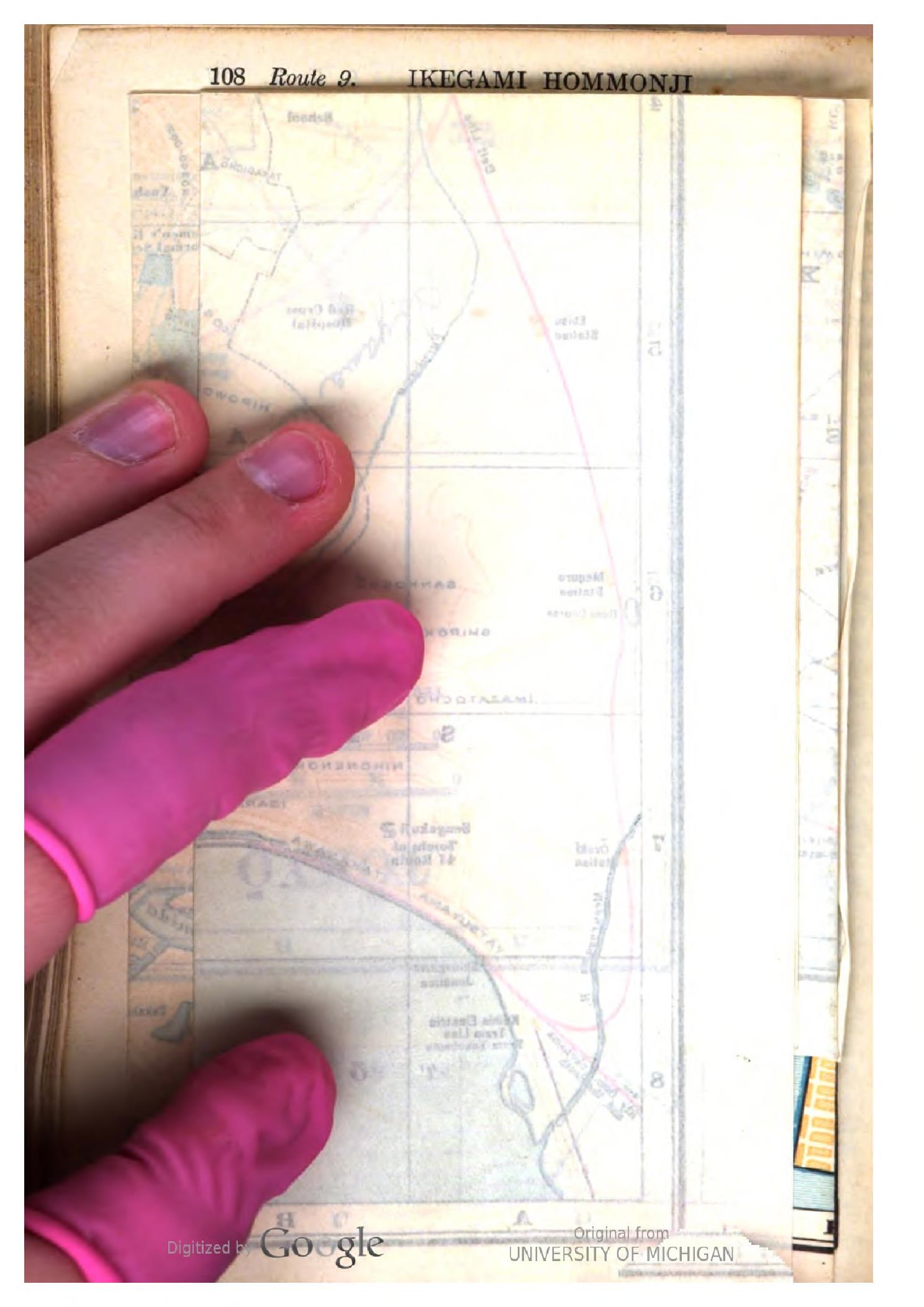
Foldout map between pages 108 and 109
108ページと109ページの間の折込地図
このページの翻訳・編集注
原本スキャンでは折込地図が手で押さえられており、全体を判読できません。
a dagoba surmounting an immense stone lotus and containing a bizarre reliquarium (also lotus-shaped and resting upon 8 green tortoises) enshrining a much bewrapped, greatly revered tooth said to have belonged to Nichiren. The host of carefully tied little packages contain offerings to the shrine. A few hundred feet below this, beyond the double gateway, is the Daibo, a much venerated structure on the site of the spot where Nichiren died. Within is a pillar swathed in silk brocade against which he leaned before his death; a bit of hard wood which served as his pillow; and a tiny wood figure purporting to be Nichiren and to have been carved by him the day before he died. His tomb is among many others in the grove up at the right of the Daibo.
骨堂は巨大な石の蓮華の上にそびえる仏塔で、内部には風変わりな舎利容器がある。これも蓮華形で、8匹の緑色の亀に支えられ、幾重にも包まれた、日蓮のものと伝わる崇敬の厚い歯を納める。丁寧に結ばれた多数の小包には、堂への供物が入っている。ここから数百フィート下り、二重門を越えると、日蓮入滅の地に建つ、崇敬を集める大坊がある。内部には、日蓮が臨終前に寄りかかったという絹の錦で包まれた柱、枕にした堅木の一片、そして没する前日に自ら刻んだと伝わる小さな日蓮木像がある。日蓮の墓は、大坊の右手上方の林にある多くの墓の中に位置する。
翻訳・編集注
原本ではページをまたいで「da-」「goba」と分割されているため、本版では語を dagoba と復元しました。
The five-storied Pagoda stands alone in a fine grove not far from the main temple. The path leading past it goes to the Ikegami Onsen, with a tea-house and a pretty landscape garden filled with flowering trees, terraces, rockeries and flowers. By following the picturesque main road at the left one soon comes to (1 M.) Omori Station.
五重塔は本堂から遠くない立派な林の中に独立して立つ。塔の脇を通る道は池上温泉へ続き、そこには茶屋と、花木、段状の地形、築山、草花に満ちた美しい庭園がある。左手の絵になる本道をたどれば、ほどなく1マイル先の大森駅に着く。
Because of its many advantages as a suburb, not a few Tokyo merchants live in Omori, which is favorably known to foreigners for its excellent Omori Hotel.*
郊外住宅地として多くの利点があるため、大森には東京の商人が少なからず住む。また外国人の間では、優れた大森ホテル*で評判がよい。
翻訳・編集注
原本では本文が excellent で改行され、直後の脚注見出し「* Omori Hotel」が文を補う組版です。本版では検索性と可読性のため本文中にホテル名を補いました。
* Omori Hotel, a quiet, unpretentious, well-conducted, moderate-priced hotel (4 min. walk from the Omori Station), managed by Mr. Sadao Inohara, favorably known to many travelers for his long connection with the Imperial Gov't Railway Hotel at Nara, the Keijo Hotel at Seoul (Korea, Chosen), and with other popular hotels catering to foreign taste and travelers. Prompt service; good home cooking; modern conveniences. English spoken. Telephone. For rates and other information, address S. Inohara, Proprietor Omori Hotel, Omori, Tokyo.
*大森ホテル。大森駅から徒歩4分。静かで飾り気がなく、経営が行き届いた中価格のホテル。経営者の猪原貞夫氏は、奈良の帝国政府鉄道ホテル、朝鮮・京城の京城ホテルをはじめ、外国人の嗜好と旅行者の需要に応える人気ホテルに長く勤務したことで、多くの旅行者によく知られている。迅速なサービス、良質な家庭料理、近代的な設備。英語可。電話あり。料金その他の問い合わせ先は、東京・大森、大森ホテル経営者 S. Inohara。
The plum blossoms of Omori locality attract many visitors in late Feb. Relics of the early autochthons have been dug up in the neighborhood.
大森一帯の梅花は2月下旬に多くの見物人を集める。付近では古代の先住者が残した遺物が発掘されている。
The traveler with ample time may like to visit the near-by (tram-car, ½ hr.) Haneda, a popular resort of the Tokyoites, near the sea, with a locally famed shrine to Inari. The chief festivals are in March and Sept., but at all times during the summer throngs of holiday folks swarm over the place (a sort of local Coney Is.) and render it attractive. The scores of small restaurants specialize in sea-food, and the shops sell marine zoology in many forms.
時間に余裕のある旅行者は、近くの羽田へ足を延ばしてもよい。路面電車で30分、海辺にある東京市民の人気行楽地で、土地で名高い稲荷社がある。主な祭礼は3月と9月だが、夏はいつでも休日客が群れ集まり、いわば土地のコニー・アイランドのような賑わいを見せる。何十軒もの小料理店が魚介料理を専門とし、店では海産動物をさまざまな形で売っている。
From Omori the train parallels the sea to (15 M.) Shinagawa, an important junction on the outskirts of Tokyo. The traveler planning to visit the Tombs of the 47 Ronin (p. 186) and Shiba Park (p. 168) can save a little time by descending from the train here and visiting them in the order named. 18 M. Tokyo, see below.
大森から列車は海岸と並行して走り、起点から15マイルの品川へ至る。品川は東京郊外の重要な分岐駅である。四十七士の墓(186ページ)と芝公園(168ページ)を訪れる予定なら、ここで下車して記載順に回ると少し時間を節約できる。起点から18マイル、東京。以下参照。
このページの翻訳・編集注
原本107–109頁の画像とOCRデータを再照合し、走り見出しを除外したうえで、英文の誤読、跨頁語、固有名詞、数値、単位を校正しました。日本語訳も全段落を再校閲しています。歴史的な表現や評価は原著の記録性を尊重して残しています。