横浜から伊香保・草津へ
From Yokohama to Ikao and Kusatsu
横浜から伊香保温泉へ向かい、榛名山・榛名湖を巡って草津温泉へ至る山岳保養旅行。原本85–105頁を画像・OCR照合し、英文校正と日本語校閲を行った版です。
- 原著
- pp. 85–105
7. From Yokohama to Ikao and Kusatsu.
7. 横浜から伊香保、草津まで。
Ikao, or Ikaho, a beautiful and popular summer resort in the splendid Ikao Mts., 2600 ft. above the sea (in Kotsuke Province), on the steep northeastern slope of Haruna-san, 7 hrs. by rail from Yokohama, celebrated for its fine, bracing air; its many hot springs which gush from the hills and plunge down innumerable gorges to the lowlands, its charming views, grand old forests and its Imperial Reserve, is one of the most accessible and thoroughly delightful of all the Japanese hill-stations. None possess more diversified scenery, a greater profusion of exquisite wild flowers, a more picturesque town, and a wider range of interesting walks and rides. It unites nearly all the most desirable requisites of an ideal summer outing place: a quaint, clean, comfortable, non-luxurious, semi-foreign hotel (English spoken), where good food is given at reasonable prices (one replete with Japanese charm, and from the balconies of which one enjoys one of the most magnificent prospects in nature); a comparative immunity from mosquitoes; a multiplicity of trails leading through forests to entrancing peaks, ferny dells, sparkling brooks, and steam-
伊香保(Ikaho)は、上野国、榛名山北東の急斜面、海抜2,600フィートの伊香保山地にある美しく人気の高い避暑地で、横浜から鉄道で7時間。爽快な空気、丘から湧き、無数の谷を低地へ流れ下る温泉、魅力的な眺望、壮大な古林、御料地で名高く、日本の高原保養地の中でも特に行きやすく、心から楽しめる場所の一つである。景観の変化、美しい野花の豊かさ、町の絵画的な趣、散歩や乗馬の多彩さで、ここに勝る所は少ない。理想的な夏の滞在地に望まれる条件をほぼ備える。日本情緒に富み、バルコニーから自然界でも屈指の眺望を楽しめる、趣深く清潔で快適、過度に豪華でない洋風旅館(英語可)があり、手頃な料金で良い食事を出す。蚊も比較的少なく、森を抜けて魅惑的な峰、シダの谷、きらめく小川、湯気立つ
このページの翻訳・編集注
原本画像とOCRデータを照合して英文を校正し、固有名詞・数値・単位を確認したうえで日本語訳を校閲しました。歴史的な表現は原著の記録性を尊重して残しています。
IKAO
伊香保
Flowers*
花*
ing gorges; and a gem of a lake (excellent skating in winter) stocked with big carp and trout. Hard by, in a green and romantically picturesque gorge, is one of the most bizarre temples in the Empire. The entire region around Ikao is studded with roaring waterfalls, and rent by deep gorges from which steam rises incessantly. On rainy days, when this hangs low above the town, it imparts a decided Plutonian aspect to it. Hissing hot medicinal water straight from the seething heart of the adjacent hills is piped directly into the many bath-houses, there to be tempered by cold water from the same hills. The town is built on a series of terraces reclaimed from the sloping hillside; and the main st., Odori, comprising a score or more flights of stone steps 20 or more ft. wide, is one of the quaintest in Japan. The air is crisp in April; cool in May; delightful in June (barring the rains); and cooler in July and Aug. than one finds it at the seashore. The season begins usually about July and terminates with the Oct. (20th) festivals. During this period rooms in the hotels or inns should be engaged in advance (telephone and telegraph connections). At the beginning of the cold winter crowds of peasant pilgrims begin to arrive — folks who aim to get lower rates at the inns and who profess to believe that in the cold weather one gets more benefit from the baths. The best skating on Lake Haruna is in Feb.
峡谷へ向かう道が無数にあり、大きな鯉と鱒を放した宝石のような湖では冬に良いスケートができる。すぐ近くの緑濃くロマンチックな峡谷には、国内でも特に奇抜な寺の一つがある。伊香保一帯には轟く滝が点在し、深い谷から絶えず蒸気が立つ。雨の日、その蒸気が町の上へ低く垂れ込めると、冥府を思わせる様相となる。隣の山腹の煮え立つ地中から噴く薬湯は、多くの浴場へ直接引かれ、同じ丘の冷水で温度を調える。町は斜面を造成した幾段もの台地に築かれ、幅20フィート以上の石段が幾重にも続く大通りは、日本でも特に趣深い。4月は空気がきりりとし、5月は涼しく、6月は梅雨を除けば快適、7月と8月も海岸より涼しい。季節は通常7月に始まり、10月20日の祭りで終わる。この間はホテルや宿を事前予約すべきである。冬の寒さが始まると、安い宿賃を求め、寒い時期ほど湯治の効き目があると信じる農村の巡礼者が押し寄せる。榛名湖のスケートは2月が最良。
In the vicinity of Ikao the hunter (open season Oct. 1 to April 1) will find copper pheasants ( yamadori ), quail ( uzura ), wild pigeons ( yamabato ), whose booming notes ring musically through the green woods; green pheasants (kiji) and a wide variety of smaller game. The flower-lover will find so many exquisite flowers growing wild that he will be reminded of the celebrated region roundabout Cape Town, in South Africa, which ships tons of everlastings each year to England. White magnolia; the Paulownia imperialis; a wealth of wistaria; azaleas; Jack-in-the pulpit; white dogwood; spiraea; Cherokee roses; wild hydrangea; fox-lily; rhododendrons; columbine; several varieties of clematis, iris, and lilies; funkia; peonies; several rare ferns, and a host of other flowers grow wild in the woods and dingles, along with specimens of nearly all the trees represented in the Japanese flora. Owing to the frequent rain — a dampening characteristic of most of Japan's hill-stations — every inch of the mt. slopes is carpeted with green, while the deep gorges are literally choked with vigorous plant life. The immensely tall cryptomerias and the lithe pines which often reach up the sides from the very bottoms of the canyons, arc always attractive, but particularly so when they are interspersed with flowering trees, wild raspberries, and the strong, sinewy, suffocating wistaria vines — the lianas of the Japanese woods. The frail pretty pink flower which grows so profusely in the interstices of the massive walls
伊香保周辺では、狩猟期(10月1日から4月1日)に、ヤマドリ、ウズラ、ヤマバトを見つけることができる。ヤマバトの低く響く声は緑の森に音楽のように鳴りわたる。キジや多種多様な小鳥獣もいる。花を愛する者は、野に咲く精妙な花々の多さに、毎年大量のエバーラスティングを英国へ送る南アフリカ、ケープタウン周辺の有名な地方を思い出すだろう。白木蓮、桐、藤、躑躅、テンナンショウ、白い花水木、シモツケ、チェロキー・ローズ、野生の紫陽花、キツネユリ、石楠花、オダマキ、数種のクレマチス、菖蒲、百合、ギボウシ、芍薬、珍しい羊歯、その他多くの花が、森や谷間に野生し、日本の植物相を代表するほとんどすべての樹木とともに見られる。日本の多くの山地保養地に共通する湿った特徴である雨の多さのため、山腹は隅々まで緑に覆われ、深い峡谷は文字どおり旺盛な植物で埋め尽くされている。谷底から側面へ伸びる非常に高い杉やしなやかな松はいつも魅力的だが、花木、野生の木苺、そして日本の森の蔓植物である強くしなやかで息苦しいほどの藤蔓が交じる時、とりわけ美しい。巨大な石垣の隙間に町じゅう一面に咲く、か弱く可憐な桃色の花は
このページの翻訳・編集注
原本画像とOCRデータを照合して英文を校正し、固有名詞・数値・単位を確認したうえで日本語訳を校閲しました。歴史的な表現は原著の記録性を尊重して残しています。
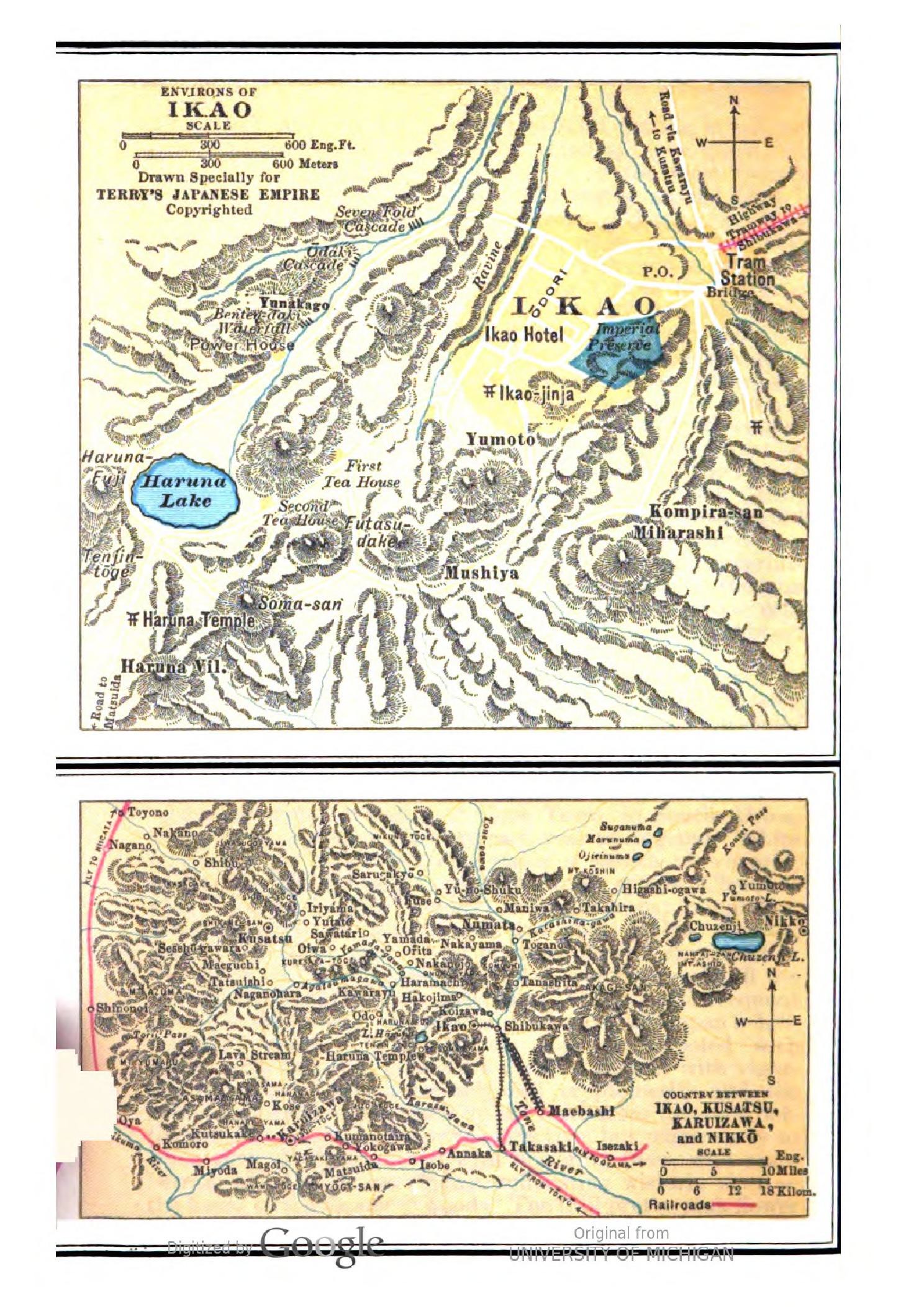
Maps: Environs of Ikao; Ikao, Kusatsu, Karuizawa, and Nikko
地図:伊香保周辺/伊香保・草津・軽井沢・日光
このページの翻訳・編集注
86ページと87ページの間に挿入された無番号の地図です。
IKAO
伊香保
The Hot Springs.
温泉。
throughout the town is the Saxifraga sarmentosa (Japanese Yukinoshita). The display of cherry blossoms in April is charming. 1
町じゅうに見られるユキノシタ(Saxifraga sarmentosa)である。4月の桜は美しい。
The Rly. from Yokohama to (80 M.) Takasaki is described in Rte. 6, p. 66. An Electric Line runs hence to (1 hr.) Shibukawa where one transfers into another electric line (densha) which climbs the mt. (2000 ft., about 1 hr.) to the town.
横浜から80マイルの高崎までの鉄道はRoute 6、66ページに記載する。ここから電気鉄道で1時間の渋川へ行き、別の電車に乗り換える。電車は約1時間かけて2,000フィートを登り、町へ達する。
Trains on the Ryomo & Joetsu South Line of the Imperial Gov't run frequently from Tokyo to Shibukawa direct. For fares consult the time table.
国有鉄道の両毛・上越南線の列車は、東京から渋川まで頻繁に直通する。運賃は時刻表を参照のこと。
The Electric cars start from a point near the rly. station. The climb is picturesque, with fine views. The Ikaho Station is 10 min. walk below the town. Conveyances meet trains. Low fares. Hotel coolies will be awaiting the traveler who announces in advance his arrival.
電車は鉄道駅近くから発車する。登りは絵のように美しく、眺望もよい。伊香保駅は町の下方、徒歩10分のところにある。列車には乗物が迎えに来る。運賃は安い。到着を前もって知らせておけば、ホテルの荷夫が旅行者を待っている。
The Japan Tourist Bureau (head office in the Tokyo Central Rly. Station) will cheerfully furnish the traveler any information he may desire relating to the Ikaho region.
ジャパン・ツーリスト・ビューロー(本部は東京中央停車場内)は、伊香保地方について旅行者が望む情報を快く提供してくれる。
Hotels. Ikao Hotel, semi-foreign, with foreign food, good baths (free) and attendance; from 8 yen and upward; small reduction for 2 pers. in one room; special rates for a long stay. — Kogure Budayu Hotel, 5-6 yen. There are 40 or more native inns, rooms in which can be had for about yen 10 a week, and a special price arranged for food. The Chihira has fine views.
ホテル。伊香保ホテルは半洋式で、洋食、良い浴場(無料)、世話係を備え、料金は8円以上。1室2名には小割引があり、長期滞在には特別料金がある。小暮武太夫ホテルは5~6円。和風旅館は40軒以上あり、部屋は週10円ほどで取れ、食事は別に特別料金を取り決めることができる。千明は眺望がよい。
The name Ikaho means 'High Mountains' and is derived from the huge Haruna Range rising behind it. According to the local tradition (which should be taken with a grain of salt) the springs were discovered during the reign of the (11th) Emperor Suinin (b.c. 70-a.d. 70). The 12 chief families (who have adopted for their crests the 12 signs of the zodiac) trace their lineage to famous personages of the 6th cent. The uninteresting Ikao Jinja on a terrace (2716 ft.) back of the town is intimately associated with the early history of the place, and the present (modern) structure is said to stand on the site of one erected in 834. The large Buddhist temple, the Tenshoji, erected in 1583 on the site of the present school house, was burned during the last decade. The Imperial Preserve, opposite the Ikao Hotel, is the favorite summer retreat of a Prince of the Imperial Household. The Yachiyo Park and Athletic Ground is at the lower end of the town, near the rly. station.
伊香保という名は「高い山々」を意味し、背後にそびえる大きな榛名山系に由来する。地元の伝承によれば、温泉は第11代垂仁天皇(紀元前70年から紀元70年)の治世に発見されたというが、この話は多少割り引いて受け取るべきである。十二の主要家は、紋に十二支を採用しており、6世紀の有名人物に系譜をたどるという。町の背後、標高2716フィートの段丘にある目立たない伊香保神社は、この地の初期史と密接に結びつき、現在の近代的な建物は834年に建てられた社の跡に立つといわれる。現在の学校の敷地に1583年に建てられた大きな仏寺、天正寺は、直近の10年間に焼失した。伊香保ホテルの向かいにある御料地は、皇族の一人が好む夏の滞在地である。八千代公園と運動場は町の下端、鉄道駅の近くにある。
The chief constituents of the Ikao springs are bicarbonate of calcium; magnesium and ferric oxide; sulphate of calcium; magnesium and sodium; chloride of sodium; silicic acid and minor solids. Some are more strongly impregnated with iron than others, and some are decidedly sulphuric. Their temperature ranges from cold to 113° F. The waters run out of the mta. in little clouds of steam, through open conduits or into bamboo pipes, a multiplicity of which criss-cross the town and lead into the different houses. The gorge at Yumoto is stained a bright yellow by the precipitations from certain of the streams, and these give rise to a valuable loeal industry — that of dyeing cloth. The natives believe that belts saturated with the metallic deposits have medicinal qualities, and that kimonos so dyed and worn are equal to a course of the baths. In many of the shops small bolts (14 in. wide by 280 long) of cotton crape of different patterns, dyed in ( Takasaki ) the
伊香保温泉の主成分は、重炭酸カルシウム、マグネシウムと酸化鉄、硫酸カルシウム、マグネシウムとナトリウム、塩化ナトリウム、ケイ酸および少量の固形物である。鉄分をより強く含む泉もあり、はっきり硫黄質のものもある。温度は冷泉から華氏113度までさまざまである。湯は小さな蒸気の雲を伴って山から流れ出し、開いた水路や竹管を通る。町を縦横に走る無数の竹管は、それぞれの家へ湯を引いている。湯本の峡谷は、いくつかの流れからの沈殿物で明るい黄色に染まり、これが布を染めるという価値ある地場産業を生んでいる。地元の人々は、金属沈殿物を染み込ませた帯に薬効があり、そのように染めた着物を着ることは一連の入浴に等しいと信じている。多くの店では、幅14インチ、長さ280インチのさまざまな柄の綿縮の小反が、高崎で
このページの翻訳・編集注
原本画像とOCRデータを照合して英文を校正し、固有名詞・数値・単位を確認したうえで日本語訳を校閲しました。歴史的な表現は原著の記録性を尊重して残しています。
IKAO
伊香保
Birds.
鳥類。
characteristic yellow hue, are sold (¥1) to the pilgrims as local productions. The yellowish-bronze sediment is cleared out of the pipes twice yearly and sold to dyers and to those persons who wish to benefit by the Ikao waters but cannot come to them. The natives bathe in the A.M., at noon, and after supper. — Other specialties of the town are turned woodwork articles in many forms; pretty basket-work, and a superfine charcoal made from the wood of the Nara, a species of oak. In many of the shops will be seen bizarre and distorted specimens of petrified wood which has been so converted, it is said, by the chemical action of the waters. The power obtained through the many big overshot and undershot wheels which creak all over the place is used to turn lathes for the workers in wood.
特有の黄色に染められ、土地の産物として巡礼者に1円で売られている。黄銅色の沈殿物は年に二度管から取り除かれ、染物業者や、伊香保の湯の効能を得たいが来られない人々に売られる。地元の人々は午前、正午、夕食後に入浴する。町のその他の特産には、さまざまな形の挽物木工、可愛らしい籠細工、ナラ、すなわち樫の一種から作る上等な木炭がある。多くの店では、湯の化学作用でそうなったといわれる、奇妙にねじれた木化石の標本を見ることができる。町のあちこちできしむ多数の上掛け・下掛け水車から得られる動力は、木工職人の旋盤を回すのに用いられている。
Dozens of greater and lesser peaks, rounded and wooded hills, and deep ravines environ the town, and from the crests of some of the loftier mts. extensive and awe-inspiring views are obtainable. Because of some odd slant in the native mind the local authorities have not added English to the many guide-posts which point the way about the region to those who can read Japanese, but on some of these thoughtful travelers have penciled instructions in English that are an aid to the pedestrian. The hills are grid-ironed with a multiplicity of well-defined trails, and the author has tried to make his observations regarding these as clear as possible. The visitor whose time is limited is advised to take with him on his rambles, as guide and carrier, one of the native boys about the hotel; as a rule they are willing to give a day's service for 50 sen, and certain of them have a scattered knowledge of the lore of the woods, the birds, and the flowers. The Birds are as numerous as the latter, and on any stroll through the forest one will see cuckoos (hototogisu); lovely Japanese blue flycatchers ( ruri ); woodpeckers (kitsutsuki; wagtails ( sekirei ); bull-headed shrikes ( mozu ); Manchurian great tits ( shijukara ); Japan jays (kakesu); silver-eyes (mejiro); the sweet-throated uguisu, or Japanese nightingale (p. ccii); and many familiar and unfamiliar birds. Beautiful pheasants rise from the bamboo grass on the hill-slopes, and the wild pigeon imparts music and mysticism to the cool forests. The common people call the cuckoo kakkodori from the similarity of its call to the word kakko. The numerous skylarks ( hibari ) are of a species known as Alauda japonica.
大小数十の峰、丸みを帯びた森の丘、深い谷が町を取り囲み、より高い山々の尾根からは広大で畏怖を誘う眺望が得られる。地元の人々の心にある奇妙な傾きのためか、この地域の道を示す多くの道標に、地元当局は英語を加えていない。日本語を読める者には役立つが、そのいくつかには思いやりある旅行者が鉛筆で英語の案内を書き込み、歩行者の助けになっている。丘陵には明瞭な道が碁盤目のように多数通っており、著者はそれらについての観察をできるだけ明確に記すよう努めた。時間の限られた訪問者は、散策の際、案内人兼荷物持ちとしてホテル周辺の地元の少年を一人連れて行くとよい。彼らは概して50銭で一日働くことをいとわず、中には森、鳥、花について断片的な知識をもつ者もいる。鳥は花に劣らず多く、森を歩けばホトトギス、美しい瑠璃色の小鳥、キツツキ、セキレイ、モズ、シジュウカラ、カケス、メジロ、美しい声のウグイス(202ページ)、その他なじみのある鳥・ない鳥を数多く見るだろう。美しい雉は山腹の笹から飛び立ち、山鳩は涼しい森に音楽と神秘を添える。庶民は鳴き声が「カッコウ」に似ることから、カッコウをカッコドリと呼ぶ。数多いヒバリは Alauda japonica として知られる種である。
Walks and Excursions (see the accompanying map). There are enough of these to occupy one's time for weeks; the most popular only are described below. The local guides, obtainable through the hotel management, get ¥1.20 a day, and are supposed to provide their own food, besides carrying that of their employers. The woods are said to be free from poison ivy and its concomitant miseries.
散策と遠足(添付地図参照)。数週間を費やせるほど数が多いので、以下には最も人気のあるものだけを記す。ホテルの管理者を通じて雇える地元ガイドは一日1円20銭で、雇い主の食事を運ぶほか、自分の食事は自分で用意することになっている。森にはツタウルシとそれに伴う厄介事はないといわれる。
To (1/4 M., 15 min.) Yumoto ('Source of the Hot Water'), a picturesque spot back of the town whither pilgrims go in the early a.m. to drink of the evil-tasting water. The walk can be included in the one described below. Proceed from the hotel to the main st., turn up left to the foot of the steps leading to the Ikao Jinja, then bear round to the right along the edge of the Yusawa ravine, beneath overhanging cliffs clothed with vegetation. There are some pretty shops, a good view of the gorge (right), and a quaint bridge. On reaching the latter turn abruptly to the left on the near side, and follow the steaming hot stream to its source. The dell is romantically and wildly picturesque, though very suggestive of the sullen demoniacal forces which lie but a few yards beneath one's feet. At one place under the green tunnel there are seats and a dipper — the latter to be avoided. The water tastes of iron and is unpalatable. Scores of rills rush noisily out from as
湯本(「温泉の源」、4分の1マイル、15分)へ。町の背後にある絵になる場所で、巡礼者は早朝、味の悪い水を飲みに行く。この散策は下記の行程に組み入れられる。ホテルから大通りへ進み、左へ上って伊香保神社へ続く階段の下へ出る。そこから右へ回り、植物に覆われた張り出す崖の下、湯沢の谷の縁に沿って進む。きれいな店がいくつかあり、右手には谷のよい眺め、そして趣のある橋がある。橋に着いたら手前側で急に左へ曲がり、湯気を上げる熱い流れを源までたどる。谷はロマンチックで荒々しく絵になるが、足元わずか数ヤード下に横たわる陰鬱な魔的な力を強く思わせる。緑のトンネルの下のある場所には腰掛けと柄杓があるが、後者は避けるべきである。水は鉄の味がし、口には合わない。多数の細流が
このページの翻訳・編集注
原本画像とOCRデータを照合して英文を校正し、固有名詞・数値・単位を確認したうえで日本語訳を校閲しました。歴史的な表現は原著の記録性を尊重して残しています。
Excursions. IKAO
遠足。伊香保
many crevices in the hillside, and leave yellow, plushy tracks where they have passed.
丘の斜面の多くの割れ目から音を立てて流れ出し、通った跡に黄色いビロードのような筋を残す。
To Kompira-san (or Monokiki-yama, 1/2 M.; 1 hr. stiff climb over a good road beneath trees), Miharashi (1 M.), Mushiyu (3 1/2 M.; chair for the round trip, ¥2.40), and Yumoto. Kompira is the name of a deserted shrine 10 min. walk down left from the point (beyond the bridge and post-office) where one turns off the main road and begins the ascent of the hill; the path is well defined, with stone steps at intervals. Keep the rocky gulch at the right; the glades are lovely and primeval, and usually echo to the cuckoo's call. At the summit there is a tiny shack of a tea-house oblivious to a view that holds one spellbound by its immensity. Far below, wriggling along the valley floor backed by towering foothills of the Nikko Mts., goes the Tone River; a silvery streak which farther up at the left is stained by the untidy inflow of the petulant Agatsuma * gawa. Cutting the E. skyline is the lofty Tsukuba Mt., rising 2925 ft. from Hitachi Province. Akagi-san (5000 ft.) is nearer, while trailing away at the left, their giant ridges threatening the sky, are Komochi-yama, Onoko-yama, and a half-score formidable humps and cones, with Shirane-san (7500 ft.) lording it above them. The delighted eye takes in hundreds of sq. miles of valley land hemmed in by bulky hills, planted to various grains that reflect all the shades of green from that of sprouting rice to the more somber hue of brooding pine trees. At this tea-house one may, perchance for the first time, be offered a tea-substitute popular throughout Japan. It is made of parched barley; is called mugiyu [mugi is a generic term for barley, wheat, oats, and rye]; has a dark amber tint; a taste true to the grain; is said to be less injurious than tea, and is drunk extensively by Japanese soldiers.
金比羅山(または物聞山、半マイル、木陰のよい道を約1時間のきつい登り)、見晴(1マイル)、蒸し湯(3.5マイル、往復の椅子2円40銭)、湯本へ。金比羅は、橋と郵便局を越えて本街道から分かれ、丘を登り始める地点から左へ10分下ったところにある、廃れた祠の名である。道はよく分かり、ところどころに石段がある。岩の谷を右に見て進む。林間の開け地は美しく原始的で、たいていカッコウの声が響く。頂上には小さな茶屋小屋があり、その広大さに見る者を呆然とさせる眺望に気づいていないかのようである。はるか下、日光連山の高い前山を背に谷底をうねって流れるのは利根川で、銀色の筋のように見える。その左上流では、気まぐれな吾妻川の濁った流入で色を汚されている。東の稜線を切るのは常陸国から2925フィートそびえる筑波山である。赤城山(5000フィート)はより近く、左手には小持山、小野子山、その他十ほどの手ごわい瘤や円錐峰が巨大な尾根を空へ脅かすように連ね、その上に白根山(7500フィート)が君臨している。喜ぶ目は、重々しい丘に囲まれた何百平方マイルもの谷地を見渡す。そこには発芽した稲の緑から沈んだ松の緑まで、あらゆる緑を映すさまざまな穀物が植えられている。この茶屋では、おそらく初めて、日本中で親しまれる茶の代用品を出されるかもしれない。炒った大麦で作られ、麦湯と呼ばれる。麦は大麦、小麦、燕麦、ライ麦の総称である。濃い琥珀色で、穀物そのものの味がし、茶より害が少ないとされ、日本兵にも広く飲まれている。
At the right of Kompira-san (path at the left), on a bold, bald bluff (20 min. walk) called Miharashi, one may enjoy another remarkable panorama. Thither the trail descends the hill at the right and soon joins the long path winding across the elope to Mushiya. Notwithstanding the houses of this (uninteresting) place are visible, the walk is deceptively long (l hr.), as the last portion rounds a number of hills and incipient ravines. Malodorous sulphurous gases issue from pipes stuck in the ground and supply a sort of al fresco bath for rheumatic rustics. Returning, one descends into the ravine and bears round to the left, skirting on the way the base of the twin peaks of Futatsu-dake (chair to the summit and return to the hotel, ¥4.20). A 20-min. walk brings one to the 1st tea-house on the Haruna road, whence it is 30 min. back to the hotel. Yumoto can be included in this trip, the whole of which can be accomplished in one forenoon. If one elects to return to the hotel from Miharashi, the path to its intersection with that from Kompira-san should be followed, thence downward
金比羅山の右手、左の小道を取った先にある見晴と呼ばれる大胆な裸の崖(徒歩20分)では、もう一つのすばらしい眺望を楽しめる。そこへは道が右手の丘を下り、やがて斜面を横切って蒸し湯へ巻いていく長い道に合流する。このあまり興味深くない場所の家々は見えているにもかかわらず、歩きは意外に長い(1時間)。最後の部分がいくつもの丘と小さな谷の始まりを回り込むからである。地面に差し込まれた管から悪臭のある硫黄ガスが出ており、リウマチに悩む田舎の人々のための露天風呂のような役を果たしている。帰路は谷へ下り、左へ回って二ッ岳双峰の麓をかすめる(頂上までの椅子とホテルへの帰りで4円20銭)。20分歩くと榛名道の第一茶屋に至り、そこからホテルへは30分で戻れる。湯本はこの行程に組み込め、全体は午前中一杯で済ませられる。見晴からホテルへ戻る場合は、金比羅山からの道と交わる地点まで道をたどり、そこから下る。
このページの翻訳・編集注
原本画像とOCRデータを照合して英文を校正し、固有名詞・数値・単位を確認したうえで日本語訳を校閲しました。歴史的な表現は原著の記録性を尊重して残しています。
IKAO Benten Waterfall.
伊香保弁天滝。
for 20 min. (keeping the ravine on the left) to a hill behind the Ikao Jinja.
(谷を左手に見ながら)20分進むと、伊香保神社の背後の丘に出る。
To the Nanae, or Seven-Fold Cascade (1/2 M.; chair, ¥1.60); BENTEN-DAKI (2 1/2 M.; chair, ¥2.40); and the (near-by) Odaki Cascade (chair for the round trip, ¥3). The walk can be made leisurely in about 2 1/2 hrs. and allow 1/2 hr. for a rest at each place. Descend the steps of the main st. (picturesque view in retrospect) to the bisecting path at the foot, then turn left and go down through the cryptomeria forest to the torrent flowing through the gorge. Thence the road leads up the slope beneath lines of immensely tall trees rising from the flank of the hill. The path is idyllic and recalls certain of the heavily shaded roads through the Karlsbad region. Beyond the summit of the ridge the trail descends abruptly to the left; the bypath leading back up the hill-side goes to Baron Kawasaki's country villa where a sign-board forbids admittance 'unless on business.' A few minutes' walk down the charmingly irregular and rocky path brings one to a series of pretty cascades seen to the best advantage from the tea-house facing the lower one. As we shall approach this later from below, we now cross the small bridge at the foot of the first fall and climb the path at the left. Fine views at the right as we cross the glades. Many lovely flowers and some wild raspberries (yama-ichigo) grow hereabout. The hamlet at the far right, on the brink of the stream below Odaki, is Yunokago. Avoiding the numerous confusing by-paths which branch to the right we follow the main trail as it hugs the hillside, anon descending and ascending, trending always to the left until the roar of a waterfall is borne in from the right. The last path that leads sharply down at the right before we reach (15 min.) Benten-daki, must be returned to later and followed to Odaki. The long steel flume below the waterfall here conducts the water which generates the electricity used for lighting Ikao.
七重滝(半マイル、椅子1円60銭)、弁天滝(2.5マイル、椅子2円40銭)、および近くの大滝(往復の椅子3円)へ。この散策は約2時間半でゆっくり歩け、各所で半時間ほど休める。大通りの石段を下り(振り返ると絵になる眺め)、下の分岐道へ出て左折し、杉林を下って谷を流れる急流へ向かう。そこから道は、山腹からそびえる非常に高い木々の列の下を斜面へ上る。この道は牧歌的で、カールスバート地方の濃い木陰の道を思わせる。尾根の頂を越えると、道は左へ急に下る。山腹を戻る脇道は川崎男爵の別荘へ通じ、看板には「用事なき者入るべからず」とある。魅力的に不規則な岩道を数分下ると、美しい滝の連なりに出る。下段の滝に面した茶屋から見るのが最もよい。後で下からここへ近づくので、いまは最初の滝の下の小橋を渡り、左手の道を登る。林間を横切るところでは右手に良い眺めがある。このあたりには多くの美しい花と野生の木苺(山苺)が育つ。大滝の下の流れのほとり、はるか右手の集落は湯ノ籠である。右へ分かれる多くの紛らわしい脇道を避け、山腹に沿う本道を進む。道は下ったり上ったりしながら常に左へ向かい、右手から滝の轟きが聞こえてくる。弁天滝に着く15分ほど手前で右へ急に下る最後の道は、あとで戻って大滝へ向かうために使う。この滝の下の長い鋼製水路は、伊香保の照明に用いる電気を起こす水を導いている。
The Benten-daki (Waterfall of the Goddess Benten), about 18 ft. wide and 40 ft. high, stands at the upper end of a rocky and picturesque gorge. The water comes from Lake Haruna, and after falling with a deafening roar into a turbulent pool, it dashes down the ravine to form a number of insignificant rapids and then the Odaki ('Big Fall'). The inevitable teahouse with its highly colored sweets and insipid, non-exhilarating mugiyu, shrewdly extracts the customary toll (in lieu of fees) by occupying practically the only vantage point from
弁天滝は幅約18フィート、高さ約40フィートで、岩の多い絵のような峡谷の上端にある。水は榛名湖から来て、耳をつんざく轟音とともに荒れた淵へ落ちたのち、谷を駆け下りていくつかの小さな早瀬を作り、さらに大滝へ至る。派手な色の菓子と、薄くて元気の出ない麦湯を出すお決まりの茶屋は、滝を満足に眺められるほとんど唯一の場所を占めることで、料金の代わりに慣例の通行料を抜け目なく徴収している。
which the falls can be seen satisfactorily. Above, on a considerably higher level, is a foot-path which leads (about 2 hrs. going up; less returning) to the head of Lake Haruna. — Returning along the trail to the first by-path at the left (so narrow that it resembles a watercourse), a sharp 10 min. descent is made between overhanging trees to the river-bed,
その場所からなら滝をよく見ることができる。かなり上の高い所には、榛名湖の上端へ通じる徒歩道がある(上り約2時間、帰りはそれより短い)。来た道を戻り、左手最初の脇道(水路のように狭い)へ入ると、張り出す木々の間を10分ほど急に下って川床に出る。
このページの翻訳・編集注
原本画像とOCRデータを照合して英文を校正し、固有名詞・数値・単位を確認したうえで日本語訳を校閲しました。歴史的な表現は原著の記録性を尊重して残しています。
LAKE HARUNA
榛名湖
Haruna Jinja.
榛名神社。
Sections of the path beyond to Yunokago village are a bit roughish and are not much liked by ladies; for some distance the trail is indistinct and leads through the river-bed (right). After the woods-path is picked up again, a slight climb brings one to the rather insignificant Odaki fall (20 ft.; 50 ft. across). The village is a few yards farther down the stream. Instead of descending to it, we turn up at the right to (5 min.) another path (leading right) which should not be followed. The main trail continues (5 min.) to a deserted shrine at the upper end (right) of a twin line of splendid cryptomerias — the largest measuring 13 ft. in circumference just above the base. Hence the path bears round to the right, crosses a small brook, and reveals the Nanae Cascade. The return to the hotel is along the trail pursued on the outward journey.
その先、湯ノ籠村までの道の一部はやや荒れており、女性にはあまり好まれない。しばらく道は不明瞭で、右手の川床を通る。再び森の道を拾うと、少し登って、あまり目立たない大滝(高さ20フィート、幅50フィート)に至る。村は流れの少し下手にある。そこへ下る代わりに右へ上り、5分で別の道(右へ通じる)に出るが、これは取ってはならない。本道はさらに5分進み、見事な杉の二列の上端右手にある廃社へ至る。最大の杉は根元すぐ上で周囲13フィートを測る。ここから道は右へ回り、小川を渡ると七重滝が姿を現す。ホテルへの帰りは往路と同じ道をたどる。
To (5 M.) Lake Haruna and the (6 1/2 M.) Haruna Jinja (horse, ¥2.20; chair, ¥4.20). A beautiful walk to which a leisurely day should be devoted. The first I is along a steady incline to the plateau; the 2d, a gentle descent to the lake; and the last lap, an abrupt descent (good wide road) into a wild and romantically beautiful ravine where the temple stands. The return is a steady 45 min. trudge out of the gorge; a gentle uphill walk to the 2d tea-house; thence a descent of 1 hr. to the hotel. The whole is easily equivalent to 15 M. on a level. The views from the mt. ridges are glorious, and the lake is a gem of beauty. Steps can be economized by taking a lad from the hotel (50 sen) to carry the luncheon and rain-coats, point out the different mt. peaks, and set the right pace so that one may not have stiff muscles the next day. By starting at 7 a.m. (breakfast can be had as early as one may wish it) and walking methodically, one can easily reach the temple at 10; 2 hrs. to inspect the fine carvings, the gorge, and the village; then a leisurely walk of 1 hr. will bring one to the tea-house on the lake shore. The luncheon can be pieced out here with hot tea, etc., and by ordering this sent to the back veranda one may enjoy a delightful vista of water and mts.
榛名湖(5マイル)と榛名神社(6.5マイル、馬2円20銭、椅子4円20銭)へ。ゆったり一日を費やすべき美しい散策である。最初の行程は台地までの着実な登り、第二は湖への緩やかな下り、最後は寺の立つ野趣豊かでロマンチックに美しい谷へ、広い良道を急に下る。帰路は谷から45分の着実な登り、第二茶屋までの緩い上り、そこからホテルまで1時間の下りである。全体として平地15マイルに容易に相当する。山稜からの眺望はすばらしく、湖は美しい宝石である。ホテルの少年(50銭)を連れて昼食と雨具を運ばせ、山々の名を示してもらい、翌日筋肉痛にならないよう適切な歩調を保たせれば、足数を節約できる。午前7時に出発し(朝食は望むだけ早い時刻に取れる)、規則的に歩けば、10時には容易に寺へ着ける。立派な彫刻、谷、村を見学するのに2時間、その後1時間ゆっくり歩けば湖畔の茶屋に着く。ここで昼食に熱い茶などを足すことができ、それを裏の縁側へ運ばせれば、水と山々の楽しい眺めを味わえる。
Beyond Yumoto, where the bridge spanning the gorge is crossed, the zigzag road (several short cuts) leads to the 1st tea-house. Futatsu-dake looms up bulkily at the left, and the hills resound to the liquid whistle of meadow-larks, the booming note of wild pigeons, and the answering call of the cuckoo. In summer the slopes are decked with a glorious display of day-lilies; on rainy days one passes through dense clouds of mist that fill the canons with great rolls like cotton-batting, and hide the mts. behind an impenetrable veil. The vast, silent upland plain, which stretches from the top of the ridge and the 2d tea-house to the shore of the lake, is strangely beautiful. Great herds of cattle could be pastured in the deep grass that grows, unchecked and uncut on its gentle slopes.
湯本を過ぎ、谷に架かる橋を渡ると、ジグザグ道(いくつか近道がある)が第一茶屋へ続く。左手には二ッ岳がどっしりとそびえ、丘には草原のヒバリの澄んだ声、山鳩の低く響く声、カッコウの応える声が響く。夏には斜面が見事なニッコウキスゲで飾られる。雨の日には濃い霧の雲の中を通り、霧は綿の巻物のように峡谷を満たし、山々を通しがたい幕の向こうに隠す。尾根の頂と第二茶屋から湖畔まで広がる、広大で静かな高原は、不思議な美しさをもつ。緩やかな斜面に伸び放題に育つ深い草には、大きな牛の群れを放牧できるだろう。
このページの翻訳・編集注
原本画像とOCRデータを照合して英文を校正し、固有名詞・数値・単位を確認したうえで日本語訳を校閲しました。歴史的な表現は原著の記録性を尊重して残しています。
LAKE HARUNA Haruna Fuji.
榛名湖 榛名富士。
and charming pictures could be painted of its unforgettable views. The sub-soil is volcanic ash, and should one happen to pass here (as did the writer on one of his trips to the lake) when the distant Yarigatake is erupting, and the wind is blowing in the right direction, one will experience the curious sensation of walking beneath a steady fall of fine ashes. On the other hand, if the above phenomenon be present and is added to by rain, one will be reminded of similar predicaments in towns of N. China, when the sand from the great Loess combines in the air with the water and precipitates a fluid mud upon the just and the unjust.
その忘れがたい眺めは魅力的な絵にできるだろう。下層土は火山灰であり、著者が湖への旅の一つで経験したように、遠くの槍ヶ岳が噴火し、風向きが都合よければ、細かな灰が絶えず降る下を歩くという奇妙な感覚を味わうことになる。さらにこの現象に雨が加われば、北中国の町々で似たような難儀に遭ったことを思い出すだろう。大黄土の砂が空中で水と結び、正しい者にも不正な者にも流動する泥を降らせる時のことである。
Haruna Lake (called also Kami no se, and Ikao-ko)» a deep, pear-shaped body of water approx. 4 M. in circumference, is thought to fill the crater of a long-extinct volcano, and is well stocked with salmon troutrnasu) and carp (hoi). It freezes solidly in Feb. (the coldest month of the region), and, besides affording fine fishing and skating, supplies ice to Ikao and neighboring points. At the Kohantei Restaurant on the beach, boats can be had at 50 sen an hr., along with, fishing-tackle ( tsuridogu ). The fish sometimes attain to a good size (5 lbs.; 18 in. long) and afford good sport for line fishermen; the catch can be cooked to order in the restaurant. The tall, conical peak at the right of the lake (1 hr. to the rocky summit) is the Haruna Fuji (so called for its resemblance to Fuji-san ). The bold cliff at the left of it is Eboshigatake; the one farther along, Bingushi-yama; and the odd pinnacles at the left, Suzurigatake. Beyond the tea-house the surplus water of the lake flows through a tunnel seen after crossing the pass. The flat patch of shore land at the edge of the plain, at the right as one approaches the lake, is beautiful with multicolored irises in summer. From the meadow end of the lake the road winds along the base of the hill under a tunnel of green foliage. On the near side of the restaurant it turns up sharply to the left and ascends to the Tenjin Pass (1000 ft. above Ikao), flanked on both sides by small tea-houses. From one side here a splendid view is had of the lake and the surrounding mts., and from the other an equally extensive one over the semi-tropical gorge in whose lower depths the Haruna Temple stands. The big red torii under which we pass marks the rear entrance to its domain. The gradual descent along the winding, well-kept road, over quaint bridges spanning plunging waterfalls, with alluring vistas ahead and constantly rising mts. behind, is beguiling. The precipitous slopes are covered with growing things which the wild wistaria and honeysuckle bind in an almost impenetrable jungle. After sampling the wild grapes which abound one is usually tempted to refer to them witn the Cockney's pronunciation of the a.
榛名湖(神ノ瀬、伊香保湖とも呼ばれる)は、周囲約4マイルの深い梨形の水域で、長く死火山となった火口を満たすものと考えられている。マスと鯉が豊富に放たれている。地域で最も寒い2月には固く凍り、釣りとスケートに適するほか、伊香保や近隣へ氷を供給する。湖畔の湖畔亭レストランでは、ボートを1時間50銭で借りられ、釣道具もある。魚は時にかなりの大きさ(5ポンド、18インチ)に達し、釣り人によい楽しみを与える。釣果はレストランで注文に応じて調理してもらえる。湖の右手にある高い円錐形の峰(岩の頂まで1時間)が、富士山に似ることから榛名富士と呼ばれる。その左の大胆な崖は烏帽子ヶ岳、さらに先が鬢櫛山、左手の奇妙な尖峰が硯ヶ岳である。茶屋の先で、湖の余水は峠を越えてから見える隧道を通って流れ出る。湖へ近づく時、右手、平原の端にある平らな岸地は、夏には色とりどりの菖蒲で美しい。湖の草原側の端から道は丘の麓に沿い、緑の葉のトンネルの下を曲がりくねって進む。レストランの手前で道は急に左へ曲がり、伊香保より1000フィート高い天神峠へ登る。峠の両側には小さな茶屋が並ぶ。一方からは湖と周囲の山々の見事な眺めがあり、もう一方からは、榛名神社が下方の深みに立つ半熱帯的な谷を広く見渡せる。下を通る大きな赤鳥居は、その社域の裏口を示す。曲がりくねったよく整えられた道を徐々に下り、落下する滝に架かる趣ある橋を渡り、前方に魅力的な眺め、背後に絶えず高まる山々を見ながら進む道は、人を惹きつける。急斜面は植物で覆われ、野生の藤と忍冬がほとんど通れない密林のように絡みついている。豊富な野葡萄を味わうと、ついコックニー風の発音でそれを呼びたくなる。
Three hrs. out from Ikao one passes beneath the weatherbeaten outergate flanked by a wooden sign depicting two mus-
伊香保を出て3時間ほどで、風雨にさらされた外門をくぐる。その両側には、交差する二つのマスケット銃を描いた木の標識が立ち、内門へ続く段丘の側壁に沿って進む。
このページの翻訳・編集注
原本画像とOCRデータを照合して英文を校正し、固有名詞・数値・単位を確認したうえで日本語訳を校閲しました。歴史的な表現は原著の記録性を尊重して残しています。
THE HARUNA TEMPLE
榛名神社
kets crossed, and skirts the side wall of the terrace leading to the inner gate. The setting of the structure is so unique that one is usually unprepared for its astonishingly fantastic appearance. Nothing in Japan is quite like it, and it bears a striking resemblance to pictures of gnome-land or the hidden glens that Rip Van Winkle saw in his weird dreams. The narrow canyon through which a tumbling torrent (the Numa-ogawa) rushes like some wild thing flying for its life, is choked with cryptomerias and Chamaecyparis so immense and so tall that they appear to rise for a thousand feet in an effort to reach the heat and light. To trace their upward passage one must stand still and throw the head far back, and even then the tops are scarcely discernible. High above the quaint temple, and seemingly ready to topple over and crush it, rise moss-covered, craggy, granite spires, ever-menacing but strangely beautiful. Across the great rift in the earth rises the opposite wall from which many of the original trees have partly detached themselves, and as if unable longer to maintain the perpendicular on its sheer sides, hang head downward awaiting the freshet or the axe that will dislodge them. A delightful coolness pervades the place, and white-clad pilgrims glide quietly to and fro in a setting that any artist would love to paint.
この建物の立地は非常に独特で、見る者はその驚くほど幻想的な姿にたいてい不意を突かれる。日本にはこれとまったく同じものはなく、小鬼の国や、リップ・ヴァン・ウィンクルが奇妙な夢に見た隠れ谷の絵に驚くほど似ている。沼小川という転げる急流が、命からがら逃げる野生のもののように走る狭い峡谷は、巨大で高い杉とヒノキに埋め尽くされ、それらは熱と光を求めて千フィートも伸び上がっているように見える。その伸びる先をたどるには、立ち止まって頭を大きく後ろへ反らさねばならず、それでも梢はほとんど見分けがたい。趣ある社殿のはるか上には、今にも倒れて押しつぶしそうな、苔に覆われたごつごつした花崗岩の尖塔がそびえる。常に脅かすようでありながら、奇妙に美しい。大地の大きな裂け目の向こうには反対側の壁が立ち、そこでは多くの古木が半ば身を離し、切り立つ側面でこれ以上垂直を保てないかのように頭を下に垂れ、増水か斧が自分たちを引き落とすのを待っている。心地よい涼気があたりに満ち、白衣の巡礼者たちは、どんな画家も描きたくなるような景の中を静かに行き来する。
A tea-house stands on the edge of the lowest terrace, while higher up, on a broader one, are the priests' apartments. From this point a flight of stone steps leads up to a fine gateway in the natural wood ( keyaki ) with doors, posts, and panels (both sides) covered with wood carvings (the work of Miyaguchi Genzaemon in 1830) so noteworthy in detail, so broad in scope, and so effectively presented that one ungrudgingly ranks them among the best in the Empire. Mythological dragons, impossible quadrupeds, birds, animals, men in fighting armor, and warriors on horseback and on foot, are all here portrayed in high and low relief with a crispness and vigor that amaze and attract. The bronze fitments of the gateway and the involved dragon rosettes on the panels of the doors are also worth noting.
最下段の段丘の端には茶屋があり、さらに上の広い段丘には神職の住まいがある。ここから石段が上り、天然の欅材の立派な門へ続く。扉、柱、両面のパネルは、1830年の宮口源左衛門の作になる木彫で覆われ、その細部の注目すべきこと、構想の大きさ、表現の効果によって、惜しみなく帝国内屈指のものに数えられる。神話上の龍、あり得ない四足獣、鳥、動物、甲冑姿の男たち、騎馬および徒歩の武者が、高浮彫・低浮彫で鮮明かつ力強く表され、見る者を驚かせ、惹きつける。門の青銅金具と、扉のパネルにある入り組んだ龍の飾りも注目に値する。
The Temple proper, a Shinto structure erected in 1725 and dedicated to Homusubi (said to be the Shinto God of Fire) and to Haniyasu-Hime (Goddess of Earth and Growing Things), shows the effect of a moist situation and of great age. It backs up squarely against a sheer rocky wall, in the depths of which, entered through gold-lacquered doors at the back of the inner shrine, is a sacred cave, very moist and gloomy, but withal too sacred to be profaned by ordinary eyes. Here centuries ago were found a strangely fashioned bronze horse, a Chinese metal mirror, and other things preserved in the reliquary, but which the amiable bonzes show with beaming faces to whosoever is genuinely interested. Conspicuous among these relics are some sculptured kakehotoke, or Hanging Buddhas (metal disks with ears carved with
本殿は1725年に建てられた神道建築で、火の神とされる火産霊命と、土と成長の女神である埴安姫に捧げられている。湿った立地と長い年月の影響をよく示している。社殿は切り立つ岩壁にぴたりと背をつけており、奥社背後の金漆塗りの扉を通って入るその奥には、非常に湿り陰鬱な神聖な洞窟がある。ただし、普通の目で見るにはあまりに神聖である。ここでは何世紀も前に、奇妙な形の青銅の馬、中国の金属鏡、その他の品々が見つかり、厨子に保存されている。親切な僧たちは、本当に関心をもつ者にはにこやかにそれらを見せてくれる。これらの遺物の中で目立つのは、彫刻された懸仏、すなわち仏や観音の像を刻んだ耳付きの金属円盤である。
このページの翻訳・編集注
原本画像とOCRデータを照合して英文を校正し、固有名詞・数値・単位を確認したうえで日本語訳を校閲しました。歴史的な表現は原著の記録性を尊重して残しています。
THE HARUNA VILLAGE Bottle-gourds.
榛名村 瓢箪。
figures of Buddha and of Kwannon); some Chinese (or Korean) nickel mirrors made more than a thousand years ago and bearing a striking resemblance to those in the Shoso-in at Nara; a remarkably preserved sword about 2 ft. long made by the celebrated master Okazaki Masamune in 1330; another one forged for the celebrated Morinaga-Shinno (1308-1335, son of the Emperor Go-Daigo ), and a number of minor objects. The big sculptured and gilded ascending and descending dragons on the side beams of the porch are said to be carved each from a single piece of wood. Black lacquer and gold are the prevailing tones of the interior. The 60 panels of the coffered ceiling are painted with flowers and winged dragons; the characters adorning the circle inclosing the four central ones represent the cardinal points. Around the inner shrine are some painted dragons and bold carvings. At the left of the temple yard is a much-prized lantern made of a special imported iron ( Namban-tetsu ) and ascribed to Nitta Yoshisada. The detached buildings contain nothing especially interesting. The tall rock at the left of the gateway is called Hoko-iwa (halberd rock). The pinnacle rocks which rise in such grandeur above the temple all bear fanciful names — Thunder-God Rock, Armor Rock, Tortoise Rock, etc. Of the thousands of pilgrims who visit the temple each year, many come during the great festivals of May 8-15.
また、千年以上前に作られ、奈良の正倉院の鏡に驚くほど似ている中国製または朝鮮製の白銅鏡、1330年に名匠岡崎正宗が作った保存状態のきわめてよい約2フィートの刀、後醍醐天皇の皇子である有名な護良親王(1308-1335)のために鍛えられたもう一振り、その他いくつかの小品がある。拝殿の側梁にある大きく彫られ金箔を施された昇龍・降龍は、それぞれ一木から彫り出されたものといわれる。内部の主調は黒漆と金である。格天井の60枚のパネルには花と翼ある龍が描かれ、中央四枚を囲む円に添えられた文字は四方を表す。内陣の周囲には彩色された龍と大胆な彫刻がある。境内左手には、南蛮鉄と呼ばれる特別な輸入鉄で作られ、新田義貞の作とされる、たいへん珍重される灯籠がある。離れの建物には特に興味深いものはない。門の左手の高い岩は鉾岩と呼ばれる。社殿の上に壮大にそびえる尖岩には、雷神岩、鎧岩、亀岩など、いずれも空想的な名が付いている。毎年この社を訪れる数千人の巡礼者の多くは、5月8日から15日の大祭の時期に来る。
A few yards below the temple, on the near side of the (red) Bridge of the Gods ( shinkyo ), in a high cliff at the right, is a cave which stood formerly at the rear of a temple erected in the 14th cent.; the roof marks are still to be seen against the wall. Farther along is a 3-storied, time-stained pagoda. The flagged walk is pieced out by stone steps as it descends farther into the chasm, across which, high up at the left, is a curious natural stone arch called Kurakake-iwa, or Saddle Rock. Still farther down the stream is a huge gateway, and beyond it a big bronze torii marking the upper end of Haruna Village ( machi ). This is referred to as the ni-no-torii, because 3 M. farther down is another big wooden one, the first. In years gone by a succession of torii marked the 17 M. of now wretched roadway to Matsuida (see Rte. 6), and up it from the companion temples at Myogi-san there trudged each year perhaps 3 times the 40,000 that are said still to come to this hoary old temple to pray to its divinities for good crops and prosperous times. To aid in this desideratum each pilgrim brings with him a gourd 1 which he fills with sanctified water to take back and scatter over his little realty holdings. Near the 2d torii are the ruins of several temples that were in their prime 300 yrs. before Columbus discovered America, and when the entire gorge was
社殿の数ヤード下、赤い神橋の手前側、右手の高い崖には、14世紀に建てられた寺の背後にかつてあった洞窟がある。壁には屋根の跡がなお見える。さらに進むと、時代の染みを帯びた三重塔がある。敷石の道は石段で継がれながら、さらに深く谷底へ下っていく。左手高くには、鞍掛岩または鞍岩と呼ばれる奇妙な天然の石のアーチがある。さらに下流には巨大な門があり、その先には榛名村(町)の上端を示す大きな青銅鳥居がある。これは二の鳥居と呼ばれる。3マイル下にもう一つ大きな木造鳥居、すなわち一の鳥居があるからである。かつては、現在ではひどい道となった松井田(Route 6参照)までの17マイルに、鳥居が連続して立っていた。妙義山の対になる寺々からこの道を毎年、おそらく現在なおこの古びた社へ豊作と繁栄を神々に祈りに来るといわれる4万人の三倍ほどの人々が歩いた。この願いを助けるため、巡礼者はそれぞれ瓢箪を持参し、聖なる水を満たして持ち帰り、自分の小さな土地に撒く。第二鳥居の近くには、コロンブスがアメリカを発見する300年前に盛時を迎え、谷全体が
1 The dried bottle-gourds ( hyotan ), which in China are tied to the backs of children on the boats to assist them in floating if they should fall overboard, are common in Japan, and pilgrims usually carry them on their journeys.
1 乾燥した瓢箪(hyotan)は日本では一般的で、巡礼者は旅の際によく携える。中国では、船上の子どもがもし水中へ落ちた時に浮く助けとなるよう、子どもの背に結びつけることがある。
このページの翻訳・編集注
原本画像とOCRデータを照合して英文を校正し、固有名詞・数値・単位を確認したうえで日本語訳を校閲しました。歴史的な表現は原著の記録性を尊重して残しています。
Funao Waterfall IKAO TO KUSATSU
船尾滝 伊香保から草津へ
a scene of Buddhist activity. The red, metal-trimmed bridge, the moss-grown stone lanterns, and the multiplicity of dismantled stone-work are relics of those palmy days. The rushing stream that seems to whisper of vanished glory, the singing birds, the lovely flowers, and the park-like aspect of the sequestered place, so many miles removed from the strenuous world, axe all very charming and restful.
仏教活動の舞台であった。赤い金属縁の橋、苔むした石灯籠、崩れた石造物の数々は、その栄えた時代の名残である。消えた栄光をささやくように流れる急流、さえずる鳥、美しい花、そして厳しい世間から何マイルも隔たった隠れた場所の公園のような趣は、どれもたいへん魅力的で心を休ませる。
The traveler so inclined may vary the return trip and lengthen it a bit by diverging from the main trail (right) about midway between Haruna Lake and the 2d tea-house, and proceed to (4 M.) Garameki, which has a mineral spring and whence the shortest way back to Ikao would be to descend the path to Mushiyu, thence via the 1st tea-house, or over the Miharashi trail. The Futatsu-dake can also be ascended over one of the several clear paths to the summit. Haruna Fuji is scalable, and a guide (¥1) can be obtained at the lakeside teahouse. The summit is not so needle-pointed as the natives love to picture it, but the views from it are inspiring and are worth the climb. Soma-yama (4850 ft. above the sea, 2250 above Ikao), the highest of the Haruna peaks, is near the 2d tea-house; the trail is clearly defined and a good walker can reach the base in 25 min. Another 1/2 hr. of stiffish climbing (chains fixed in the rocks help one over the worst places) will bring him to the summit, whence Fuji-yama is visible at the S., beyond the Chichibu Range. A small shrine stands at the top, and to this many devout pilgrims go each year, usually via the considerably harder and roughish trail from Mushiyu. A half-score chains and a ladder help one to the top on this side, but a greater spiritual reward awaits one because of the increased difficulties of the ascent. The trip from Ikao to the summit and return can be made in one forenoon by getting an early start. The return journey can be varied by proceeding first to Benten-daki, then Odaki and the Nanae Cascades; also via Mushiyu, Miharashi, and Kompira-san.
その気のある旅行者は、榛名湖と第二茶屋のほぼ中間で本道から右へ分かれ、鉱泉のあるガラメキ(4マイル)へ進むことで、帰路に変化をつけ、少し長くすることができる。そこから伊香保へ戻る最短路は、蒸し湯への道を下り、第一茶屋を経るか、見晴道を通ることである。二ッ岳も、頂上へ通じるいくつかの明瞭な道のいずれかで登れる。榛名富士は登ることができ、湖畔の茶屋で案内人(1円)を雇える。山頂は地元の人々が好んで描くほど針のように尖ってはいないが、そこからの眺めは胸を打ち、登る価値がある。榛名の峰々で最も高い相馬山(海抜4850フィート、伊香保より2250フィート高い)は第二茶屋の近くにある。道は明瞭で、健脚なら25分で山麓に着く。さらに半時間ほどのかなりきつい登りで、岩に固定された鎖が難所を助けてくれ、山頂に達する。そこから南方、秩父山地の彼方に富士山が見える。頂上には小さな祠があり、多くの敬虔な巡礼者が毎年訪れる。たいていは蒸し湯からのかなり難しく荒い道を経由する。この側では十ほどの鎖と梯子が頂上への助けとなるが、登りが難しい分だけ、より大きな霊的報いが待つ。早立ちすれば、伊香保から山頂への往復は午前中にできる。帰路は、まず弁天滝へ進み、次いで大滝、七重滝へ出ることで変化をつけられる。蒸し湯、見晴、金比羅山を経由することもできる。
The walk down to the (2 1/2 M.) Mizusawa Kwannon Temple (1 hr. via the Shibukawa jinriki-road, thence through the woods at the base of Sengen-yama; chair, ¥2.40; horse, ¥1.30) will not repay one unless time hangs heavily. The Buddhist temple is weather-beaten and as uninteresting as the idols it contains. Beyond it (2 M.; 1 hr.; chair, ¥2.60; horse, ¥1.60) is the attractive Funao Waterfall, but the last part of the journey is tiresome. The traveler with time to spare will find the walk down the old highway to Shibukawa prolific in panoramic views; some travelers walk this (delightful in the early a.m.; time, 1 hr.) on leaving Ikao, and send their luggage down in the electric car (chair, ¥2.60; jinriki, 50 sen).
水沢観音寺(2.5マイル。渋川人力車道を1時間進み、そこから浅間山麓の森を通る。椅子2円40銭、馬1円30銭)へ下る道は、時間を持て余すほど余裕がある場合を除けば、あまり得るところがない。寺は風雨にさらされ、中の仏像と同じく興味に乏しい。その先(2マイル、1時間。椅子2円60銭、馬1円60銭)には魅力的な船尾滝があるが、行程の最後は骨が折れる。時間に余裕のある旅行者なら、渋川への旧街道を下る道で、豊かな眺望を楽しめる。伊香保を発つ際にこの道を歩き(早朝は楽しい。所要1時間)、荷物だけを電車で下ろす旅行者もいる(椅子2円60銭、人力車50銭)。
Ikao to Kusatsu (a 3-day trip). While the all-day (30 M.) ride in a tram-car, basha and kayo, is apt to prove a bit wearisome, the countrv through which one passes is magnificent —
伊香保から草津へ(三日行程)。電車、馬車、駕籠を使う終日の30マイルの旅は少し疲れるかもしれないが、通過する地方は壮麗である。
このページの翻訳・編集注
原本画像とOCRデータを照合して英文を校正し、固有名詞・数値・単位を確認したうえで日本語訳を校閲しました。歴史的な表現は原著の記録性を尊重して残しています。
IKAO TO KUSATSU Agatsuma River.
伊香保から草津へ 吾妻川。
the scenery ranking with the grandest in the Empire. Kusatsu, in its primeval volcanic setting high-poised in the Kotsuke Mts., with unusually interesting hot mineral baths, is unique. No place is just like it, and the curious phases of life one sees there are unforgettable. While one quarter of the town is crowded with lepers, the visitor need have no fear of contagion (possible only after long and frequent intercourse), as the sulphurous (and other chemical and diabolical) stenches that hiss out from the seething subterraneous furnace below it act as correctives and curatives. Few places of the world will remind one so much of what one imagines the nether world to be like. The hotel is clean and comfortable, with delightful sulphur baths.
その景色は帝国内でも最も壮大なものに数えられる。上野国の山々の高い原始的な火山地帯にある草津は、非常に興味深い熱い鉱泉浴を備え、独特である。これとまったく同じ場所はなく、そこで目にする生活の奇妙な相は忘れがたい。町の四分の一にはハンセン病患者が多くいるが、訪問者が感染を恐れる必要はない(長く頻繁な接触の後にのみ起こり得る)。地下の沸き立つ炉から噴き出す硫黄臭その他の化学的で悪魔的な臭気が、矯正と治療の作用を果たすからだという。冥界とはこのようなものかと想像させる場所は、世界でもそう多くないだろう。ホテルは清潔で快適で、心地よい硫黄浴がある。
Several routes are practicable from Ikao, but the best, easiest, and most popular is by electric tram (43 sen) to Shibukawa, thence basha (p. xci) to (¥1.50) Tatsuishi, and from there up the winding mt. road ( kago, ¥2.50; horse, ¥1.50) to (5 M.) Kusatsu. Before undertaking the trip one should have the manager of the hotel at Ikao telephone to Nakanojo and Kusatsu and ascertain if the road is open. The Agatsuma River is powerful and capricious, and is subject to devastating floods. That of 1910 wrecked the road so badly that 2 yrs. were required to put it back into commission. When it washes out the bridges the traveler is obliged to ford and re-ford the river (wire-rope ferries), walk long stretches, and make wide detours over tallish hills. A clear day is necessary to the full enjoyment of the mt. views, and an early start is advisable. The 6.30 a.m. tram-car from Ikao reaches Shibukawa a little after 7, and the basha leaves (or is supposed to leave) at 8. The horses are fed with such frequency en route that one cannot hope to reach Tatsuishi before 6 p.m. (or 7), and the walk or ride thence will consume 2 hrs. more. Those who dislike walking should telephone ahead to the hotel at Kusatsu and ask to be met at Tatsuishi by coolies, ponies, and a kago — the latter very uncomfortable for any one weighing over 100 lbs. Unless one is met there, a guide and lanterns should be taken along, as the road through the canyon at night is of a blackness similar to that of Erebus. [The basha are expected ultimately to make Kusatsu their terminus.] If one can find an idle horse in Tatsuishi, it can be had for the trip for 75 sen. If there are several in the party, it is advisable to hire a special basha from Shibukawa (¥8-10), for when the ordinary vehicles are crammed with the proletariat they are almost as uncomfortable as a Black Maria. The seat up near the driver is usually the most sheltered from rain. The lurching of the crude conveyance is apt to pitch one (particularly when drowsy) out from the rear seat.
伊香保からはいくつかの道が可能だが、最良で最も容易、かつ最も一般的なのは、電車(43銭)で渋川へ行き、そこから馬車(91ページ)で立石へ(1円50銭)、さらに曲がりくねった山道を駕籠(2円50銭)または馬(1円50銭)で草津(5マイル)へ上る道である。出発前には、伊香保のホテル支配人に中之条と草津へ電話してもらい、道が通れるか確かめるべきである。吾妻川は力強く気まぐれで、壊滅的な洪水を起こしやすい。1910年の洪水では道路がひどく破壊され、復旧に2年を要した。橋が流されると、旅行者は川を何度も徒渉し、ワイヤーロープの渡しを使い、長い区間を歩き、やや高い丘を大きく迂回しなければならない。山々の眺望を十分楽しむには晴天が必要で、早立ちが望ましい。伊香保6時30分発の電車は7時過ぎに渋川へ着き、馬車は8時に出る、または出ることになっている。途中で馬に非常に頻繁に餌をやるので、立石に午後6時、時には7時前に着くことは期待できず、そこからさらに歩きまたは騎乗で2時間を要する。歩くのを好まない者は、草津のホテルへ前もって電話し、立石で荷夫、馬、駕籠を手配してもらうとよい。ただし駕籠は100ポンドを超える者には非常に不快である。そこで迎えがなければ、案内人と提灯を伴うべきである。夜の峡谷の道は冥府のように真っ暗だからである。馬車は最終的には草津を終点にする見込みである。立石で空いた馬が見つかれば、75銭でこの行程に使える。一行が数人なら、渋川から特別馬車(8~10円)を雇うのが望ましい。通常の車両が庶民でぎゅう詰めになると、囚人護送車とほとんど同じほど不快だからである。御者に近い席が、ふつう雨を最もしのぎやすい。粗末な乗物の揺れは、特に眠い時、後部座席から人を投げ出しがちである。
By telephoning from Ikao to the basha baiting-stable at Shibukawa, a boy will meet the Ikao tram-car and carry luggage to the stable for a small fee. The basha proceeds to the N. end of the town, thence to Kanai Village, where the roaring Agatsuma-gawa is crossed to the shore town of Koizawa. At' the right hereabout the Agatsuma pours its cold mt. water into that of the Tone River, known for its trout. The diverging tramway at Koizawa goes to Numata and forms a link in the trip from Nikko hither over the Konsei Pass (Rte. 16). Beyond the bridge our road turns abruptly to the left and fol
伊香保から渋川の馬車休憩場へ電話しておけば、少年が伊香保電車を出迎え、少額で荷物を厩舎まで運んでくれる。馬車は町の北端へ進み、そこから金井村へ向かい、そこで轟く吾妻川を渡って川沿いの小井沢へ出る。このあたり右手で、吾妻川は冷たい山水を、鱒で知られる利根川へ注ぐ。小井沢で分かれる軌道は沼田へ向かい、金精峠を越えて日光からここへ至る旅(Route 16)の一部をなす。橋を越えると道は急に左へ折れ、
lows the river almost to its source (near Kusatsu). Ikao and the commanding summits of Futatsu-dake are soon seen perched high in the mts. at the far left. Although the highroad here is good enough for motor-cars, the instability of some of the bridges farther on — particularly those propped on brackets against the granite walls high above the swirling river — should
川をほとんど源流、草津近くまでたどる。伊香保と、二ッ岳の目立つ頂が、左手遠くの高い山々にすぐ見えてくる。このあたりの街道は自動車にも十分よいが、先へ進む前に、運転者はその先のいくつかの橋の不安定さを考え直すべきである。とくに、渦巻く川の高みで花崗岩の壁に腕木で支えられた橋がそうである。
このページの翻訳・編集注
原本画像とOCRデータを照合して英文を校正し、固有名詞・数値・単位を確認したうえで日本語訳を校閲しました。歴史的な表現は原著の記録性を尊重して残しています。
Nakanojo.
中之条。
IKAO TO KUSATSU
伊香保から草津へ
make the motorist think twice before proceeding. While stout enough to bear up under a loaded basha weighing a ton, they might collapse under a 2-ton automobile. In the springtime the fields by the wayside are brown with ripening winter wheat, which contrasts sharply with the tender green of sprouting rice, the more somber green of the lofty pines which clothe the hill-slopes, and the yet richer hues of the omnipresent hemp (plant and product called asa), widely cultivated for its fiber (which is made into a stout linen). The power generated by the many water-wheels seen along the route is used for cleaning rice and hulling wheat and buckwheat (soba), much of the flour of which is made into a kind of macaroni called soba (and sobakiri ). Roses, hydrangea, spiraea, honeysuckle, and a host of wild flowers deck the countryside and enliven the humble cottages of the peasantry. Striking features of the highroad are the swift mail-carriers one sees sprinting lightly along with small bundles of mail-matter strapped to their shoulders, or piled in a light hand-cart which they pull rapidly after them. Tall mts. flank the entire route at the right, and into gashes in their sides the road winds frequently, to round gulches or to escape the undermining effect of the greedy river. The capricious nature of this has necessitated massive and expensive granite revetments, swinging bridges suspended by coarse wire, and miles of costly riparian work of the style known to the natives as 'serpent-baskets,* and referred to in Rte. 25. Even these do not prevent the rapacious waters from eating deeply into the paddy-fields and the mulberry plantations that flank the stream on its opposite bank. Adown the swift current one sees occasional rafts of logs that swing round the wide bends with grace and speed and shoot the rapids with ease and safety.
それらは、1トンの荷を積んだ馬車には耐えられるほど丈夫でも、2トンの自動車の下では崩れるかもしれない。春、道端の畑は熟しつつある冬小麦の褐色に染まり、それが芽を出した稲の柔らかな緑、山腹を覆う高い松のより沈んだ緑、そして繊維用に広く栽培される麻のさらに濃い色合いと鮮やかに対照をなす。沿道に見える多くの水車で生じる力は、米を搗き、小麦や蕎麦の殻をむくのに用いられる。蕎麦粉の多くは、蕎麦または蕎麦切りと呼ばれるマカロニの一種に作られる。薔薇、紫陽花、シモツケ、忍冬、多くの野花が田園を飾り、農民の質素な家々を明るくする。街道の目を引く特徴は、肩に小さな郵便物の束をくくりつけ、あるいは軽い手車に積んで素早く引きながら、軽やかに走る速達郵便夫たちである。右手には全行程を通じて高い山々が並び、道はその側面の裂け目へしばしば曲がり込む。谷を回るため、あるいは貪欲な川が土台をえぐるのを避けるためである。この川の気まぐれな性質のため、巨大で高価な花崗岩の護岸、粗い針金で吊った吊橋、地元で「蛇籠」と呼ばれRoute 25でも触れた様式の高価な河川工事が何マイルにもわたり必要となった。それでもなお、激しい水は対岸の水田や桑畑を深く食い破る。速い流れを下って、時おり丸太の筏が広い曲がりを優雅かつ素早く回り、早瀬を難なく安全に下るのが見える。
The Nakanojo baiting-station is usually reached about 10.30, and as the Shibukawa basha turns back here, the traveler must wait (sometimes 2 hrs.) for the corresponding basha to come in from Tatsuishi. The time can be passed to better advantage in one of the several tea-houses, the Takeno-ya (where the coach stops), the Fukuda, Nabe-ya, etc. In the former a palatable soup, rice, eggs, tea, and some minor native dishes are served for 25 sen. If the amiable proprietor quizzes the traveler as to his destination, etc., it is usually with the laudable intention of telephoning ahead to the hotel manager at Kusatsu to apprise him of approaching travelers so that he may have horses and kagos in waiting at Tatsuishi. Beyond Nakanojo the road bears to the left, crosses the Yamada-gawa (a tributary of the Agatsuma-gawa), and continues along the right bank of the latter. Haramachi (Inn: Tachibana, ¥2) is reached about 1 p.m.; beyond it the road climbs into the hills, which are marked by many cascades and plunging waterfalls. For the following 3 hrs. the scenery is extraordinarily grand; the road
中之条の馬車休憩所には通常10時半ごろ着く。渋川の馬車はここで引き返すので、旅行者は立石から対応する馬車が来るまで、ときには2時間待たねばならない。この時間は、馬車の停まる竹野屋、福田屋、鍋屋など、いくつかの茶屋の一つで過ごすとよい。竹野屋では、25銭で口に合う汁、ご飯、卵、茶、いくつかの小さな和食が出る。親切な主人が旅行者に行き先などを尋ねる時は、たいてい、草津のホテル支配人へ前もって電話し、近づく旅行者を知らせて、立石に馬や駕籠を用意しておかせるという立派な意図からである。中之条を越えると道は左へ折れ、吾妻川の支流である山田川を渡り、吾妻川の右岸に沿って進む。原町(宿:橘、2円)には午後1時ごろ着く。その先、道は丘陵へ登り、そこには多くの小滝や落ちる滝がある。続く3時間、景色は非常に壮大で、道は
このページの翻訳・編集注
原本画像とOCRデータを照合して英文を校正し、固有名詞・数値・単位を確認したうえで日本語訳を校閲しました。歴史的な表現は原著の記録性を尊重して残しています。
KAWARAYU HOT SPRINGS Tatsuishi.
川原湯温泉 立石。
rises gradually to a point hundreds of feet above the angry river, which anon spreads out in wide, fan-shaped rapids, or tears with a sullen roar through deep gorges so narrow at some places that a goat could almost spring across them. Here Nature shows herself in one of her wildest and most unbridled moods. With every mile the prospect changes; at times the hills slope back from the roadway, showing tiny houses and shrines perched high like those of the Austrian Tyrol; at others they rise sheer hundreds of feet, and the creaking stage-coach has to crawl gingerly along on narrow terraces cut from their soggy sides. In the angles of some of the awe-inspiring gulches the hard granite has so repelled encroachment that the rickety wood bridges are swung on stout piano wires over spaces down which one looks 500 ft. upon miniature Niagaras or slanting cascades. Tremendous rifts in the earth's crust, awe-inspiring mts., dense forests, yawning chasms, and fetching views mark the road to a point (reached about 4 p.m.) where a foot-bridge spans the river and a road leads left to (1/2 M.) Kawarayu Hot Springs (Inn: Kawarayu ¥2.50), a popular and highly picturesque resort perched on a beautiful and lofty terrace above the river. Here pedestrians who make the short-cut overland trip from Ikao to Kusatsu usually stop for the night. (Horse from Ikao and return, ¥5.) Farther along another bridge leads across to the town.
怒ったような川の数百フィート上まで徐々に上っていく。川は時に扇形の広い早瀬となって広がり、時には山羊なら飛び越えられそうなほど狭い深い峡谷を、不機嫌な轟きとともに裂くように流れる。ここで自然は、最も荒々しく制御されない気分の一つを見せている。1マイルごとに眺めは変わる。ある所では丘が道から後退し、オーストリアのチロルのように小さな家や祠が高みに載っているのが見え、別の所では数百フィートも垂直に立ち上がり、きしむ乗合馬車は湿った側面を削って作った狭い段を慎重に這うように進まねばならない。畏怖を誘ういくつかの谷の角では、硬い花崗岩が侵食を拒んだため、粗末な木橋が太いピアノ線で吊られ、その下500フィートには小さなナイアガラか斜めの滝のような水流を見下ろす。地殻の巨大な裂け目、畏怖すべき山々、深い森、大きく開いた深淵、魅力的な眺望が、午後4時ごろ着く地点まで道を特徴づける。そこでは歩道橋が川を渡り、左手の道が川原湯温泉(半マイル、宿:川原湯、2円50銭)へ続く。川の上の美しく高い段丘に載る、人気がありたいへん絵になる保養地である。伊香保から草津へ近道の陸路を行く徒歩旅行者は、たいていここで一泊する(伊香保から馬で往復5円)。さらに先には、もう一つの橋が町へ渡る。
The river now broadens and we traverse a tunnel gouged through a rocky scarp with a perpendicular drop of hundreds of ft. to the river below. The stone retaining-walls hereabout are 50 or more ft. high and were built at great expense. Above this splendidly massive work is thrown a suspension bridge below which the river rushes at tremendous speed. Naganohara (Inn: Otsu-ya, ¥2), 7 1/2 M. from Kusatsu, is reached about 5.20; hence to Tatsuishi the road is fairly level and uninteresting. The poor town of Tatsuishi is the junction-point of the trail from Karuizawa (p. 75). A limited range of food can be had at the inn, where the basha stops (and whence it starts back to Nakanojo at 8 a.m.), but whosoever plans to sleep here in order to climb to Kusatsu by daylight must be equipped with a good flea-powder or be prepared to share his bed with numerous bizarre and biting entomological specimens. Here the side-road to Kusatsu goes up (N.) the gorge at the right — unless washed out by the violent torrent which rushes down it and merges its muddy waters with the trickling head-waters of the Agatsuma-gawa. In such a case a roundabout trail is followed across the hills. The scenery is wild and picturesque. The first 3 M. are between the high, sloping sides of the canyon, which are densely wooded, fragrant with wild flowers, and dotted here and there with charcoal-burners' huts. The wild wistaria is a glory in early June. The trend is steadily upward, and about 1 1/2 hrs. out from Tatsuishi the road emerges from
川はここで広がり、下の川へ数百フィート垂直に落ちる岩の断崖をうがった隧道を通る。このあたりの石造擁壁は高さ50フィート以上で、多大な費用をかけて造られた。この見事に重厚な工事の上には吊橋が架けられ、その下を川がすさまじい速さで流れる。草津から7.5マイルの長野原(宿:大津屋、2円)には5時20分ごろ着く。ここから立石までは道はかなり平坦で面白みに乏しい。貧しい町立石は軽井沢からの道(75ページ)の分岐点である。馬車が停まる宿、また朝8時に中之条へ戻る宿では、限られた食事が取れる。ただし、日中に草津へ登るためここで泊まろうとする者は、よい蚤取り粉を備えるか、奇妙で噛みつく昆虫標本の群れと寝床を分かつ覚悟をしなければならない。ここで草津への脇道は右手の谷を北へ上る。ただし、そこを激しく流れ下る急流に道が流され、泥水が吾妻川の細い源流と合わさっている場合は別で、その時は丘を越える迂回路をたどる。景色は野性的で絵のようである。最初の3マイルは、森深く、野花の香りがし、ところどころに炭焼き小屋が点在する、峡谷の高く傾斜した両側の間を通る。野藤は6月初めに見事である。道は着実に上り、立石を出て約1時間半で
このページの翻訳・編集注
原本画像とOCRデータを照合して英文を校正し、固有名詞・数値・単位を確認したうえで日本語訳を校閲しました。歴史的な表現は原著の記録性を尊重して残しています。
KUSATSU HOT SPRINGS
草津温泉
the ravine and skirts a series of tall hills at the left. The views across the wide country at the right, to the lofty Shirane-san are splendid. The traveler who tramps downward over this trail in the early hours of a spring morning will be charmed by the beauty and brooding solitude of the place.
谷を抜け、左手に高い丘の列をかすめて進む。右手の広い地方を越えて高い白根山を望む景色はすばらしい。春の早朝、この道を下って歩く旅行者は、この場所の美しさと沈思するような孤独に魅了されるだろう。
Kusatsu (4500 ft.), celebrated for its hot sulphur springs, bears practically the same relation to North Central Japan that the Hot Springs of Arkansas do to the Middle West of the U.S.A., since it is the rendezvous for rheumatics; those unfortunates afflicted with the dread disease which No. 606 aimed to cure; lepers and other physically infirm persons. The fastidious may not like some of the sights they will witness in the baths to which the members of the leper colony go, but these can be avoided. The small, scattered town (more like the resort of the 'Old Scratch' himself than of humans), is built on the sloping sides of a V-shaped ravine through the bottom of which flow streams of steaming water that paint their runways with all the colors of the spectrum, and distribute a stench which delicate nostrils find some difficulty in assimilating. The gulch is on a lofty plateau surrounded by plains and hills which shut in the town in such a way that one enters the upper end of the main st. almost before one is aware of its existence. On moist, lowering days clouds of steam hang over the gorge and impart an infernal aspect to it. Great clouds of steam nse from the baths which flank the central square, and when one approaches this at night the scene is weird in the extreme.
草津(標高4500フィート)は熱い硫黄泉で知られ、中部以北の日本における位置づけは、米国中西部におけるアーカンソー州ホットスプリングスにほぼ相当する。リウマチ患者、いわゆる606号で治療しようとされた恐ろしい病に苦しむ不幸な人々、ハンセン病患者、その他身体の弱った人々が集まる場所だからである。潔癖な人は、ハンセン病患者の地区の人々が入る浴場で見る光景を好まないかもしれないが、それらは避けることができる。小さく散在する町は、人間の保養地というより悪魔そのものの保養地のようで、V字形の谷の斜面に築かれている。谷底には湯気を上げる流れが走り、その流路をスペクトルのあらゆる色で染め、繊細な鼻には受け入れがたい臭気を広げる。谷は平原と丘に囲まれた高い台地にあり、町が閉じ込められるような地形なので、町に入ったと気づく前に大通りの上端へ入り込むほどである。湿った曇りがちの日には、蒸気の雲が谷に垂れこめ、地獄めいた様相を与える。中央広場の両側にある浴場からは大きな蒸気の雲が上がり、夜にそこへ近づくと光景はこの上なく怪しい。
Hotels (comp. p. zziz). The Shirane Hotel (English spoken), in semi-foreign style, stands at the extreme W. end of the town, in a semicircle of hills higher than the town proper, and facing a gorge down which rush streams of scalding sulphur water. This water is piped direct into the hotel baths, which are clean, and free to guests. Rates from ¥5 a day and upward, Am. pi.; 5% reduction for a week or more. A small room by the month, ¥4 a day; large room, ¥4.50; Japanese room with foreign bed, ¥3.50. There are a number of inns in the native style, but they are apt to house guests (10,000 repair hither annually) with whom the traveler might not Like to come into contact. Rates from ¥3 to ¥3.50 a day; native food. — Certain of these hostelries have elaborately sculptured facades in which the turtle figures as a symbol of the longevity assured by the cure.
ホテル(229ページ参照)。白根ホテル(英語可)は半洋式で、町の西端、町の中心より高い半円形の丘の中に立ち、熱い硫黄泉が奔流となって下る谷に面している。この湯はホテルの浴場へ直接引かれ、浴場は清潔で宿泊客は無料で使える。料金はアメリカ式プランで1日5円以上、1週間以上は5パーセント引き。月極めでは小部屋1日4円、大部屋4円50銭、洋式寝台付き和室3円50銭。和風旅館もいくつかあるが、旅行者が接触を好まないかもしれない客(年に1万人がここへ来る)を泊めることがある。料金は1日3円から3円50銭、和食。これらの宿の中には、治療で得られる長寿の象徴として亀を配した、精巧な彫刻正面をもつものがある。
The Hot Springs, which came prominently to the fore in the 16th cent, and which range in temperature from about 75° to 160° F., contain a large percentage of sulphur, alum, iron, arsenic, and a combination of mineral acids, and are much extolled for their curative properties. Some of the cold springs are of corrosively acid water. All issue from fissures in the volcanic breccia, and where the hottest of the waters run down through open gulches or bamboo pipes to the primitive bathhouses the rocks are in some places stained vitriolic blues, brilliant yellows (with thick incrustations of flowers of sulphur), jade greens, and copperas streaks that present a beautiful appearance when the sun shines upon them. In the pools the
16世紀に名を知られるようになった温泉は、温度が華氏約75度から160度まであり、硫黄、明礬、鉄、ヒ素、鉱酸の組み合わせを多く含み、治癒力を高く称えられている。冷泉の中には腐食性の酸性水もある。すべて火山角礫岩の割れ目から湧き、最も熱い湯が開いた谷や竹管を通って素朴な浴場へ流れ下る所では、岩の一部が、陽光を受けると美しい胆礬色の青、鮮やかな黄色(厚い硫黄華の付着)、翡翠色、緑礬色の筋に染まっている。池の中では
このページの翻訳・編集注
原本画像とOCRデータを照合して英文を校正し、固有名詞・数値・単位を確認したうえで日本語訳を校閲しました。歴史的な表現は原著の記録性を尊重して残しています。
THE KUSATSU BATHS
草津浴場
sulphur flowers cover everything several millimeters thick; many of the near-by rocks are hot to the touch. In the center of the town the steaming water is led into wide evaporating-pans where the sulphur deposits are collected. The sulphuretted odors which rise all over the town are said to keep mosquitoes and noxious insects away and to be antiseptic and disinfectant. The town records show that the place is remarkably free from infectious diseases other than those brought by persons seeking the cure. Nor does the steam which floats up constantly in many quarters appear to increase the summer temperature, which rarely rises above 80° F. Although the winters are cold, and heavy snows lie on the surrounding mts. for months at a time, snow rarely remains long in Kusatsu, as the underground rivulets melt it quickly. The curative properties of the waters are said to be remarkable, and while they seem to have no effect upon leprosy in its advanced stages, unfortunates afflicted with the pathogenic organism known as Treponema pallidum appear to get prompt relief. The searching qualities of the acids in the waters find every little abrasion of the skin, and so efficacious are they in healing skin-diseases and wounds that many of the soldiers injured in the Japan-Russia War were sent here by the Gov't to find relief and health. Persons afflicted with rheumatism and gout are cured of them. According to the Japanese proverb, 'Love is the only grave distemper against which the waters of Kusatsu can effect nothing.'
硫黄華が数ミリの厚さであらゆるものを覆い、近くの多くの岩は触れると熱い。町の中心では、湯気を上げる湯が広い蒸発皿へ導かれ、硫黄の沈殿物が集められる。町じゅうに立ちのぼる硫化臭は、蚊や有害な虫を遠ざけ、防腐・消毒の作用があるといわれる。町の記録によれば、療養を求める人々が持ち込む感染症以外、この地は感染症が驚くほど少ない。また、多くの場所で絶えず立ちのぼる蒸気は、夏の気温を上げることもないようで、気温はめったに華氏80度を超えない。冬は寒く、周囲の山々には何か月も深い雪が残るが、地下の細流がすばやく雪を溶かすため、草津では雪が長く残ることはまれである。湯の治癒力は顕著だといわれ、進行したハンセン病には効果がないようだが、梅毒トレポネーマとして知られる病原体に侵された不幸な人々には速やかな軽快が見られるという。湯に含まれる酸の浸透性は皮膚の小さな擦り傷を一つ残らず見つけ、皮膚病や傷を癒す力が非常に強いため、日露戦争で負傷した多くの兵士が、救済と健康を求めて政府によりここへ送られた。リウマチや痛風に苦しむ人々も治るとされる。日本のことわざによれば、「草津の湯でも治せない重い病は恋だけ」である。
The Baths, scattered all over the small town, in many ways are the most interesting in Japan. Their average temperature ranges from 100° to 118°, but in certain of the houses, notably the Netsu-no-yu described below, the coldest bath is 114° and the hottest about 125°; the latter are the promptest in their action and effect, and they quickly bring out blisters on the tenderest parts of the body. To avoid these the timid seek the cooler waters — which are best adapted to those with weak hearts and lungs. The hot baths cause palpitation of the heart and pronounced lassitude, but the latter is usually offset by the tonic crispness of the mt. air. The blisters (which do not come unless one bathes several times daily) presage their arrival by slight fever and loss of appetite. At the end of 4-5 weeks they become red, swell, exude pus, and then heal. The first stage of the cure (10-14 days) is free from them. It is when they are at their worst (3d-5th week) that the unfortunate possessor is unable to walk without pain and is the subject of humorous allusion to what is known locally as the 4 Kusatsu walk 9 — a ludicrously inelegant gait which must be seen to be appreciated. As the chief active substances in some of the baths are free sulphuric acid and arsenic that bite into the suffering flesh like hot steel pincers, the men patients move about slowly and painfully, with the legs well apart; planting
小さな町のあちこちに散在する浴場は、多くの点で日本で最も興味深い。平均温度は華氏100度から118度だが、いくつかの浴場、とくに後述の熱の湯では、最もぬるい湯でも114度、最も熱い湯は約125度である。後者は作用と効果が最も速く、体の最も柔らかい部分にすぐ水疱を生じさせる。臆病な人々はこれを避けて、心臓や肺の弱い人に最も適した、よりぬるい湯へ向かう。熱い湯は心悸亢進と強い倦怠を起こすが、後者はふつう山気のきりりとした強壮感で相殺される。水疱は一日に何度も入浴しなければ出ないが、軽い発熱と食欲不振で前触れを示す。4、5週間の終わりには赤く腫れ、膿を出し、その後治る。療養の第一段階、10日から14日には水疱は出ない。最もひどい第3週から第5週には、不幸にもそれを持つ者は痛みなしに歩けなくなり、地元で「草津歩き」と呼ばれる滑稽なほど不格好な歩き方の対象になる。これは見なければわからない。いくつかの浴場の主な有効成分は遊離硫酸とヒ素で、熱い鋼のやっとこのように苦しむ肉に食い込むため、男性患者は脚を大きく開き、ゆっくり痛々しく動く。まず
このページの翻訳・編集注
原本画像とOCRデータを照合して英文を校正し、固有名詞・数値・単位を確認したうえで日本語訳を校閲しました。歴史的な表現は原著の記録性を尊重して残しています。
THE FEVER BATH
熱風呂
Lepers.
ハンセン病患者。
first one foot forward, then edging the other and the torso round to it, assisted by a cane and facial contortions. The axillae come in also for a visitation of the sores, and the arms are sometimes held wide like the wings of a vulture drying its feathers in the sun. Ointments are forbidden, and to protect the raw and stinging blisters from too virulent attacks of the acid, bathers usually swathe them tenderly in cotton wool — an operation performed au jour just before entering the bath. Great fortitude is required to resist the inclination to discontinue the baths when the blisters begin to appear, for the agony produced by the contact of the acidulous waters is acute. Even the stoic Japanese writhe under the treatment. The bather who once gets the acrid water in his eyes will be willing to forego a repetition of it. There is no special dietary regime, and no medical treatment is prescribed, as at foreign spas. Six or 7 weeks and about 120 baths constitute the cure; mild diseases require from 3 to 5 baths a day; serious ones from 1 to 3 (3-5 min. in the hot water each time). The weak condition of the patient usually prevents his taking exercise. Foreigners should seek medical advice and undergo a physical examination before attempting the more powerful baths. Persons who have gone through a course of treatment at Kusatsu sometimes repair to the milder baths of Ikao to clear the skin of the irritation caused by the stronger waters.
片足を前へ出し、次にもう一方の足と胴をそこへにじり寄せ、杖と顔のゆがみで助ける。腋の下にも潰瘍ができることがあり、腕は時に、日に羽を乾かす禿鷲の翼のように大きく広げられる。軟膏は禁止されており、ただれ、刺すように痛む水疱を酸の激しい攻撃から守るため、入浴者はふつう、浴直前に水疱を綿でそっと包む。水疱が出始めた時に入浴をやめたい誘惑に耐えるには、大きな忍耐が必要である。酸性の湯に触れる苦痛は鋭いからである。禁欲的な日本人でさえ、この治療には身をよじる。辛い湯が一度目に入った入浴者は、二度と繰り返したくないと思うだろう。外国の温泉地のような特別な食餌療法も、医療処方もない。6、7週間、約120回の入浴で一療程となる。軽症では一日3~5回、重症では1~3回、毎回3~5分熱い湯に入る。患者は衰弱しているため、たいてい運動はできない。外国人はより強い浴場を試みる前に、医師の助言を求め、身体検査を受けるべきである。草津で一療程を終えた者は、強い湯で生じた皮膚の刺激を鎮めるため、より穏やかな伊香保の湯へ移ることがある。
The most interesting and typical of the several baths is the Netsu-no-yu, or Fever Bath, under gov't supervision, in a squat frame building facing the central square. The Goza-no-yu, where the Lepers bathe, is farther down the gorge; the sights and the human misery one witnesses there are so repulsive, and are such a drain on one's sentiment, that squeamish persons had better stay away. The stranger unfamiliar with the time-honored customs of rural Japan will be impressed curiously by the promiscuous bathing of the sexes in all the baths, but he cannot fail to note the natural decorum which everywhere prevails. He may also wish to remember the statement of a witty writer, to the effect that 'in Japan the nude is seen but not looked at.' If this be borne in mind one will have no difficulty in gaining admission as a spectator; cameras and notebooks are, however, excluded. Five baths daily, called Jihan-yu, or time-baths, are the rule in the Netsu-no-yu, the hrs. varying with the season. In summer the first is usually at 5 a.m.: the others at 8 and 10 a.m. and at 2 and 5 p.m. When all is ready a bath attendant goes out into the st. and blows several long blasts on a brass horn, and soon the bathers are seen ambling painfully across the square. In the bathhouse they mount to a platform which rises round the central pools and disrobe to a thin white shirt or tunic. From 40 to 60 can enter the pools at one time, and when this batch is out a second group is admitted. All bathers must submit to a sort
いくつかの浴場の中で最も興味深く典型的なのは、中央広場に面した低い木造建物にある、政府監督下の熱の湯、すなわち「熱病の湯」である。ハンセン病患者が入る御座の湯は谷のさらに下にある。そこで目にする光景と人間の苦しみは非常に強烈で、感情を消耗させるため、気の弱い人は近づかないほうがよい。日本の農村に伝わる古い習慣に不案内な異国の人は、すべての浴場で男女が一緒に入浴することに奇妙な印象を受けるだろうが、どこにも自然な節度が行き渡っていることにも気づかずにはいられない。また、「日本では裸体は見えるが、見つめられはしない」と述べた機知ある書き手の言葉を思い出すとよい。これを心に留めれば、見物人として入場するのに困ることはない。ただしカメラと手帳は持ち込み禁止である。熱の湯では、一日5回の入浴、時間湯が原則で、時刻は季節によって変わる。夏は最初が通常午前5時、他は午前8時、10時、午後2時、5時である。準備が整うと浴場係が通りへ出て真鍮の角笛を長く数度吹き、まもなく入浴者たちが痛そうに広場をよろよろ渡ってくるのが見える。浴場では中央の湯槽を囲んで高くなった台へ上がり、薄い白いシャツまたは上衣だけになる。40人から60人が一度に湯槽へ入り、その組が出ると第二の組が入る。すべての入浴者は一種の
このページの翻訳・編集注
原本画像とOCRデータを照合して英文を校正し、固有名詞・数値・単位を確認したうえで日本語訳を校閲しました。歴史的な表現は原著の記録性を尊重して残しています。
NETSU-NO-YU
熱の湯
of semi-military discipline, and must enter and leave the water together, at the word of command of the bath-master. The ratio of men and women is about 4 to 1. Against the walls, in racks like cue-racks in a billiard-room, stand scores of deal boards about 8 ft. long and 1 ft. wide; each man takes one of these, then all range themselves in a row around the outer edges of the sunken pools. A curious performance now begins and lasts for 20-25 min. One end of the plank is dipped into the water and by a deft wrist-motion a corner is lifted and with it about a gallon or more of water, which is flopped to one side with a splash; then the other side is raised with a like result, the rim of the pool giving forth meanwhile a resounding smack as the plank strikes it, first on one edge, then on the other. In a minute or two a concerted rhythm is attained; bodies begin to sway in unison, and to the 40 or more resounding whacks is added a vocal chant which soon rises to a roar. The sound of the voices and the noise made by the water and the boards is deafening. Air is supposed to enter the holes made in the water, and to cool it — bringing the temperature down from about 135° to 125°. The spirit of joyousness evoked by the rhythmical shouting and by the belief that they are beating the heat out of their common enemy inspires the bathers (now in a lather of perspiration) with a sort of Dutch courage, which, be it said, does not evaporate when they slip their tender bodies into the scalding liquid. During the performance the planks are turned about and the cooler ends put in to whip the water. At a given signal the boards are withdrawn, placed upright in their racks, and heavy beams to divide the pools into aqueous lanes just wide enough to accommodate a line of bathers are placed in position. At another signal the bathers — who are now joined by women who have taken no part in the cooling operation — kneel in rows along the beams and pour each a hundred or more big dippers full of the hot water over their heads and necks — to prevent congestion and syncope on entering the water. By this time rising steam has filled the room with a thick gray mist, and any clothing seems as heavy as if one were in a Turkish bath. Many of the naked backs of the bathers show moxa scars as big as a silver 50 c. piece, usually near the spine. During an interval of about 10 min. the patients rest, or swathe their loins with an exaggerated clout of cotton wool, and prepare for the scalding ordeal.
半軍隊式の規律に従い、湯長の号令で一斉に入湯し、一斉に出なければならない。男女の比率はおよそ4対1である。壁際には、ビリヤード室のキュー掛けのような棚に、長さ約8フィート、幅約1フィートの松板が何十枚も立てかけてある。男たちはそれを一枚ずつ取り、沈み込んだ湯槽の外縁に沿って一列に並ぶ。ここから奇妙な作業が始まり、20~25分続く。板の一端を湯に差し入れ、巧みな手首の動きで角を持ち上げると、1ガロンほど、あるいはそれ以上の湯がすくわれ、湯しぶきを上げて片側へ落ちる。次に反対側を同じように持ち上げる。その間、板がまず一方の縁、次にもう一方の縁で湯槽の縁を打ち、よく響く音を立てる。1、2分でそろったリズムができ、体が一斉に揺れ始め、40以上の響く打音に声の唱和が加わり、やがて轟きへ高まる。声と湯と板の音は耳を聾するほどである。湯にできた穴に空気が入り、湯を冷ます、すなわち温度を約135度から125度へ下げると考えられている。律動的な掛け声と、共通の敵である熱さを叩き出しているという信念が呼び起こす喜びの気分は、いまや汗まみれの入浴者に一種の空元気を与える。しかもその勇気は、柔らかな体を熱湯へ滑り込ませても消えない。作業中、板は向きを替えられ、冷えた端を湯に入れて湯をかき回す。合図があると板は引き上げられ、棚に立てられ、重い梁が置かれて湯槽を水路状に区切り、入浴者が一列に入れる幅だけを残す。さらに別の合図で、冷却作業に加わらなかった女性たちも合流した入浴者は、梁に沿って列をなし膝をつき、入湯時の鬱血や失神を防ぐため、各自が大きな柄杓で100杯以上の湯を頭と首にかける。この頃には立ちのぼる蒸気が部屋を濃い灰色の霧で満たし、衣服はトルコ風呂の中にいるように重く感じられる。裸の背中の多くには、ふつう背骨近くに、銀の50セント硬貨ほどの大きさの灸痕が見える。約10分の間隔の間、患者は休むか、腰を大げさな綿布で包み、熱い湯の試練に備える。
Suddenly the stentorian voice of the bath-master asks if all are ready. The last vestige of clothing is now whipped off, hastily twisted into a bundle and thrown to the platform, and primitive Japan is represented by youth and manhood, matrons and maidenhood, fat and slender, winsome and otherwise, who lower themselves slowly into the almost boiling water, until hues of shiny black polls and slowly purpling faces
突然、湯長の大音声が全員の準備を尋ねる。衣服の最後の名残はさっと脱ぎ取られ、急いで束にねじられて台へ投げられる。そして原始の日本が、若者と壮年、主婦と乙女、太った者と細い者、愛らしい者とそうでない者によって表される。彼らは、ほとんど沸騰する湯へゆっくり身を沈め、やがて板の上には、光る黒い頭と、ゆっくり紫色を帯びていく顔だけが
このページの翻訳・編集注
原本画像とOCRデータを照合して英文を校正し、固有名詞・数値・単位を確認したうえで日本語訳を校閲しました。歴史的な表現は原著の記録性を尊重して残しています。
Excursions.
遠足。
SAI-NO-KAWARA
サイノカワラ
only are to be seen above the boards. A silence like that of the grave ensues, and is broken only by the loud ticking of the time-clock and the echo of plashing boards and chants and roars in other near-by baths. The bath-master now tells them they will have to stand the ordeal but three short minutes, and he chants a sort of deliberate doggerel, to animate them. An anguished ai of lamentation or a rippling moan is the only response; these three minutes mean almost an eternity to the exquisitely tender, sore-flecked bodies into which the hot acid is biting zestfully, but the Japanese suffer it with accustomed fortitude. When, at the end of the first minute, which in the tense silence seems much longer, the bath-master assures them that but two minutes remain, a thin cheer surcharged with eager agony ripples through the room. The clock ticks with awful slowness, and when the prompter tells them there remains but a single minute a score of parboiled bodies almost pop out of the water, so vehement is the response. Not a few of the grim faces look as if they could not stand the ordeal a split-second longer, much less a minute. But they do, and with the final ringing shout, 'Get out of the water s-l-o-w-l-y,' — starting at a point high up the scale and descending to a rich basso profundo, — the threescore bodies rise like corks that have been held below the surface, and with such amazing unity that it would be a good watch that could register the fraction of time between the first and the last. The torso seems to be the part they want most to release from the grip of the acid, for many of the bathers stand waist-deep and mop their dark red, steaming bodies with towels which a man or a woman attendant brings them. And such bodies! Those who think that the etiolated tint is the finest for the human animal should see a group of these bathers as they sit around 'in their bones' after an immersion in such waters. They are not all scarred or diseased; many in fact take the cure for some little rheumatic tinge; a fancied ill resulting from the national scourge, dys-
見えるようになる。墓のような静寂が訪れ、それを破るのは時限時計の大きな音と、近くの他の浴場から聞こえる板が湯を打つ音、唱和、轟きの反響だけである。湯長は、耐えるべき試練は短い3分だけだと告げ、励ますために意図的に滑稽な歌のようなものを唱える。返るのは、嘆きの苦しい「ああ」という声か、波のようなうめきだけである。この3分は、熱い酸が容赦なく食い込む、繊細で傷だらけの体にはほとんど永遠に等しいが、日本人は慣れた忍耐でこれに耐える。緊張した沈黙の中でずっと長く感じられる最初の1分が終わり、湯長が残り2分だと告げると、熱望と苦痛を帯びたかすかな歓声が室内にさざめく。時計は恐ろしく遅く刻み、合図役が残り1分と告げると、二十ほどの半煮えの体が湯面から飛び出しそうになるほど反応は激しい。厳しい顔の少なからぬものは、一瞬たりとも、まして一分など耐えられないように見える。しかし彼らは耐える。そして最後に響きわたる「ゆっくり湯から出よ」という叫び、高い音域から始まり豊かな低音へ下っていく声とともに、六十ほどの体が湯面下に押さえられていたコルクのように浮き上がる。その一体性は驚くべきもので、最初と最後の差を測れる時計があればたいしたものだろう。酸の支配から最も解放したいのは胴体らしく、多くの入浴者は腰まで湯に入ったまま立ち、男または女の係員が持ってくる手拭いで暗赤色に湯気立つ体を拭く。なんという体だろう。血の気のない青白さこそ人間の体に最も美しいと考える人は、こうした湯に浸かった後、裸のまま座る入浴者の一群を見てみるとよい。彼らが皆、傷や病をもつわけではない。実際には多くの者が、軽いリウマチ気味や、消化不良という国民病に起因すると想像される不調のため、
Kia; or as a preventive against the future. This is particularly the case with the women, who outwardly are as fit as any human animal could be. The rosy bronze of the skin when it begins to lose the rich red hue imparted by the heat is comparable only in beauty to that wonderful crimson the oculist with his special light sees at the back of the human eye. It registers a new color harmony, the exact counterpart of which one sees under no other condition. The hopelessness of a correct definition becomes apparent when a faultlessly symmetrical maiden sits tailor-fashion, like some beautiful nude goddess, in the pearly haze that filters through the paper shoji, and drowsily awaits the return of sufficient strength to dress herself!
あるいは将来への予防として療養を受けている。これはとくに女性に当てはまる。外見上、彼女たちは人間として望み得るほど健康に見えるからである。熱によって与えられた濃い赤みが薄れ始めた肌の薔薇色を帯びた青銅色は、美しさにおいて、眼科医が特別な光で人の眼底に見るあの見事な深紅にだけ比べられる。それは新しい色彩の調和を記録し、他のどんな条件でも正確な対応物は見られない。紙障子を通して差す真珠色の霞の中で、完全に均整の取れた乙女が、美しい裸の女神のように胡坐をかき、服を着るだけの力が戻るのを眠そうに待っている時、正確な定義など望めないことが明らかになる。
A number of Walks, and Excursions on Horseback, are possible in the Kusatsu neighborhood. A favorite short stroll is to (1/2 M.) Sai-no-Kawara (p. 52), a volcanic spot where
草津周辺では、散策や乗馬遠足がいくつも可能である。人気の短い散策は、半マイル先の賽の河原(52ページ)へ行くもので、そこは火山性の場所である。
このページの翻訳・編集注
原本画像とOCRデータを照合して英文を校正し、固有名詞・数値・単位を確認したうえで日本語訳を校閲しました。歴史的な表現は原著の記録性を尊重して残しています。
SHIRANE-SAN
白根山
there are some stone images of Jizo and little piles of rocks commemorating dead children. A number of hot springs bubble out of the conglomerate rock or run from holes in the cliffs. They evidently flow over the banked fires of a slumbering volcano, since the waters — in many instances scalding to the touch — hold considerable sulphur in solution, which they deposit as an almost impalpable powder in the many pools roundabout. These are the haunts of innumerable tiny flies; the pebbles of jade-green, blue, and yellow resemble semiprecious stones. The views of the gorge with its steam and its stench are very curious. The big stones in the river-bed — often dry in summer — are so loosely anchored that many will wobble to the touch of a hand. By following the ravine (W. from the Shirane Hotel) and leaving the line of torii at the left, one soon comes to a point (marked by a stone Jizo) where the stream bifurcates. The path at the left goes to its source, through the Sai-no-Kawara. The trail which winds over the hills (right) from a point 1/2 of the way, goes to (2 1/2 M.) Sessho-gawara near the foot of Shirane-san.
そこには地蔵の石像と、亡くなった子どもを記念する小さな石積みがいくつかある。温泉はいくつも礫岩から泡立って湧き出し、また崖の穴から流れ出る。湯は明らかに眠る火山の火床の上を流れている。多くは触れると火傷するほど熱く、かなりの硫黄を溶かし込んでおり、それを周囲の多くの池に、ほとんど触れないほど細かな粉として沈殿させる。ここは数えきれない小さな蝿のすみかで、翡翠色、青、黄色の小石は半貴石のようである。蒸気と臭気を伴う谷の眺めは非常に奇妙である。夏にはしばしば乾く川床の大石は、固定があまりにゆるく、手で触れるだけで揺れるものも多い。白根ホテルから西へ谷をたどり、鳥居の列を左に見て離れると、やがて流れが分岐する地点に出る。そこは石地蔵で示されている。左の道は賽の河原を通って源へ行く。途中から右へ丘を巻いていく道は、白根山の麓近くの殺生河原(2.5マイル)へ至る。
Shirane-san (7500 ft.), a recently active volcano 7 1/2 M. N.W. of Kusatsu (horse, ¥2.25; coolie to act as guide, ¥1), is usually approached from this point. The path from Sessho-gawara is rough and overgrown, and climbers will do well to diverge to the left about 1 hr. before reaching Shibu-toge. A 4 hrs. steady ride and climb from Kusatsu will take one to the summit (no difficulties), where there are 3 lakes in 3 separate craters, 2 of them cold, the other boiling hot; the latter holds free sulphuric acid in solution, to which constituent the baths of Kusatsu owe their efficacy. Prior to 1882, Shirane-san was regarded as a dead, innocuous volcano, but the eruption of that year, during which the central lake was greatly agitated and threw up a column of boiling water, mud, and stones to a height of 50 ft., was the precursor of later ones. 'The surface levels of the lakes are subject to frequent and sudden changes. In 1875 the water of the central lake lay 140 ft. below the crater lip: in 1882 it rose to within 20 ft. of the top, and in 1907 it had fallen to 100 ft. All the lakes are now shrinking in size.'
白根山(7500フィート)は、草津の北西7.5マイルにある近年活動した火山で、通常はこの地点から向かう(馬2円25銭、案内役の荷夫1円)。殺生河原からの道は荒れて藪が多く、登山者は渋峠へ着く約1時間前に左へ分かれるとよい。草津から4時間の着実な騎行と登りで頂上に着く(困難はない)。そこには三つの別々の火口湖があり、二つは冷たく、一つは沸騰するほど熱い。後者は遊離硫酸を含み、草津の浴場の効能はこの成分に由来する。1882年以前、白根山は死火山で無害と考えられていたが、その年の噴火では中央湖が激しく乱れ、熱湯、泥、石の柱を50フィートの高さまで吹き上げ、後の噴火の先触れとなった。「湖面の高さは頻繁かつ突然変化する。1875年には中央湖の水面は火口縁より140フィート下にあったが、1882年には頂上から20フィート以内まで上昇し、1907年には100フィートまで下がった。現在、すべての湖は縮小している。」
At Shibu Village (17 M. from Kusatsu; horse, ¥4; 9 M., 4 hrs. from the Shibu Pass) there are hot springs and a good inn ( Kanagu-ya, ¥1.50) where travelers are often presented with a pot of the delicious quince jelly (marumero) made in the locality. From Shibu westbound travelers may proceed to (12 M., basha in hrs., 35 sen) Toyono, a station on the Shin-etsu Rly. Line (Rte. 6). The intervening scenery is fine. — Travelers from Kusatsu to Karuizawa will find a list of charges for a jinriki, kago, or horse posted in the hotel lobby. Foreign saddles can be obtained here, but there is usually a disproportionate charge for them.
渋村(草津から17マイル、馬4円。渋峠から9マイル、4時間)には温泉と良い宿(金具屋、1円50銭)があり、旅行者はしばしば、この地で作られるおいしいマルメロのゼリーを一壺贈られる。渋から西へ向かう旅行者は、信越線の駅である豊野へ進むことができる(12マイル、馬車、35銭)。途中の景色はよい。草津から軽井沢へ向かう旅行者は、人力車、駕籠、馬の料金表がホテルのロビーに掲示されているのを見るだろう。ここでは洋鞍も借りられるが、たいてい不釣り合いに高い料金を取られる。
The Return from Kusatsu to Tatsuishi should be made
草津から立石への帰路は
このページの翻訳・編集注
原本画像とOCRデータを照合して英文を校正し、固有名詞・数値・単位を確認したうえで日本語訳を校閲しました。歴史的な表現は原著の記録性を尊重して残しています。
in the early morning, as the trail is then beautiful. Breakfast can be had at 4.30; jinriki, 80 sen; 2 men ¥1.40. A good walker can compass the downward journey easily in 2 hrs. Several trails branch off at the left, near the top of the st. leading out of the Kusatsu gulch. The road which trends right and skirts the base of the hills should be followed. Another trail leads off at the left just before the gorge is entered. From this point to Tatsuishi is all down grade.
早朝は道が美しいので、その時間に出発するとよい。朝食は4時30分にとれる。人力車80銭、二人曳き1円40銭。健脚なら下りを2時間で容易に歩ける。草津の谷から出る通りの上端近くで、左へいくつかの道が分かれるが、右へ向かい丘の麓を回る道を進む。峡谷へ入る直前にも左へ道が分かれる。ここから立石まではすべて下りである。
The Overland Trip from Ikao to Nikko presents fewer difficulties if taken in the opposite direction, for which reason it is described in Rte. 16.
伊香保から日光への陸路旅行は、逆方向にたどる方が容易なため、Route 16で説明する。
このページの翻訳・編集注
原本画像とOCRデータを照合して英文を校正し、固有名詞・数値・単位を確認したうえで日本語訳を校閲しました。歴史的な表現は原著の記録性を尊重して残しています。