横浜から鎌倉(江ノ島)を経て横須賀(浦賀・三崎)へ
From Yokohama via Kamakura (Enoshima) to Yokosuka (Uraga and Misaki)
横浜から鎌倉・江ノ島を経て横須賀へ向かい、浦賀のペリー記念碑と三崎まで足を延ばす旅程。原本28–40頁を画像照合し、段落単位で英文校正・日本語校閲を行った版です。
- 原著
- pp. 28–40
2. From Yokohama via Kamakura (Enoshima) to Yokosuka (Uraga and Misaki).
2. 横浜から鎌倉(江ノ島)を経て横須賀(浦賀・三崎)へ
Imperial Government Railway.
鉄道:国有鉄道。
Kamakura (from kama, a scythe, and kura, a warehouse), 14 M. S.W. of Yokohama, in Sagami Prov., anciently the military capital and chief city of Japan; justly renowned as a seaside resort of rare charm and tranquillity (good hotel; lovely beach; delightful views; fishing, golfing, boating, bathing, tennis, dancing), lies in a fertile tree- and flower-decked region overlooking the beautiful Sagami Bay, and is popular with foreigners — many of whom have summer villas there. The climate is milder than that of Tokyo, and spring comes earlier.
鎌倉(kama は鎌、kura は倉の意)は、横浜の南西14マイル、相模国にある。古くは日本の軍事上の首都であり中心都市であった。美しい相模湾を望む、樹木と花に彩られた豊かな土地に位置し、得がたい魅力と静けさを備えた海浜保養地として名高い。設備のよいホテル、美しい浜辺、快い眺望があり、釣り、ゴルフ、ボート、海水浴、テニス、ダンスも楽しめる。外国人にも人気が高く、夏の別荘を構える者も多い。気候は東京より温暖で、春の訪れも早い。
Frequent trains of the Imperial Gov't Lines (Yokosuka Branch) leave Yokohama daily for (about 40 min.) Kamakura. For time of departure, fares, and other information consult the Rly. Time Table. A favorite method with pedestrians is to proceed to (10 M.) Ofuna Jct., by train and do the remaining 4 M. on foot. The broad highway (comp. the accompanying plan) flanks the rly. and traverses a series of green valleys lying between verdure-covered hills. The outskirts of Kamakura begin about 1 M. from Ofuna. At 1 2/3 M. the Engakuji Temple is passed. The Kenchoji is 1/2 M. beyond this, and a walk of another 1/2 M. brings one to the Hachiman Temple. The country is beautiful, peaceful, and safe.
国有鉄道横須賀支線の列車が、横浜から鎌倉へ毎日頻繁に運行している(約40分)。発車時刻、運賃その他は鉄道時刻表を参照されたい。徒歩旅行者に好まれる方法は、列車で大船分岐駅(10マイル)まで行き、残る4マイルを歩くものである。幅広い街道(付図参照)は鉄道に沿い、緑の丘に挟まれたいくつもの青々とした谷を通る。鎌倉の郊外は大船から約1マイルの地点で始まる。1と2/3マイルで円覚寺を過ぎ、その先半マイルに建長寺、さらに半マイル歩けば八幡宮に着く。沿道は美しく、平穏で安全である。
Taxis and motor-buses meet trains in Kamakura, and tram-cars that proceed to a point near Enoshima, and other places, start from near the station.
鎌倉では列車の到着に合わせてタクシーや乗合自動車が待機し、江ノ島近くをはじめ各地へ向かう路面電車も駅付近から発車する。
Motor-cars for the run from Yokohama (good road) can be hired cheaply of the Hotel New Grand management. Descriptive booklets, maps, etc., are distributed by the Japan Tourist Bureau, and by the Kaihin Hotel, at Kamakura.
横浜からの自動車旅行には良好な道路があり、ホテル・ニューグランドを通じて車を安く借りられる。案内冊子や地図などは、ジャパン・ツーリスト・ビューローおよび鎌倉の海浜ホテルが配布している。
Kamakura Town (pop. 10,000) is scattered over a wide area dotted with many groves and fine avenues of pine trees, junipers (byakushin), cryptomerias, and Salisburias. The native restaurants facing the station are inferior to the hotel below. The wide tree-shaded avenue which leads left to the (1 M.) Hachiman Temple, comes up from the sea at the right. The great Daibutsu is at the far right of the station as one leaves it.
鎌倉の町(人口1万)は広い範囲に散在し、松、ビャクシン、杉、イチョウの木立や立派な並木道が随所に見られる。駅前の日本料理店は、後述するホテルには及ばない。左手の八幡宮(1マイル)へ続く、木陰の広い参道は、右手の海から延びている。大仏は駅を出て右手の最も奥にある。
The *Kamakura Kaihin Hotel (Tel. add. 'Kaihin, Kamakura'), a large, modern, well-appointed, well-managed and well-liked hotel (Pl. C, 3) in a spacious park (6 acres of lawn and pine grove bordering on the ocean), is popular with foreigners and is a favorite rendezvous of motorists. Sunday dinners a specialty. Excellent food, good service. English spoken. Broad, cool verandas. Superb views. Upward of 80 rooms, many with private baths. Electric fans in summer; steam heat in winter. Long Distance Telephone. Moderate rates. Member of the Japan Hotel Association. For further information address the hotel, or Mr. R. Hamura, Managing Director.
*鎌倉海浜ホテル(電報宛名「Kaihin, Kamakura」)は、海に面した芝生と松林6エーカーの広い庭園内に建つ、大規模で近代的、設備と経営が行き届いた評判のよいホテルである(図C・3)。外国人に人気があり、自動車旅行者の好んで集まる場所でもある。日曜のディナーが名物。料理とサービスは良好。英語が通じる。広く涼しいベランダと見事な眺望を備える。客室は80室以上で、専用浴室付きも多い。夏は扇風機、冬は蒸気暖房。長距離電話あり。料金は手頃。日本ホテル協会会員。詳細はホテルまたは支配人R・ハムラ氏に照会のこと。
Historical sketch. When Minamoto Yoritomo left the province of Izu, where he had been exiled by Kiyomori, and began war against the Taira, he selected for his military residence the then small village of Kamakura, which had been that of his ancestor Yoriyoshi. When he became shogun in 1192 he established the shogunate here and laid the foundation of the feudal system of gov't which was not overthrown till 1868. The hitherto nondescript town became a rich and populous city, and was the seat of gov't in E. Japan from the end of the 12th to the middle of the 15th cent. In the days of its greatest prosperity it extended all over the broad plain delimited by the Hachiman
歴史概略。平清盛によって流されていた伊豆国を出て平氏との戦いを始めた源頼朝は、祖先の頼義も居を構えた、当時は小村にすぎなかった鎌倉を軍事上の本拠に選んだ。1192年に将軍となると、ここに幕府を開き、1868年まで覆されなかった封建統治制度の基礎を築いた。それまで目立たなかった町は富裕で人口の多い都市となり、12世紀末から15世紀半ばまで東日本の政治中心地であった。最盛期には、八幡宮を境として広がる平地一帯を占め、
このページの翻訳・編集注
原本画像と照合して英文を校正し、日本語訳を校閲しました。綴り、表現、歴史認識は原著の記録性を尊重して残しています。
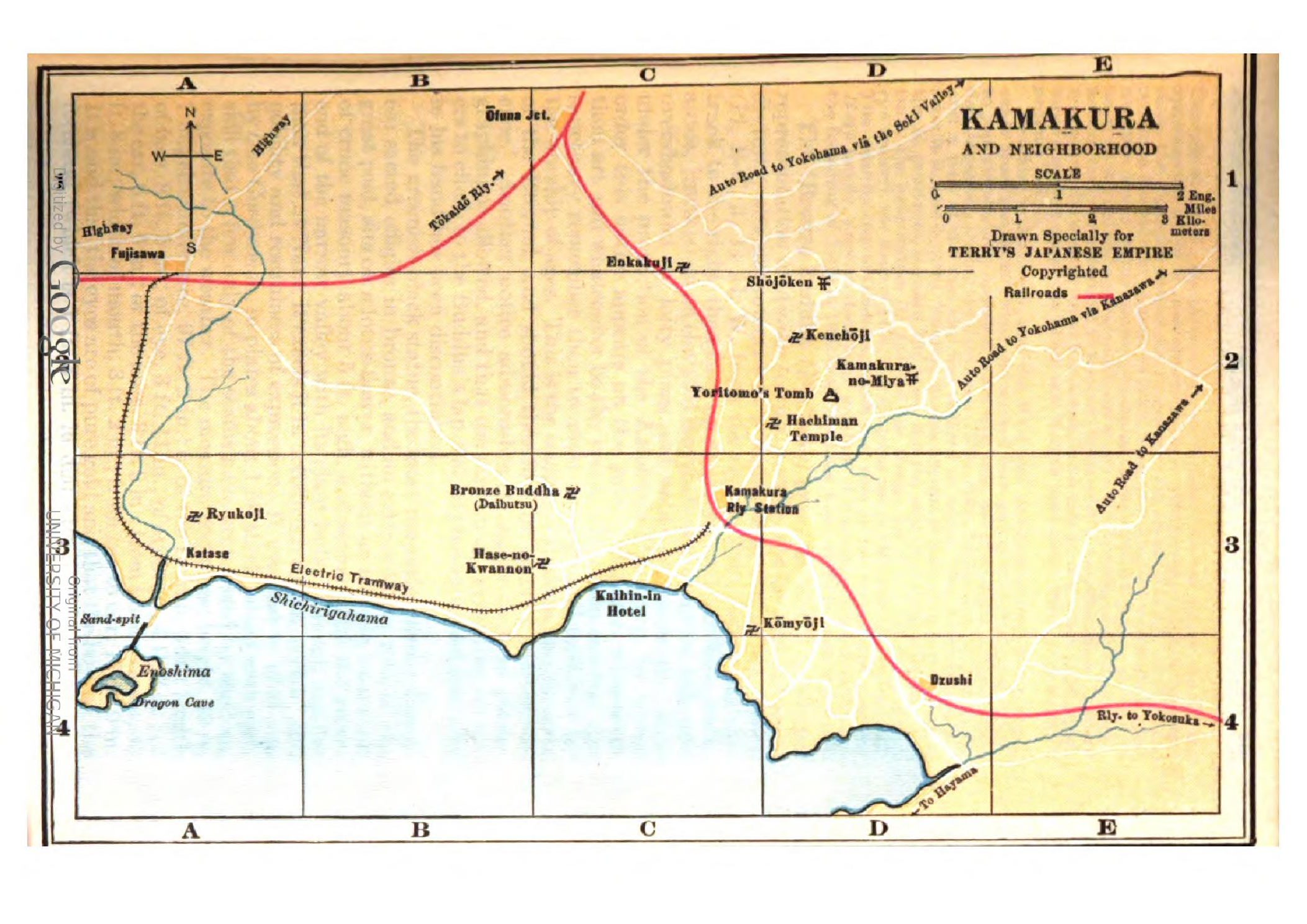
Map: Kamakura and Neighborhood
地図:鎌倉とその周辺
このページの翻訳・編集注
28ページと29ページの間に挿入された無番号の地図です。
Temple at the N., the promontory which leads into the sea at the E., the opposite one at the W., and the sea at the S. After the downfall of the Minamoto, the Fujiwara shogun and members of the Imperial family continued to reside at Kamakura: palaces, temples, residences of nobles were built in great number, and a happy, active population of over 200,000 people are said to have once lived and worked and loved where a fishing-village and a few storm-beaten temples now stand to remind the traveler of vanished glory. History records that a century after Yoritomo's death this great military capital sheltered a million people; in which case it must have been almost as large as the present Tokyo.
北は八幡宮、東西は海へ突き出す二つの岬、南は海によって区切られていた。源氏の没落後も、藤原将軍や皇族は鎌倉に住み続け、宮殿、寺院、貴族の邸宅が数多く建てられた。いまは漁村と、風雨にさらされた数寺が往時の栄華を旅人に伝えるだけだが、かつては20万を超える活気ある人々がここに暮らし、働き、人生を営んだという。頼朝の死から一世紀後、この軍事都市には100万人が住んでいたとも記録され、それが事実なら現在の東京に近い規模であったことになる。
Besides the Minamoto, and the Hojo and Ashikaga rulers, Nichiren and other Buddhist zealots lived and worked here, and in their time passed away to join the shadowy ancestral hosts who form the prototypes of the present-day Japanese. During the Genko war (1333), Nitta Yoshisada took Kamakura, and a part of the vast city was reduced to ashes. The Ashikaga shoguns rebuilt it, and in 1349, Takauji, having appointed his son Motouji regent of the E. provinces, installed him here. But the civil wars of the following century, the substitution (in 1439) of the Uesugi for the Ashikaga as Kwan-ryo (rulers), the siege of 1454, and the great fire of 1526 laid the city in ruins. The near-by city of Odawara, which next rose as the seat of the powerful Hojo family, drew to itself large numbers of Kamakura's inhabitants, and the founding of Yedo in 1603 dealt it a blow from which it never recovered.
源氏、北条氏、足利氏の支配者に加え、日蓮をはじめとする熱烈な仏教者もここで活動し、やがて世を去って、現代日本人の原型をなす祖先の列へ加わった。元弘の乱(1333年)では新田義貞が鎌倉を攻略し、広大な市街の一部は灰燼に帰した。足利将軍家が再建し、1349年には尊氏が子の基氏を東国の執権としてここに置いた。しかし翌世紀の内戦、1439年の管領交代、1454年の包囲、1526年の大火によって町は荒廃した。その後、強大な北条氏の本拠として栄えた近隣の小田原が鎌倉の住民を大勢吸収し、1603年の江戸開府は、鎌倉に回復不能の打撃を与えた。
The *Bronze Buddha (Daibutsu; pron. die-boots'), a colossal representation of Amida (comp. p. ccii), the favorite Japanese divinity, sits unprotected in a sequestered fold of the valley (Pl. B-C, 3) 1 1/2 M. W. from the rly. station (follow the car-track to the right, then turn up at the right; 15-20 min. walk: autos, jinrikis) on an elevated site sheltered by green hills and overshadowed by lofty pines and noble cryptomerias. It is under the protection of the Kotoku-in Monastery, by whose order this notice appears on the gate: 'Stranger, whosoever thou art and whatsoever be thy creed, when thou enterest this sanctuary remember thou treadest upon ground hallowed by the worship of ages. This is the temple of Buddha and the gate of the Eternal, and should therefore be entered with reverence.' Another notice admonishes strangers that no photographing is allowed, and that the custom of permitting travelers to climb to the Buddha's lap and be photographed standing in his hand has been discontinued.
*青銅の大仏(Daibutsu、発音は「ダイ・ブーツ」)は、日本で広く信仰される阿弥陀を表した巨像である(202ページ参照)。鉄道駅の西1と1/2マイル(線路沿いに右へ進み、さらに右へ上る。徒歩15〜20分。自動車・人力車あり)、人里離れた谷間の高台に、覆いもなく座している(図B-C・3)。周囲は緑の丘に守られ、高い松と見事な杉が影を落とす。高徳院の管理下にあり、門には同院の命による次の掲示がある。「旅人よ、あなたが何者で、いかなる信仰を持とうとも、この聖域に入るときは、長い世代の礼拝によって清められた地を踏んでいることを忘れてはならない。ここは仏の寺であり、永遠への門である。ゆえに敬意をもって入るべきである。」別の掲示では写真撮影を禁じ、旅行者を大仏の膝に登らせ、その手の上に立って撮影させる習慣は廃止されたと告げている。
The greenish-black statue, the most majestic among Japanese sacred effigies in bronze, and an extraordinary relic of the great past, sits on a lotus-flower, without an aureole, on a socle of crude masonry about 5 ft. high, and seems to fill the entire end of the narrow valley with its giant bulk. Though smaller than that at Nara, it excels it in artistic execution, repose, and nobility and restfulness of expression. It was cast in 1252 A.D. by Ono Goroyemon, in plates about 1 in. thick joined with such skill that a few only of the seams have been bared by the long exposure to the weather. The measurements are: height, 49 ft. 7 in.; circumference, 97 ft. 2 in.; c. of the thumb, 3 ft.; length of face, 8 ft. 5 in.; of eye, 3 ft. 11 in.; of eyebrow, 4 ft. 2 in.; of the ear, 6 ft. 6 in.; of the nose, 3 ft. 9 in.; from knee to knee, 35
緑がかった黒色の像は、日本の青銅製聖像のなかでも最も荘厳なものの一つであり、偉大な過去を伝える並外れた遺物である。光背を持たず、高さ約5フィートの粗い石積みの台座上で蓮華に座し、その巨大な量感によって狭い谷の奥を埋め尽くすように見える。奈良の大仏より小さいが、造形、静けさ、表情の気高さと安らぎでは勝っている。1252年、小野五郎右衛門が厚さ約1インチの板を巧みに接合して鋳造したもので、長年風雨にさらされながら、継ぎ目が露出した箇所はわずかしかない。寸法は、高さ49フィート7インチ、周囲97フィート2インチ、親指の周囲3フィート、顔の長さ8フィート5インチ、目3フィート11インチ、眉4フィート2インチ、耳6フィート6インチ、鼻3フィート9インチ、両膝の間35
このページの翻訳・編集注
原本画像と照合して英文を校正し、日本語訳を校閲しました。綴り、表現、歴史認識は原著の記録性を尊重して残しています。
ft. 8 in.; width of mouth, 3 ft. 2 in.; from ear to ear, 17 ft. 9 in. It is said that the eyes are of pure gold and that the boss on the forehead (which is 1 ft. 3 in. in diameter and represents the jewel which sheds a radiance over the universe) contains 30 lbs. of pure silver. There are 830 curls on the head, each 9 in. high, and supposed to represent the snails which, according to the legend, once crawled up the original Buddha to shelter his bald head from the burning sun! When completed, the statue (which weighs 450 tons) was inclosed in a building 50 yds. sq. with a massive roof supported by 63 immense keyaki-wood columns: this structure was destroyed by a tidal wave in 1369, as was a similar one in 1494 — since when the image has remained unhoused. Some of the foundation stones still stand. Inside the head (entrance fee, 2 sen) is a standing gilt figurine of Amida backed by a gilded mandorla. The inscriptions on the bronze tablets refer to the history of the image. The nobly proportioned head, bent forward slightly as if weighted with the wisdom of the ages, imparts the impression of profound meditation; the serene majesty of the calm, beautiful, pure Hindu type of face combines wonderful peace with complete detachment from its environment. A vague luster as of glinting gold slants out from the half-closed, all-seeing eyes, while the whole body indicates absorption, lack of tension, and the blessed peacefulness of nirvana. The mouth is closed tightly; the hands rest in the lap, the thumbs touching each other.
フィート8インチ、口の幅3フィート2インチ、両耳の間17フィート9インチ。両目は純金、額の白毫は直径1フィート3インチで、宇宙を照らす宝珠を表し、純銀30ポンドを含むという。頭髪の巻毛は830個あり、一つが高さ9インチ。伝説では、焼けつく太陽から釈迦の禿頭を守るため、かつて這い上がったカタツムリを表すという。重さ450トンの像は完成時、63本の巨大な欅柱が大屋根を支える、一辺50ヤードの堂内に安置された。この建物は1369年の津波で壊れ、1494年に建てられた同様の堂も破壊されて以来、像は露座のままである。礎石の一部はいまも残る。頭部内部(拝観料2銭)には、金色の光背を負う阿弥陀の小さな金色立像がある。青銅板の銘文は大仏の由来を記す。均整の取れた頭部は、積年の英知の重みに耐えるようにわずかに前へ傾き、深い瞑想を思わせる。穏やかで美しい、純粋なインド型の顔が示す静かな威厳には、見事な平安と周囲からの完全な超然が同居する。半眼の、すべてを見通す目からは金色のほのかな光が斜めに差すようで、全身は没我、緊張からの解放、涅槃の祝福された平安を表す。口は固く閉じ、両手は膝上に置かれ、親指が触れ合っている。
The Temple of Hase-no-Kwannon (Pl. B-C, 3), a dilapidated, barn-like structure founded (perhaps) by the Empress Gensho in A.D. 736, dates from the 15th cent. and stands a short way to the left of the Daibutsu, on a lofty terrace whence sweeping views of Kamakura and the surrounding country may be had. Foreigners visit it usually for a glimpse of the huge carved and gilded figure (comp. Hase-dera, Rte. 34) of the Eleven-faced Kwannon, which stands in a darksome retreat behind folding doors opened for 10-20 sen. The bronze figure facing the apartment represents Dainichi Nyorai, and was a gift to the temple by the Ashikaga shogun, Yoshimasa.
長谷観音堂(図B-C・3)は、大仏の少し左手、鎌倉と周辺を広く見渡せる高台に立つ、納屋のような古びた建物である。736年に元正天皇が創建したともされるが、現存する堂は15世紀のもの。外国人が訪れる主な目的は、10〜20銭を納めて折戸を開けてもらい、暗い奥に立つ巨大な木彫金色の十一面観音像を見ることである(長谷寺、Route 34参照)。その部屋に向かい合う青銅像は大日如来で、足利将軍義政が寺へ寄進した。
The Temple of Hachiman, on Tsurugaoka Hill (Pl. D, 2), 10 min. walk to the N. of the rly. station, and at the N. terminus of the splendid old pine-flanked avenue which leads up from the (1 M.) ocean, is one of the most important of the temples dedicated to Ojin Tenno, the Japanese Mars.
鶴岡の丘にある八幡宮(図D・2)は、鉄道駅から北へ徒歩10分。海(1マイル)から延びる、古い松並木の見事な参道の北端に位置する。日本の軍神に当たる応神天皇を祀る社寺のうち、最も重要なものの一つである。
Ojin Tenno, the 15th Mikado (A.D. 201-310) was the son of the Empress Jingo, whom history enshrines as a woman distinguished for beauty, intelligence, piety, energy, and warlike spirit. When accompanying her husband, Chuai Tenno, to suppress a revolt in Kyushu, she learned that it had been instigated by the ruler of one of the Korean principalities, and forthwith she counseled the invasion of that country. The Emperor demurred, but soon thereafter died, and the Empress, keeping his death a secret, acting as a Regent for her unborn son, and accompanied by her faithful counselor, Takeshi-uchi no Sukune, or Takenouchi (the Japanese Methuselah, who died aged 306 yrs., and who was a favorite subject with the early color-print makers), fitted out a fleet, clad herself in manly armor, invaded Korea and subdued it. The popular belief is that the future war-god's pre-natal spirit animated her and enabled her to perform this great undertaking, and from this circumstance a number of temples were erected to him and in time he
第15代の応神天皇(201〜310年)は神功皇后の子である。皇后は、美貌、知性、信心、活力、武勇に秀でた女性として歴史に刻まれている。夫の仲哀天皇に従って九州の反乱鎮圧へ赴いた際、その背後に朝鮮半島の一国の支配者がいると知り、直ちに同地への侵攻を進言した。天皇はためらったが間もなく没し、皇后はその死を秘して、まだ胎内にいた皇子の摂政として振る舞った。忠実な助言者、武内宿禰(306歳で没したという日本のメトセラで、初期の錦絵師が好んだ題材)を伴い、艦隊を整え、自ら男装の甲冑をまとって朝鮮へ侵攻し、これを服属させたという。民間では、未来の軍神の胎内にある霊が皇后を奮い立たせ、この大事業を成し遂げさせたと信じられた。このため応神を祀る社寺が数多く建てられ、やがて応神は
このページの翻訳・編集注
原本画像と照合して英文を校正し、日本語訳を校閲しました。綴り、表現、歴史認識は原著の記録性を尊重して残しています。
became the tutelar of the Minamoto clan. In 712, the Empress Gemmei had a shrine erected to him at Usa, in Buzen, and on the occasion of its dedication 8 white banners were seen to descend from heaven! In consequence of this miraculous apparition the shrine received the title of Yahata-no-Yashiro, or 'Sanctuary of the Eight Banners,' and Ojin was honored with the canonical title of Hachiman (Chinese: 'eight banners') Dai-jingu. In later times, the Buddhist priests, who were endeavoring to amalgamate Shinto with their own creed, discovered that Ojin incorporated the eight incarnations of a Bosatsu, and thereafter Buddhists and Shintoists alike worshiped him as the God of War.
源氏の守護神となった。712年、元明天皇は豊前の宇佐に応神を祀る社を建て、その鎮座祭では八流の白旗が天から降ったという。この奇瑞により社は「八幡の社」、すなわち「八つの旗の聖所」と呼ばれ、応神には八幡大神という神号が贈られた。後世、神道を仏教へ取り込もうとした僧侶たちは、応神が菩薩の八つの化身を備えると説き、以来、仏教徒と神道家の双方が軍神として崇拝した。
Between the yrs. 1041-1108 another Hachiman sprang up in the person of Minamoto Yoshiie, oldest son of Yoriyoshi; the father prayed to Hachiman for a brave and warlike son and was rewarded by one who gained such renown that he is remembered as one of the most valiant and dashing characters of the Middle Ages. The father named him Hachiman-Taro, or 'First-born son of Hachiman.' Numerous shrines and temples stand to both the Hachimans throughout the country, and to them youths go to pray for valor; mothers to commend their sons to their keeping in time of war; and wives to plead for the safety of their husbands. (Comp. Yawata Hachiman, Rte. 27).
1041〜1108年には、源頼義の長男・義家という、もう一人の「八幡」が現れた。頼義は勇猛な男子を授かるよう八幡に祈り、中世屈指の勇壮な武将として名を残す子を得た。父は彼を八幡太郎、すなわち「八幡の長男」と名づけた。全国には二人の八幡を祀る社寺が数多くあり、若者は勇気を願い、母は戦時の息子の加護を託し、妻は夫の無事を祈る(八幡、Route 27参照)。
The approach to the temple is unusually picturesque; the broad lotus-pond in the lower yard, near the big drum-bridge, is a glory in August. The aged icho tree, said to be over a thousand years old, near the wide steps leading to the upper terrace, is of considerable historical significance to the Japanese, since it sheltered the high-priest Kugyo, who in 1219 murdered the 3d (and last) Minamoto shogun, Sanetomo, as he was descending the steps from the temple. The present structure, in the Ryobu-Shinto style, dates from 1828 and occupies the site of one destroyed by fire. The immense wooden doors, swung on pivots let into soffits, are heavily embossed after the Moorish manner. The temple proper contains nothing to interest the traveler, but in the arcade which surrounds it on 3 sides (fee, 10 sen) is an interesting collection of ancient arms and armor, numerous relics of Ieyasu and of other shoguns; some sculptured wood images ascribed to Unkei; a curious old conch-trumpet, etc.
社への参道はひときわ絵になる。下段の境内にある大きな太鼓橋近くの広い蓮池は、8月には見事である。上段へ続く幅広い石段のそばには、樹齢千年を超えるという老イチョウがあり、日本人にとって歴史上重要な木である。1219年、源氏三代目にして最後の将軍・実朝が社から石段を下りてきたところを暗殺した別当公暁が、この木に身を隠したからである。現在の建物は両部神道様式で、焼失した建物の跡に1828年に建てられた。軒下の受けに軸をはめて開閉する巨大な木戸には、ムーア風の重厚な浮彫が施されている。本殿自体には旅行者の興味を引くものは少ないが、三方を囲む回廊(拝観料10銭)には、古い武器と甲冑、家康その他の将軍の遺品、運慶作と伝わる木彫像、珍しい古法螺貝などが展示されている。
The *Kenchoji (Pl. D, 2), a huge, sadly time-stained temple founded by the bonze Doryu in 1253 (during the Kencho Era, whence its name), is the seat of a subdivision of the Rinzai branch of the Zen sect (p. cxcix) of Buddhists, and stands well back from the road 1/2 M. N.E. of the Hachiman Temple. It is reached by following the highway up through a deep cut in the hills, then past a line of houses and gardens amid bamboo groves, lofty trees, and a riot of semi-tropical vegetation. A big bronze bell swings in a low tower at the right of the colossal inner gate, and as one crosses the threshold of this and passes from the lively thoroughfare, vocal with children's voices, to the ancient grove of giant cryptomerias and junipers, where the whitening skeletons of the vast fanes repose amid a solemn spiritual solitude, the contrast is abrupt and complete. Save for the thin wind which sighs and moans almost ceaselessly through the lofty trees (as if lamenting the vanished splendor of shogunal days), a strange and penetrating melancholy,
*建長寺(図D・2)は、八幡宮の北東半マイル、街道から奥まった場所に立つ、歳月の染みが痛ましいほど残る巨大な寺である。建長年間の1253年、僧道隆が創建し、年号にちなみこの名を得た。仏教禅宗の臨済宗(199ページ)の一派の本山である。丘を深く切り通した街道を上り、竹林、高木、旺盛な亜熱帯植物に囲まれた家並みと庭を過ぎると着く。巨大な内門の右手、低い鐘楼には大きな青銅の鐘が吊られている。子どもの声が響く活気ある街道から門をくぐり、巨大な杉とビャクシンの古い林へ入ると、荘厳で霊的な静寂の中に大伽藍の白みかけた骨組みが横たわり、その対照は突然で完全である。高木の間をほとんど絶えず細い風がため息をつき、うなるように渡るほかは静かで、その風は将軍時代の失われた栄華を嘆くかのようである。そこには奇妙で胸に染みる憂愁が
このページの翻訳・編集注
原本画像と照合して英文を校正し、日本語訳を校閲しました。綴り、表現、歴史認識は原著の記録性を尊重して残しています。
accentuated by the effects of a hoary antiquity, broods above the place, and suggests the mutability of temporal things. 'The weirdness of decay manifest in the temples, the neutral tones of the old timbers, the fading spectral grays and yellows of wall surfaces, the eccentricities of the joints, the carvings of waves and dragons and demons, once splendid with lacquer and gold, now time-whitened to the tint of smoke, and looking as if about to curl away like smoke and vanish, are all very striking.'
古色蒼然たる歳月の作用によっていっそう深まり、境内を覆い、現世のものが移ろうことを思わせる。「寺々に現れた崩壊の異様さ、古材のくすんだ色、壁面から消えかける亡霊のような灰色と黄色、継ぎ目の不規則さ、波、龍、鬼の彫刻。かつて漆と金に輝いたものが、いまは時によって煙色に白み、煙のように巻き上がって消え去ろうとしているかに見える。そのすべてが強く心を打つ。」
The most conspicuous figure of the interior is a huge seated Jizo of nondescript workmanship; the faded wood panels at the right and left are well carved and are erroneously attributed to the great Hidari Jingoro. The weather-beaten bird-panels of the coffered ceiling are ascribed to Kano Motonobu, and the 100 standing figurines of Jizo, to Eshin. The brilliant sunlight of seven centuries has robbed every fitment of the interior of its youth and freshness, and the dark tiled floor adds to the drab effect. Behind the main edifice is a very large, painfully old, but withal sturdy structure, with a remarkable thatched roof and hoary timbers that appear to be held in place by sheer force of will; the interior is uninteresting. — The visitor with time to spare should not fail to climb the steepish hill (Shojoken) behind the temple and inspect the popular shrine on its summit — dedicated to Hanzobo, a mythical hobgoblin whose good offices are insured by means of the myriad paper prayers stuck flag-like in the earth along the avenue leading to the top. Proceeding to the rear (left) of the Kenchoji, we follow the picturesque path to its intersection with a cross-path, where a signboard points the way. Beyond the tea-house the lane (flanked by fine cherry trees) leads to a series of new stone steps that zigzag upward to the shrine.
堂内で最も目立つのは、出来栄えにさほど特色のない巨大な地蔵坐像である。左右の色あせた木彫欄間は見事だが、名工・左甚五郎作という伝承は誤りである。格天井の風雨に傷んだ鳥の絵は狩野元信作、100体の地蔵立像は恵心作とされる。七世紀にわたる強い日差しが堂内のあらゆる装飾から若々しさと鮮明さを奪い、暗い瓦敷きの床が沈んだ印象を強める。本堂の背後には、見るからに古いが頑丈な大建築がある。目を引く茅葺屋根と古びた材木は、意志の力だけで形を保っているかのようで、内部には見るべきものがない。時間のある旅行者は、寺の背後にあるやや急な勝上嶮を登り、頂上の人気ある半僧坊を訪れるとよい。半僧坊は神話上の天狗で、頂上への参道沿いには、その加護を願う無数の紙札が旗のように地面へ立てられている。建長寺の左奥へ進み、絵になる小道を交差路までたどると道標がある。茶店の先では、立派な桜並木の小道が、新しい石段へ続き、社までジグザグに上っている。
Two large bronze repulsive Tengu guard the structure, which rests like an eagle's nest on a small plateau cut from the mt. side; the cap of the scarp rises steeply behind it, and into its face are let tablets referring to the history of the shrine and to the generosity of those who made it possible. The view from the atrium, over the wide and deep valley far below to the distant mts. and sea is glorious. The air is sweet with piny odors and surcharged with charm and a wondrous tranquillity. A host of lovely flowers, prominent among them cherry blossoms and azaleas, add color harmony. Bronze and stone lanterns, monuments, mortuary tablets, and much mystic paraphernalia sit about the yard, while within the building are many brass fitments, an attractive high altar, and numerous kakemono. From the end of the terrace one looks far down the wooded vale to the gigantic, weather-beaten roofs of the old Kenchoji, embowered in its dense grove, whence anon there rides up on the vagrant breeze, the deeply resonant, melodiously rich tones of its fine bronze bell — mellowed by the sum-
大きく恐ろしげな二体の青銅天狗が社を守る。建物は山腹を削った小さな平場に鷲の巣のように載り、背後には崖の上端が急にそびえる。崖面には社の由緒と、建立を可能にした寄進者の篤志を記す石板がはめ込まれている。前庭からは、はるか下の広く深い谷を越えて遠山と海を望み、眺望は壮麗である。空気は松の香りに甘く、魅力と不思議な静けさに満ちる。桜とツツジを中心に多くの美しい花が色彩の調和を添える。境内には青銅や石の灯籠、記念碑、墓碑、さまざまな宗教用具が並び、社内には多くの真鍮金具、魅力的な高い祭壇、数々の掛物がある。テラスの端から木深い谷を見下ろすと、密林に包まれた古い建長寺の巨大な、風雨に傷んだ屋根が見える。時おり気まぐれな風に乗り、立派な青銅鐘の深く響く、豊かで美しい音色が上ってくる。その音は七百年の夏の
このページの翻訳・編集注
原本画像と照合して英文を校正し、日本語訳を校閲しました。綴り、表現、歴史認識は原著の記録性を尊重して残しています。
mer suns of 700 yrs., but still vibrant with its booming challenge to Buddhism and nirvana. At one end of the terrace stands a lighthouse that serves as a beacon to those who toil up the steep slope at night to lay their griefs before the goddess within the shrine. At the right of the top of the steps is still another shrine, dedicated to the benevolent Jizo, protector of little dead children. At the left is a converging flight of steps which leads (between twin lines of chains) over many gnarled and twisted tree roots to the crest of the hill. The view from the top, over a thousand square miles of wooded hill and valley land, of rippling sun-kissed sea, and glistening, snow-capped volcanoes, is entrancing. Out over the lowlands toward Yokohama one sees many miles of cultivated patches of various shades of green; tiny hamlets tucked away at the base of bold hills; miles and miles of roadway stretching between; and a towering mt. range on the distant skyline. Seaward the wonderful cone of Fuji, the smoking crater of Oshima, the crescent-shaped beach of Kamakura, and the gem-like island of Enoshima are the chief features in the line of vision. — Ladies usually find the descent easiest when keeping outside the chain and maintaining it as a support at the right. — Regaining the main road and following it (right) to the point where it crosses the rly., then continuing along it to a cluster of houses where (1/4 M.) two tall torii stand astride it, one enters the grove (right) which envelops
陽光によってまろやかになりながらも、仏法と涅槃を告げる轟く呼び声として、なお力強く振動している。テラスの一端には灯台があり、夜、急坂を苦労して登り、社内の女神に悲しみを訴えに来る人々の道標となる。石段上の右手には、幼くして死んだ子どもを守る慈悲深い地蔵を祀る別の社がある。左手には合流する石段があり、左右二列の鎖の間を、節くれ立ってねじれた木の根を越えながら丘の頂へ導く。頂上から眺める、千平方マイルに及ぶ森林の丘と谷、陽光を浴びて波打つ海、雪を戴いて輝く火山の景観は、人を魅了する。横浜方面の低地には、さまざまな緑色の耕作地が何マイルも続き、険しい丘の麓に小村が隠れ、その間を道が延々と結び、遠い地平には高い山並みがそびえる。海側では、富士の見事な円錐、大島の煙る火口、三日月形の鎌倉海岸、宝石のような江ノ島が主な眺めとなる。女性は鎖の外側を歩き、右手で鎖を支えにすると下りやすい。本道へ戻って右へ進み、鉄道を横切る地点を越え、家並みのある場所まで約4分の1マイル進むと、道をまたぐ二基の高い鳥居があり、その右手の林へ入る。そこに包まれているのが
The Enkakuji ('remote temple'), a spot beautiful with flowers and lissome bamboos. The curious pagoda-like granite monument rising from a tortoise at the left of the terrace, was erected by popular subscription to commemorate the Kamakura men who perished in the Japan-Russia War. The several shallow caves behind it are not always free from large (5 ft. or more long) grayish-green venomous serpents called aodaisho, and other reptilia. — The chief object of the temple interior, a big gilt Buddha backed by a huge mandorla, is not as interesting as the Great Bell, the largest in Kamakura, which hangs in a massive, vermiculated belfry at the summit of 148 dilapidated steps leading upward from the wood torii opposite the big gate. It dates from A.D. 1201, is 4 ft. 7 in. in diameter, 6 in. thick at the lip, weighs over a ton and is 8 ft. high. In the small shrine, hard by the tower, are a number of curious paintings illustrating an ancient procession between Kamakura and Enoshima, and said to be upward of 600 yrs. old. — As indicated at p. 28, the walk hence over the highroad to Ofuna Jct. is no farther than the return to the Kamakura Station.
円覚寺(「遠い寺」の意)であり、花としなやかな竹が美しい場所である。テラス左手には亀の上から立ち上がる奇妙な多層塔形の花崗岩碑があり、日露戦争で没した鎌倉出身者を追悼するため、民間の寄付で建てられた。背後の浅い洞窟には、体長5フィートを超える灰緑色の毒蛇「アオダイショウ」その他の爬虫類がいることもある。堂内の主尊である、大きな光背を負う金色の大仏よりも、鎌倉最大の洪鐘のほうが興味深い。鐘は大門向かいの木造鳥居から、荒れた148段を登った先の、重厚で虫食い状の肌を持つ鐘楼に吊られている。1201年の鋳造で、直径4フィート7インチ、口縁の厚さ6インチ、重さ1トン以上、高さ8フィート。鐘楼そばの小社には、鎌倉と江ノ島の間を進む古代の行列を描いた、600年以上前という珍しい絵がいくつかある。28ページで述べたとおり、ここから街道を大船分岐駅へ歩いても、鎌倉駅へ戻るのと距離は変わらない。
The Kamakura-no-miya (Pl. D, 2), a Shinto shrine erected in 1869 to the memory of the Emperor Go-daigo's son, stands about 3/4 M. N.E. of the Hachiman Temple, and is of purely historical interest. The cavern in which Oto-no-miya was imprisoned after his unsuccessful attempt to overthrow the feudal
鎌倉宮(図D・2)は、後醍醐天皇の皇子を記念して1869年に建てられた神社で、八幡宮の北東約4分の3マイルにある。興味の中心はもっぱら歴史にある。大塔宮が封建政権の打倒に失敗した後、幽閉された洞窟は、
このページの翻訳・編集注
原本画像と照合して英文を校正し、日本語訳を校閲しました。綴り、表現、歴史認識は原著の記録性を尊重して残しています。
gov't, is a dank place cut from the hill behind the shrine and defended by a fence and closed doors. Between the shrine and Hachiman, at the end (right) of a converging roadway, on a narrow terrace cut from the hill, in a small inclosure, is the neglected tomb of the great Minamoto Yoritomo. Other equally dilapidated ones stand roundabout. — Almost every grove in Kamakura contains a weather-beaten temple or shrine, and every hill and valley for miles around is heavy with the bones of dead notables. Minor temples are the Komyoji; the Kokuonji, with numerous large images ascribed to Unkei, but far more likely the work of some later artist; and the Ennoji, with a sculptured figure of Emma-o also attributed to Unkei and called 'work of the revived Unkei,' from the circumstance that the Regent of Hell is reputed to have returned the master to earth with the injunction not to come back until he had carved a good image of him. The Sixteen Pools (Ju-roku-ido), where Kobo-Daishi is said to have bathed, are not worth visiting.
社の背後の丘をくり抜いた湿った場所で、柵と閉ざされた扉に守られている。鎌倉宮と八幡宮の間、道が合流する地点の右端、丘を削った狭いテラスの小さな囲いには、源頼朝の荒れた墓がある。周囲には同じように傷んだ墓が並ぶ。鎌倉では、ほとんどすべての木立に風雨にさらされた寺社があり、何マイルにも及ぶ丘と谷は、亡くなった名士の遺骨で満ちている。小寺には光明寺、運慶作とされる多数の大像を持つ国恩寺(実際には後世の作である可能性が高い)、運慶作と伝わる閻魔王像を持つ円応寺がある。閻魔像は「生き返った運慶の作」と呼ばれる。地獄の王が運慶を地上へ戻し、自分のよい像を彫り終えるまで戻ってくるなと命じたという伝説による。弘法大師が沐浴したという十六井は、訪れるほどのものではない。
A stretch of fine sanded beach (Yuigahama) lies crescent-shaped behind the hotel, and is the delight of children. When strong winds blow inland a heavy sea pounds the sand into huge dunes. In calm weather the foam-crested rollers bring in a myriad seed-clams that bury themselves with whimsical rapidity as soon as they strike the beach — which here is patrolled by men and women who pick up the many varieties of seaweed tossed up by the waves, and watch the fishing-boats come in and unload their queer cargoes of marine creatures. On this beach, in the 13th cent., the emissaries of the great Kublai Khan were beheaded as a reminder that the Nipponese did not fear a Mongolian invasion and would not pay tribute to any Mongol prince. The boys in the native town at the E. end often repair hither to fly big kites with long trailing tails. The tall pines between the beach and the hotel bend toward the N. and indicate the direction of the prevailing winds. When the sea is calm, the boat-ride across to the Dragon Cave at Enoshima (consult the hotel manager) is delightful.
ホテルの背後には、細砂の由比ヶ浜が三日月形に延び、子どもたちを喜ばせる。強い風が陸へ吹くと、荒波が砂を打ち上げて巨大な砂丘を作る。穏やかな日には白波が無数の稚貝を運び、浜へ着くやいなや、愉快なほど素早く砂へ潜る。浜では男女が波に打ち上げられた多種の海藻を拾い、漁船が戻って珍しい海の生き物を荷揚げするのを眺めている。13世紀にはこの浜でフビライ・ハンの使節が斬首された。日本人は蒙古襲来を恐れず、いかなる蒙古の君主にも朝貢しないという意思表示であった。東端の町の少年たちは、長い尾を引く大凧を揚げにしばしばここへ来る。浜とホテルの間の高い松は北へ傾き、卓越風の方向を示している。海が穏やかなら、江ノ島の龍窟までの船旅は楽しい(ホテル支配人に相談のこと)。
Enoshima, a strikingly picturesque so-called islet of volcanic tufa about 1 1/2 M. in circumference, rising steeply to about 240 ft. above the sea, and connected with the mainland by a narrow sand-spit covered with water only at high tide, is 4 M. from Kamakura (whence it is visible across the bay), and forms one of the most popular excursions. Tram-cars (densha) leave at frequent intervals from the terminus facing the rly. station, and for some distance flank the celebrated (for beautiful views and fine surf) Shichiri ga hama, or Seven ri shore. One leaves the car at the Katase terminus (Ryukoji Temple; uninteresting), follows the main st. down at the left, and in 8 min. emerges on the causeway and bridge leading to the island. At the far end of the bridge a 3-sen toll is exacted and a ticket
江ノ島は火山性凝灰岩からなる、ひときわ絵になる、いわゆる小島である。周囲約1と1/2マイル、海面から約240フィートまで急にそびえ、満潮時だけ水に覆われる細い砂州で本土とつながる。鎌倉から4マイルで、湾越しにも見え、最も人気のある遠足先の一つである。路面電車は鉄道駅前の終点から頻繁に発車し、美しい眺望とよい波で名高い七里ヶ浜にしばらく沿って走る。片瀬終点(龍口寺は見るほどではない)で下車し、左手の大通りを下ると、8分で島へ続く堤道と橋へ出る。橋の先端では通行料3銭を徴収され、帰りに返す切符を
このページの翻訳・編集注
原本画像と照合して英文を校正し、日本語訳を校閲しました。綴り、表現、歴史認識は原著の記録性を尊重して残しています。
handed the visitor to be returned on leaving. The immense globular baskets strewn along the beach are for imprisoning live fish. The view of Fuji-san at the right, particularly when seen dimly through a ghostly haze, is of almost uncanny beauty. The numerous tea-houses perched in commanding positions on the rocky shore are popular with the natives. A narrow main st., pieced out with stone steps and flanked by numerous byways, zigzags up the hill from the end of the bridge, and is faced by a host of attractive shops.
渡される。浜に点々と置かれた巨大な球形の籠は、生魚を囲っておくためのもの。右手に見える富士山、とりわけ幽霊のような霞越しにぼんやり現れる姿は、ほとんど妖しいほど美しい。岩礁の見晴らしのよい位置に建つ数多くの茶店は地元の人々に人気がある。橋の終点からは、石段で継ぎ足され、多くの脇道が分かれる細い大通りが丘をジグザグに上り、両側には魅力的な店がひしめく。
Enoshima has been called the City of Mother-of-Pearl. 'In every shop, behind the lettered draperies, there are miracles of shell-work for sale at absurdly small prices. The glazed cases laid flat upon the matted platforms, the shelved cabinets set against the walls, are all opalescent with nacreous things, — extraordinary surprises, incredible ingenuities; strings of mother-of-pearl fish, strings of mother-of-pearl birds, all shimmering with rainbow colors. There are little kittens of mother-of-pearl, and little foxes of mother-of-pearl, and little puppies of mother-of-pearl, and girls' hair-combs, and cigarette-holders, and pipes too beautiful to use. There are little tortoises, not larger than a shilling, made of shells, that, when you touch them, however lightly, begin to move head, legs, and tail, all at the same time, alternately withdrawing or protruding their limbs so much like real tortoises as to give one a shock of surprise. There are storks and birds, and beetles and butterflies, and crabs and lobsters, made so cunningly of shells, that only touch convinces one they are not alive. There are bees of shell, poised on flowers of the same material, — poised on wire in such a way that they seem to buzz if moved only with the tip of a feather. There is shell-work jewelry indescribable, things that Japanese girls love, enchantments in mother-of-pearl, hair-pins carven in a hundred forms, brooches, necklaces, and what-not.' — Conspicuous among these dainty trifles are large and small balloon-fish tinted and suspended on bow-shaped frames down which they travel to the delight of children; likewise strings of the greenstone that bears such a close resemblance to coarse jadeite and mentioned at p. cxxiii. Here one notes the rare and exquisitely beautiful glass-sponge called hossugai (Hyalonema Sieboldi), lacy fabrics of tenuous flint fished up as living organisms from a depth of 200 fathoms or more; and the unfailingly strange and interesting sea-horse (Hippocampus heptagonus), or Tatsu-no-otoshigo. The color tones of some of the conchylia are very beautiful, ranging from a delicate pink, through light green and orange to rich heliotrope. Prices everywhere are flexible, and foreigners are asked double and treble for everything.
江ノ島は「真珠母の都」と呼ばれてきた。「どの店にも文字入りの暖簾の奥に、驚くほど安い値段で売られる貝細工の奇跡がある。畳の座に平たく置かれたガラスケースも、壁際の棚付き戸棚も、真珠層の品々で乳白色に輝く。驚異的な意匠、信じがたい工夫。虹色にきらめく真珠母の魚を連ねたもの、鳥を連ねたもの。小さな猫、狐、子犬、少女用の櫛、煙草差し、使うには美しすぎる煙管も、みな真珠母でできている。シリング貨より大きくない貝製の小亀は、どれほど軽く触れても頭、脚、尾を一斉に動かし、手足を交互に引っ込めたり突き出したりする。その動きは本物の亀そっくりで、思わず驚かされる。コウノトリや小鳥、甲虫、蝶、蟹、海老も貝で巧みに作られ、触れてみるまで生きていないとは信じられない。同じ素材の花に止まる貝の蜂は、針金で支えられ、羽根の先で動かすだけで羽音を立てそうに見える。言葉に尽くせない貝細工の装身具、日本の少女が愛する品、真珠母の魔法、百様に彫られた簪、ブローチ、首飾りなどがある。」こうした優美な小物の中でも、彩色した大小のハリセンボンを弓形の枠から吊るし、枠を伝って動かして子どもを喜ばせる玩具が目につく。123ページで触れた粗い翡翠によく似た緑色石の数珠もある。さらに、水深200尋以上から生きた生物として引き上げられる、細い珪質繊維のレースのような、稀少で非常に美しいガラス海綿ホッスガイ(Hyalonema Sieboldi)や、常に奇妙で興味深いタツノオトシゴ(Hippocampus heptagonus)が見られる。貝類の色調には、淡い桃色から薄緑、橙、濃い紫紅色まで、たいへん美しいものがある。どこでも値段は交渉次第で、外国人には何でも二倍、三倍を求める。
The most picturesque spot on the island is the Dragon Cave, so-called because its sinuous shape (370 ft. deep) is that of the dragon which anciently devoured many of the children of the
島で最も絵になる場所は龍窟である。奥行370フィートの曲がりくねった形が、昔、近隣の
このページの翻訳・編集注
原本画像と照合して英文を校正し、日本語訳を校閲しました。綴り、表現、歴史認識は原著の記録性を尊重して残しています。
neighboring village of Koshigoe! In the 6th cent., coincident with a violent earthquake, Enoshima is said to have emerged from the sea, and the Goddess Benten (to whom the island shrines are dedicated), descended from the clouds, married the dragon and thus put an end to his ravages. The credulous believe that a hidden passage connects the cave with Fuji-san, and that lovers who visit it together are sure to be estranged within a year. — The only path to the cavern is that which zigzags up over the summit and is called Chaya-machi from the numerous tea-houses which flank it. The touts for most of these are raucous-voiced, insistent women, who pester the traveler at every step, and essay to force cups of the detestable green tea upon whomsoever pauses for the briefest instant to enjoy the glorious view spread far below. In these cha-yas, which always throughout Japan monopolize the spots whence the finest views are obtainable, marine zoology in its most repulsive forms is cooked and served to the horde of hungry pilgrims (throngs in July-Aug.) who trudge up and down the island byways. From the summit (magnificent panoramas), steps of light gray madrepore twist steeply downward until they reach the base of the cliff (left) where they merge into undulating steps (slippery and perilous when wet) cut from the mother rock.
近隣の腰越村の子供たちを食べた竜の姿に似ているため、この名があるという。6世紀、大地震と同時に江ノ島が海中から現れ、島の諸社に祀られる弁天女神が雲から降りて竜と結婚し、その害を鎮めたと伝えられる。信心深い人々は、この洞窟から富士山へ通じる秘密の道があり、恋人同士で訪れると一年以内に必ず仲違いすると信じている。洞窟へ至る唯一の道は頂上を越えてジグザグに続くもので、両側に茶屋が多いことから茶屋町と呼ばれる。多くの茶屋では、声高で執拗な女客引きが旅行者につきまとい、はるか下に広がる壮観を少しでも立ち止まって眺めようとする者に、ひどい緑茶を無理に飲ませようとする。日本各地で最良の眺望地点を占めるこれらの茶屋では、海の生き物のなかでも特に食欲をそそらないものが調理され、島の小道を上り下りする空腹の参詣者たち(7、8月には大群となる)に供される。頂上からは壮大な展望が開け、淡灰色の珊瑚石の階段が急に曲がりながら下り、左手の崖下で母岩を刻んだ波打つ階段へ続く。雨に濡れると滑りやすく危険である。
The view of the sea hereabout is entrancing, particularly when a whistling N. wind hurries the waves in, to burst into seething foam on the jagged rocks. A plank walk with a railing leads to the cavern mouth (admission 5 sen) where ragged, importunate men, for a 10-sen fee, disrobe, dive to the bottom of the sea, and bring up sea-snails or whatever they may have planted there at low tide. The waves rush into the cavern with a deafening roar; the rocks are of a peculiar pinkish tinge. The shrine at the back is dedicated to Benten. For a 2-sen fee a small boy with a candle leads one into a dripping, subterraneous passage called the dragon's tail. The lateral corridors are supposed to be his wings. — Returning to Katase one may vary the route by boarding the tram-car for (time 15 min.) Fujisawa and returning thence to Yokohama by rly. (Rte. 24).
このあたりの海景は心を奪う。とりわけ北風が笛のように鳴り、波をせき立てて尖った岩に煮え立つ泡となって砕けさせる時が美しい。手すり付きの板道が洞窟口へ続く(入場料5銭)。そこでは、ぼろをまとったしつこい男たちが10銭で服を脱ぎ、海底へ潜って巻貝などを拾ってくる。ただし、干潮時に自分たちで置いておいた物かもしれない。波は耳をつんざく轟音とともに洞窟へ押し寄せ、岩は独特の桃色を帯びている。奥の祠は弁天を祀る。2銭を払うと、蝋燭を持った少年が、水滴の落ちる地下通路「竜の尾」へ案内する。左右の枝道は竜の翼とされる。片瀬へ戻った後は、路面電車で藤沢へ出て(15分)、そこから鉄道で横浜へ戻る別経路もとれる(Route 24)。
From Kamakura the rly. bends broadly to the left and traverses a green, hilly, and picturesque region; the Hase-no-Kwannon Temple is seen on a terrace at the far right; at the left, near the summit of a tall wooded hill, is a curious Chinese-style garden embracing a cluster of shrines and images. As the hills close in, the view narrows and the train runs through a magnificently wooded district where the vegetation thrives with semi-tropic vigor. Every bit of the land, not too steep to afford a footing to the farmer, is under intensive cultivation; the smaller hills show garden plots up to, and over, their summits, and the brown squares of freshly-harrowed soil, awaiting the quickening seed, form color contrasts pleasing to the eye.
鎌倉を出ると鉄道は大きく左へ曲がり、緑の丘が連なる絵のような地方を横切る。右手遠くの高台に長谷観音が見え、左手の樹木に覆われた高い丘の頂近くには、祠や像を集めた珍しい中国風庭園がある。丘が迫るにつれて眺めは狭まり、列車は亜熱帯を思わせる勢いで植物が繁る、見事な森林地帯を走る。農夫が足場を得られないほど急な場所を除けば、土地は隅々まで集約的に耕されている。低い丘では畑が頂上まで、さらに頂を越えて続き、種を待つ耕したての褐色の区画が、目に快い色の対照をなしている。
このページの翻訳・編集注
原本画像と照合して英文を校正し、日本語訳を校閲しました。綴り、表現、歴史認識は原著の記録性を尊重して残しています。
Many of the straw-thatched huts have rows of lilies growing on their roof ridges.
藁葺き小屋の多くでは、屋根の棟に沿って百合が列をなして咲いている。
15 M. Dzushi (zoo'-she), a popular seaside resort on the W. side of the peninsula overlooking Sagami Bay, lies 1/2 M. right of the rly. amid lovely surroundings. A number of Yokohama people have seaside cottages here. The fine automobile road continues down the W. shore to Hayama ('foothill'), a delightful retreat where certain members of the Japanese nobility have country villas (besso). Excellent sea-bathing and enchanting views of Fuji-san. — The rly. now bears to the left and crosses the peninsula to the E. shore, cutting through many tall green hills flanked by valleys diapered with rice-fields. The highway at the left connects Dzushi with Kanazawa and forms a cross-country link between the road skirting the E. shore from that point and the section between Dzushi and Misaki at the extreme end of the peninsula. The two roads unite near Kikuna, and motorists from Yokohama often proceed from Kamakura to Dzushi, thence through Hayama and Akiya to Misaki, and back via Kikuna, Uraga, and Yokosuka. While the trip is beautiful at any season, it is doubly so on a clear day (all too rare in spring) when the broad stretch of sea and the mainland beyond are visible along with Fuji and other giant mts.
15マイル地点の逗子(発音 zoo'-she)は、半島西岸から相模湾を望む人気の海浜保養地で、鉄道の右手半マイル、美しい環境のなかにある。横浜の人々のなかには、ここに海辺の別荘を持つ者も多い。立派な自動車道は西岸を南へ進み、葉山(「山の麓」の意)へ続く。葉山は快適な避暑地で、日本の華族の一部が別荘を構えている。海水浴に適し、富士山の眺めも魅惑的である。鉄道はここから左へ向きを変え、半島を横断して東岸へ向かう。水田を敷き詰めた谷を両側に従える、緑濃い高い丘をいくつも切り抜けて走る。左手の街道は逗子と金沢を結び、金沢から東岸沿いに延びる道と、逗子から半島最南端の三崎へ向かう道を内陸でつないでいる。二つの道は菊名付近で合流する。横浜からの自動車旅行者は、鎌倉から逗子へ進み、葉山・秋谷を経て三崎へ至り、菊名・浦賀・横須賀経由で戻ることが多い。この旅はどの季節も美しいが、晴天の日には格別である。春には残念ながら晴天が少ないものの、広い海とその向こうの陸地、富士山その他の高峰を一望できる。
The tall hill seen at the right after leaving Dzushi is Futagoyama. Many splendid specimens of evergreen Coniferae, flowering Bignoniaceae, and wild vines add color to the verdant hills, whose bases are perforated with numerous artificial caves, of no great depth, that shelter tiny shrines or serve the husbandmen as storerooms. If the season be too early for the planting of rice, certain of the paddies are covered with ripening barley, wheat, peas, broad-beans, rape, mustard, onions, or radishes, and each seems to vie with the other in adding some delicate floral tint or shade of green to the lovely prospect. Dense groves of slim bamboos rise here and there like gigantic plumed buggy-whips amid the broader and taller forest trees. The occasional palmettoes, with palm-leaf fans in embryo on their low trunks, impart a sub-tropical aspect to the countryside. When their leaf-stalks decay, they leave a fibrous substance which serves the farmers as flags to frighten off corvine freebooters. Primitive well-sweeps are features of the locality. The train enters a deep cut in the hills, runs upward through a tunnel, then downward through another to the pretty bay and harbor of 18 M. Taura, separated by 4 tunnels from
逗子を出て右手に見える高い丘は二子山である。常緑の針葉樹、花をつけるノウゼンカズラ科の植物、野生の蔓などの見事な姿が緑の丘に彩りを添える。丘の麓には浅い人工洞窟が数多く開けられ、小さな祠を収めたり、農家の物置に使われたりしている。田植えにはまだ早い季節なら、水田の一部は熟しつつある大麦、小麦、豌豆、蚕豆、菜種、芥子、葱、大根などに覆われ、それぞれが繊細な花の色や緑の濃淡を競って美しい眺めをつくる。細い竹の密生した林が、より太く高い森の木々の間から、羽飾りをつけた巨大な鞭のように所々で立ち上がる。低い幹に扇形の葉の芽をつけたシュロが時折見え、田園に亜熱帯的な趣を与える。葉柄が朽ちると繊維質が残り、農民はそれを旗のようにして、略奪に来るカラスを追い払う。原始的な跳ね釣瓶もこの地方の特色である。列車は丘の深い切通しへ入り、トンネルを上り、次のトンネルを下って、18マイル地点の美しい田浦の湾と港へ出る。田浦から先は四つのトンネルを隔てて
19 M. Yokosuka (yo-kos-kah), a picturesque port (pop. 32,000) at the foot of a range of hills scattered over with houses, and overlooking Tokyo Bay. One of the principal gov't arsenals and naval dockyards utilizes the fine landlocked harbor (nearly a mile long), and photographing is forbidden. Visitors are debarred from the dockyards unless equipped with
19マイル地点の横須賀(発音 yo-kos-kah)に至る。人口3万2千、家々の点在する丘陵の麓にあって東京湾を望む、絵のような港町である。長さ約1マイルの優れた内湾には、政府の主要な工廠と海軍造船所の一つが置かれ、写真撮影は禁止されている。訪問者が造船所へ入るには、
このページの翻訳・編集注
原本画像と照合して英文を校正し、日本語訳を校閲しました。綴り、表現、歴史認識は原著の記録性を尊重して残しています。
a permit from the naval authorities. The Naval Artificer's School is under Imperial patronage. The harbor is usually filled with war-craft undergoing repairs, and the town is made martial by the presence of many men-of-war's men. Tourists usually come hither to visit the Grave of Will Adams, the first Englishman who came to Japan. His tomb crowns the summit of a hill, Anjin-zuka ('Pilot Hill') at the rear of the town, 1/2 M. from the station. By following the main st. past the barracks (right) one soon comes to a fork in the road and a bridge, which one crosses, then turns to the left. The narrow st. winds now to the left, now to the right, passing first a small Buddhist temple, then a Shinto shrine behind a tall torii. At the far end of the shrine inclosure, turn sharply to the right, and follow the long st. to the foot of the hill where stands a monument (Anjin Hi) to Adams unveiled in 1912. The inscription (hibun) on the face, in Chinese and Kana characters, apprises the stranger that 'the graves of Will Adams and his wife are on the summit of the hill.' The legend on the back says 'the monument was erected in 1910 by admirers of the exiled pilot'; the names are those of Baron Sufu, Governor of Kanagawa Prefecture; and Sir Claude Maxwell Macdonald (sometime) Ambassador of H.B.M.'s Gov't to Japan.
海軍当局の許可証が必要である。海軍工機学校は皇室の保護下にある。港は修理中の軍艦で埋まっていることが多く、多数の水兵が町に軍港らしい雰囲気を与える。旅行者がここを訪れる主な目的は、日本へ来た最初のイギリス人ウィリアム・アダムズの墓である。墓は駅から半マイル、町の背後にある按針塚(「水先案内人の丘」)の頂に立つ。兵営を右手に見て大通りを進むと、まもなく分かれ道と橋に出る。橋を渡って左へ曲がる。細い通りは左右に曲がりながら、まず小さな仏寺を過ぎ、次いで高い鳥居の奥にある神社を過ぎる。神社境内の突き当たりで鋭く右折し、長い通りを丘の麓まで進むと、1912年に除幕されたアダムズ記念碑(按針碑)が立つ。正面の漢字と仮名による碑文は「ウィリアム・アダムズと妻の墓は丘の頂にある」と旅人に告げる。背面には「この碑は、異国に留め置かれた水先案内人を敬慕する人々により1910年に建てられた」とある。名を連ねるのは神奈川県知事・周布男爵と、かつて英国政府の駐日大使を務めたサー・クロード・マクドナルドである。
The Tombs, which stand on the crest of Tsukayama ('Tomb hill'), are reached first by following the long winding roadway, then ascending the successive flights of stone steps flanked by trees planted by foreign ambassadors. On a clear day the views over the undulating country from points near the summit are very beautiful. The woods are sweet and undefiled, a host of wild flowers grow in the underbrush, and singing birds enliven the neighborhood. The shorter of the twin tombs is that of Adams' Japanese wife. Inscriptions on the several stone lanterns at the base of the socle advise that they were erected to the memory of the pilot and his wife by the residents of Anjin-cho, Nihonbashi (Tokyo), where Adams dwelt for a time. Tea and light refreshments may be had at the custodian's house at the right near the summit. The road which descends the hill at the rear goes to Hayama.
塚山(「墓の丘」)の尾根に立つ二基の墓へは、まず長く曲がりくねる道をたどり、次いで外国大使らが植えた木々に挟まれた石段を幾段も上る。晴天の日、頂上近くから起伏する田園を望む景色はたいへん美しい。森は清らかで香りよく、下草には多くの野花が咲き、鳥のさえずりがあたりを活気づける。二基のうち低い方がアダムズの日本人妻の墓である。台座の下にある数基の石灯籠の銘によれば、アダムズが一時住んだ東京・日本橋按針町の住民が、水先案内人とその妻を記念して奉納したものである。頂上近く右手の管理人宅で茶と軽食をとれる。丘の裏を下る道は葉山へ通じる。
Will Adams, a native of Kent, was sailing-master of a fleet of Dutch trading vessels which set out for the East Indies on a trading expedition in 1598. Owing to a series of misfortunes, most of the ships were wrecked, but Adams arrived at Bungo, April 19, 1600. Because of his knowledge of shipbuilding, mathematics, and foreign affairs in general; and because also he was bluff and honest and unlike the fawning Dutch traders and the shifty Jesuitical Portingalls, he became a great favorite with the Shogun Ieyasu, who by golden promises induced (and perhaps forced) him to stay in Japan, where he was appointed a teacher of mathematics and artillery; was employed as an intermediary with the foreign traders; and was presented with the fief of Hemmi-mura (Yokosuka), in Miura-gori. When Adams realized that he was held in gilded bondage, he married a Japanese woman (by whom he had a son who died young) and changed his name to Miura Anjin — the first word symbolic of the district in which his fief was located; the latter a corruption of pilot, or engineer. He died at Hirado May 16, 1620, and according to the wish ex-
ケント出身のウィリアム・アダムズは、1598年、東インドとの交易を目指して出帆したオランダ商船団の航海長であった。相次ぐ不運で船の大半は難破したが、アダムズは1600年4月19日に豊後へ到着した。造船、数学、さらに海外事情全般に通じていたこと、また率直で誠実な人柄が、へつらうオランダ商人や、原著のいう狡猾なイエズス会系ポルトガル人とは異なっていたことから、将軍家康に大いに気に入られた。家康は魅力的な約束によって、あるいは半ば強制的に、彼を日本へ留めた。アダムズは数学と砲術の教師に任じられ、外国商人との仲介役を務め、三浦郡逸見村(横須賀)に領地を与えられた。恵まれてはいても自由を奪われた身だと悟ると、彼は日本人女性と結婚し、若くして亡くなった息子をもうけ、三浦按針と名乗った。三浦は領地の所在する郡名を、按針は水先案内人または技師を意味する語を表している。1620年5月16日に平戸で亡くなり、遺言に示した希望に従って
このページの翻訳・編集注
原本画像と照合して英文を校正し、日本語訳を校閲しました。綴り、表現、歴史認識は原著の記録性を尊重して残しています。
pressed in his will, was buried on the hillock overlooking his estate. History and the drama have woven an appealing romance about this sad, solitary figure held in friendly captivity far from his native land, and the sympathetic mind can easily picture him standing on the summit of the hill which was later to be his grave, gazing wistfully, and with straining eyes, at the lovely sea unrolled at his feet, and beyond which were the wife and kindred and country he was nevermore to see.
自領を見下ろす丘に葬られた。歴史と演劇は、故国から遠く離れ、友好的とはいえ囚われの身となったこの悲しく孤独な人物を、心を打つ物語として描いてきた。後に自らの墓となる丘の頂に立ち、足下に広がる美しい海を、そしてその彼方にあって二度と会えない妻や親族、祖国を、目を凝らして切なく見つめる姿は、共感をもつ者なら容易に思い描けるだろう。
The Monument to Commodore Perry (p. cclxxiv) stands on the seashore about 4 3/4 M. down the coast from Yokosuka, and 1 1/2 M. beyond the port of Uraga. A good walker can make the round trip easily in 3 hrs. and enjoy every foot of the excellent sea-road. Shops and dwellings flank it nearly the whole way, and there are numerous tea-houses. That at Otsu, midway of the towns, sits near the beach and commands beautiful views of the bay. Characteristic features of some of the wayside shops are protecting sheds which arch above the roadway like those of the rest-houses on the main roads of Java. Frequent basha go to and fro, but are usually too crowded to suit the foreigner. The jinriki fare from Yokosuka to Uraga (50 min.) is 40 sen, with an additional 20 sen to the monument. ¥1.50 for the round trip is ample. — The road from Yokosuka follows the contour of the beach; pedestrians can save a little by cutting through some of the converging lanes. At the extreme end of the town, at a precipitous bluff crowned by a small temple, the road turns abruptly to the right, leads through a tunnel, then follows the coast through a picturesque hamlet. Charming views at the left. Uraga (oo-rang'-ah), the clearance port for the junk trade to Tokyo, was visited by Perry in 1853. The two dockyards are owned by private interests. Mizuame is a local specialty. The temple is not worth inspecting. To reach the monument we continue through the town, thence up and down over a fine woods-road through a remarkably pretty country. At the far end of Kurihama village (1/4 M. inland), beyond a quaint arched bridge, a signboard points the way toward the sea. The tea-house at the corner of the road on the beach has upper rooms whence superb views over Uraga Channel and its procession of ships are to be had. The distant shores are those of Awa and Kazusa Provinces. The Monument stands in the center of a broad square inclosed by banks faced with stone; 36 gray granite posts linked by ship's anchor-chains inclose the broad plinth, whence rises the socle, then the shaft which supports the flat, gray monolith. Two vertical lines of black characters in Chinese and Japanese adorn the face of the slab, on the reverse of which, in English, is the translation: 'This Monument commemorates the First Arrival of Commodore Perry, Ambassador from the United States of America, who landed at this place July 14, 1853. Erected July 14, 1901, by America's Friend Association.' Within the inclosure are many young trees planted by friendly hands. At the right of the socle is a Kaneko pine tree, planted July 14, 1901,
ペリー提督記念碑(274ページ)は、横須賀から海岸沿いに約4と3/4マイル、浦賀港を越えて1と1/2マイル先の海辺に立つ。健脚の人なら3時間で容易に往復でき、海沿いの立派な道を全区間楽しめる。ほぼ沿道全体に店と家が並び、茶屋も多い。両町の中ほど、大津の茶屋は浜近くにあり、湾の美しい眺めを得られる。道沿いの店の一部には、ジャワ島の幹線道路にある休憩所のように、道路上へ弓形に張り出す覆いが付いている。馬車が頻繁に往来するが、たいてい混雑しすぎて外国人向きではない。横須賀から浦賀まで人力車で50分、40銭。記念碑まではさらに20銭で、往復1円50銭あれば十分である。横須賀からの道は浜の輪郭に沿う。徒歩なら合流する小道を横切って少し近道できる。町の外れ、小寺を頂く切り立った岬で道は急に右へ曲がり、トンネルを抜け、絵のような集落を通って海岸沿いに続く。左手の眺めが美しい。浦賀(発音 oo-rang'-ah)は東京へ向かう和船交易の通関港で、1853年にペリーが訪れた。二つの造船所は民営である。水飴が土地の名物。寺は見物するほどではない。記念碑へは町を抜け、驚くほど美しい田園の、よく整った森の道を上り下りする。内陸へ4分の1マイル入った久里浜村の外れ、風変わりなアーチ橋を越えると、海への道を示す標識がある。浜の角にある茶屋の二階からは、浦賀水道とそこを連なって進む船を見渡す素晴らしい眺めが得られる。遠岸は安房国と上総国である。記念碑は石張りの土手に囲まれた広場の中央に立つ。船の錨鎖でつないだ灰色花崗岩の柱36本が広い基壇を囲み、その上に台座、さらに平らな灰色の一枚岩を支える柱身が立ち上がる。石碑正面には漢文と日本文による黒い縦書き二行が刻まれ、裏面にはその英訳として「この記念碑は、アメリカ合衆国使節ペリー提督が1853年7月14日にこの地へ初めて上陸したことを記念する。米友協会により1901年7月14日建立」とある。囲いの中には友好のしるしとして植えられた若木が多い。台座の右手には、1901年7月14日に植えられた金子松があり、
このページの翻訳・編集注
原本画像と照合して英文を校正し、日本語訳を校閲しました。綴り、表現、歴史認識は原著の記録性を尊重して残しています。
by Viscount Kaneko. Another, called the Roders (sic) pine was planted on the same day by Rear-Admiral Frederick Rodgers. Modest souvenirs of the spot are the equivalve shells of the Arcidae (Arca subcrenata, Japanese, sarubo) which lie scattered in the sand along the beach.
金子子爵によって植えられた。もう一本は原文で「ローダーズ松」と呼ばれ、同じ日にフレデリック・ロジャーズ海軍少将が植えた。この地のささやかな土産となるのは、浜の砂に散らばるサルボウ(Arca subcrenata、フネガイ科)の左右同形の貝殻である。
About 10 M. farther down the coast, at the extreme S. end of the Miura-gori Peninsula, overlooking Sagami Bay, is the nondescript town of Misaki, with a Marine Biological Laboratory (Misaki Rinkai Jikken-jo) established in 1895 and containing rare and interesting specimens of marine fauna. It is a part of the excellent Imperial University at Tokyo, by which it is maintained. The highroad follows the trend of the coast and skirts the shore of Kaneda Bay (3 1/2 M. wide) between Senda-saki and Ame-saki, before turning inland and crossing the foot of the peninsula. The round trip of 20 M. is a good day's run for a jinriki shafu, with whom a bargain should be struck before starting. A native inn at Misaki provides food and lodging of a kind at reasonable prices. On June 18 each year a great festival is celebrated at the Kainan-jinja at Misaki, and a gorgeous festival-car is taken down to the beach and set afloat to the accompaniment of music and jubilation. Immense numbers of cuttlefish are captured offshore at Misaki, sometimes as many as 200,000 in a single day. — About 1 M. off the coast is the reef-rimmed island of Joga-shima, the S. point of the Miura-gori Peninsula, at the W. side of the entrance to the Gulf of Tokyo. At the W. edge of the island (reached by a ferry from Misaki), 106 ft. above high water, is the Nagatsuru Saki Lighthouse, with a fixed green light visible 9 M. at sea. — Returning from Misaki the pedestrian or the motorist will perhaps elect to follow the road leading N. to Dzushi, Kamakura, etc., along the W. shore of the peninsula. On clear days the sea-views are exquisite. The country is a succession of wooded hills with flat valleys and native hamlets between. An automobile trip for the 50 M. or more from Yokohama to Misaki and return can be arranged with the hotel manager. A car holding 6 persons can be had with a chauffeur for about ¥30. The trip is delightful throughout its length.
海岸をさらに約10マイル南下した三浦郡半島南端、相模湾を望む場所に、これといった特徴のない三崎の町がある。1895年設立の三崎臨海実験場があり、希少で興味深い海洋動物標本を所蔵する。東京帝国大学の優れた施設で、同大学が維持している。街道は海岸線に沿い、千駄崎と雨崎の間では幅3と1/2マイルの金田湾岸を回り、その後内陸へ折れて半島基部を横断する。往復20マイルは人力車夫の一日の行程に適し、出発前に料金交渉をしておくべきである。三崎の日本旅館では、手頃な料金で相応の食事と宿泊を得られる。毎年6月18日、三崎の海南神社では大祭があり、華麗な山車を音楽と歓声のなか浜へ曳き下ろし、海に浮かべる。三崎沖では膨大な数のイカが獲れ、一日20万匹に及ぶこともある。海岸から約1マイル沖には、岩礁に囲まれた城ヶ島がある。三浦郡半島の南端をなし、東京湾入口の西側に位置する。三崎から渡船で着く島の西端、高水位から106フィート上には長津呂崎灯台があり、固定緑灯は海上9マイルから見える。三崎から戻る徒歩旅行者や自動車旅行者は、半島西岸を北へ、逗子・鎌倉方面へ向かう道を選んでもよい。晴天時の海景は絶品である。樹木に覆われた丘が連なり、その間に平らな谷と集落がある。横浜から三崎まで50マイル以上を往復する自動車旅行はホテル支配人が手配できる。6人乗りの車を運転手付き約30円で借りられる。全行程を通じて快い旅である。
このページの翻訳・編集注
原本画像と照合して英文を校正し、日本語訳を校閲しました。綴り、表現、歴史認識は原著の記録性を尊重して残しています。